· Certifications & Compliance · 21 min read
Written by our factory
OEM Lighting Team ·
LED Strip Certification: What to Ask Your Factory For
A strip is certified by layer, not by logo. UL 8750, UL 2108, UL 1598 and the plenum test are four different files, the 50 V line silently removes LVD and EESS, and six artefacts in one email separate a factory with a file from a factory with a sentence.
There is no such thing as an “LED strip certificate”. There are four different products called LED strip, each with its own file, and the voltage printed on the reel decides which files can exist at all. If you take one thing from this page: ask which layer you are buying, then ask for the record that names that layer and your model number. Everything else follows.
This is written for the buyer who has already been sent a PDF with a gold border and is trying to work out what it actually proves. The factory-floor side of the same question — wire gauge, adhesive, bin consistency, ageing — sits in how to vet an LED lighting factory; the document chain for mains-voltage fixtures is in CE documents for LED lighting.
Why “certification” is the wrong word for a strip
A strip is not one thing. It is a PCB with LEDs on it, a pair of conductors, sometimes an aluminium channel, sometimes a driver, sometimes a plug. Each addition changes the product class, and the product class picks the standard.
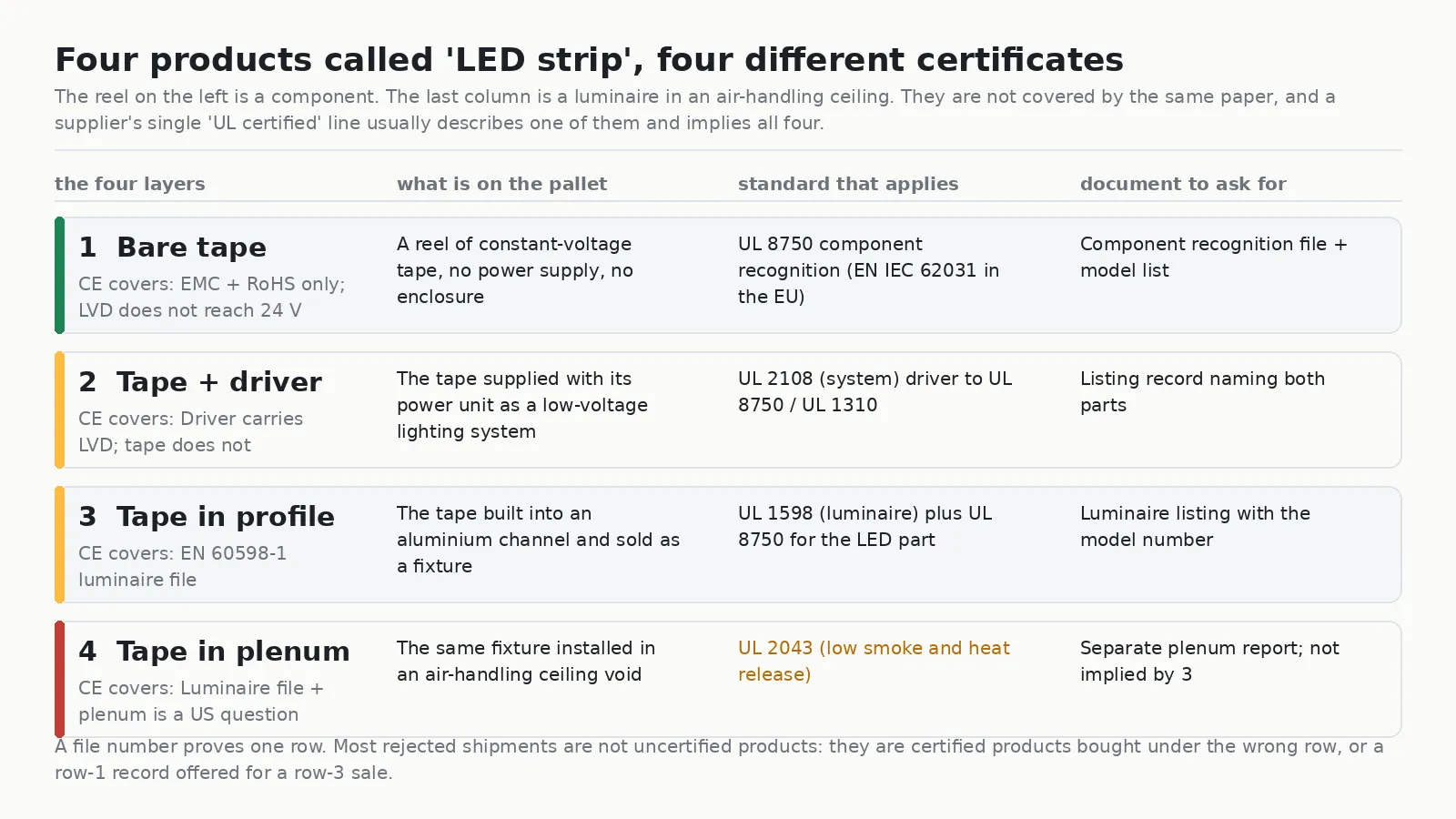
Read the columns as four separate products:
- Bare tape. A reel, no supply, no enclosure. In North America the LED part is evaluated as LED equipment to UL 8750, and the reel is normally a recognised component — which is not the same as a listed product. In Europe the equivalent module standard is EN IEC 62031.
- Tape plus driver. Supplied as a low-voltage lighting system, the assembly is evaluated to UL 2108 (Low Voltage Lighting Systems), with the power unit in its own right to UL 8750 or, if it is a Class 2 supply, UL 1310.
- Tape in a profile, sold as a fixture. Now it is a luminaire: UL 1598 for the fixture, with the LED equipment inside still to UL 8750.
- The same fixture in an air-handling ceiling. Commercial ceilings often use the void above as a return-air plenum. That requires UL 2043, a fire test for heat and visible-smoke release, and it is additional — a UL 1598 listing does not imply it.
One more mix-up worth naming: UL 2388 is for flexible lighting products such as rope light, evaluated as a decorative portable product. A tape with a Class 2 supply is not that product, and a UL 2388 report offered for a 24 V reel proves nothing about the reel.
So when a supplier writes “our strips are UL certified”, the honest translation is “one of the four rows above has a file, and I am hoping you assume it is the row you are buying.”
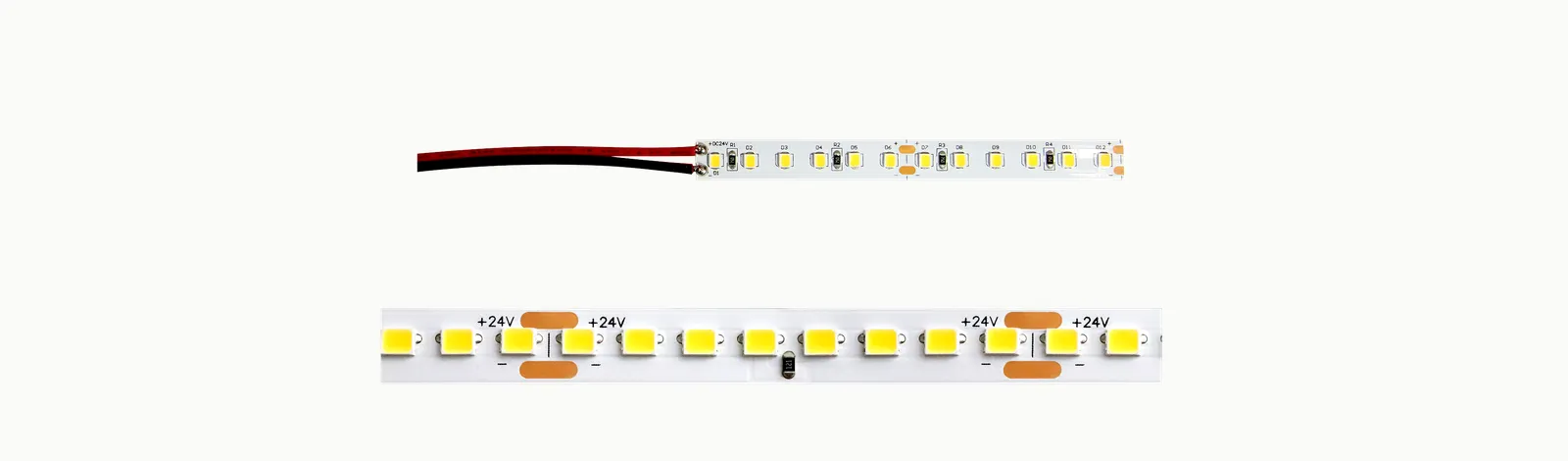
The raw material of every row in the table: a constant-voltage tape with its two feed conductors. Nothing on the reel carries the compliance duty; the duty belongs to whoever assembles and imports the finished article.
One number decides which file you need
The rated input voltage is not a quality grade. It is a legal boundary, and it is the fastest way to predict which documents a supplier should be able to produce.
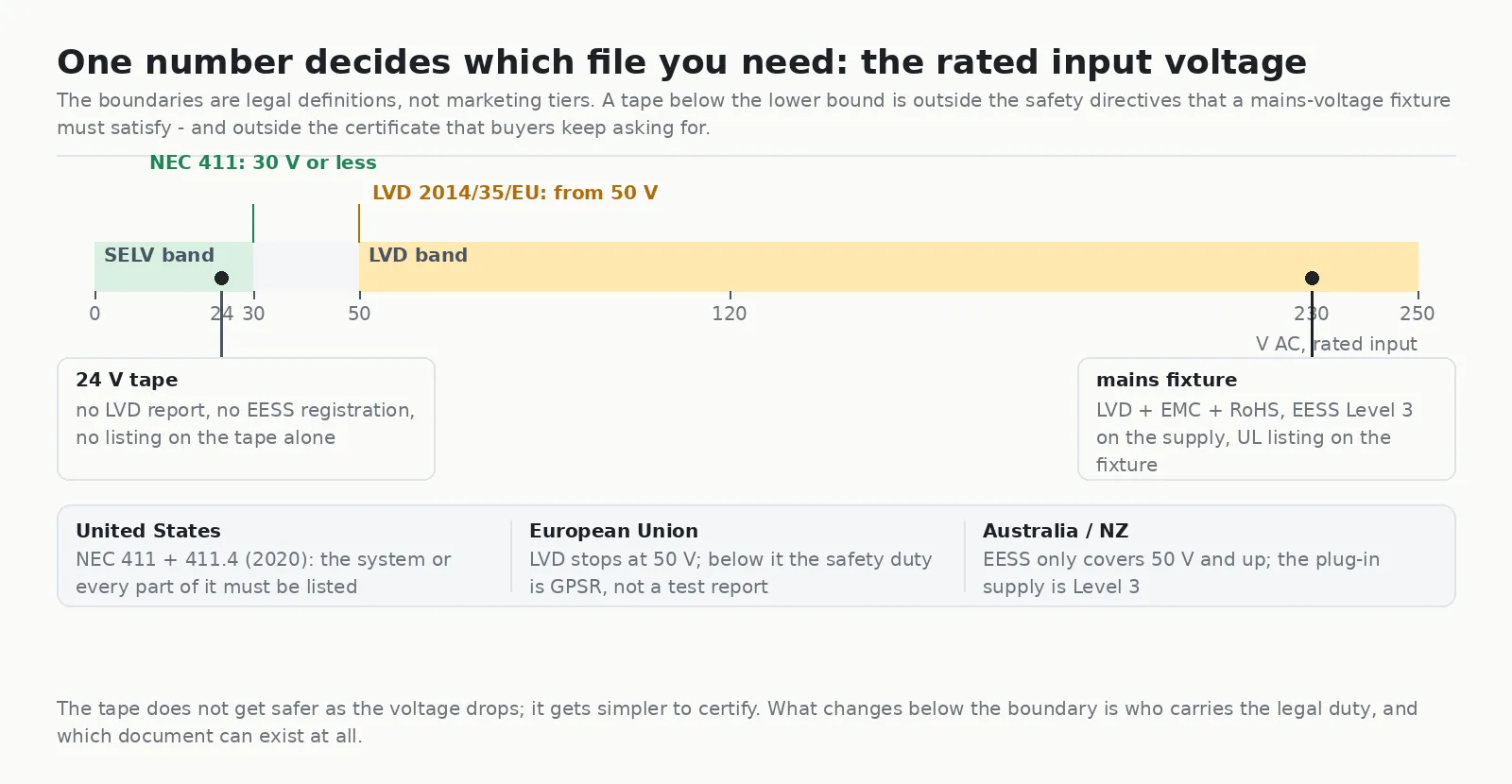
Three consequences, and they explain most of the confusion in this category.
Europe. The Low Voltage Directive 2014/35/EU applies to equipment rated between 50 V and 1 000 V AC (75–1 500 V DC). A 24 V tape is outside it — so there is no LVD test report to send you, and a supplier who offers one for a 12 V or 24 V reel is showing you someone else’s paper. What a tape does need in the EU is EMC compliance for its driver, RoHS, and the ecodesign and energy-label rules where the tape qualifies as a light source. Below 50 V the general safety duty does not disappear; it moves to the General Product Safety Regulation (EU) 2023/988, in force since 13 December 2024, which requires an EU-based responsible person on the product and online listing. That is your obligation as importer, not the factory’s.
United States. NEC Article 411 governs lighting systems operating at 30 V or less (and the limit tightens to 15 V AC where wet contact is likely). Since the 2020 edition, 411.4 is explicit: Class 2 power sources and the lighting equipment connected to them must be listed. The practical reading for a 24 V installation is that either the whole system is listed as an identified system, or every part of it — luminaire, power supply, fittings, cable — is a listed part used as listed. A listed driver with an unlisted reel is not a listed system.
Australia and New Zealand. The EESS covers equipment rated from 50 V AC; extra-low-voltage equipment below that sits outside the scheme, while the plug-in supply feeding it does not. External power supplies and LED drivers for domestic use are classified Level 3 under AS/NZS 4417.2 — high risk, which means third-party certification plus product registration before import. Detail on that file is in SAA and RCM for Australia.
The US picture in detail
Most strip disputes I see are American, because the US is where “listed” carries contractual weight with an inspector even when no federal law says “thou shalt”.
| What you are buying | Standard that applies | What the record should name |
|---|---|---|
| Bare tape, 12 V or 24 V | UL 8750 (LED equipment) | Tape model, as a recognised component |
| Tape with its power unit | UL 2108 (low-voltage lighting system) | System, or both parts, at the tested ratings |
| Tape built into a profile | UL 1598 (luminaires) + UL 8750 | Fixture model number, with the LED equipment |
| Fixture in an air-handling space | UL 2043 (heat and smoke) | The fixture model, plus the plenum evaluation |
| Power unit on its own | UL 1310 (Class 2) or UL 8750 (driver) | Supply model, output voltage and current |
| Controllers, wireless, DMX | FCC Part 15 Subpart B (unintentional radiator) | Test report on the controller |
Two of those rows catch people who did everything else right.
UL 2108 is a system standard. Its editions and revisions move: the second edition was published in December 2015, with revisions in 2021 and 2024 that added requirements on batteries and on constructions that were previously accepted. A report from an old edition is not automatically wrong, but it is evidence about a different design review, and the buyer should know which edition the record cites.
UL 2043 is not implied by anything. If the strip runs in a plenum void above a retail ceiling, the plenum evaluation is a separate test on the specific product, and the number that matters is smoke and heat release, not lumens. Ask before the ceiling closes, because retrofitting is not possible.
The European picture in detail
For a 24 V tape sold into the EU, the file that a customs broker or a marketplace will ask for is thinner than for a fixture — and what matters shifts to labelling and traceability:
- EMC. The driver is the emitter. Under the EMC Directive the technical file centres on the driver’s test report to EN IEC 55015 and the related immunity standards. A tape with no driver has almost nothing to test here.
- RoHS. Applies to the whole article, including the solder, the PCB finish and the PVC or silicone jacket. Ask for the material declaration, not the logo.
- Ecodesign and energy labelling. Regulation (EU) 2019/2020 defines a light source by optical characteristics — including a luminous flux between 60 and 82 000 lumen — and explicitly excludes LED dies and LED packages. A tape that meets the definition is a light source and carries the information requirements; a tape that does not is a component. Whether yours qualifies is a question about your SKU, and the answer must be consistent between the label, the technical documentation and the packaging.
- GPSR. From 13 December 2024, consumer products need a named EU responsible person, and marketplace listings must show it. A factory in Zhongshan cannot be your responsible person.
- UK. CE marking continues to be recognised in Great Britain indefinitely, so a compliant EU file is normally the working route; UKCA remains an alternative rather than a parallel necessity for most categories.
The pattern to notice: in Europe, a low-voltage tape is largely an electromagnetic and material question, plus labelling. In the US it is a listing question. Both are answerable, neither is answered by the other’s documents, and a single “CE & UL” line on a quotation tries to answer both with one sentence.
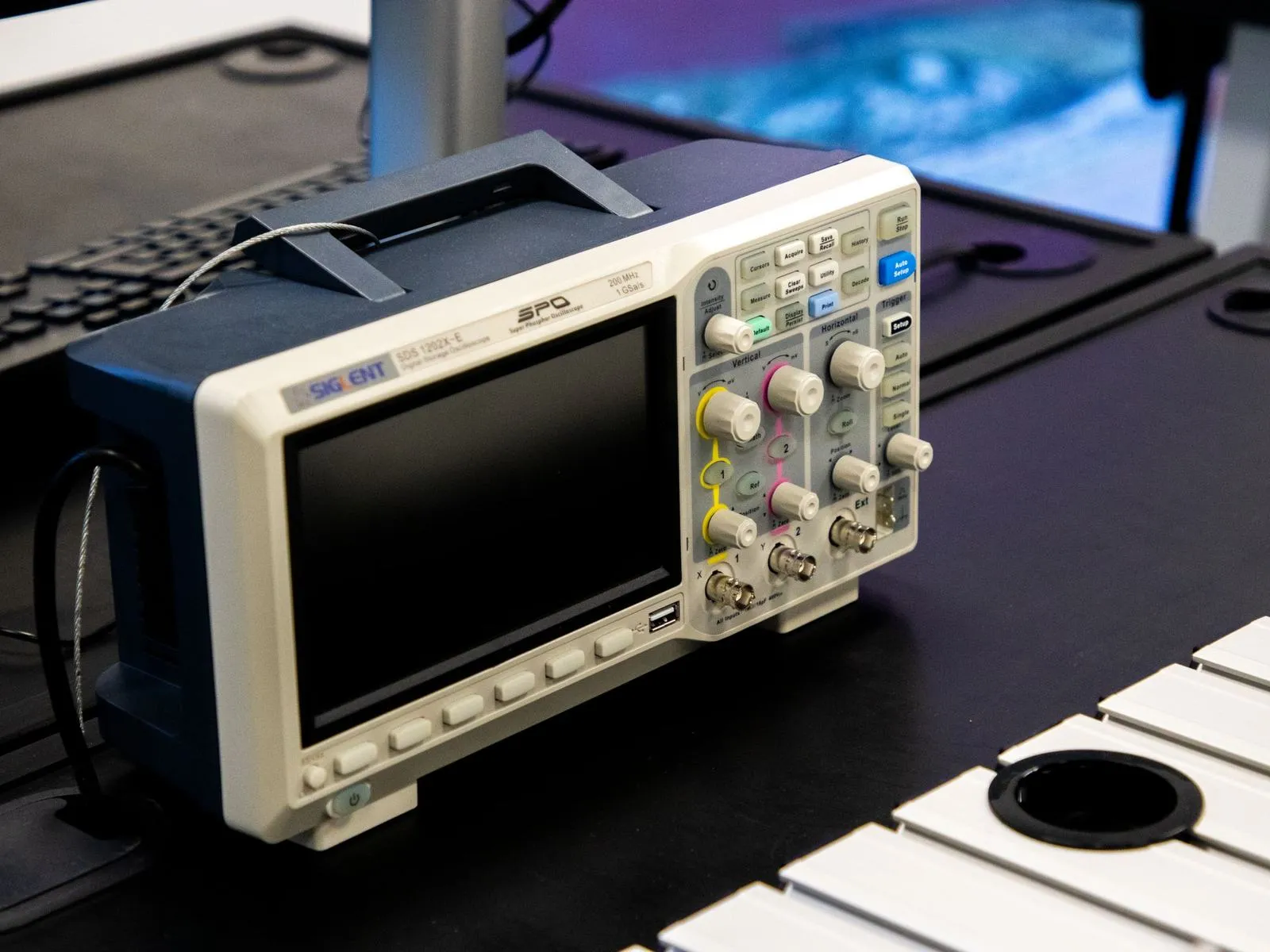
What the EMC part of the file actually is: measurements on the driver, at load, with the tape run at its rated length. It is not a measurement of the reel.
Six things to ask, and what a vague answer hides
Here is the request I would send instead of “please send your certificates”. Each line asks for an artefact that either exists or does not.
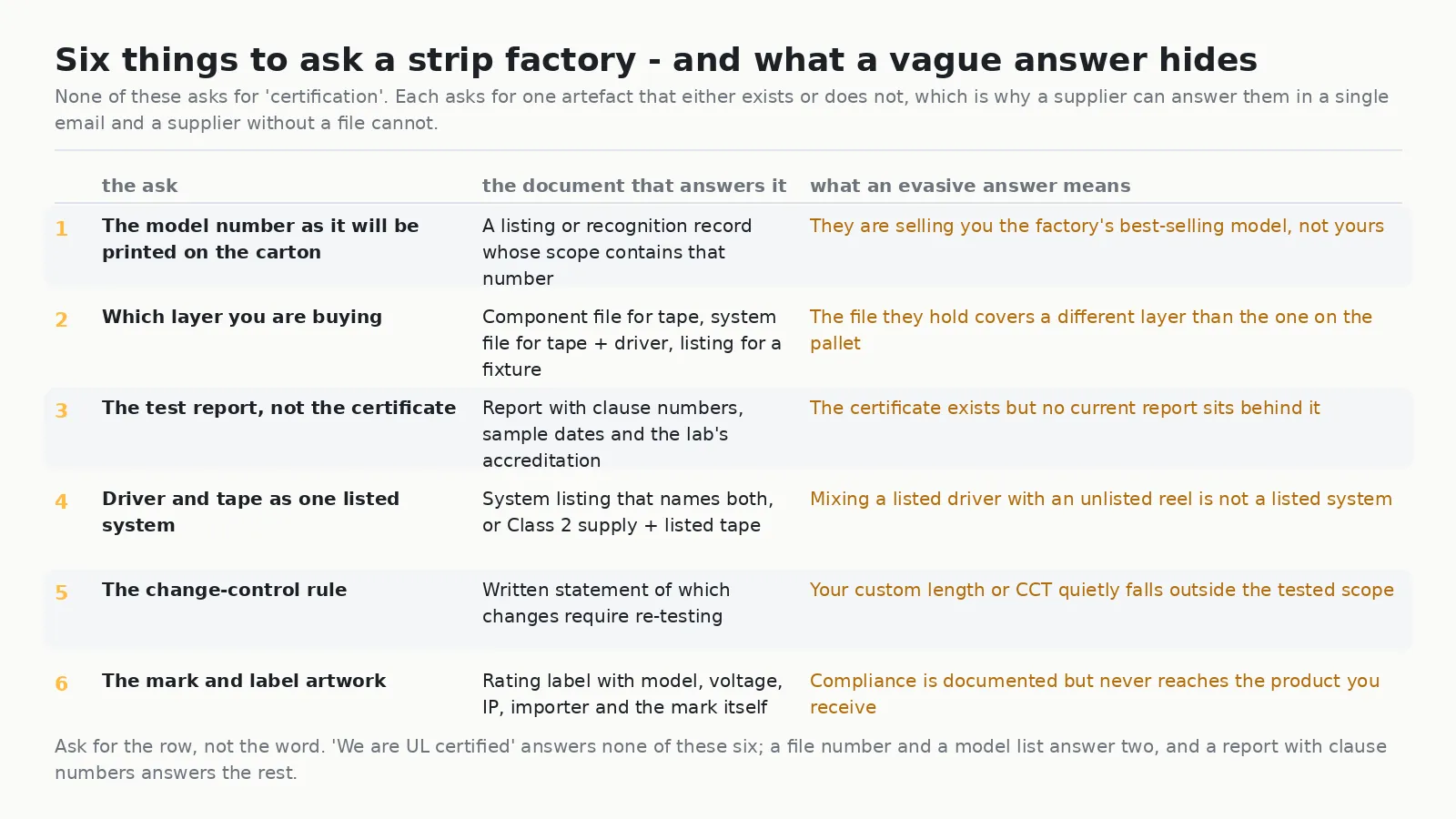
A worked version you can paste into an email:
- The model number exactly as it will appear on the carton and the rating label. Not the factory’s catalogue family — the article number your PO will reference.
- Which layer we are buying — bare tape, tape plus supply, tape in profile, tape in plenum — and the certificate type that covers that layer.
- The test report behind the certificate, with clause numbers, sample receipt and test dates, and the laboratory’s accreditation. A certificate is a summary; the report is the evidence.
- Driver and tape together as one listed system, or a Class 2 supply plus listed tape, with the ratings at which each was evaluated.
- The change-control rule in writing: which of our requested changes keep the model inside the tested scope, which need the record updated, and which need a new test.
- The rating label and carton artwork, showing model, rated input, output, IP rating, importer or responsible person, and the mark itself.
Two verification habits make these answers checkable rather than trusted:
- Search the record, not the PDF. UL listing and recognition records are public in UL Product iQ; certification bodies’ registers cover the EU and UK; the EESS platform publishes Australian certificates and supplier registrations. If the model is not in the database under the manufacturer’s legal name, the paper is a copy of something else.
- Compare three strings. Model number on the certificate, model number on the rating label, model number on the carton. They diverge more often than you would expect, usually because a family certificate was applied to a new variant.

Where custom orders break the file
This is the expensive part, and it is not a factory-quality problem. A good factory ships a change the file does not cover, because nobody asked whether the change was inside the scope.
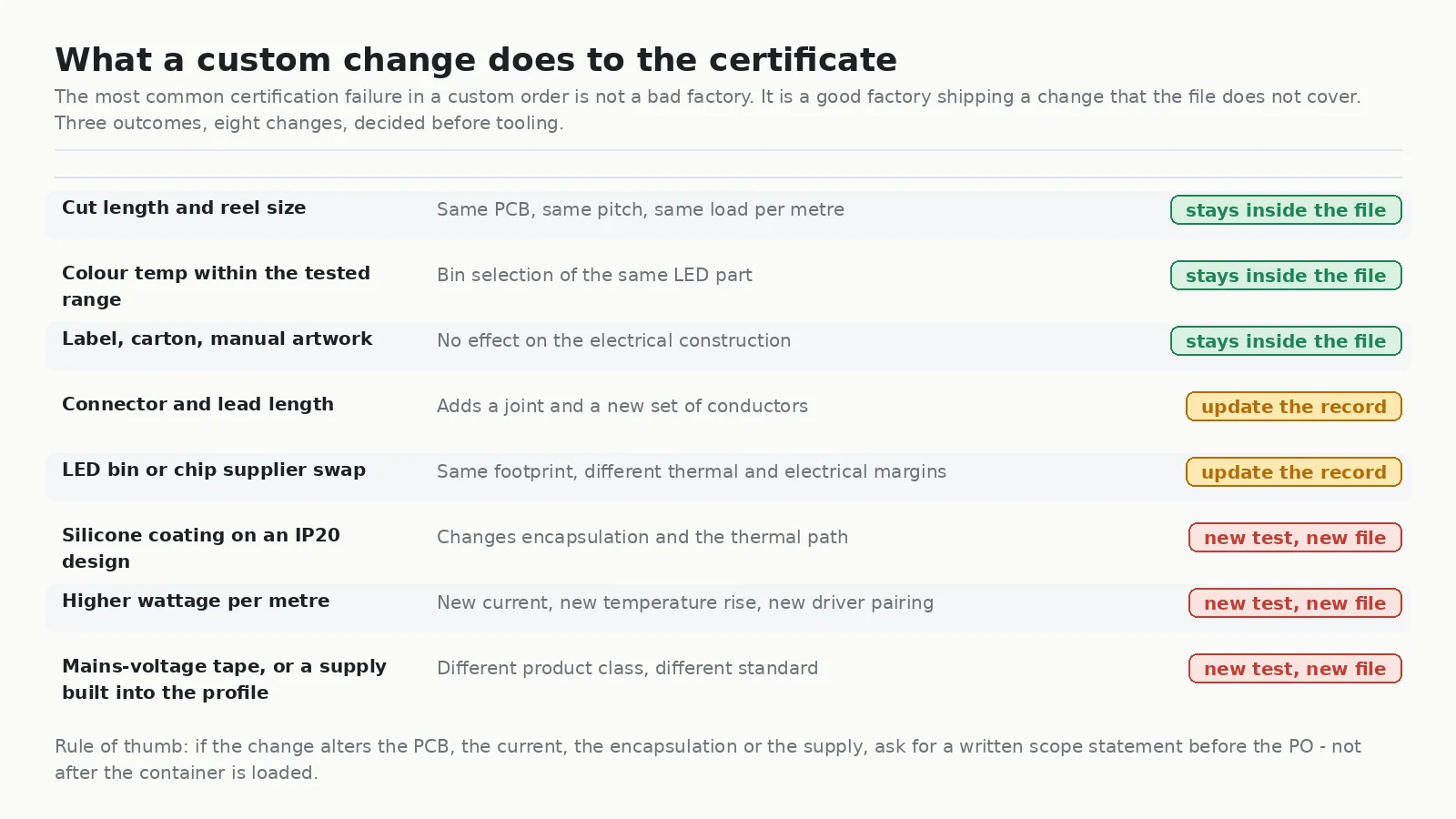
The rule of thumb at the foot of that figure is the one I would put in a purchase order: if the change alters the PCB, the current, the encapsulation or the supply, ask for a written scope statement before tooling. Four specific cases come up constantly:
- Silicone coating on an IP20 design. The coating changes the thermal path and the construction. A waterproof version of a dry design is not the same article, however identical it looks on a sample table. The same logic runs through IP65 weatherproof LED programmes.
- Higher wattage per metre. More current, more temperature rise at the same pitch, and a new driver pairing. The IP rating does not change; everything that matters about heat does.
- A different LED bin or chip supplier. Same footprint, different forward voltage and thermal margin. Sometimes a record update, sometimes a re-test — and the answer depends on the margins in the original report, which is why you want the report and not the certificate.
- Mains-voltage tape, or a supply built into the profile. A different product class. It is no longer a low-voltage system, which means LVD in Europe, a different listing in the US, and a different registration in Australia.
One related trap sits on the electrical side rather than the compliance side, and inspectors do ask about it: voltage drop on a long constant-voltage run. A 14.4 W/m tape over 5 m at 24 V draws 3 A; on the pair of conductors printed on a typical tape that is roughly 1 V lost at the far end — about 4% — and about 8.6% over 10 m. The strip still works; the far end is dimmer and warmer than the near end, and a technician with a meter will find it. Feed from both ends, shorten the run, or step up to a higher-voltage system and let the supplied transformer do the work. The numbers that belong on the carton are the ones a spec sheet should also carry — the same discipline as reading a luminaire datasheet.

Retail window and shelf lighting is where strip lands in commercial projects — and where the plenum question, the driver location and the voltage-drop question all arrive at once.

Step and nosing lighting is the classic 24 V tape job: dozens of short runs, a supply hidden in a riser, and a joint at every tread. That is also where connectors, lead lengths and voltage drop stop being paperwork questions and become the reason one end of a stair looks different from the other.
What the certification actually costs, and who owns it
Two things are being bought when you pay for a strip certificate, and they scale very differently.
The type test is priced per model and per standard, and it is dominated by the engineering work needed to pass, not by the laboratory’s fee. A tape that already meets the standard on a mature platform costs a fraction of a tape designed to a price and then sent for testing. Ask any supplier quoting a certification cost which of the two situations you are in.
The factory follow-up is recurring. Listings and recognised-component records involve periodic inspection of the production site against the tested construction. That is why a supplier who holds a genuine record cares about change control, and a supplier who bought a PDF does not.
Ownership is the part buyers get wrong. The certificate belongs to the certificate holder — usually the factory, sometimes a trading company, occasionally a competitor’s brand because nobody checked. It covers the models listed in its scope and nothing else. Your own model number, your own label artwork and your own importer responsibilities are yours to carry, in every market. That is a different, and much older, set of duties — and it is why the honest answer to “can you certify our SKU?” is a plan with a date, not a file number.
Inside our own strip and linear programme
We build strip-based product two ways, and the two live under different files.
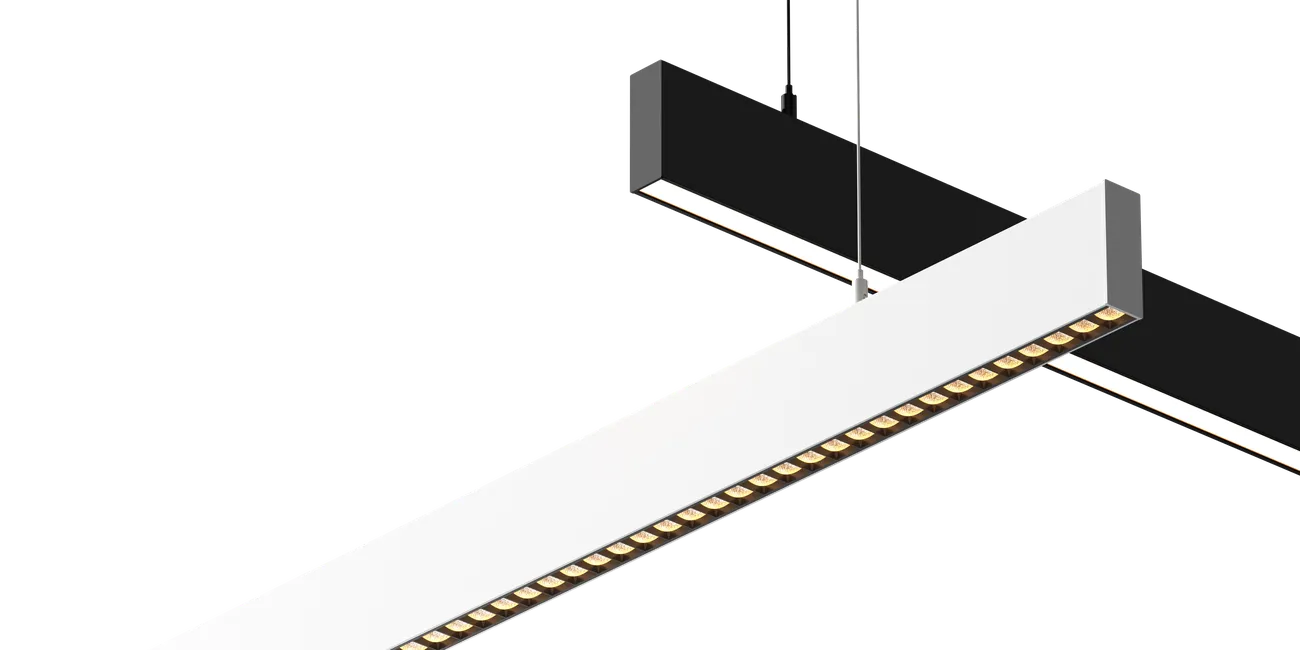
Linear architectural systems. The ATRO and similar profiles are luminaires, not reels: an extruded housing, a diffuser, a driver, and a listing that names the fixture model. Customisation runs through length, CCT, CRI, output, finish and suspension — and every one of those is checked against the tested construction before we quote, not after.
Bare and semi-finished tape. For brands that build their own fixtures, we supply tape and profiles as components. In that case the file belongs to you, and we will tell you plainly which layer we are handing over so that your testing house knows what it is receiving.
Certificates, photometric files, IP test reports and the certificate scope sheets for our own ranges are published on the certifications page. If your product is a linear or track-based fixture rather than a strip, the same layer logic applies with a different standard list — commercial lighting and the OEM/ODM process describe how we sequence a project from spec sheet to shipment. And if your strip programme is part of a larger custom build, the driver side is worth reading next: custom LED driver OEM covers the part of the file that is most often shared between two suppliers who never speak to each other.

FAQ
Do LED strip lights need UL certification? In the US, the NEC is not federal law, so nothing makes a private sale illegal. But Article 411 requires that lighting systems at 30 V or less be listed as a system, or assembled from listed parts, and the 2020 edition’s 411.4 states that Class 2 power sources and the lighting equipment connected to them must be listed. Any permitted commercial installation, and any retailer or specifier with a lawyer, will treat that as mandatory. The correct question is not “is it required” but “which listing covers the layer I am buying”.
Does a 24 V LED strip need CE marking? The CE mark is not one thing; it is a bundle of directives. A 24 V tape sits below the Low Voltage Directive’s 50 V lower bound, so no LVD report exists for it. Its driver needs EMC compliance, the whole article needs RoHS, and where the tape qualifies as a light source under Regulation (EU) 2019/2020 the ecodesign and energy-labelling information requirements apply. A supplier who sends you an LVD certificate for a 12 V reel has sent you the wrong document.
What is the difference between UL 8750 and UL 2108? UL 8750 is the standard for LED equipment used in lighting products — the LED modules, the arrays, the drivers. UL 2108 is the standard for low-voltage lighting systems: the assembly of luminaires and a power unit operating as a system at low voltage. A tape evaluated alone is normally UL 8750 as a recognised component; a tape sold with its supply as a kit is usually UL 2108. They are not interchangeable, and one does not imply the other.
Is a UL recognised component the same as UL listed? No. A recognised component is evaluated for use inside a larger product, with conditions of acceptability that the final assembler must honour. A listed product is evaluated as a complete article that can be installed as sold. A tape that is “UL recognised” is not a listed luminaire, and putting it in a channel does not make it one until somebody lists the resulting fixture.
Does an LED strip in a ceiling void need plenum rating? If the ceiling void is used for return air, yes. UL 2043 evaluates heat and visible-smoke release for discrete products installed in air-handling spaces, and it is a separate test — a UL 1598 luminaire listing does not include it. The question to ask is not “is it plenum rated” but “which model, tested to UL 2043, with a report you can show the inspector”.
What documents should I ask for instead of a certificate? Six: the model number as printed on the carton, which layer you are buying, the test report with clause numbers and dates, the system record covering driver plus tape, the written change-control rule, and the rating label artwork. Each one is checkable in a public database or against the goods, which is what makes the answer useful.
Does a custom length or a different CCT void the certification? It depends on what the change touches, and the answer should come in writing before the PO. Cut length, reel size and bin selection within the tested range usually stay inside the file. Connectors, lead length and a chip-supplier swap usually need the record updated. Silicone coating, higher wattage per metre, and anything that changes the supply need a new test. Ask the factory to name the category rather than the reassurance.
Who is responsible if an uncertified strip causes a fire? The importer or the business that placed the product on the market, in every jurisdiction covered here — plus, in the EU since 13 December 2024, a named responsible person established in the Union. The factory’s certificate, if it exists, is evidence about a model; it does not transfer the duty. That asymmetry is the real reason to spend an afternoon on paperwork.
The short version
- A strip is certified by layer. Bare tape, tape with a supply, tape in a profile, and tape in a plenum are four products under four standards.
- The rated voltage decides which files can exist. Below 50 V the EU safety directives stop applying; below 30 V the US code starts caring about listing instead.
- Ask for artefacts, not adjectives. Model number, layer, report, system record, change rule, label artwork.
- Verify in the database, not the PDF, and compare the model string in three places.
- Customisation is where files break, and the break is decided before tooling.
- The duty is yours. No factory can hold your listing, appoint your EU responsible person, or register your Australian supplier status.
Send us the reel spec, the market and the layer you intend to sell, and we will tell you which of the four rows you are in, which record has to exist for it, and what your custom changes do to that record — before the sample is approved. Request a strip or linear programme quote →
Read next: CE documents for LED lighting for the declaration-of-conformity anatomy, ETL certification for lighting for how a North American listing is scoped and verified, SAA and RCM for Australia for the EESS risk levels, and LED string lights OEM if your product plugs into a socket rather than a driver.
- led strip lights certification
- led strip ce ul requirements
- led strip compliance
- ul 2108
- ul 8750
- ul 1598
- ul 2043 plenum
- nec 411 listing
- lvd 2014/35/eu 50 volts
- eess level 3 led driver
- led tape light certification
our factory