· Certifications & Compliance · 16 min read

Written by ENCORE Lighting Team
LED Lighting Manufacturer & OEM/ODM Partner ·
CE Documents for LED Lighting: an Importer Checklist
What a European importer actually needs from an LED lighting supplier: the five documents behind one CE mark, the seven fields of a valid Declaration of Conformity, technical file contents, and a ten-item list you can email today.


A buyer in Hamburg opens a spreadsheet two weeks before a container leaves Shenzhen.
Every row is a model. Every column is a document — declaration, report, drawing, label artwork. Three rows have a blank in the report column. One row has a report whose standard edition was withdrawn in 2019.
Nothing about that spreadsheet looks urgent. The container will ship anyway. And then, at some point in the following eighteen months, a market surveillance authority in one member state will write to the importer with a request for the technical file.
This article is about that spreadsheet.
Not “what is CE” — we covered that in CE vs ENEC. This is the narrower, more practical question: which pieces of paper has a Chinese LED factory legally obliged its European importer to hold, and what does each one have to contain?
The Five Documents Behind One CE Mark
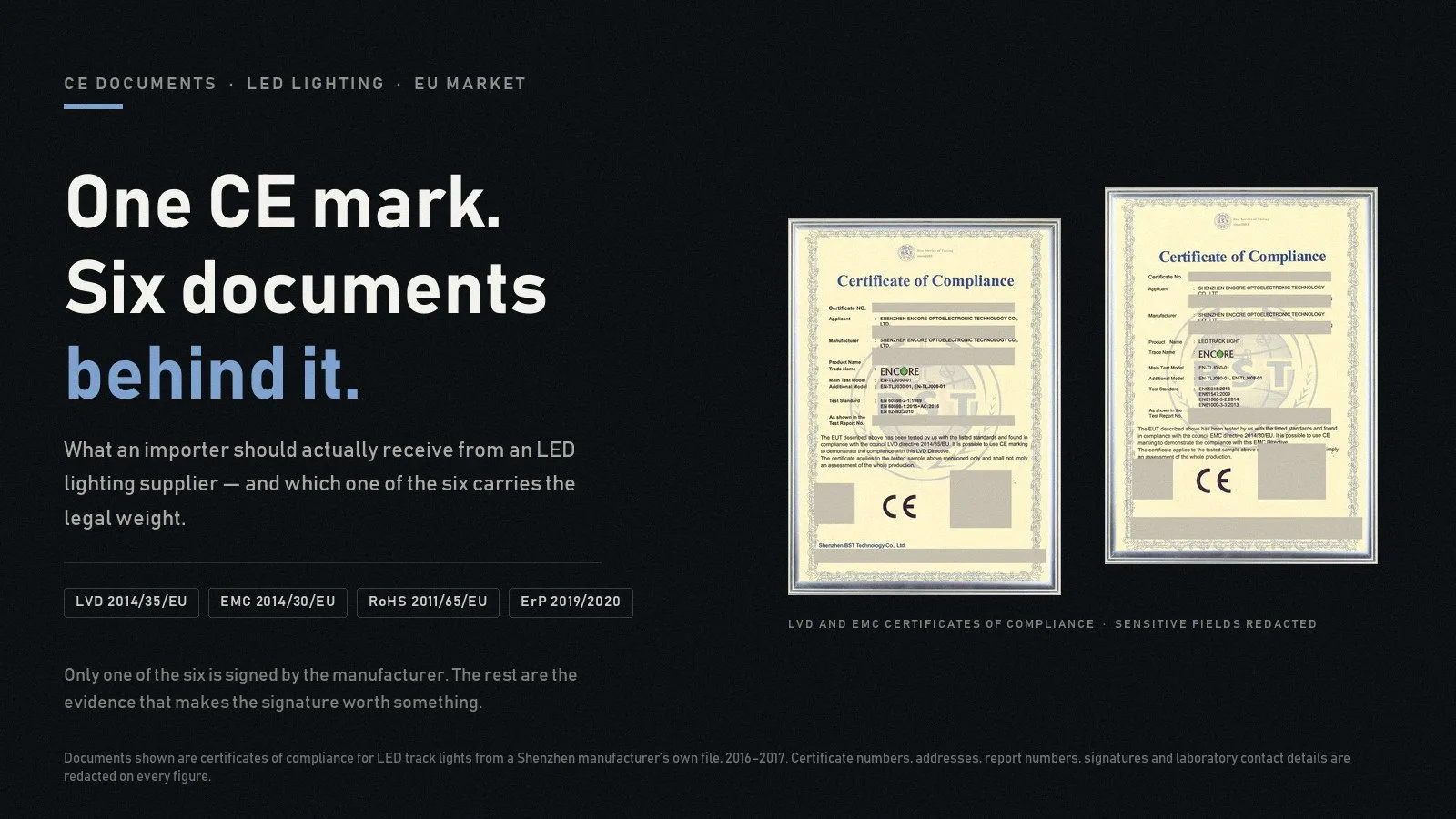
Importers usually ask for “the CE certificate.” There is no such document.
The CE mark is affixed by the manufacturer on the strength of a document set, and for a luminaire that set is layered:
- EU Declaration of Conformity — one page, signed by the manufacturer, naming the directives and standards relied on. This is the only document that carries legal weight on its own.
- Test reports — from an accredited lab, one per directive, per model family. The raw evidence.
- A certificate of compliance — the lab’s one-page summary of a report. Convenient to email. Legally, a courtesy.
- The technical file — drawings, BOM, risk assessment, label artwork, test reports, DoC. Never sent to a buyer by default; must be producible within days.
- Supporting declarations — RoHS substance documentation, ErP energy label artwork and EPREL record, and for a small subset of products, REACH or RED.
Five papers, one mark. Most sourcing disputes happen because a supplier sends number three and calls it number one.
The Directives That Apply to an LED Luminaire
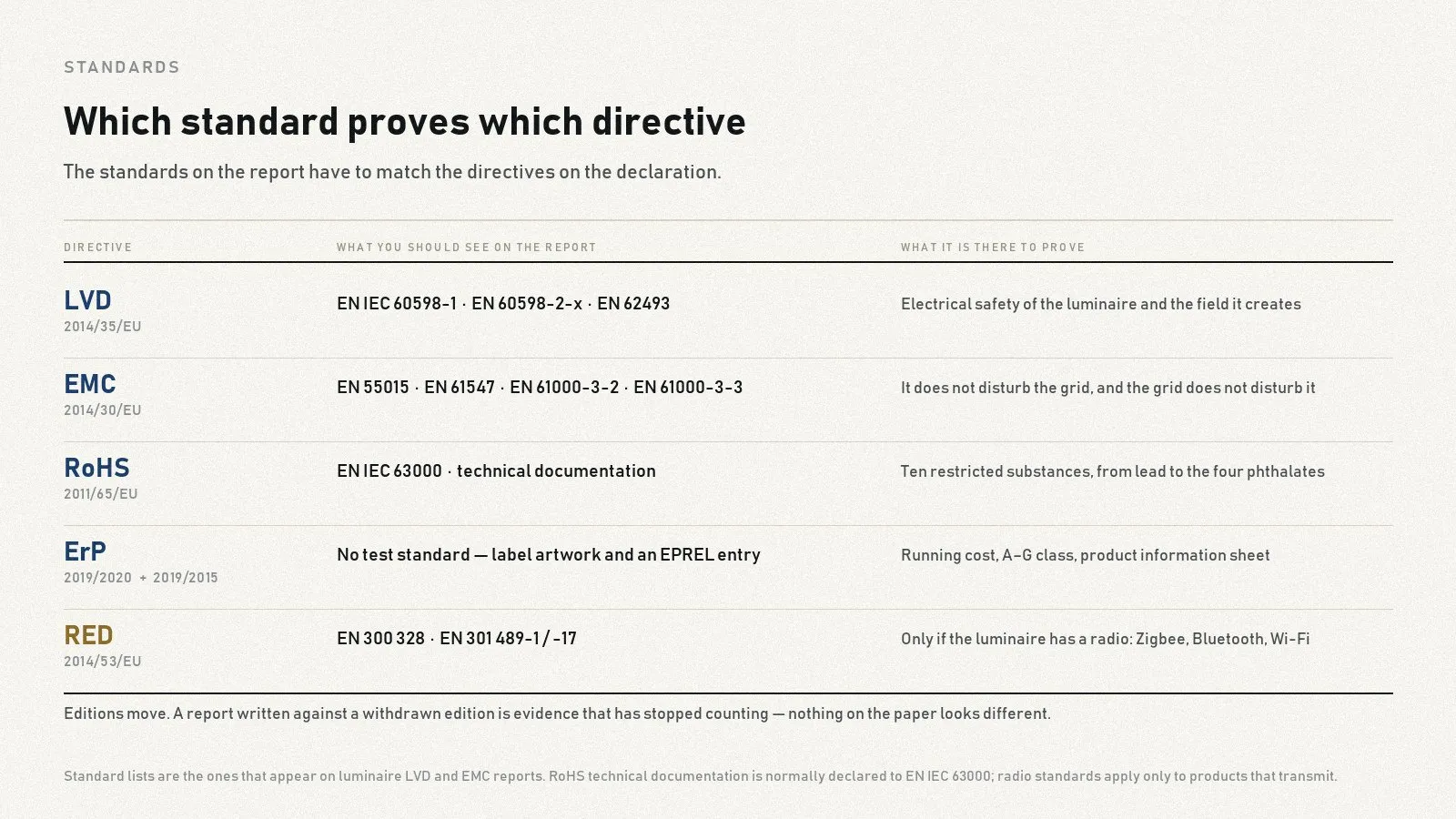
A mains-powered LED luminaire sits inside four directives almost always, and a fifth conditionally.
| Directive | Applies because | What the report cites |
|---|---|---|
| LVD 2014/35/EU | It runs on 50–1000 V AC | EN IEC 60598-1, EN 60598-2-x, EN 61347-1/-2-13 (driver), EN 62493 (EMF) |
| EMC 2014/30/EU | It is an electrical apparatus | EN 55015, EN 61547, EN 61000-3-2, EN 61000-3-3 |
| RoHS 2011/65/EU | It contains electronics and solder | EN IEC 63000 technical documentation, or substance test data |
| ErP 2009/125/EC + (EU) 2019/2020 | It is a light source or contains one | No test standard — energy label artwork, information requirements, EPREL registration |
| RED 2014/53/EU | Only if it transmits: Zigbee, Bluetooth, Wi-Fi, DALI-over-wireless | EN 300 328, EN 301 489-1/-17 |
Two of these are routinely fudged.
ErP is the quiet one. Since (EU) 2019/2020, a light source cannot be placed on the market without an EPREL registration number and compliant label artwork. A supplier can send you a beautiful LVD report and still be non-compliant on ErP, because ErP is paperwork, not testing. Ask for the EPREL number and check it.
RED is the trap on “smart” fixtures. The moment a track head ships with a Zigbee module, the product is no longer just LVD + EMC. CCT-tunable over a wired DALI bus is not RED. CCT-tunable over an app is.
The Declaration of Conformity, Field by Field
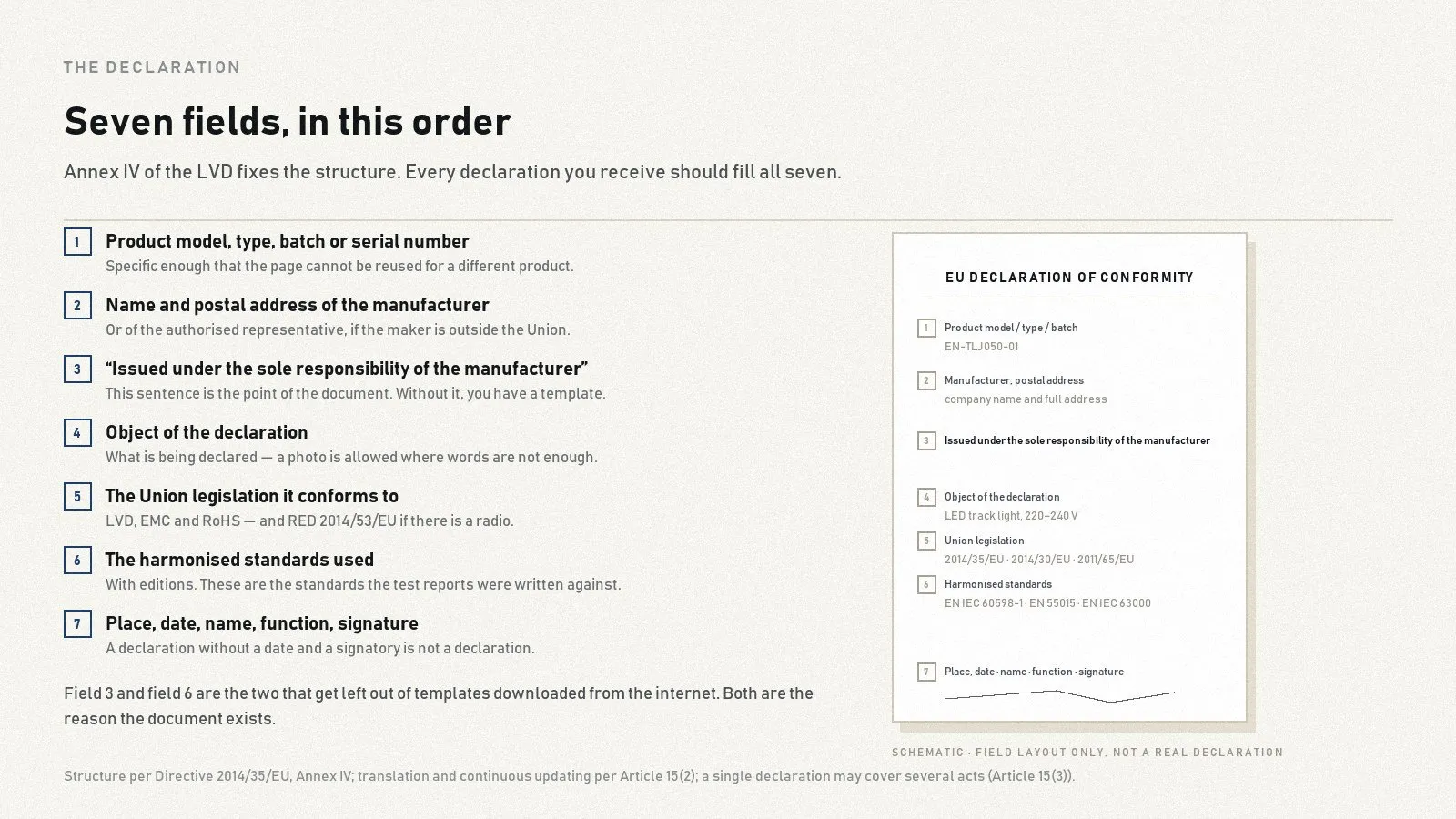
LVD Annex IV fixes the structure. A conforming declaration fills seven fields, in this order:
- Product identification — model, type, batch or serial number. Specific enough that the page cannot be reused for a different product.
- Manufacturer name and postal address — or the authorised representative’s, if the maker sits outside the Union.
- The phrase “issued under the sole responsibility of the manufacturer.” Without it you have a template, not a declaration.
- Object of the declaration — described precisely enough to identify it. “LED track light” is not enough; a photo is not enough on its own.
- The Union legislation it conforms to — LVD, EMC, RoHS at minimum, plus RED and ErP where they apply.
- The harmonised standards used, with editions. These are the standards the reports were written against. “EN 60598” is incomplete; “EN IEC 60598-1:2021” is not.
- Place, date, name, function, signature. A declaration without a date and a signature is not a declaration.
Fields three and six are where downloaded templates fall apart. A PDF scraped off the internet will have a blank signature block and a standards list without editions. Both are visible in five seconds, and both tell you the document was assembled by a sales desk.
A single declaration may legally cover several models under one family, provided the covered variants are genuinely described. It may not silently expand to cover a new model you designed last quarter.

What Is Inside the Technical File
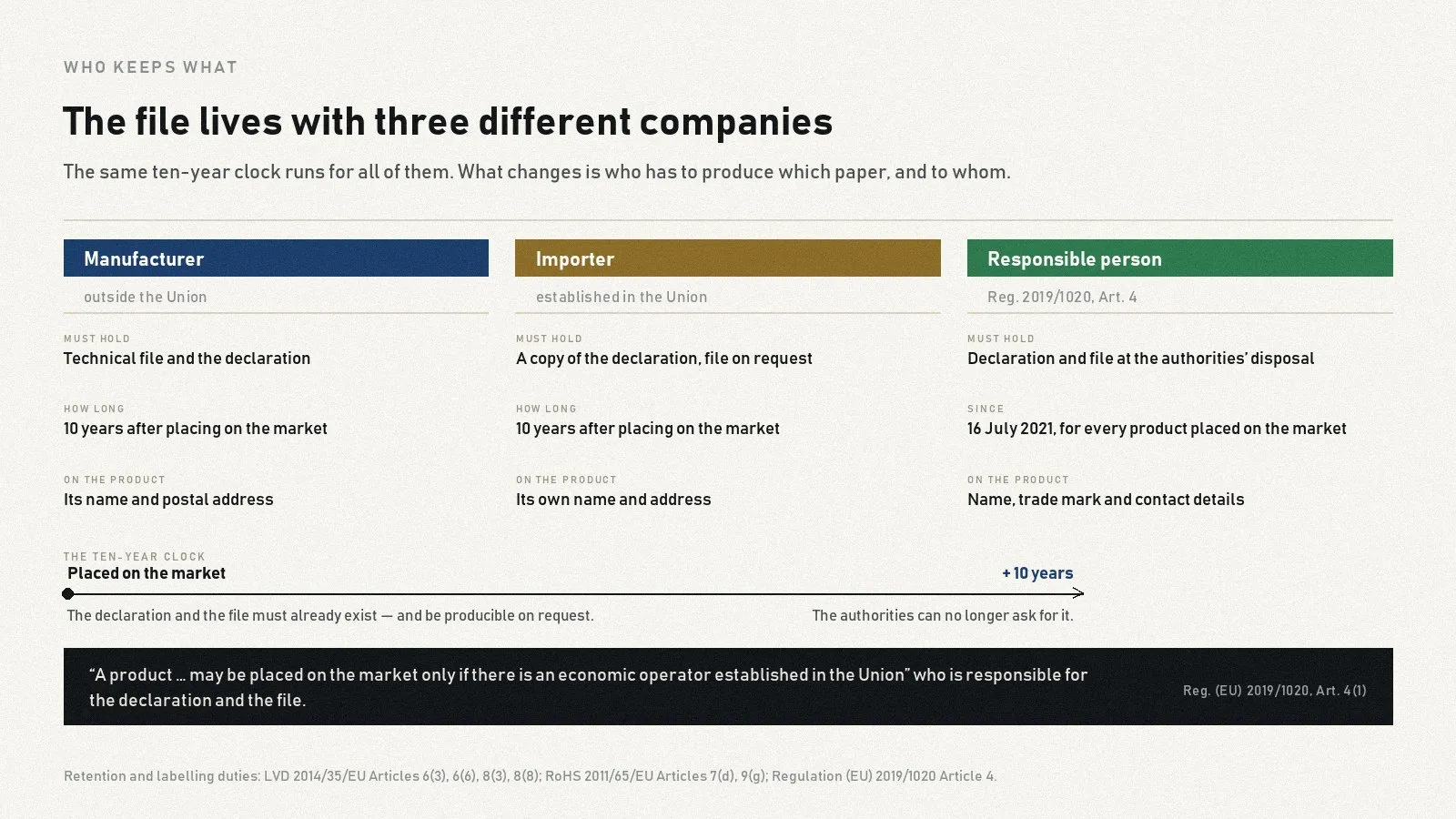
The technical file is not a document you keep in a drawer. In practice, it is three drawers in three countries — and if any one is empty, the chain breaks.
The manufacturer (outside the EU) holds the full technical file and the declaration, for ten years after the last unit is placed on the market. Contents, per LVD Annex IV and the parallel annexes in EMC and RoHS:
- general description of the model and its intended use
- conceptual design and manufacturing drawings, plus schematics of components and sub-assemblies
- descriptions and explanations needed to understand those drawings, including the operation of the circuit
- list of the harmonised standards applied in full or in part, and descriptions of the solutions adopted where those standards were not applied
- results of design calculations and examinations carried out
- test reports
- a statement of conformity to the applicable requirements, and a copy of the declaration
- the risk assessment — mechanical, thermal, electrical, photobiological (EN 62471)
The importer (inside the EU) must hold a copy of the declaration on request and verify the marking and documentation are correct before placing the product on the market. The importer’s own name and address go on the product or packaging.
The responsible person — under Regulation (EU) 2019/1020, mandatory since 16 July 2021 — must be established in the Union for every product, and must have the declaration and file at the authorities’ disposal. This is the rule that most changed the importer’s exposure. “The factory is responsible” stopped being a defence.

Report, Certificate, Declaration: Three Different Papers
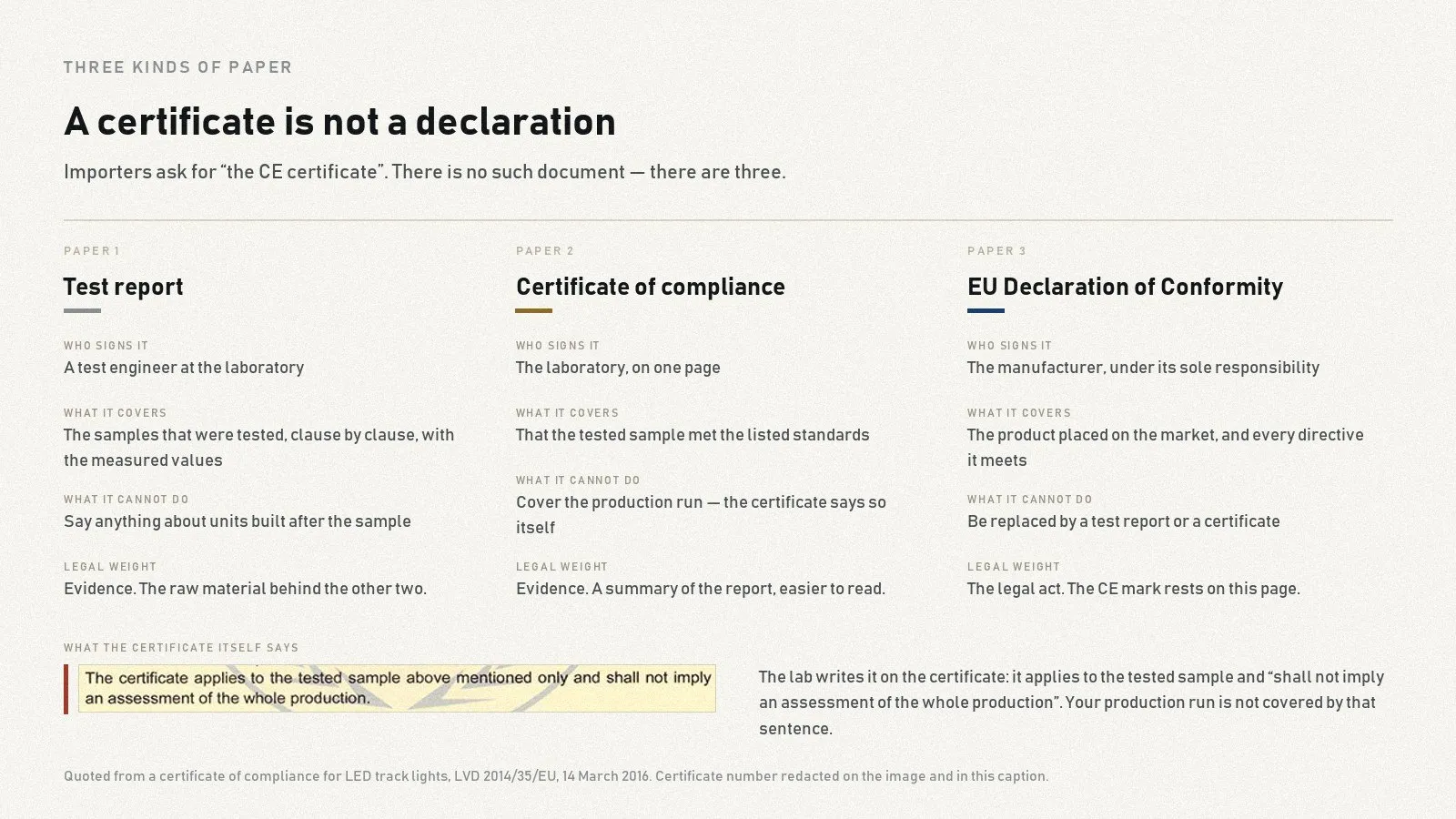
This distinction decides more sourcing arguments than any other.
| Test report | Certificate of compliance | EU Declaration of Conformity | |
|---|---|---|---|
| Who signs | Test engineer at the lab | The laboratory | The manufacturer |
| What it covers | Samples tested, clause by clause, with measured values | That the tested sample met the listed standards | The product placed on the market |
| What it cannot do | Say anything about units built after the sample | Cover the production run | Be replaced by a report or a certificate |
| Legal weight | Evidence | Evidence, easier to read | The actual legal act |
Certificates of compliance carry a sentence most people never read: the certificate applies to the tested sample above-mentioned only and shall not imply an assessment of the whole production.
That sentence is doing real work. It means the lab tested a unit, not your production line — which is why factory surveillance (ENEC, or a buyer’s own audit) exists as a separate layer. It does not make the certificate worthless; the LVD conformity assessment depends on a representative sample. It does mean that when a customer complains about a batch, the certificate is not your answer. Your process control is. That is the subject of our quality control workflow.
How to Verify a Certificate in Ten Minutes
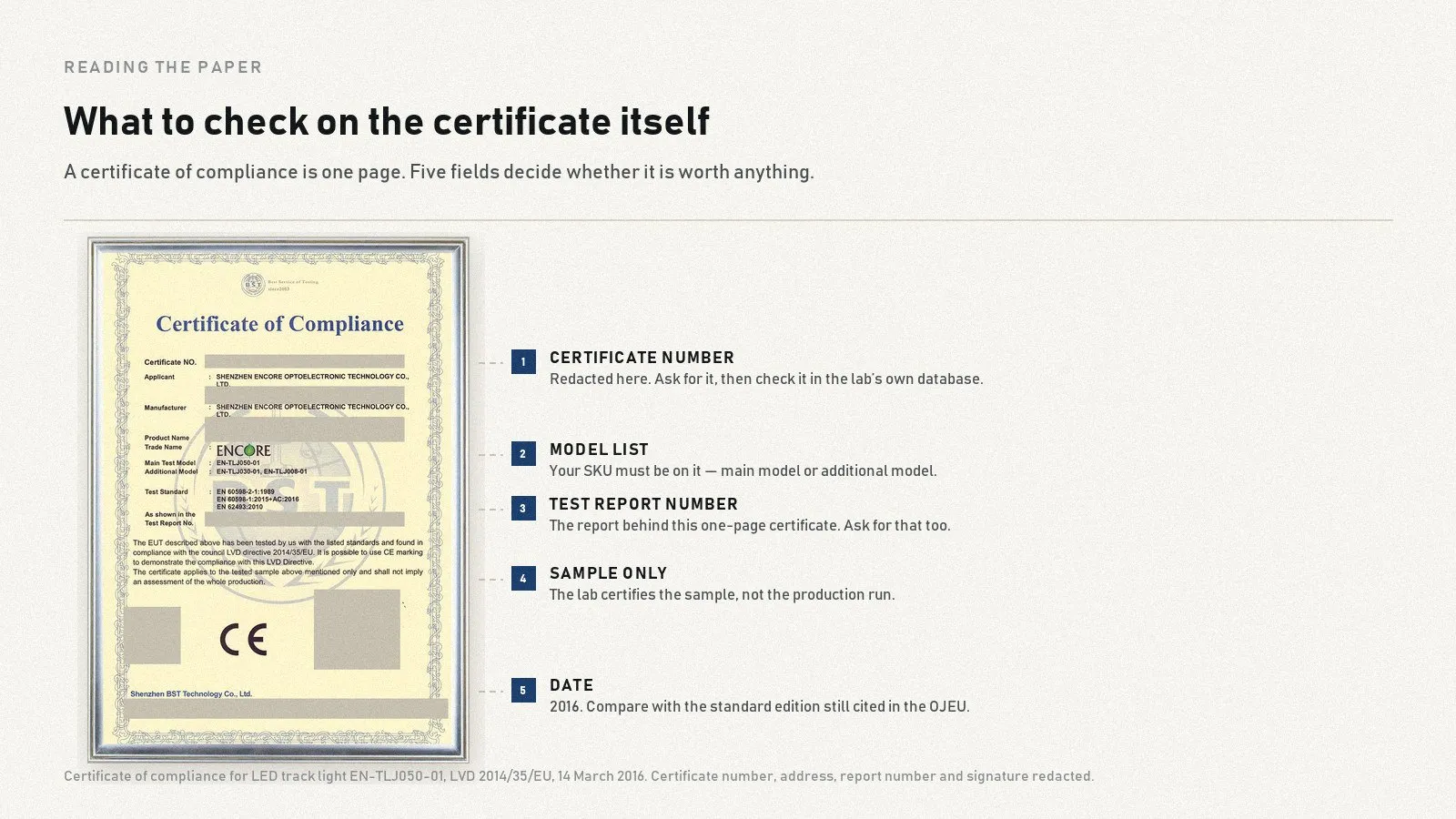
You do not need to be a lab engineer. You need five fields and one phone call.
1. The certificate number. Ask for it, then check it in the issuing lab’s own database. Reputable labs — SGS, TÜV, Intertek, Bureau Veritas, and the Chinese labs that actually test for export — publish or verify certificate numbers on request.
2. The model list. Your SKU must be on it — as the main model, or as an “additional model” explicitly listed. “Same series” is not coverage.
3. The test report number. The certificate is the summary; the report is the evidence. Ask for the report. If the supplier cannot produce it, the certificate is decoration.
4. The scope line. Confirm it says the sample above-mentioned only — and then ask the separate question: what does your process control do to keep subsequent units identical?
5. The date and the standard edition. Compare the editions cited with what is currently harmonised in the Official Journal. A 2016 report citing EN 60598-2-1:1989 has not necessarily become invalid — but the standard has been superseded, and a buyer or authority can reasonably ask for testing to the current edition.
One more field is worth checking and almost never is: the issuing lab’s accreditation scope. A lab accredited for luminaires but not for the specific clause will issue a report that looks identical and proves less.
A short note on accents: a certificate legitimately issued outside the EU is fine evidence. What matters is the accreditation of the body, not the country on the letterhead.
Red Flags in a Supplier’s Document Pack
Six patterns that repeat across almost every non-compliant pack we have audited:
- The certificate number is redacted or missing. Sometimes for privacy, more often because the number would not survive a database lookup.
- The standards list has no editions. “EN 60598, EN 55015” instead of “EN IEC 60598-1:2021, EN 55015:2019+A11:2020.” Editions are the first thing a template drops.
- Same file, different products. The report covers a 20 W downlight; the quotation is for a 40 W track head with the same housing.
- A DoC with no signature, no date, or no address. All three are required fields.
- ErP missing entirely. No EPREL number, no energy label artwork, no information requirements — while the LVD report is pristine.
- The technical file “is being prepared.” It should already exist. A file created after the buyer asks is a file created to answer the buyer.
Ten Items, One Email
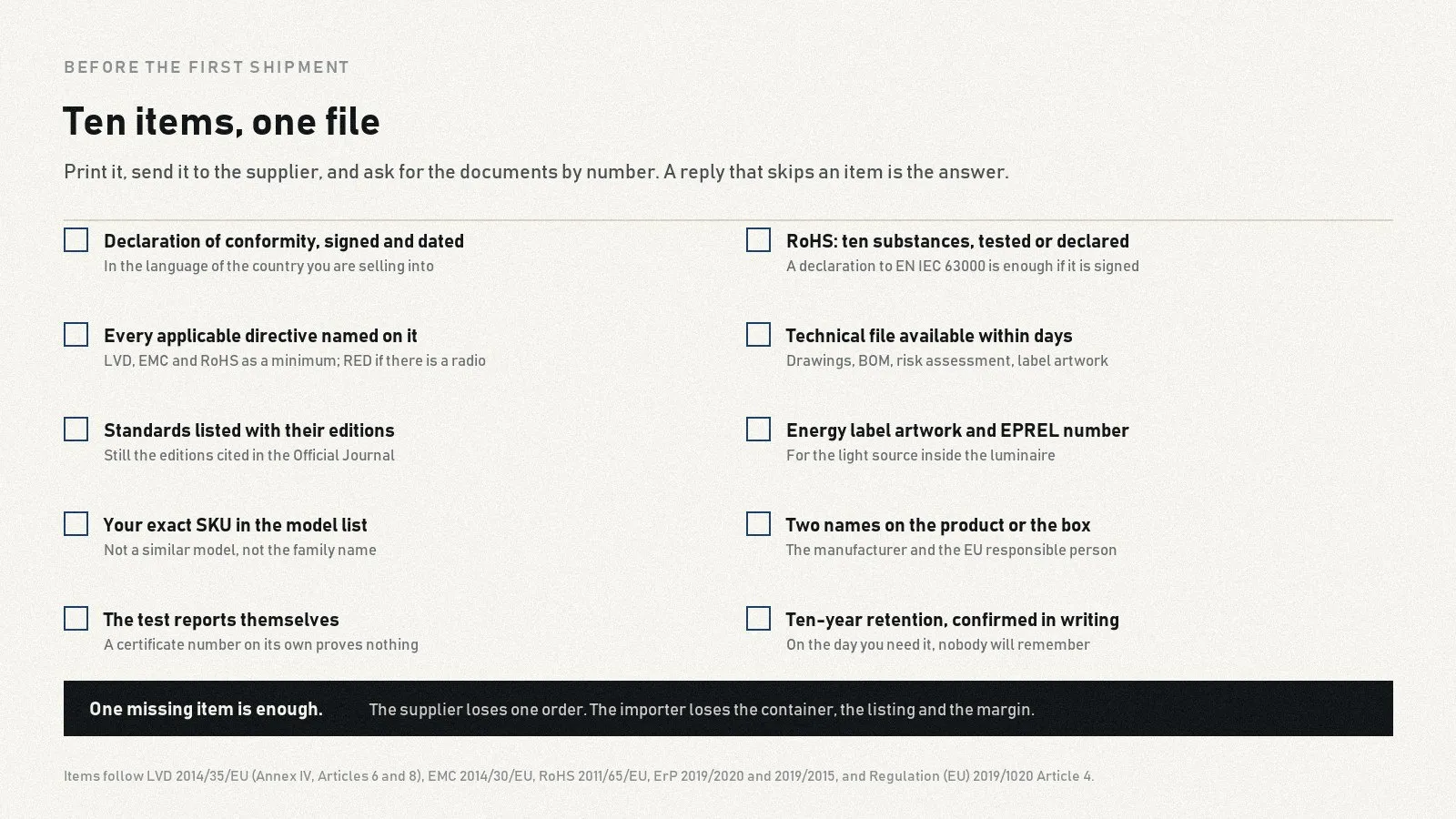
Send this list to the supplier and ask for the items by number. A reply that skips an item is itself the answer.
| # | Ask for | Pass condition |
|---|---|---|
| 1 | Declaration of conformity, signed and dated | Place, date, name, function, signature present |
| 2 | Every applicable directive named on it | LVD + EMC + RoHS minimum; RED if it transmits |
| 3 | Standards listed with their editions | Editions still current in the Official Journal |
| 4 | Your exact SKU in the model list | SKU named, not “same series” |
| 5 | The test reports themselves | Report numbers match the certificate |
| 6 | RoHS substance documentation | Declaration to EN IEC 63000, or test data |
| 7 | Technical file available within days | Confirmed in writing, with a named owner |
| 8 | Energy label artwork and EPREL number | Number resolves; label matches the source |
| 9 | Two names on the product or box | Manufacturer and EU responsible person |
| 10 | Ten-year retention, confirmed in writing | Who holds what, where, until when |
One missing item is enough. The supplier loses an order. The importer loses the container, the listing, and the margin.

Where ENCORE Sits in This Chain
We are the manufacturer outside the Union, which fixes our side of the chain.
For each model family — track lighting, LED downlights, magnetic track systems, commercial luminaires — we hold an LVD report citing the EN IEC 60598 series, an EMC report, RoHS documentation, and a signed declaration that names your SKU if it falls inside the covered family.
The full certificate set is on our certifications page; the process behind it is documented under quality control; and if you need a private-label variant, the declaration and label artwork are rewritten for your brand under our OEM/ODM programme.
What we cannot do is act as your responsible person. That role needs an establishment in the Union — an importer, a fulfilment provider, or an authorised representative. Most of our European customers use their own import entity; some use a compliance service. Get it decided before the first shipment, not after.
FAQ
What documents must an importer hold for CE-marked LED lighting?
At minimum: a signed EU Declaration of Conformity, a copy available on request, and confirmation that a technical file exists and can be produced within days. The importer’s own name and postal address must also appear on the product or its packaging.
Is a CE certificate the same as a Declaration of Conformity?
No. A “CE certificate” is normally a certificate of compliance issued by a test laboratory, covering the sample tested. The Declaration of Conformity is signed by the manufacturer under its sole responsibility and is the document the CE mark rests on.
Does CE certification for LED lighting expire?
CE itself has no certificate expiry — it is tied to the product, the legislation and the technical file. But the harmonised standards a report cites do get superseded, and both buyers and market surveillance authorities expect evidence against current editions.
How long must the technical file be kept for LED lighting?
Ten years after the last unit of the model is placed on the market. The manufacturer holds the full file, the importer holds a copy of the declaration, and under Regulation (EU) 2019/1020 the EU responsible person must have both at the authorities’ disposal.
Does an LED luminaire need an EPREL registration?
Yes, if it contains or is a light source covered by Regulation (EU) 2019/2020. ErP compliance is paperwork rather than testing: energy label artwork, product information requirements, and a valid EPREL registration number before the product is placed on the market.
Do smart LED fixtures need RED as well as CE?
Only if they transmit by radio — Zigbee, Bluetooth, Wi-Fi, or a wireless DALI gateway. A fixture dimmed over a wired bus stays under LVD and EMC. A fixture controlled by an app or a wireless gateway needs RED 2014/53/EU on top.
Can one Declaration of Conformity cover several LED models?
Yes, provided the covered variants are described accurately enough to be identified, and every listed model genuinely conforms to the named standards. A declaration cannot be extended to a newly designed model without new evidence.
If you are assembling that spreadsheet now, send us the model list and we will return the document pack that belongs to each one — declaration, reports, standard editions, label artwork — so the gaps show up before the container does. Request the CE document pack →
Read next: CE vs ENEC: The Two Truths About Selling LED in Europe for why the mark and the scheme live on different layers — or ETL Certification for Lighting for the North American counterpart to this checklist.
- ce certification documents led lighting
- eu declaration of conformity lighting
- technical file ce lighting
- ce lvd emc rohs lighting
- ce test report lighting
- en 60598 test report
- ce documentation importer check
- eprel registration led
- led lighting certification europe

ENCORE Lighting Team · ENCORE
LED Lighting Manufacturer & OEM/ODM Partner
The ENCORE engineering and sourcing team writes about LED track lighting, downlights, magnetic systems, certifications and OEM/ODM manufacturing for B2B buyers and specifiers.