· Custom & OEM Lighting · 6 min read

Written by ENCORE Lighting Team
LED Lighting Manufacturer & OEM/ODM Partner ·
OEM LED Lighting Manufacturer: 6-Step Sourcing Checklist
A 6-step sourcing checklist for working with an OEM LED lighting manufacturer: define your spec, vet the factory, get engineered samples, lock certifications, audit QC, and negotiate terms before you order.
Buying from an OEM LED lighting manufacturer is a partnership, not a purchase order. You are asking a factory to build, certify, and brand a product that carries your name — so the sourcing process has to be rigorous. This 6-step checklist is the exact framework we recommend B2B buyers use, whether you are sourcing LED track lighting, LED downlights, or a full commercial range.
Work through all six steps in order. Skipping one — especially certification or QC — is where sourcing projects go wrong.
Step 1: Define Your Specification Before You Contact Anyone
The factory cannot quote accurately if you cannot describe the product. Before you send your first RFQ, write down:
- Application — retail, museum, hospitality, office, outdoor-adjacent.
- Photometrics — beam angle, lumens, CCT, CRI, target lux at a given mounting height.
- Electrical — voltage (120V, 220–240V, 277V), wattage, dimming protocol (TRIAC, 0-10V, DALI, Zigbee).
- Mechanical — track type, housing style, finish, dimensions.
- Compliance market — which certificates you need (ETL, CE, SAA) and where the product will be installed.
Not sure what numbers to specify? Use our free beam angle calculator and lux calculator to work out photometrics, and our CCT guide and CRI guide to lock color targets before you ask for a quote.
Step 2: Vet the Factory, Not the Showroom
Now that your spec is clear, verify the candidate is genuinely an OEM LED lighting manufacturer and not a trading desk:
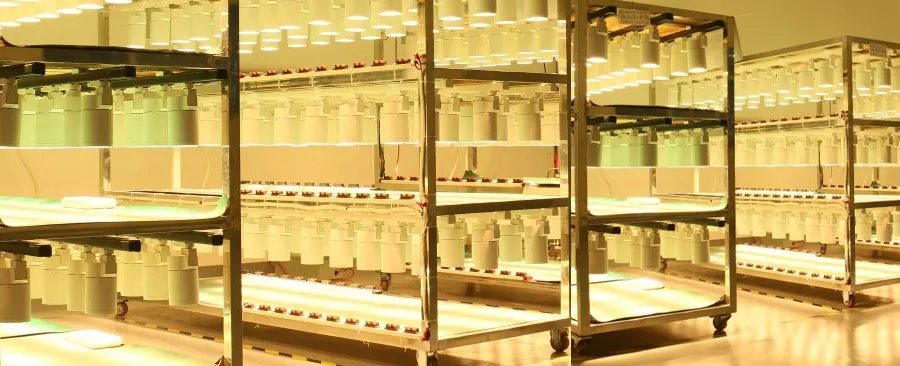
- Ask for workshop video — assembly line, SMT machines, aging-test racks, OQC bench. A factory will show you; a trader cannot.
- Ask who manufactures the driver and housing — and whether thermal design is done in-house.
- Check the factory address maps to a real industrial park, not a shared office.
- Look at the quality-control process — a mature factory publishes how it inspects incoming materials, in-process production, and finished goods.
A red flag is a supplier that can only quote catalog items and cannot engineer a custom CCT, CRI, beam, or dimming profile. A genuine OEM LED lighting manufacturer customizes the light, not just the label.
Step 3: Demand an Engineered Sample With Photometric Data
A sample is not a sticker on a catalog product. For a real OEM project, the factory should build an engineered prototype that ships with:
- A photometric (IES/LDT) file so you can verify distribution in your design software.
- Measured beam angle, lumens, CRI, and SDCM data.
- A physical unit you can evaluate for finish, thermal behavior, and driver quality.
Prototyping typically takes 2–3 weeks, with one or two revision rounds before approval. This is the point where the spec is frozen — after approval, changes become expensive because tooling and production parameters are locked.
Step 4: Verify Certifications Name Your Product
This is the step most buyers rush, and the one that hurts the most if wrong. Ask for certificates and test reports that name your exact SKU and model. A certificate for a similar product does not cover yours.
- ETL/UL for North America, CE (LVD+EMC) for Europe, SAA for Australia/New Zealand, ISO9001 for the factory.
- Ask which certificate documents will ship with your consignment so customs clearance is smooth.
- If the product needs market-specific testing (e.g., DLC for utility rebates in North America), confirm who covers the cost and timeline.
Step 5: Audit the QC Process and Aging Test
Your brand ships in every carton, so QC is non-negotiable. Confirm the OEM LED lighting manufacturer runs a four-stage loop:
- IQC — incoming quality control on LED bins, drivers, and housings per AQL.
- IPQC — in-process quality control on the line.
- 100% aging test — every fixture burned in before packing to catch early failures.
- OQC — final function and electrical testing before sealing.
For a material order, consider a third-party inspection or an in-person audit. Full traceability — tracking codes linking a shipped unit to its production batch — is a hallmark of a mature factory. Read how we run factory and quality control at our Shenzhen plant.
Step 6: Negotiate MOQ, Lead Time, and Payment in Writing
Before you pay a deposit, get three things itemized in writing:
- MOQ — commonly 500 units per model for OEM orders, with flexible trial options. Tooling is usually itemized separately.
- Lead time — samples in 7–15 days, bulk in 25–45 days. A full first OEM cycle with tooling and certification is realistically 8–14 weeks.
- Payment terms — the industry standard is 30% deposit / 70% before shipment (T/T), with L/C for large accounts. Samples are usually paid upfront.
A supplier that avoids written commitments on MOQ and tooling, or that quotes an unrealistically short lead time, is likely not building your product. Our OEM/ODM manufacturing page explains the full customization menu and process.
FAQ
What is an OEM LED lighting manufacturer? A factory that produces LED lighting to your specification under your brand — handling engineering, production, quality control, and compliance, while you own the brand and market.
How is OEM different from ODM? OEM builds a product to your exact spec with your brand; ODM adapts one of the factory’s existing catalog designs and brands it for you. OEM gives more control but usually needs tooling; ODM is faster and cheaper to start.
What is the typical MOQ for OEM LED lighting? Around 500 units per model for OEM orders, with flexible trial options. Bespoke tooling may raise it; ODM modifications may lower it. Always get it itemized in writing.
How long does an OEM lighting order take? Samples in 7–15 days, bulk in 25–45 days, and a full first cycle with tooling and certification 8–14 weeks. Repeat orders compress to 4–6 weeks.
What certifications do I need? ETL/UL for North America, CE for Europe, SAA for Australia/New Zealand. Confirm certificates name your exact SKU.
Conclusion
The six-step checklist — define the spec, vet the factory, get an engineered sample, verify certification, audit QC, and lock terms in writing — turns a risky sourcing exercise into a repeatable process. Do these six things and you will work with a true OEM LED lighting manufacturer instead of a middleman, and your product will be buildable, certifiable, and on time.
Ready to shortlist? Send us your spec sheet and target market. We will tell you honestly what is buildable, what is not, and what it costs. Request an OEM/ODM quote →
Read next: OEM LED Track Lighting: A Complete Guide to Private Label Track Lights — the full customization menu, packaging options, and lead-time table.

ENCORE Lighting Team · ENCORE
LED Lighting Manufacturer & OEM/ODM Partner
The ENCORE engineering and sourcing team writes about LED track lighting, downlights, magnetic systems, certifications and OEM/ODM manufacturing for B2B buyers and specifiers.