· Certifications & Compliance · 26 min read
Written by our factory
OEM Lighting Team ·
Christmas Lights Certification: UL, CE and What Retailers Require
Four documents get called "the certificate", and each one proves something narrow. What UL 588 covers and where the US rule pins it to a 2000 edition, why 18 of 40 recalls named the same two defects, what changes at the border on 8 July 2026, and what a retailer actually wants to see for the EU, UK and Australia.

Christmas lights certification is not one certificate. It is four different papers, each answering a different question, and a retailer who asks for “your UL certificate” is usually asking for the third one while the supplier sends the first.
Worse: the paper that matters most in the United States is not a certificate at all. From 8 July 2026 a certificate for imported seasonal lighting is data filed with customs at the moment of entry. A PDF in an email is no longer the document — it is a copy of one.
This article is about the documents and the market rules behind them. If what you need is how to audit the factory floor — wire gauge, strain relief, lampholder tooling, the cord tag — that lives in what OEM buyers should check, and the two pieces are meant to be read as a pair.
The four papers that all get called “the certificate”
A quotation pack arrives with a 40-page PDF, a certificate with a gold border, and a signed page. Three things, one name.
They are not the same, and the difference is not academic. Read them as four documents:
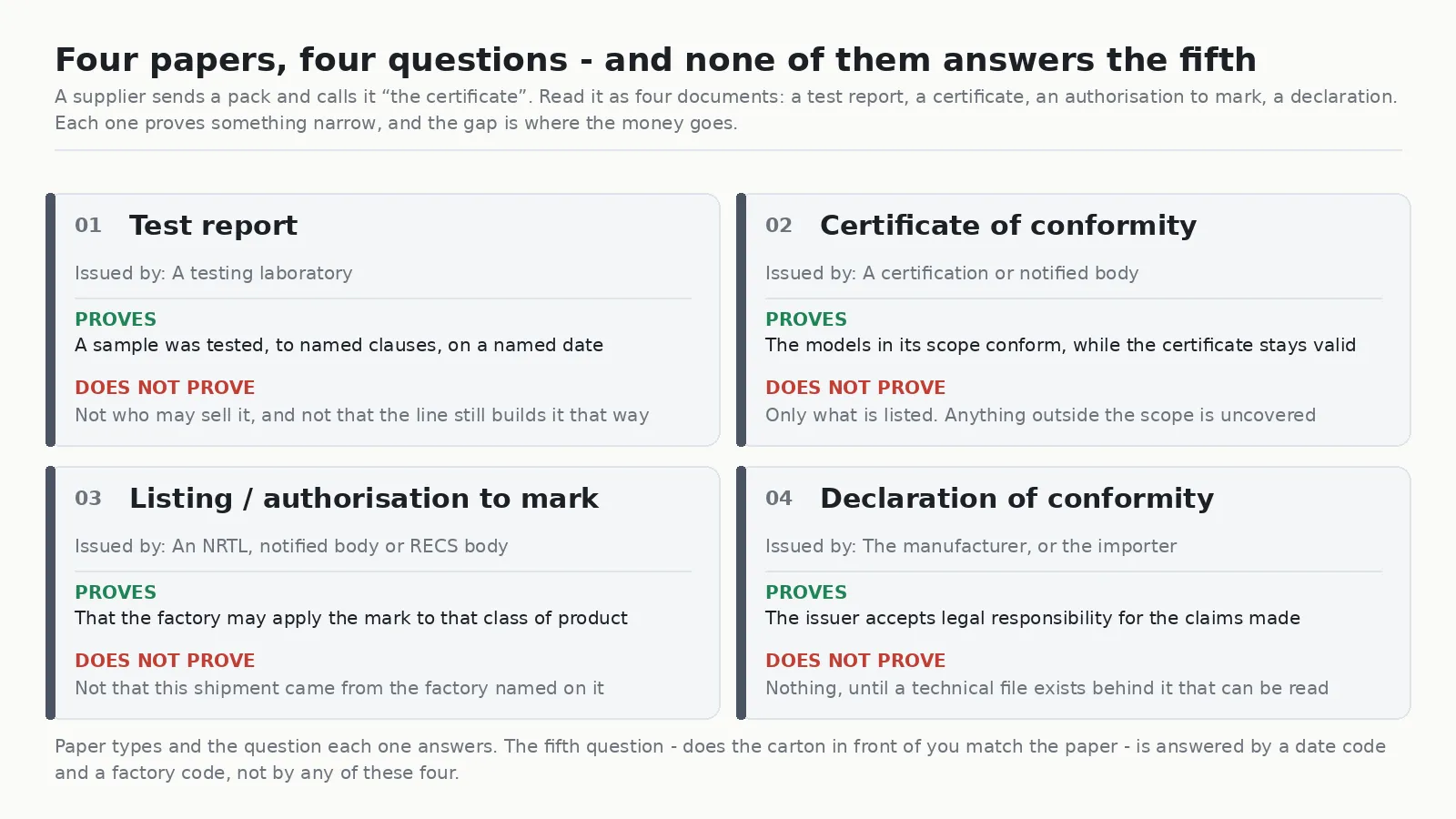
The test report says a sample was tested to named clauses on a named date. It is the only one of the four that contains measurement data, and it is also the only one that goes stale the moment the line changes a lampholder supplier.
The certificate of conformity says the models inside its scope conform, while it stays valid. Everything outside the scope is uncovered, which is why the model number matters more than the certificate’s existence.
The listing or authorisation to mark is the permission slip. In North America it is issued by an NRTL — UL, Intertek, TÜV, CSA — and it names the factory allowed to apply the mark, at a specific address.
The declaration of conformity is the manufacturer or importer taking legal responsibility. On its own it proves nothing at all, because anyone can write one.
The question none of the four answers: does the carton in front of you come from the factory named on the paper, built to the same design that was tested? That is answered by a date code and a factory code, not by a certificate.
What UL 588 actually covers
UL 588, Seasonal and Holiday Decorative Products, is the standard everything else in the US hangs from. Its scope is narrower than the phrase “Christmas lights” suggests, and the edges are where buyers get misled.
The current edition is the 19th, published 26 October 2015, last revised 13 November 2025 and ANSI-approved the same day. Section 1.1 sets the frame: temporary-use seasonal decorative lighting products and accessories with a maximum input voltage rating of 120 V, where temporary use means installation and use not exceeding 90 days.
Inside that frame:
- Factory-assembled series strings with push-in, midget-screw or miniature-screw lampholders, and parallel strings with candelabra or intermediate-screw lampholders (1.2).
- Decorative outfits: lanterns, wreaths, stars, light sculptures, candles without shades, blow-moulded figures, animated figures, tree tops, controllers, tree stands, electric tree poles, motorised displays (1.2).
- Ornaments with an adapter that replace a push-in lamp in a series string (1.3).
Outside it, and the exclusions are written into the standard itself:
- Lampholders larger than intermediate-screw, non-seasonal lighting, permanently connected products, cord sets, temporary power taps (1.4).
- Nightlights — those are UL 1786. Flexible lighting products that are not part of a decorative outfit — those are UL 2388 (1.4).
- Portable lamps with a seasonal decoration and a shade open top and bottom — that is UL 153 (1.5).
And one addition that catches people out: a pre-lit artificial tree taller than 30 in (762 mm) but not over 12 ft (3.7 m), or a wreath over 48 in (1219 mm) outer diameter, must additionally be investigated to UL 2358, the fire test outline for pre-lit artificial trees (1.6).

So a UL 588 report offered for a 24 V string, a solar stake light or a rope light proves nothing about that product. It is a different product with a different standard, and the single most common thing we see in a supplier’s document pack is the factory’s best-selling mains-voltage line being used as a company-wide credential.
The US rule is pinned to an edition published in 2000
Here is the fact that separates a real compliance conversation from a paperwork conversation.
16 CFR 1120 — the CPSC’s substantial product hazard rule for seasonal and decorative lighting — incorporates UL 588 by reference, and the edition it points at is the 18th, approved 21 August 2000 (§1120.4(c)(1)).
UL has published a 19th edition and revised it many times since. Both statements are true at once, and they answer different questions.
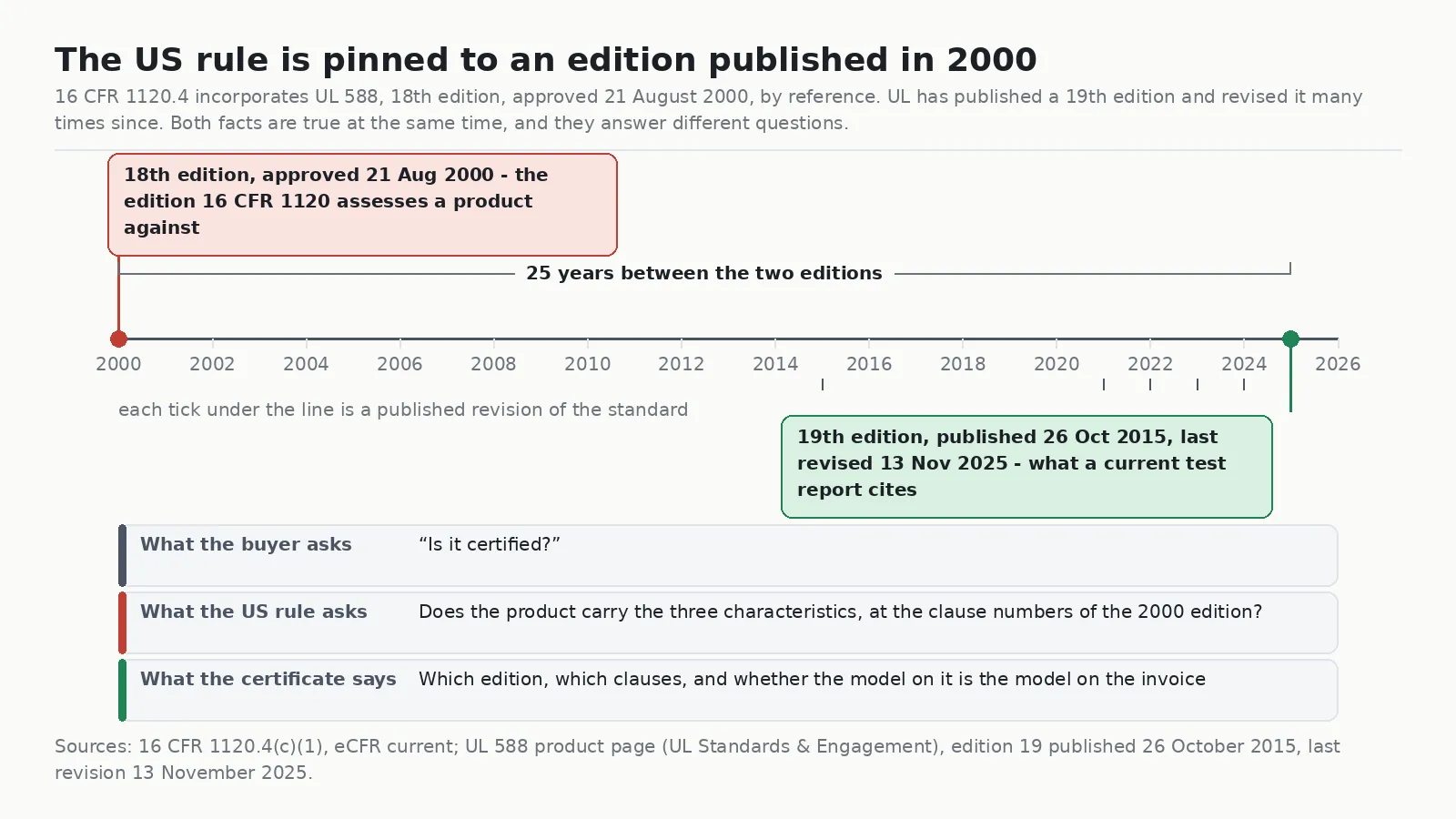
What this means in practice:
- A current test report will cite the 19th edition and recent revisions, because that is what a lab tests to today.
- The US hazard rule asks whether the product carries three characteristics, specified by clause number in the 2000 edition.
- A retailer’s compliance team typically wants both: a current report proving the product, and a statement that it meets 16 CFR 1120.
If a supplier’s paperwork only ever mentions one edition, ask which one and why. The answer tells you whether anyone has read the rule.
Three characteristics the US rule makes non-negotiable
16 CFR 1120.2(d) defines a seasonal and decorative lighting product as portable, plug-connected, temporary-use lighting with a nominal 120 V input. Battery, solar, transformer and low-voltage products, rope light with sealed non-replaceable lamps, and portable lamps used to illuminate decorations are expressly out of scope.
For the products that are in scope, §1120.3(c) is short and absolute. A product that lacks one or more of these is deemed a substantial product hazard:
- Minimum wire size, per section 6 of UL 588.
- Sufficient strain relief, per sections 15, 71, 79 and SB15.
- Overcurrent protection, per section 7.
Deemed. Not “may be”. The consequence chain runs through the Consumer Product Safety Act: a section 15(b) report, a recall under 15(c) and (d), and refusal of entry under 17(a)(4).
Note what the rule does not do. It does not require third-party laboratory testing. A General Certificate of Conformity for a non-children’s product may rest on “a test of each product or a reasonable testing program” (15 U.S.C. 2063(a)(1)(A)) — the CPSC’s own third-party testing requirement is aimed at children’s products and a specific list of rules, and seasonal lighting is not on that list.
The market fills that gap. Retailers, insurers and marketplace compliance teams require an NRTL mark — UL, ETL, CSA — because a mark is verifiable in a public directory and a reasonable testing program is not. Legally you can ship without one. Commercially you cannot.
What 40 recalls of seasonal lights actually said
The abstract argument about wire size and strain relief gets more convincing when you read what the regulator actually published.
We pulled every recall in the CPSC’s public database under the product type “Lights (Seasonal)” — 40 records, dated 1974 to 2009 — and counted what the hazard descriptions name.
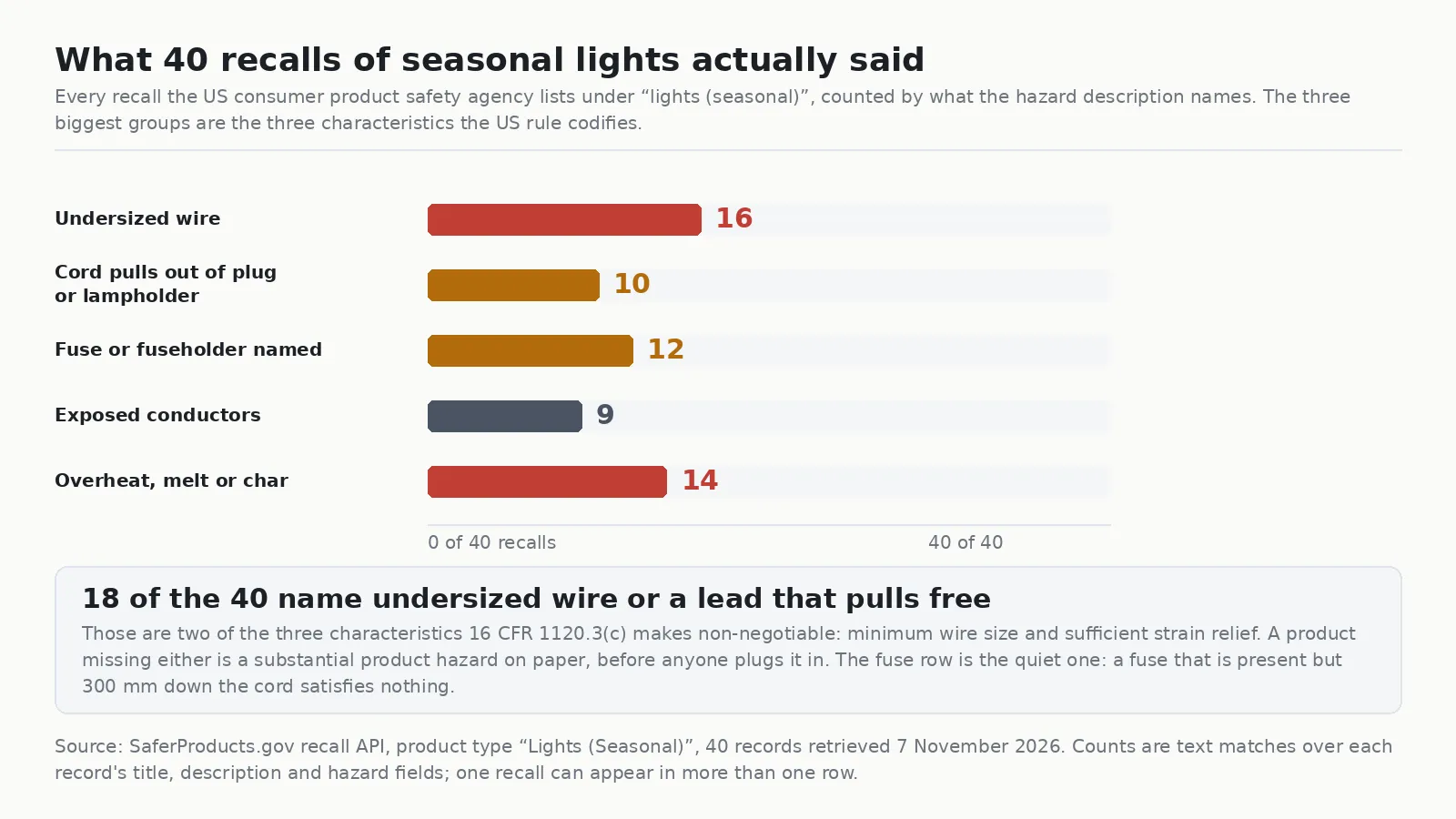
Eighteen of the forty name undersized wire, a lead that pulls free, or both. Those are two of the three characteristics 16 CFR 1120.3(c) makes non-negotiable — which is not a coincidence, it is what the rule was written about.
A few that are worth reading in full:
- Hobby Lobby, 2006 (07055). Light sets with undersized wires that could separate from plugs and sockets. CPSC had one report of a minor shock; the retailer had one report of melting wires. Every item number on that recall carried an NRTL file number —
E-214285,E-124315— printed on the tag. A file number on a tag is a claim, not a test. - Target, 2006 (06067). Fifty, one hundred and 140-count mini sets with undersized and exposed wires. The recall notice says some units carried UL file numbers and some carried no UL number at all on the tag.
- Winstar, 2001 (02065). Undersized wiring and no overcurrent protection, with “125V-3A” moulded into the plug and no independent test mark anywhere on the string.
- Flora-Lite, 2001 (02076). Wires that pulled easily out of plugs and lampholders — the strain relief failure, 22 feet of it, with a fused plug that says “TING SHEN”.
Two honest caveats. Text matching is not adjudication: one recall can name several defects, and “overheat, melt or char” is often the consequence of the other rows rather than an independent cause. And the last record in this product type is 2009 — which tells you how CPSC classifies recalls now, not that the hazard went away.
Since 8 July 2026 the certificate is data filed at the border
This is the part of Christmas lights certification that changed most recently, and a lot of supplier templates have not caught up.
16 CFR part 1110 was rewritten in a final rule published 8 January 2025 (90 FR 1800), with a technical correction in September 2025. It now requires that a certificate for an imported, CPSC-regulated finished product be eFiled — filed electronically with US Customs and Border Protection in ACE, at the time of entry.
Dates: 8 July 2026 for imported products generally, 8 January 2027 for goods entered from a foreign trade zone for consumption or warehousing.
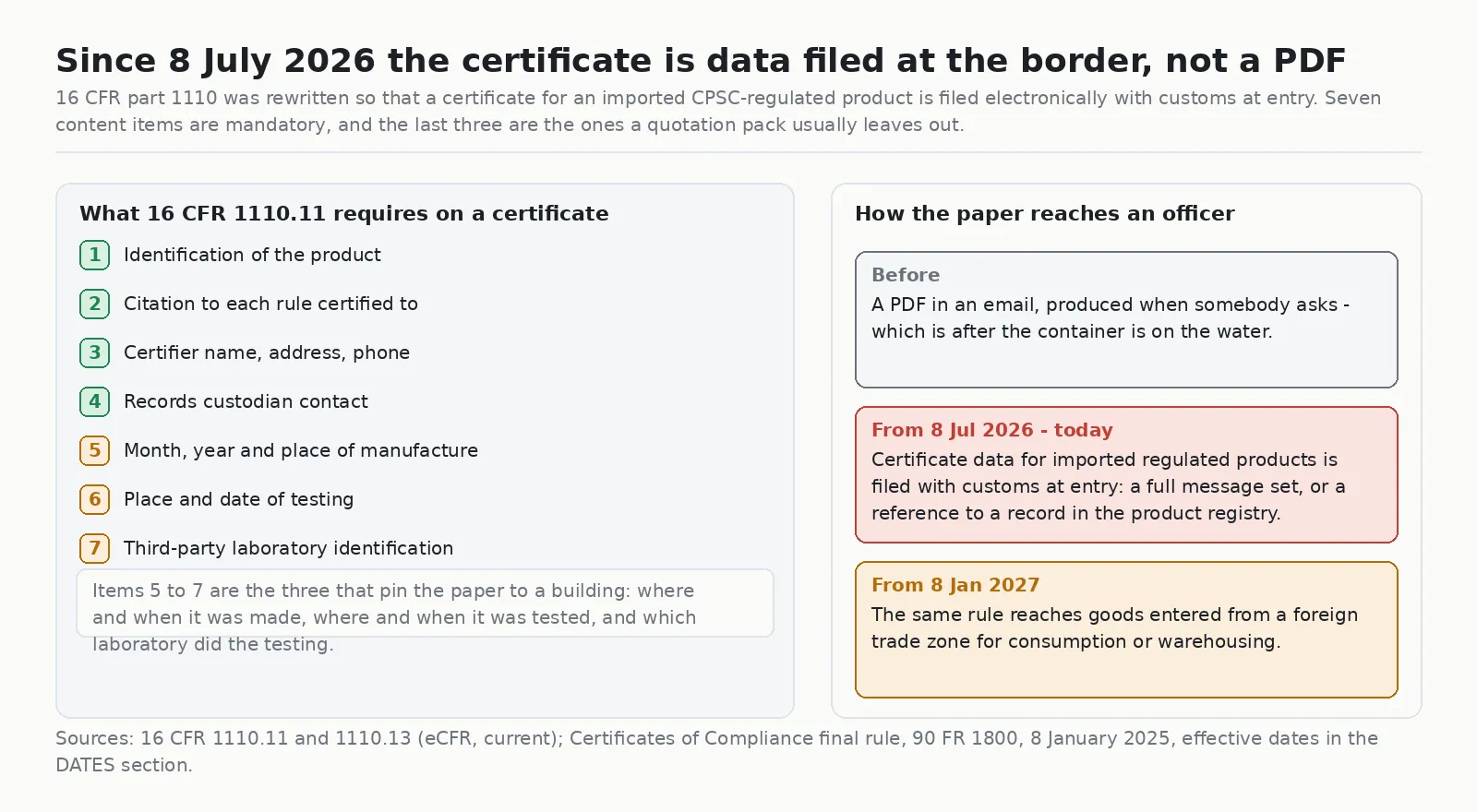
The seven content items in §1110.11 are unglamorous and none of them is optional:
- A product identifier — GTIN, model number, SKU, UPC or similar — plus a description sufficient to match the product.
- Every rule, ban, standard or regulation certified to, listed separately.
- The certifier’s name, street address, email and phone.
- The records custodian’s name and contact details.
- The month, year and place of manufacture.
- The date and place of testing, including the laboratory’s details.
- The certifier’s signed attestation.
Two of these do the real work. Item 5 pins the paper to a building — a month, a factory address. Item 6 pins a laboratory to a date. A document pack that has a certificate number and a scope but no manufacturing site and no test date cannot be eFiled, because there is nothing to type into the fields.
And who files it? §1110.7(a): for a product manufactured outside the United States, the importer is the finished product certifier. Not the factory. A Chinese supplier cannot issue a US certificate of conformity on your behalf — it can supply the test report, the manufacturing address and the attestation inputs, and you sign.
Two mechanics worth knowing before your first entry:
- There are two ways to transmit. A Full PGA Message Set carries all the certificate data elements in the entry. A Reference Message Set carries a reference ID to a record previously loaded into CPSC’s Product Registry — the same data, entered once and reused on every subsequent shipment.
- Records must be kept five years from the certificate creation date (§1110.17), and made available within 24 hours on request (§1110.13(c)).
Europe: CE is three directives and one regulation
In the EU, “CE certification” is not a certificate and there is no authority that issues it. It is a self-declaration against the directives that apply, backed by a technical file.
For a mains-voltage festive light string the list is short:
- Low Voltage Directive 2014/35/EU — applies to equipment rated 50 to 1,000 V AC. Article 6(3) requires the technical documentation and the EU declaration of conformity to be kept 10 years after the product is placed on the market.
- EMC Directive 2014/30/EU — for anything with electronics in it, which now means the controller in a flashing string, not just the lamps. Same 10-year retention.
- RoHS 2011/65/EU — Article 4(1) plus Annex II on restricted substances. This is the one that quietly fails on cheap PVC cable and solder.
- General Product Safety Regulation (EU) 2023/988 — applies from 13 December 2024 and sits on top of all of it.
The product standard the trade works to is IEC/EN 60598-2-20, lighting chains — the same document Australia mirrors as AS/NZS 60598.2.20, which the Australian EESS equipment definition cites by name.
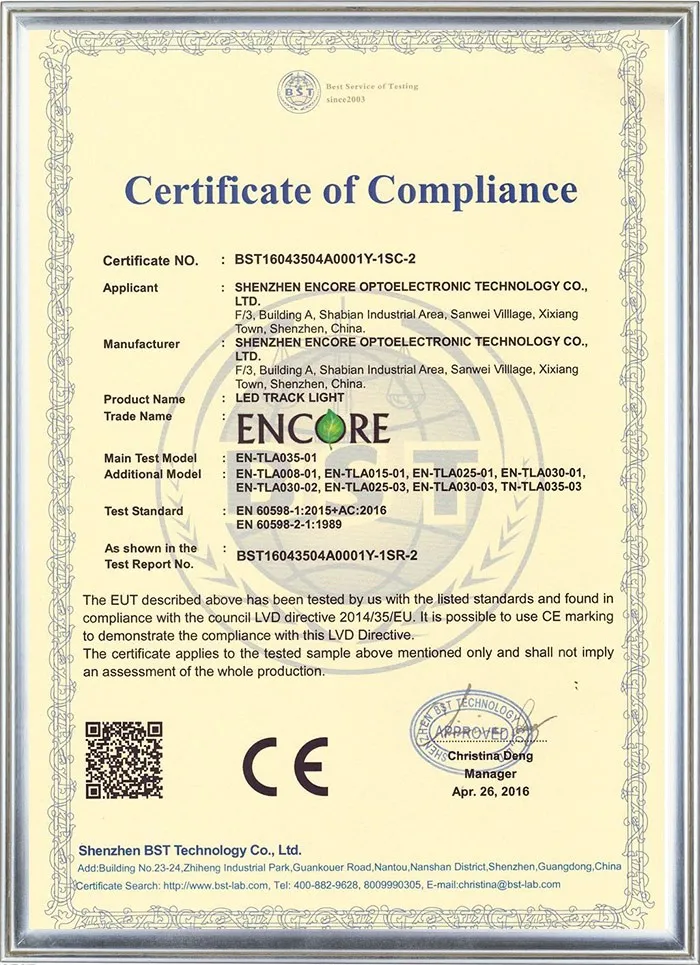
Read the paragraph in the middle of that certificate again, because it is the sentence that matters: “The certificate applies to the tested sample above mentioned only and shall not imply an assessment of the whole production.” Every serious test body writes a version of that. It is the difference between paper one and paper three.
GPSR changed who has to be named on the box
Since 13 December 2024 the GPSR requires an economic operator established in the Union to be responsible for the product before it can be placed on the market (Article 16). Their name, trade mark and postal and electronic address must appear on the product, the packaging, the parcel or an accompanying document.
For distance sales, Article 19 adds a specific list: manufacturer identity, the responsible person’s identity where the manufacturer is outside the Union, information identifying the product including a picture, and any warning or safety information.
Practically, this killed the “Made in China, sold by nobody in particular” listing. If your EU customer is a marketplace seller, they need a responsible person on the paperwork before the first pallet ships, and the name has to match the box.
The document-by-document anatomy of a CE file for a luminaire is in the five documents behind one CE mark; the mechanics are identical for a festive string, only the standard changes.
UK: both marks work, and the dates moved
Great Britain recognises CE marking alongside UKCA, under the Product Safety and Metrology (Amendment) Regulations 2024. The gov.uk guidance is explicit that this gives businesses a choice of conformity route for the GB market.
Two practical details:
- The UKCA marking may be placed on a label affixed to the product or on an accompanying document until 31 December 2027 — so a carton-only UKCA is still acceptable for a while yet.
- Technical documentation is retained for the period in the legislation, typically 10 years after the product is placed on the GB market.
For a seasonal supplier this means one less duplicate test. A UK customer asking “do you have UKCA?” is usually satisfied by a CE file plus a UK importer identified on the label — but get the label artwork right before printing, because that is a reprint, not an email.
Australia: EESS Level 3, and the mark is not the compliance
Australia is where the document requirement is the most concrete, and where the “we have RCM” answer fails most often.
In the EESS equipment definitions, a decorative lighting outfit — portable, for decorative or display purposes, light sources or lampholders interconnected by flexible cord of less than 2.5 mm² cross-section, possibly integral with a frame — is classified Risk Level 3.
Level 3 is the top of three. It requires:
- The RCM mark on the product.
- A valid Certificate of Conformity from an EESS recognised certifier, covering the specific model.
- Registration in the national EESS database, linked to the responsible supplier.
And the responsible supplier is the Australian importer or local manufacturer — never the Chinese factory. The RCM mark alone proves nothing; it is a claim that a certificate exists and is registered.
The full path, including the eight steps and the six mistakes that cost Australian sellers money, is in SAA, RCM and EESS for lighting. The short version for festive lighting: EESS Level 3, standard AS/NZS 60598.2.20 for lighting chains and 60598.2.21 for rope lights, and a certificate that names the model you are actually importing.
What retailers actually ask for
Retail compliance teams are not regulators, but they are the ones who decide whether your carton gets on a shelf, and they tend to be stricter because a recall is their name on the news.
Here is what a serious retailer asks for, in roughly the order it asks.
1. A test report for the exact model. Not the platform, not the series — the model, with the clause list visible.
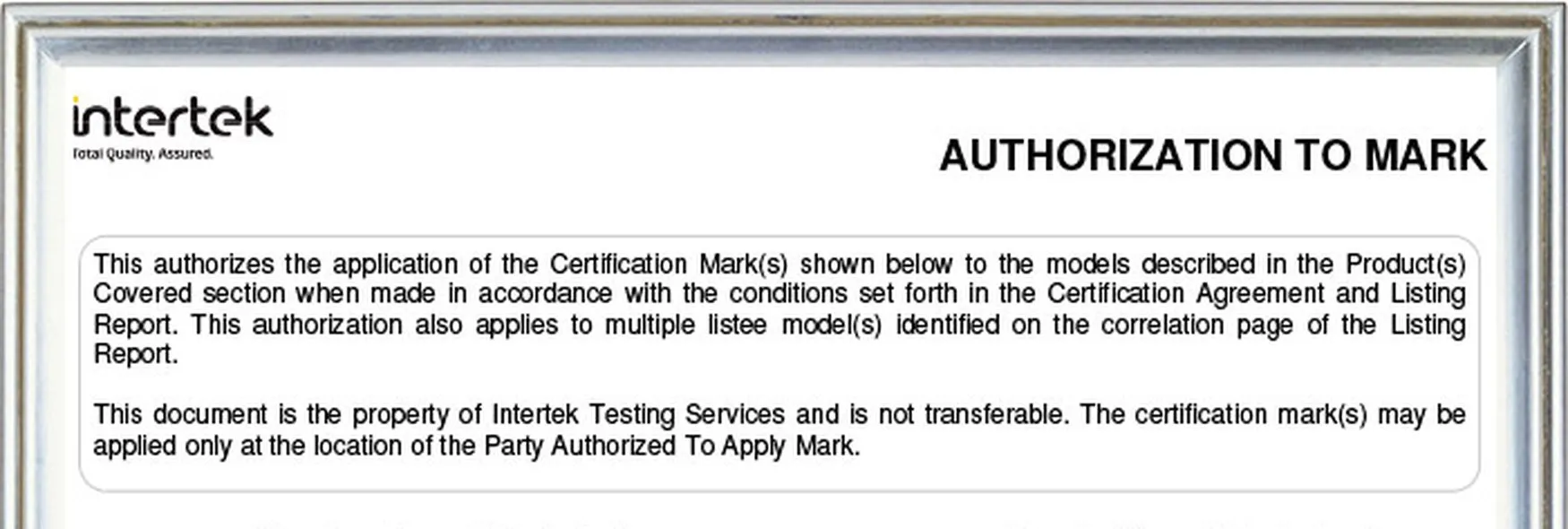
2. The authorisation to mark. For an NRTL this is a separate document from the certificate, and it names the factory address where the mark may be applied. Note the line in the document above: the mark “may be applied only at the location of the Party Authorized To Apply Mark.” A trading company cannot print it.
3. The certificate, with a scope that includes the model. Certificate scopes are written in model families. If your SKU is not in the family, the certificate does not cover it.
4. A declaration of conformity with a signature and a date. For the EU this is the DoC; for the US it is the GCC data. Both are attestations, and an unsigned one is decoration.
5. A factory identification. For the US this now has to be eFilable: a name, a street address, a month and year. For the EU it is the manufacturer’s identity on the label.
6. For the EU, a responsible person established in the Union, named on the product or its packaging.
7. For Australia, an EESS certificate number and the register entry, linked to the responsible supplier.
8. A live directory lookup. Every NRTL maintains one. The compliance team will search the file number themselves; assume they will, and make sure the file number on your tag is the one that resolves.
9. The cord tag artwork. Date of manufacture, model number, factory code, within 152 mm of the plug. This is the item that catches counterfeit documentation, because a file number can be copied and a date code has to match the shipment.
What retailers do not usually ask for, despite the folklore: a certificate per container. The certificate is per product and per certifier; the container is matched by the date code and the factory code. A supplier who offers a fresh “certificate” for every shipment is telling you they do not understand the system.
What a document pack that survives review looks like
The failure mode is almost never a missing document. It is a document that cannot be tied to the carton.
Three things make the difference.
The model number is the join key. It has to appear identically in the test report, the certificate scope, the declaration, the invoice and the carton marking. One hyphen or suffix difference and the whole chain breaks at the desk of someone who has never seen the product.
The manufacturing site has to be a real address, not a trading name. Since eFiling, an address that cannot be typed into a field is not an address. Ask for the factory’s business licence address and compare it with the one on the certificate; when they differ, ask which one the goods were made at.
The date code has to close the loop. A certificate proves a design. A date code proves which run. The cord tag does both jobs at once, which is why it is the cheapest audit in the category — and why the factory inspection checklist starts there rather than in the showroom.
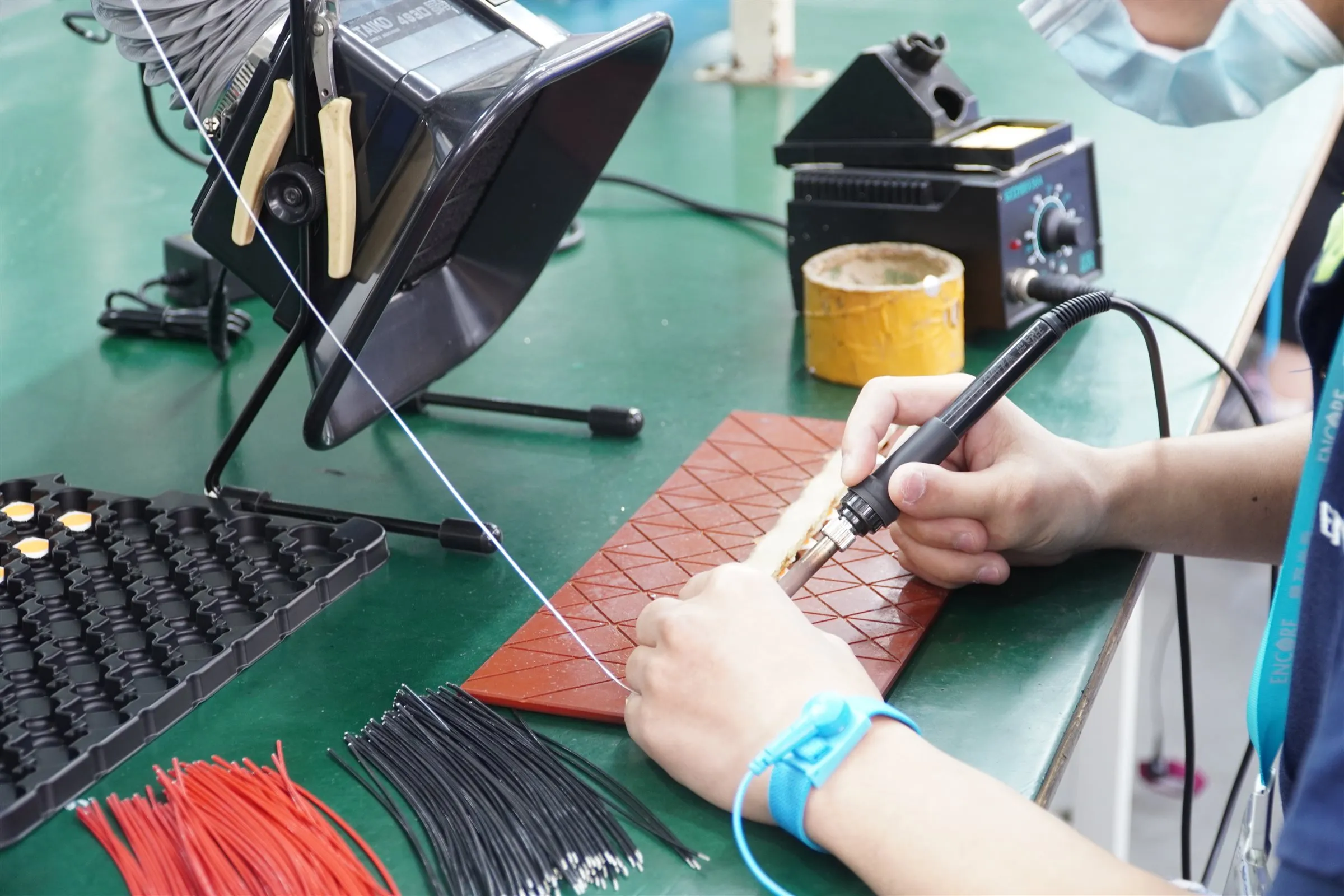
None of that is specific to Christmas. The same discipline applies to any luminaire you import, which is why we keep the full set of ETL, CE, SAA and ISO documents on one certifications page and publish the QC flow that keeps production matching the certified sample — IQC, IPQC, 100% ageing, OQC.

An ageing rack is not a certificate. It is the thing that makes a certificate true for the second container, which is the only container that matters.
Where Our factory sits in this
We build architectural and commercial lighting — track lighting, LED downlights, magnetic track systems and commercial luminaires — and we are not a festive lights factory.
What we do have is the document discipline the category runs on: NRTL listings with authorisation-to-mark documents tied to model numbers, CE files with declarations that state their own scope, EESS registrations for the Australian market, and a QC line that keeps production on the certified sample. That is the same set of papers, and reading it is the same skill.
If you are building a seasonal programme and want a second pair of eyes on a supplier’s document pack, send it over. We will tell you which lines are evidence and which are decoration. Talk to our engineers →
FAQ
Does Christmas lights certification mean UL certification?
No, and the distinction matters. In the US the legal requirement is a General Certificate of Conformity for a product that meets 16 CFR 1120 — which assesses wire size, strain relief and overcurrent protection against UL 588. A UL, ETL or CSA listing is what retailers require on top of that, and it is what a marketplace compliance team can verify in a public directory. Legally you can certify without a third-party mark; commercially you cannot sell without one.
Which edition of UL 588 does US law actually reference?
The 18th edition, approved 21 August 2000, incorporated by reference in 16 CFR 1120.4(c)(1). UL has published a 19th edition (26 October 2015, last revised November 2025) and a lab testing today will cite that one. Both facts are correct: the regulation pins the hazard rule to the older text, while current testing follows the current standard.
Do Christmas lights need third-party lab testing to enter the US?
For a non-children’s product, no — the CPSA allows a General Certificate of Conformity to rest on a test of each product or a reasonable testing program (15 U.S.C. 2063(a)(1)(A)), and the CPSC’s mandatory third-party testing list does not cover seasonal decorative lighting. Retailer requirements and marketplace policy are a different and much stricter matter. In the EU there is no third-party requirement at all for LVD compliance; the manufacturer self-declares and keeps the technical file for 10 years.
What changes for importers on 8 July 2026?
Certificates for imported CPSC-regulated finished products must be eFiled with CBP in ACE at the time of entry — either as a Full PGA Message Set carrying the data elements, or as a Reference Message Set pointing at a record in CPSC’s Product Registry. The date for goods entered from a foreign trade zone for consumption or warehousing is 8 January 2027. The importer of record is the certifier, not the factory.
Is a CE certificate the same as a UL certificate?
No. A UL or ETL listing is issued by a third-party body against a US product standard and is verifiable in that body’s directory. CE is a self-declaration that the product meets the applicable EU directives — LVD, EMC, RoHS — backed by a technical file and an EU declaration of conformity. For festive lighting the usual product standard is IEC/EN 60598-2-20 for lighting chains. The two systems do not recognise each other.
What does GPSR require on Christmas lights sold in the EU?
An economic operator established in the Union must be responsible for the product before it is placed on the market, and their name, trade mark and postal and electronic address must appear on the product, packaging, parcel or an accompanying document. For online sales, the listing must also identify the manufacturer, the responsible person, the product including a picture, and any safety warnings.
What risk level is a Christmas light string in Australia?
Decorative lighting outfits are Risk Level 3 in the EESS equipment definitions — the highest of the three. That requires the RCM mark, a Certificate of Conformity from an EESS recognised certifier covering the specific model, and registration in the national database linked to the responsible supplier. Lighting chains are assessed to AS/NZS 60598.2.20 and rope lights to AS/NZS 60598.2.21.
Can a Chinese factory issue the US certificate of conformity?
No. Under 16 CFR 1110.7(a) the importer is the finished product certifier for goods manufactured outside the United States. The factory supplies the inputs — test report, manufacturing address, month and year of production, laboratory details — and the importer signs the attestation and files it. A factory that offers to “issue the GCC” is describing something that does not exist.
How long do the records have to be kept?
Five years from the certificate creation date in the US (16 CFR 1110.17), with availability within 24 hours on request. Ten years for the EU technical documentation and declaration of conformity under the LVD (Article 6(3)) and the EMC Directive, and typically ten years in the UK. Australia ties the retention to the responsible supplier, not the factory.
Is “no UL number on the tag” a real red flag?
It is the exact wording of a 2006 recall. Target recalled mini light sets where some units carried UL file numbers E254698 or E182192 and others carried no UL number on the tag at all. A missing mark on the tag is not a paperwork gap — it is the failure mode that generated a recall.
The short version
- Four papers, four questions. Test report, certificate, authorisation to mark, declaration. Only the fourth is a promise, and only the first contains data.
- UL 588 has a narrow scope. 120 V, temporary use under 90 days, portable. Battery, solar, low voltage and rope light are different products with different standards.
- US law cites the 2000 edition. 16 CFR 1120.4(c)(1) points at UL 588 18th edition; labs test to the 19th. Ask which edition and why.
- Three characteristics are absolute. Wire size, strain relief, overcurrent protection. Eighteen of 40 recalls in this product type named the first two.
- The certificate became data. From 8 July 2026 it is eFiled at entry, by the importer, with a manufacturing address and a test date that have to be typeable.
- The importer is the certifier in the US. The factory supplies inputs. Anyone who says otherwise is guessing.
- The mark is not the compliance. RCM needs a certificate and a register entry; CE needs a technical file and a responsible person; UKCA and CE both work in Great Britain.
- A certificate proves a design; a date code proves a run. Match the carton or you have matched nothing.
Read next: LED string and fairy lights OEM for the year-round product side — customisation tiers, ampacity and the marks a carton must carry. Then Christmas lights manufacturer: what OEM buyers should check for the factory-floor half of this — wire gauge, strain relief, cord tags. Then ETL certification for lighting for how to verify a listing in six steps, and CE documents for LED lighting for the file behind a CE mark.
- christmas lights safety certification
- ul 588 christmas lights
- seasonal lighting certification
- christmas lights certification
- 16 cfr 1120
- 16 cfr 1110
- cpsc efiling
- gpsr responsible person
- eess level 3
- lighting chains en 60598-2-20
our factory