· Certifications & Compliance · 19 min read

Written by ENCORE Lighting Team
LED Lighting Manufacturer & OEM/ODM Partner ·
SAA and RCM for Australian Lamp Holders and Adapters
A custom lamp holder or power adapter for Australia is a mains-carrying product, not a spare part. What AS/NZS 3112 fixes before you choose a colour, how private label works on an accessory, and where the RCM duty lands.
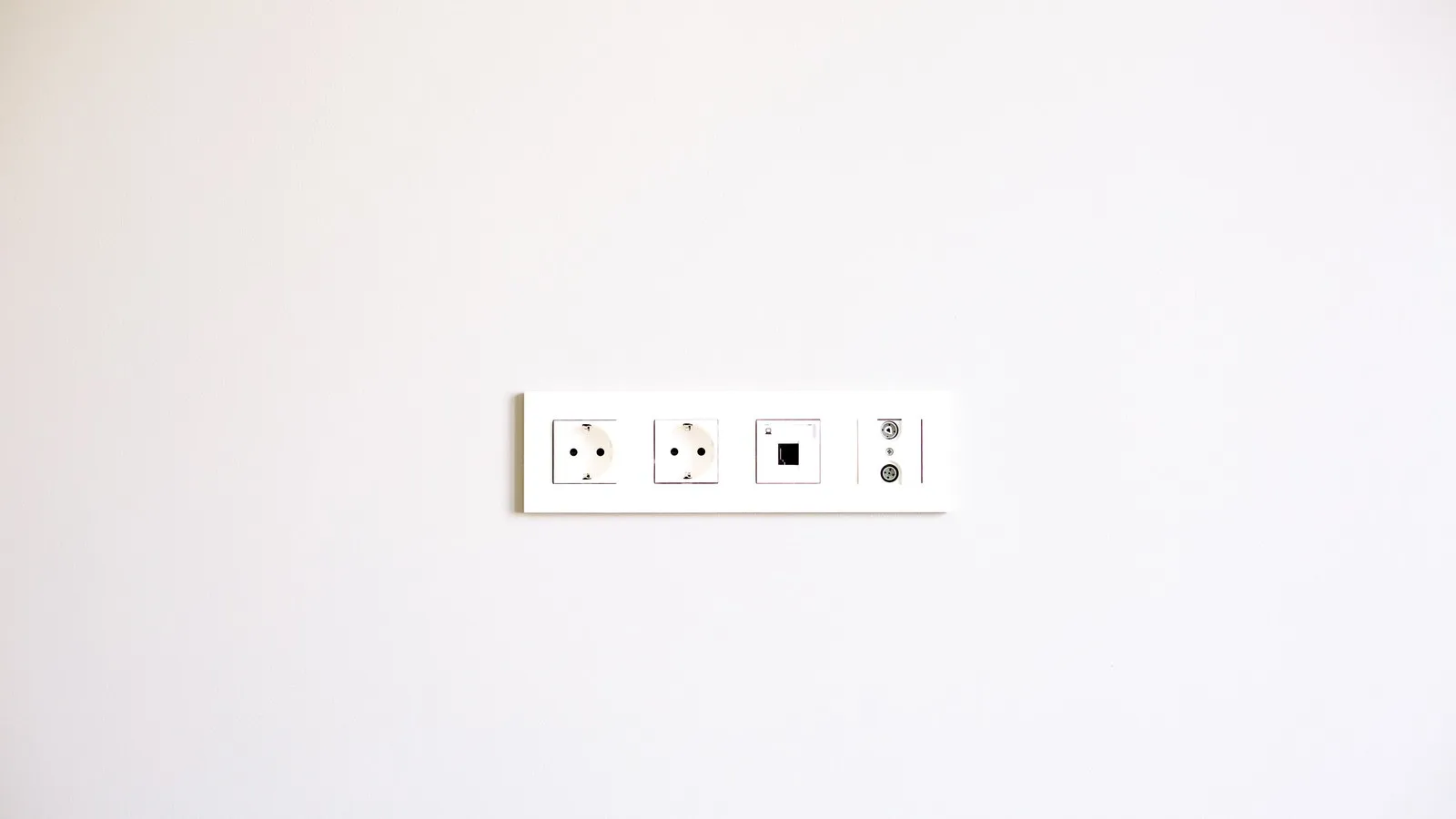
A Melbourne wholesaler asks for a pendant lamp holder with their own logo on the shade ring. The samples come back beautiful. Three weeks after the first container clears, the same wholesaler is asking a different question: which certificate covers the lamp holder itself, and whose name is on the RCM label?
Nobody in the thread can answer it, because everyone assumed the answer travelled with the luminaire.
It does not. A custom SAA lamp holder or an RCM power adapter for Australia is not a spare part riding along with the fixture. It is its own electrical product, in scope on its own voltage, tested against its own clause, marked on its own label. Accessories are where Australian compliance quietly falls apart, and they are the last thing anybody audits before the container ships.
This guide covers the accessory half of the Australian market: what the plug geometry fixes before any design choice, which of the three accessory families each carries its own certification exposure, how private label works on an accessory, and where the RCM duty lands once the certificate is in hand.
If you are still working out the difference between the certificate and the mark, read SAA and RCM explained for Australia first. This article assumes that foundation.
The Plug Decides Before You Do
Start with the constraint that cannot be negotiated, styled or rebranded.
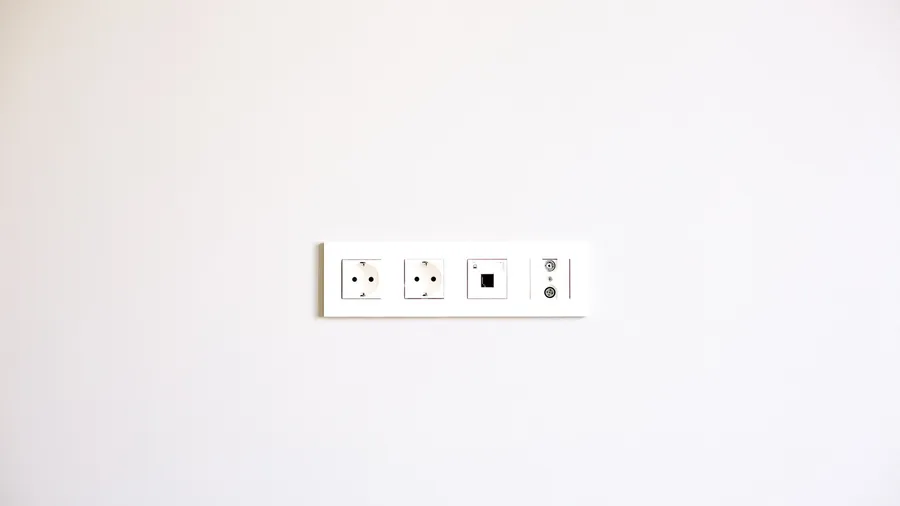
Australia’s mains interface is fixed by AS/NZS 3112: flat pins, not round ones, not the narrow North American blades, and not any of the shapes a European or US tooling already cuts. The 10 A plug carries two flat pins at a fixed pitch, with the earth pin below them.
That matters commercially more than it sounds. If a factory’s existing adapter body is built around a CEE 7/16 round-pin moulding or a NEMA blade, an Australian order is not a colour change on the same line — it is a different body, a different insert, and usually a different tool. Buyers who discover this after sampling lose a season.
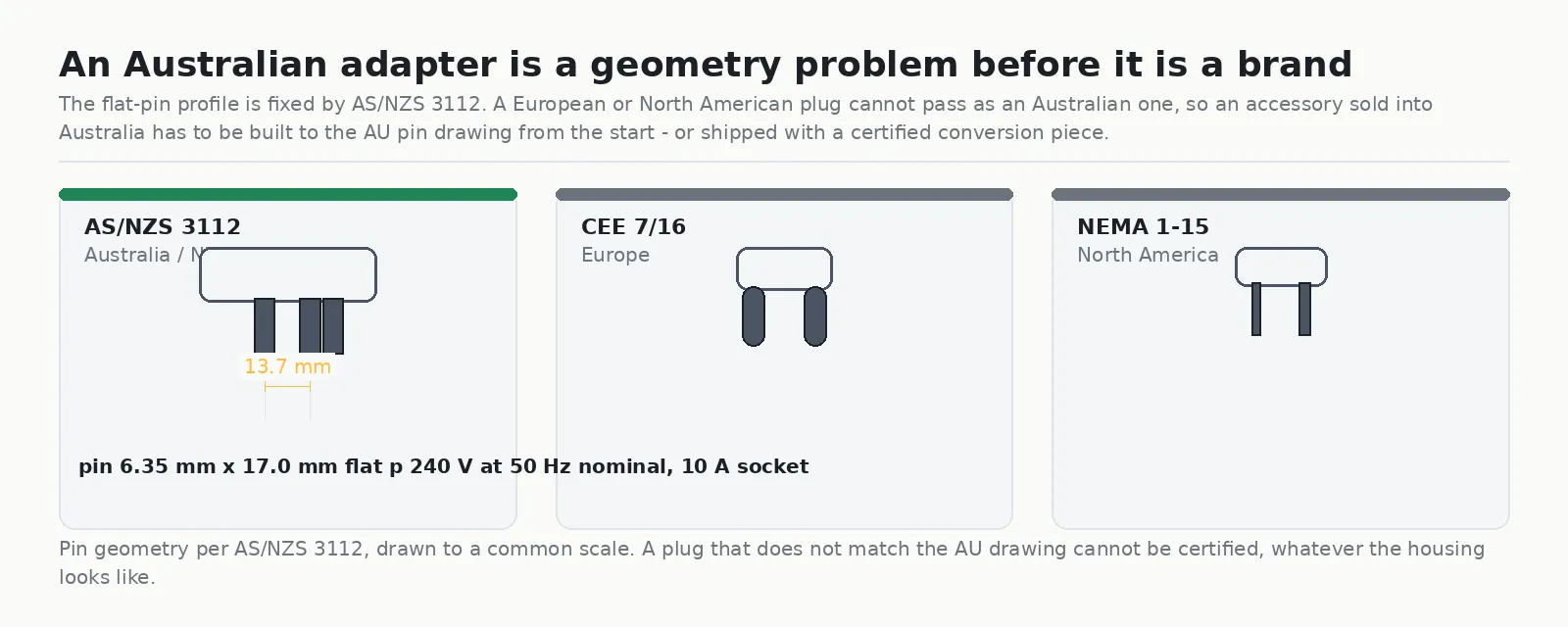
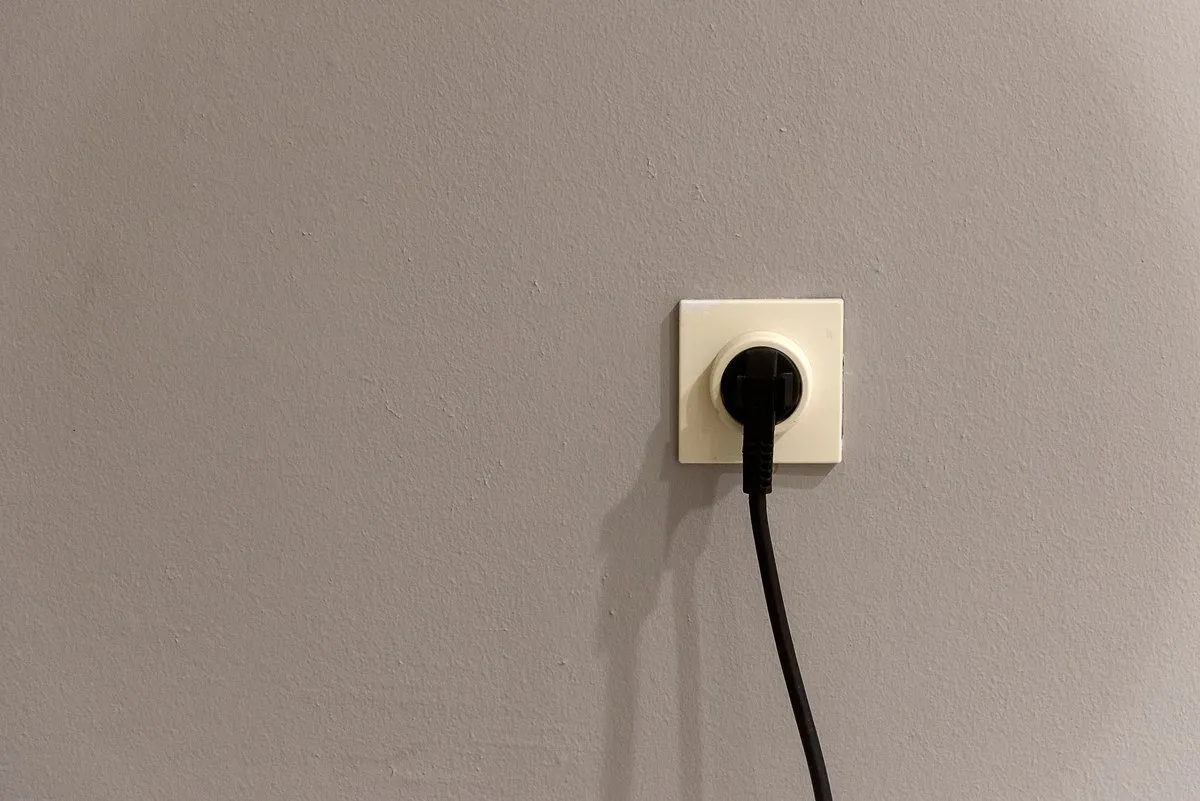
The same geometry governs the socket side. Every accessory that interfaces with the wall — a plug-in power supply, a cord set, a table lamp lead — meets this drawing:
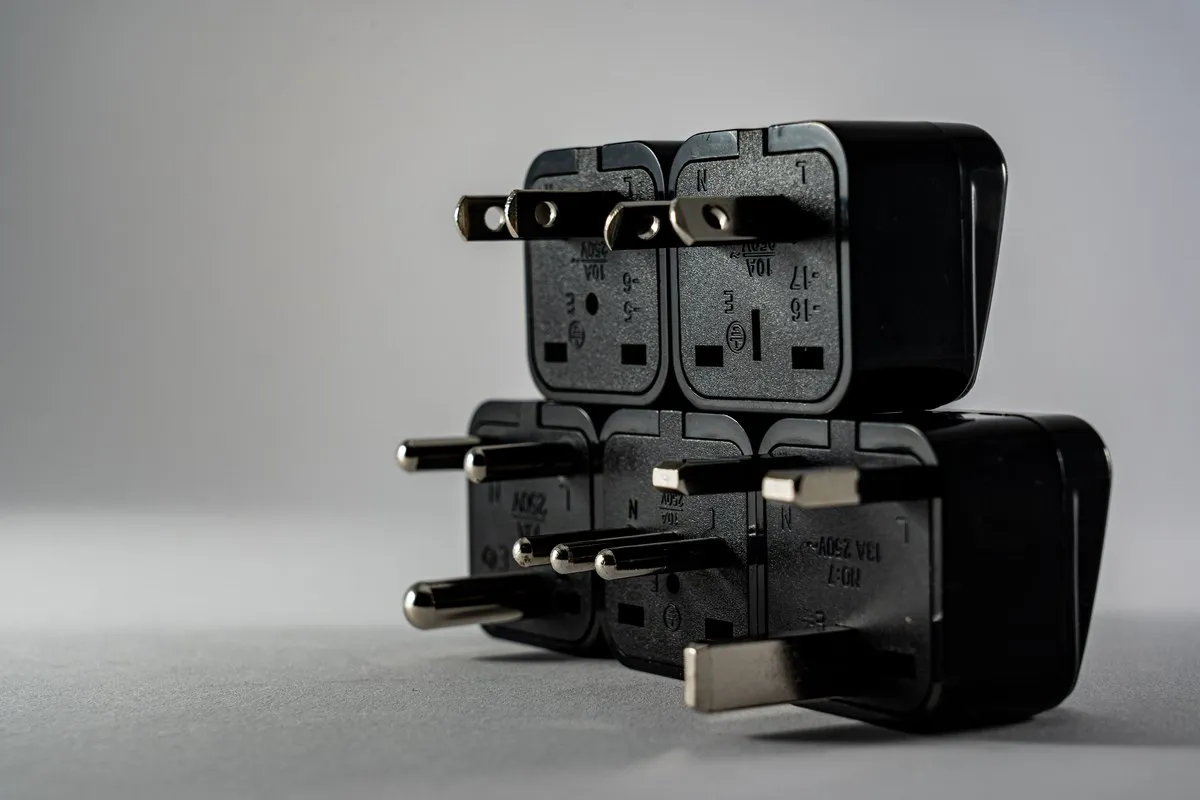
The stack of travel adapters that circulates in every procurement meeting is a useful reminder of how many interfaces exist — and of why a conversion piece is not the same thing as a compliant product:
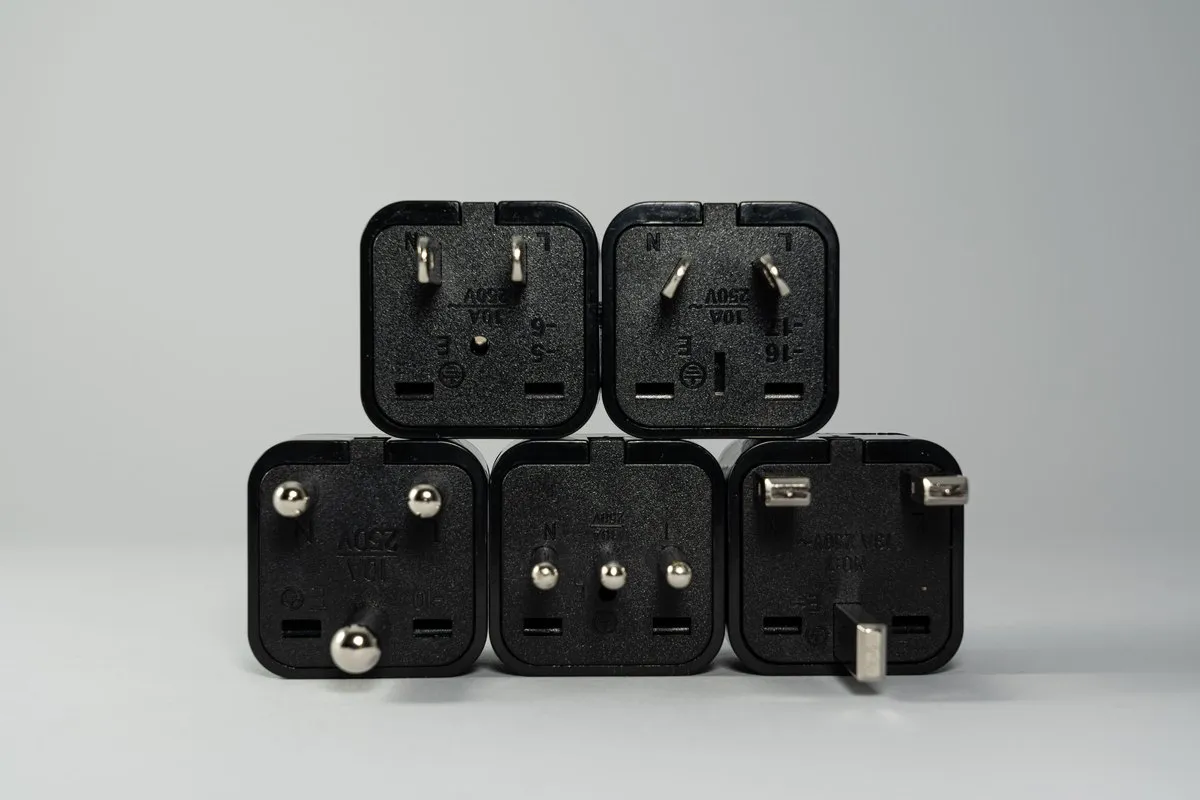
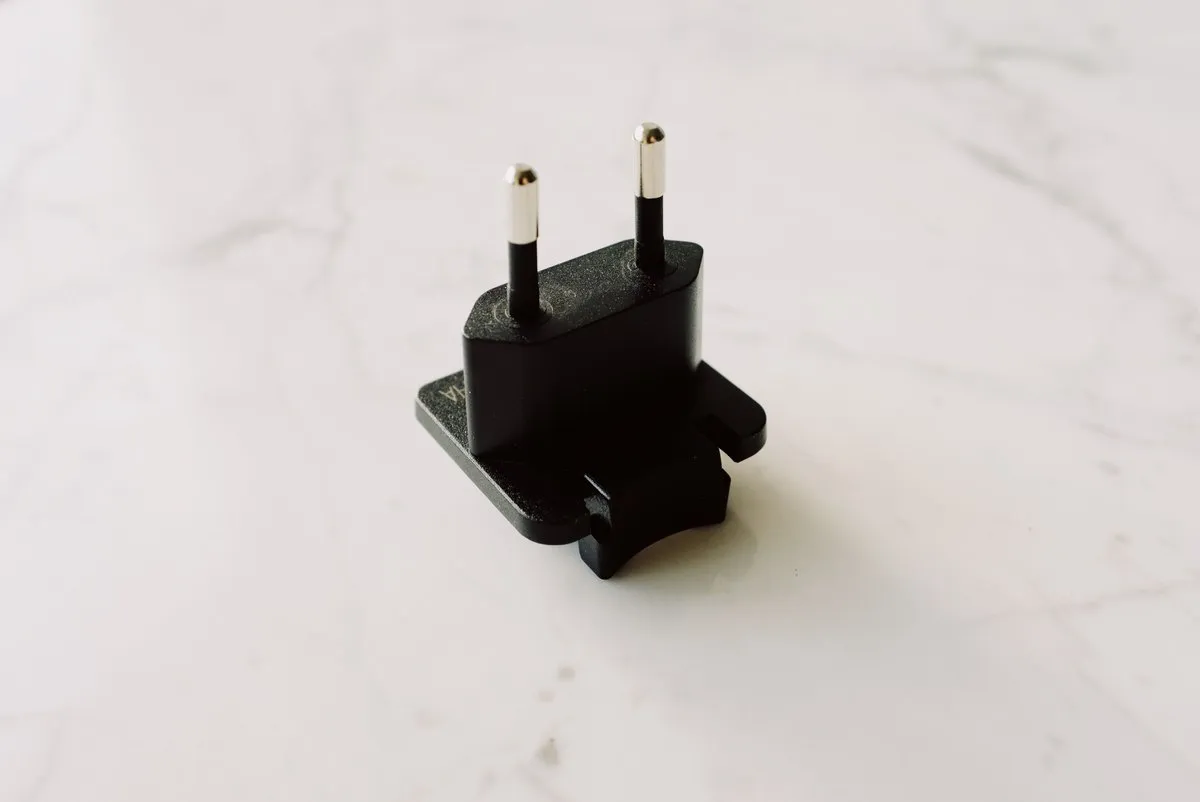
A universal travel adapter is a device for a tourist’s suitcase. It is not a component in a product you intend to register, and it is not something a certifier will accept as the mains interface of a registered model. The interface has to be built to the standard.
The practical consequence for a custom order: ask for the AU pin drawing in the RFQ. If the response describes an adapter that “fits Australia” rather than one built to AS/NZS 3112, the quotation is describing a travel accessory.
Three Accessory Families, Three Exposures
“Accessories” is one word covering three product types that behave quite differently under a certification file.
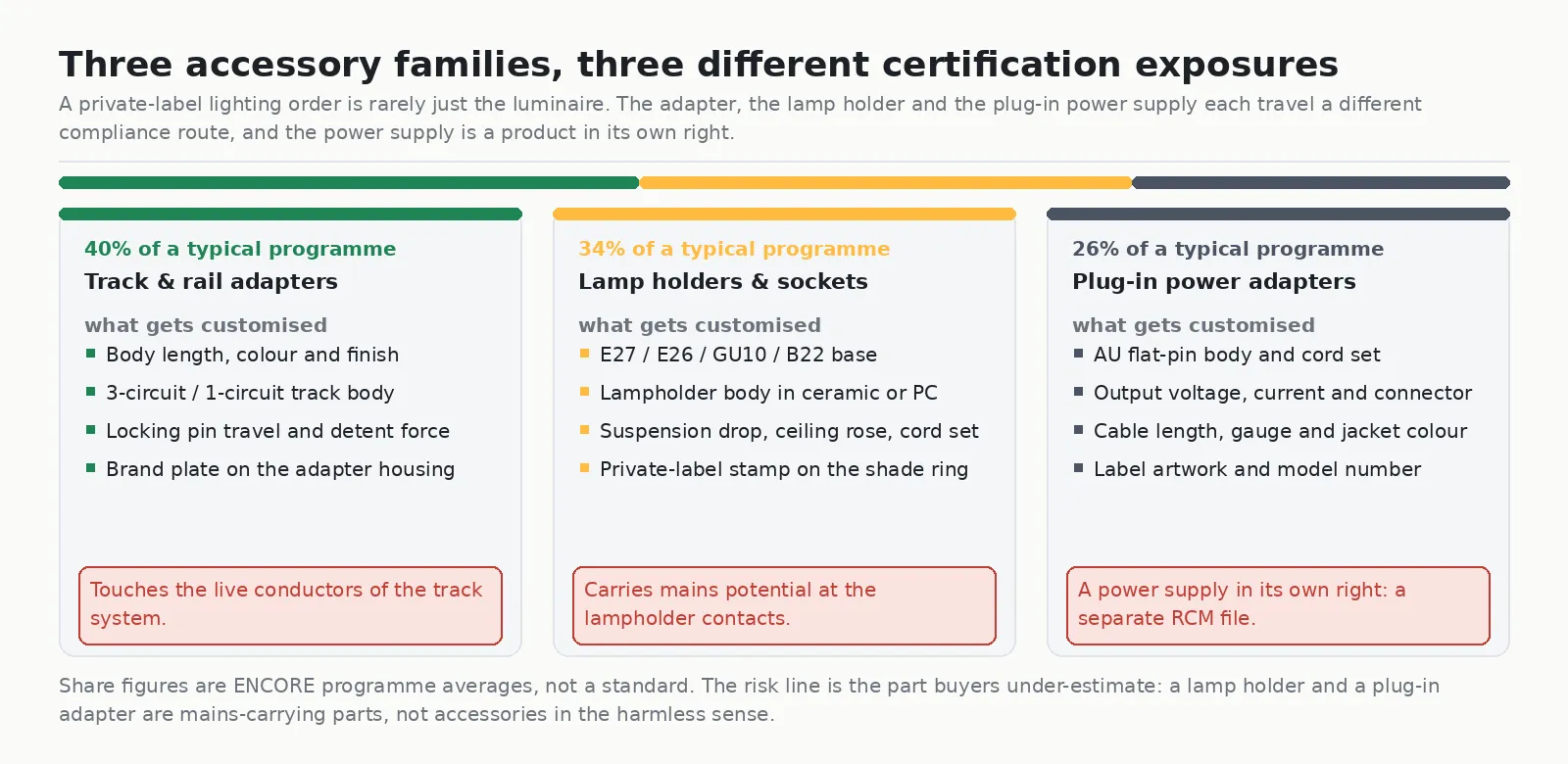
Track and rail adapters
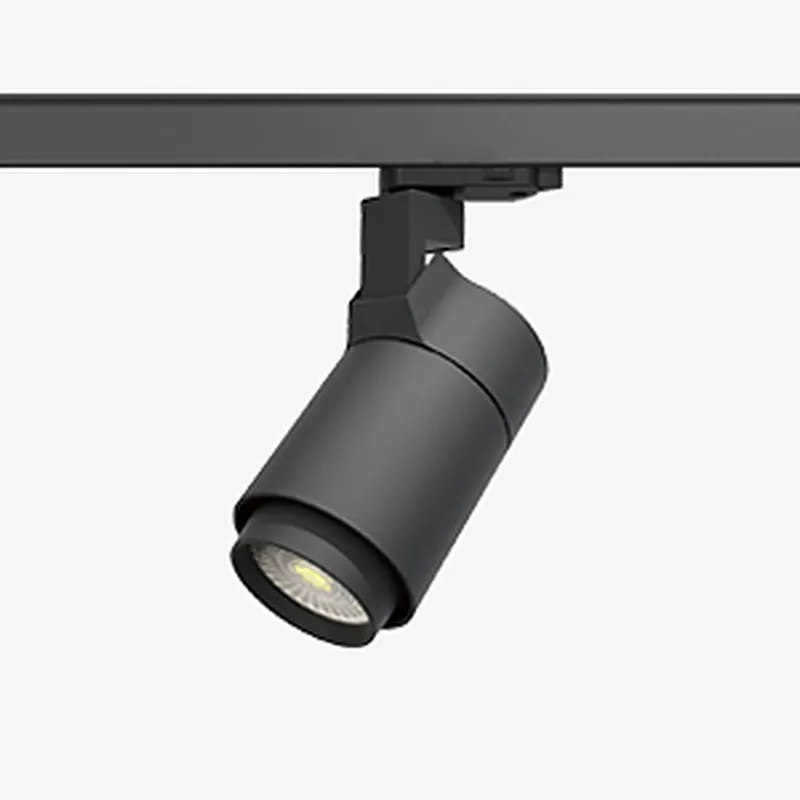
The piece that couples a luminaire to the conducting rail. On our own systems these are the adapters that convert one fixture head into track, surface, wall or pendant mounting:
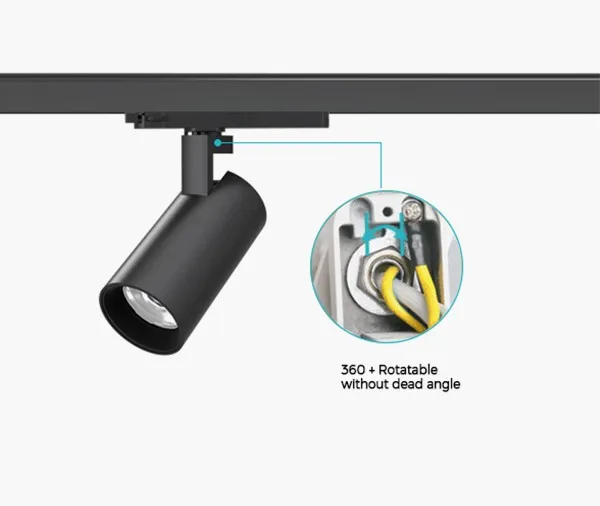
This family is the one buyers most often assume is certification-free, because it is “just the bit that clicks into the track”. It is not. The adapter is the component that makes contact with the live conductors of the rail, and it is the component whose travel and detent force decide whether the head stays electrically connected after a decade of aiming. The 360° position holder on our track heads is a moving, current-carrying assembly, not a hinge:
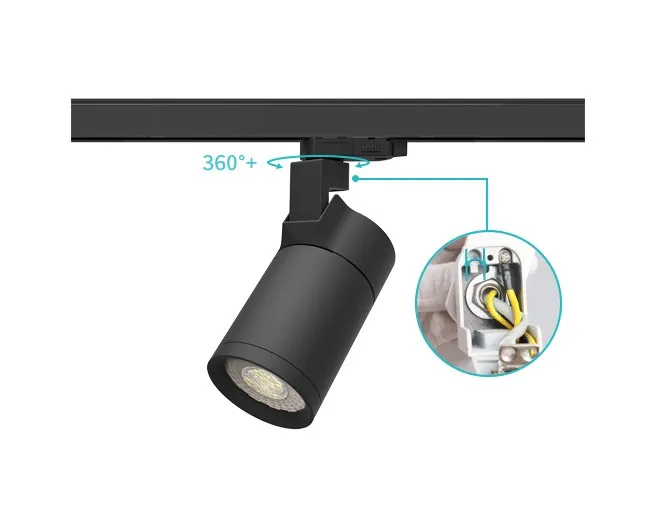
If an adapter changes the electrical characteristics of an already-certified luminaire — a different contact arrangement, a different creepage path — the certificate that named the original assembly may no longer cover what you are shipping. Re-qualify before the PO, not after a recall.
Lamp holders and sockets
E27, E26, GU10 and B22 bodies, ceramic or polycarbonate, plus the suspension, ceiling rose and cord set that turn a bare holder into a pendant. This is the family that most often carries a private label request, because the shade ring and the ceiling rose are the visible brand surfaces.
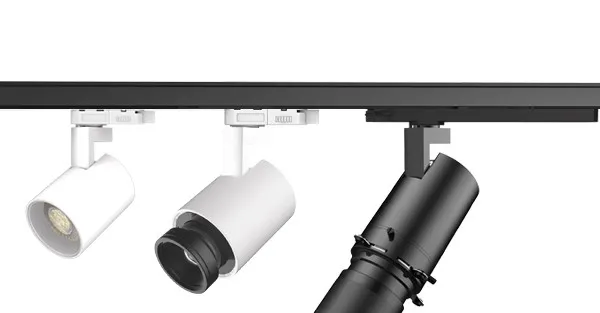
The compliance point people miss is the lampholder contacts. A lamp holder is not a passive housing: it presents mains potential at the point where a customer’s fingers go to change a lamp. That is precisely the part of the assembly the relevant standard clause is written about.
Plug-in power adapters
Separate power supplies, LED drivers sold as plug-in units, and any accessory with its own mains lead.
This is the family with the heaviest exposure, and the reason is simple: a power supply is a product in its own right. It has an input, an output, its own voltage and current, its own failure modes, and often its own control protocol. It does not inherit anything from the luminaire it feeds.
Insist on seeing the input side of the drawing, not the housing. The mains termination, the strain relief and the separation between primary and secondary are the parts a certifier photographs:
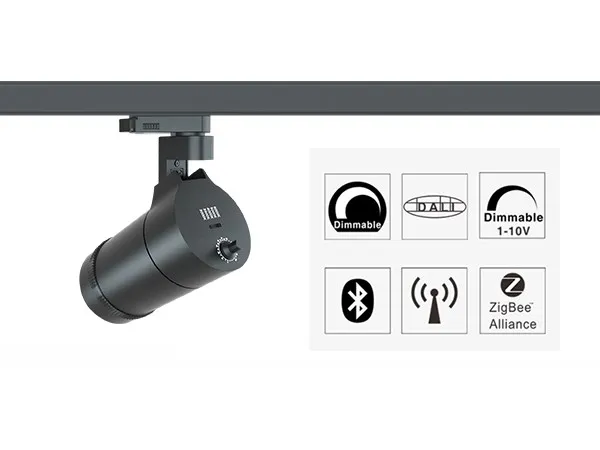
If the supply offers dimming or control, the protocol is part of the specification and has to be declared on the file — DALI, Zigbee and 1-10 V are not interchangeable labels:
The Certificate and the Mark Are Still Two Things
The accessory does not get a shortcut through the Australian system. It runs the same two-part structure as a luminaire, and mixing the two up is what stalls accessory shipments.
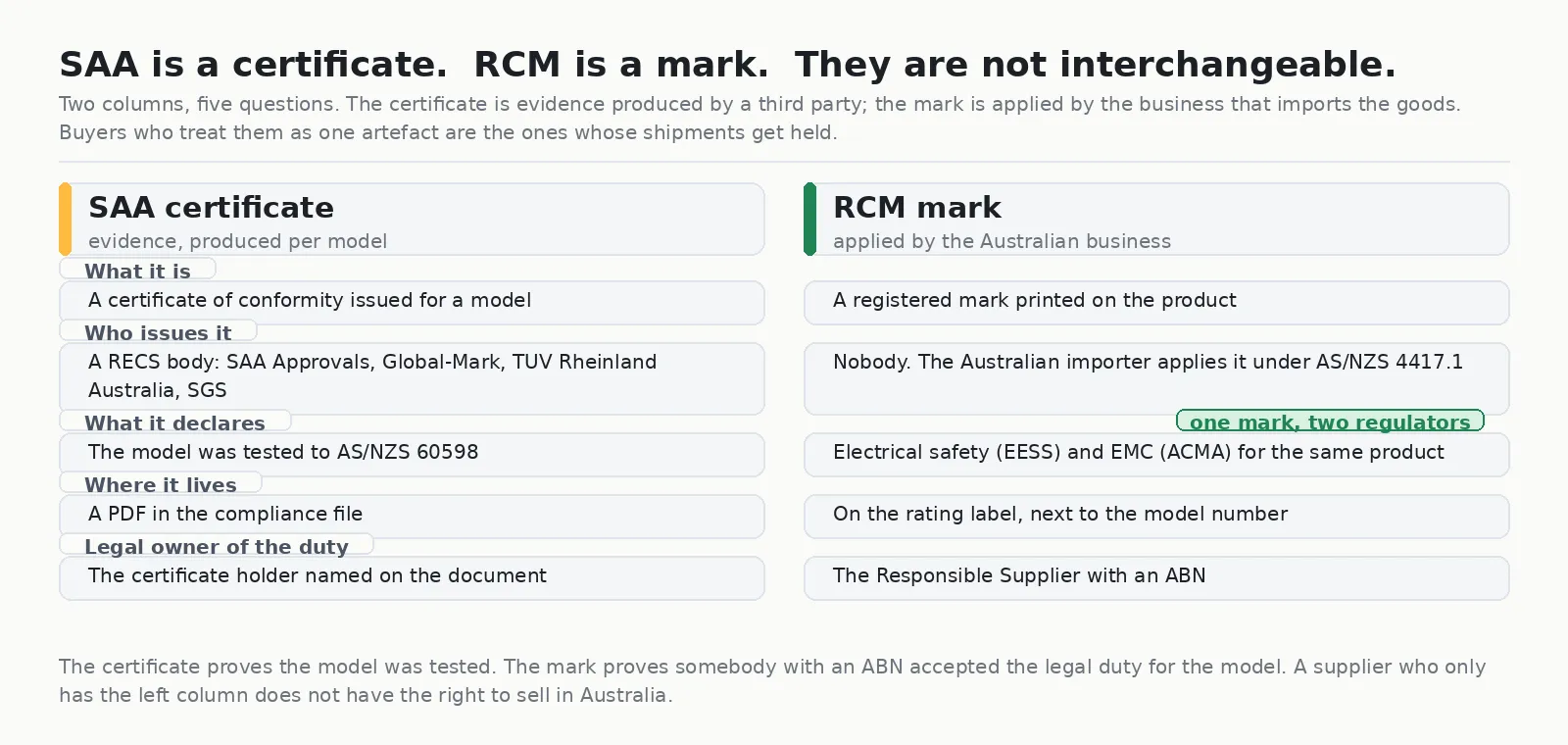
Read the left column and the right column as separate purchases. The certificate is evidence produced by a RECS body — SAA Approvals, Global-Mark, TÜV Rheinland Australia, SGS Australia and the rest of the recognised list — that a specific model was tested to a specific clause. The RCM mark is applied by the Australian business that imports the goods, because that business is the Responsible Supplier under the EESS.
That second column is the one an accessory buyer tends to believe is included in the price. It is not included in anybody’s price, because it is not a service a factory can sell. It requires an ABN, which a Chinese manufacturer cannot hold.
Which standard does an accessory actually cite?
This is the question that separates a real compliance conversation from a marketing one.
- Lampholders are covered by the AS/NZS 61184 family (bayonet) and the Edison-screw equivalents, alongside the luminaire standard when the holder is supplied as part of a fitting.
- Attachment plugs and cord sets point back to AS/NZS 3112 for the interface itself.
- Luminaires, the fittings the accessories feed, are tested to the AS/NZS 60598 family — the same series a certifier will reference when the adapter changes the assembly.
- Power supplies are tested as products, and where a specific Australian standard does not exist for the category, AS/NZS 3820 is the safety baseline.
A spec sheet that says only “SAA approved” without naming the standard and clause is telling you the supplier has not read the file either.
Private Label on an Accessory: What Can Actually Be Yours
Here is the part that is genuinely good news. Private label on accessories is often easier and faster than private label on a luminaire, because the accessory is a simpler part with a shorter tooling cycle.
What can carry your brand:
- The moulded housing. Body colour, texture and finish on adapter and lampholder housings.
- The rating label. Your brand, your model number, the RCM once you are entitled to apply it.
- The shade ring and ceiling rose. The two surfaces a customer actually sees and touches.
- The cord set. Jacket colour, length and the plug body, all buildable to the AU drawing.
- The carton and documentation. Instruction sheet languages, warning text and box artwork.
What stays fixed regardless of the brand on the label:
- Pin geometry. AS/NZS 3112 or nothing.
- The standard the model is tested against. Your brand does not change the clause.
- Who signs the Responsible Supplier Declaration. That is you, with your ABN.
An honest accessory OEM will tell you where the line falls. A supplier who offers to print your logo on a universal adapter and describe it as Australian compliant has not understood, or has decided not to say, which of those two lists the promise sits in.
Our own OEM and ODM programmes run the same split on accessories as on luminaires: tooling, finish and branding in your name, certification carried in ours and handed over as a file. The private label guide walks through how the tooling decisions map to MOQ, and the customisation and MOQ breakdown covers what changes cost what.
The Compliance Path for an Accessory
Accessories run the same route as luminaires, with one difference in emphasis: because the product is small and cheap, buyers tend to skip steps two and five.
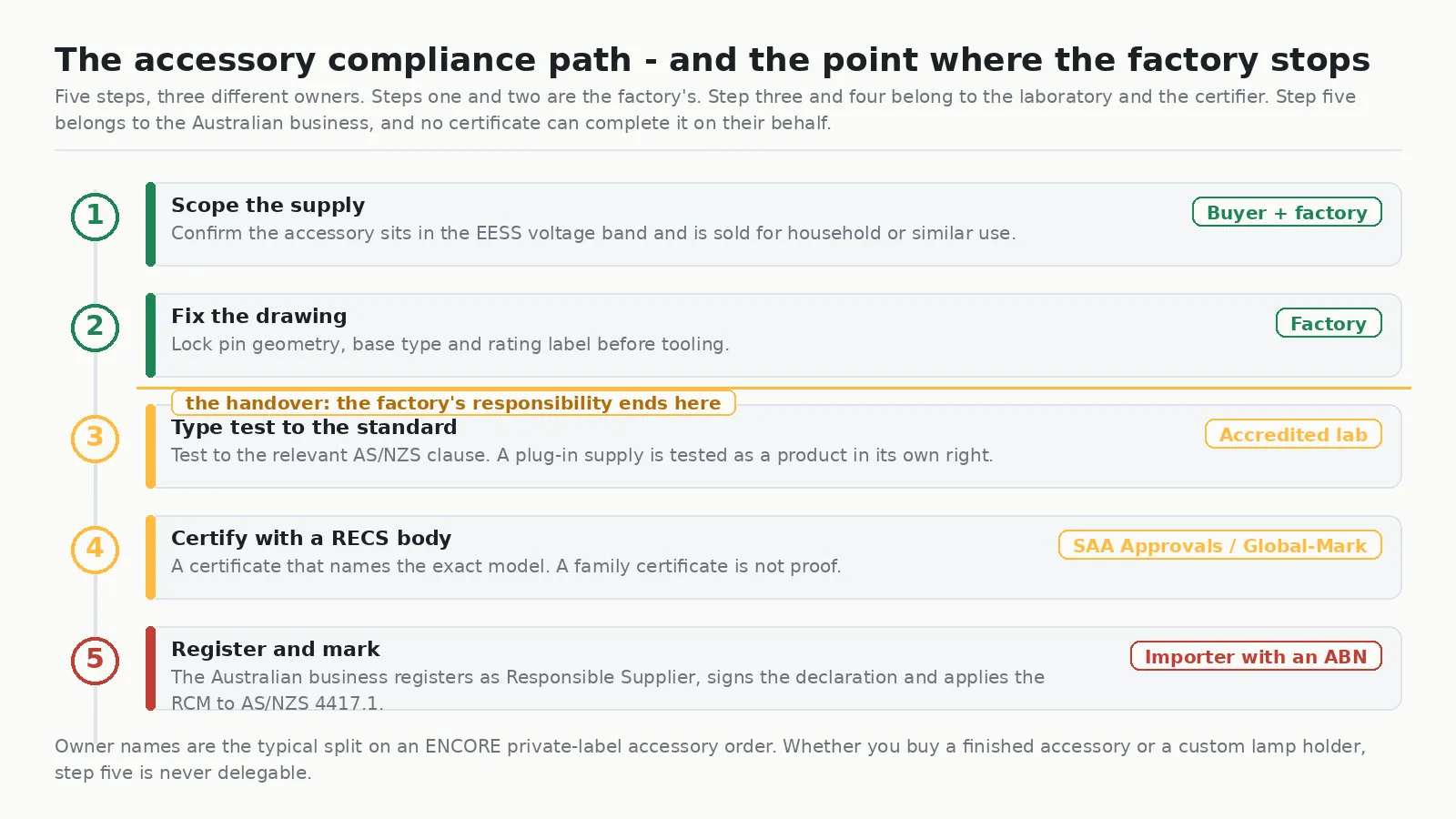
Two steps are worth calling out.
Fix the drawing before tooling. For an accessory, the drawing is the certification. Once the pin geometry, base type and cord set are locked, the test is largely a formality. Once the mould is cut, changing any of them means a new tool and a new certificate.
Register and mark in your own name. No certificate completes this step for you. It is the step that turns a compliant accessory into a sellable one.
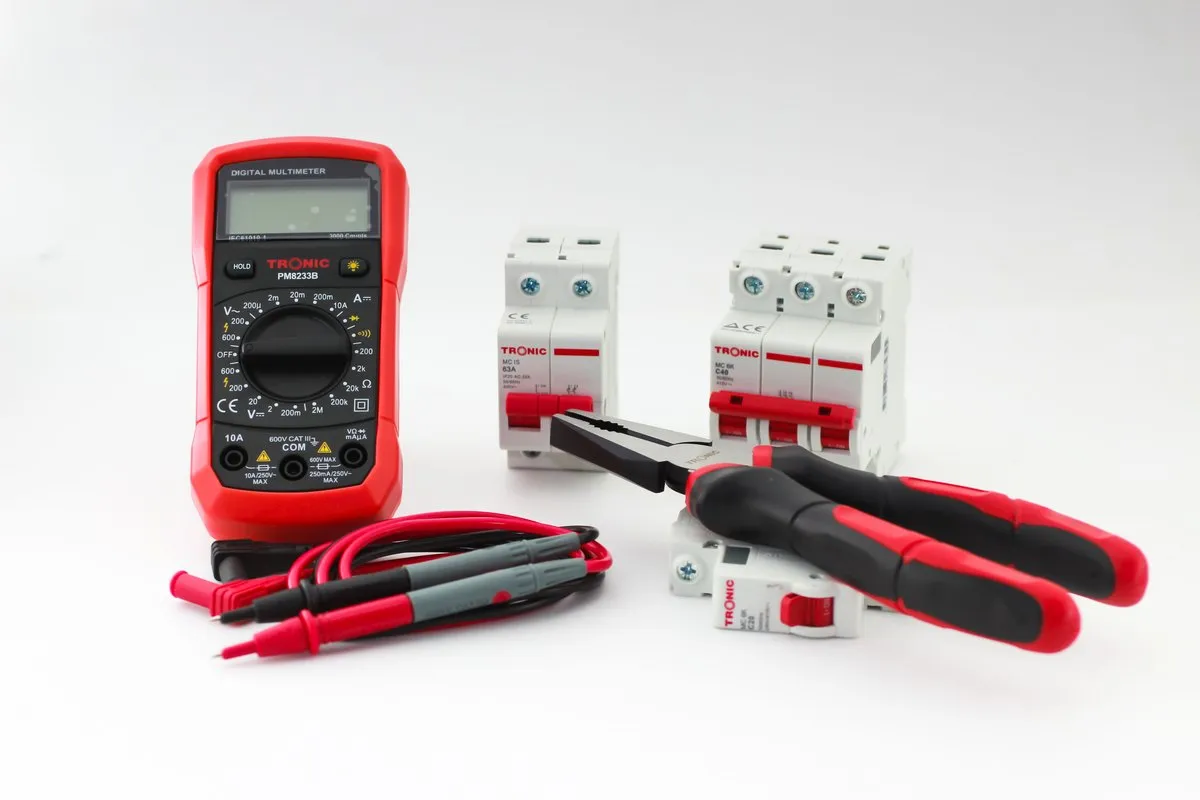
The four questions to put in an accessory RFQ
- Which AS/NZS standard and clause will this model be tested against?
- Does the certificate name this exact model number, or only a family?
- Is the mains interface built to the AS/NZS 3112 drawing, and can you send the pin drawing?
- Which RECS body will issue the certificate, and what is the model number as it will appear on it?
A supplier who answers all four in writing is a supplier who has done this before. A supplier who answers with a photo of a certificate on a wall has not.
Custom Lamp Holders and Adapters on ENCORE Systems
The accessory layer is where a lighting programme stops looking like a catalogue order and starts looking like a product line. A few of the pieces we build as custom or private-label parts:
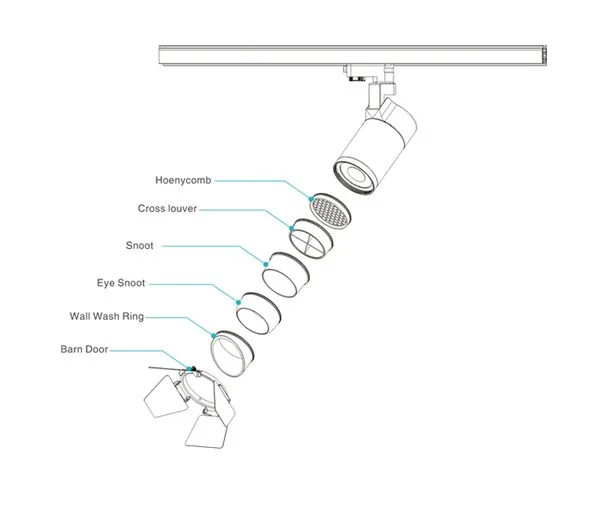
Optical accessories that attach to the front of the head — honeycomb, cross louver, snoot, eye snoot, wall-wash ring and barn door — each a separate moulding with its own tolerances:
Mounting adapters that let one head serve track, surface, wall and pendant positions without changing the optical body:
Anti-glare trim rings and adapter rings for our downlight families, in the baffle profile the project calls for:
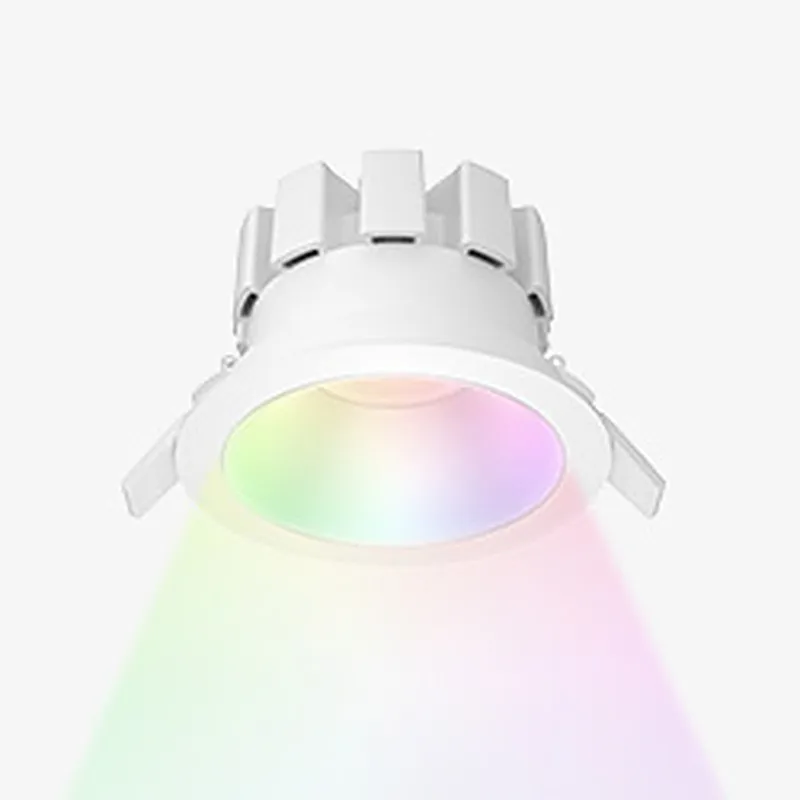
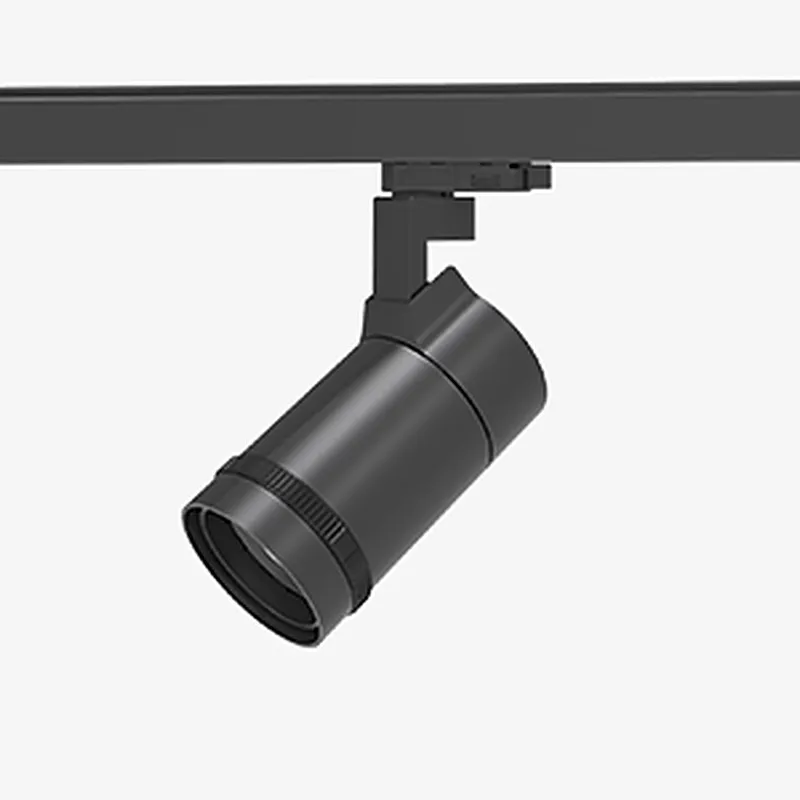
And the finished assemblies they attach to, which is where the accessory decision becomes visible:
If your programme needs an accessory to match a head that is already in production, our track lighting range, magnetic track systems, LED downlights and commercial luminaires pages list the families the accessory layer is built around. The compare series page is the quickest way to see which head takes which adapter.
For specifying the light these accessories carry, the beam angle calculator, CCT guide, CRI guide and UGR guide cover the photometric side, and the lux calculator sizes a layout before you commit to a rail plan.
What Arrives in Australia
Once the file is closed and the RCM is on the label, an accessory order travels the same chain as everything else — and the label is checked as carefully as the carton.
The arrival point is unglamorous and the failure mode is consistent. A container of perfectly good accessories is held because the model on the carton has no registration, or because the RCM on the label does not match the model on the certificate. Nothing is wrong with the product. The file is wrong.

FAQ — SAA and RCM Accessories for Australia
Do accessories need their own SAA certificate, separate from the luminaire?
Usually yes. A lamp holder, a track adapter and a plug-in power supply each present their own electrical characteristics. A plug-in power supply in particular is tested as a product in its own right and cannot be covered by the luminaire’s certificate. Where an accessory is supplied as an integral part of a certified luminaire, it may be covered by that assembly’s construction description — but only if it is named there.
Can I put the RCM mark on my accessory if I am the Australian brand?
Yes, once you have registered as the Responsible Supplier for that model in the EESS database and signed the Responsible Supplier Declaration. Applying the RCM is not a third-party service; it is an act the Responsible Supplier performs under AS/NZS 4417.1. Do it without the registration behind it and the mark is unsupported.
Is a universal travel adapter acceptable for an Australian product?
No. A universal travel adapter is designed for intermittent use by a traveller. It is not built to the AS/NZS 3112 drawing as a fixed component, it is generally not registered, and a certifier will not accept it as the mains interface of a registered model. Build the AU pin geometry into the product itself.
What is different about a custom SAA lamp holder with private label service?
Only the branding surfaces change. Your brand can go on the housing, the shade ring, the ceiling rose, the rating label and the carton. What does not change is the standard the lampholder is tested against, the pin and contact geometry, and the identity of the Responsible Supplier — which remains your Australian entity.
Which standard covers an LED power adapter sold into Australia?
It depends on the product, and the certificate has to name it. Attachment plugs and cord sets point back to AS/NZS 3112 for the interface. Where no specific Australian standard exists for the power supply category, AS/NZS 3820 is the safety baseline. The relevant standard plus AS/NZS 3820 applies at the lighter risk levels. Ask for the standard and clause in writing before you release tooling.
How long does certification take for an accessory?
Assume weeks, not days, and start before the mould is cut. Accessories generally test faster than luminaires because there are fewer variables, but the sequence is the same: lock the drawing, type test, assemble the file, lodge with a RECS body, then register and mark. A drawing change after tooling restarts the clock.
Can the factory register the model in the EESS database for me?
No. Registration is tied to the Responsible Supplier, who must be a legal entity under Australian or New Zealand law holding an ABN. A Chinese manufacturer cannot hold an ABN, so this step is always the importer’s. The factory’s job is to deliver a certificate that names the exact model you are importing.
Does changing the finish or colour of an accessory affect certification?
Cosmetic changes generally do not affect the electrical file, which is why private label on accessories is comparatively straightforward. Changes to the material of an insulating part, the wall thickness, the pin geometry or the conductor path are different: those can invalidate the certificate and have to be re-qualified.
The Short Version
An accessory sold into Australia is a product, not a spare part. The plug geometry is fixed by AS/NZS 3112 before any design decision is made. The lamp holder, the track adapter and the plug-in power supply each carry their own certification exposure, and the power supply carries the most because it is a product in its own right.
Private label on accessories is genuinely fast — the branding surfaces are yours, and the tooling cycle is short. But the certificate and the mark remain two separate things, and the second one requires an ABN that no factory can hold for you.
Buy the accessory to the AU drawing. Get the certificate to name the exact model. Finish the chain in your own name. That is the whole of it.
If you are specifying an accessory layer against a head that is already in production, send us the drawing and we will tell you what the file needs before the mould is cut.
- saa rcm power adapter for australia
- custom saa lamp holder with private label service
- SAA compliant accessories Australia
- RCM mark accessories
- AS/NZS 3112 plug
- custom lamp holder manufacturer
- private label power adapter
- LED track adapter Australia
- EESS responsible supplier accessories
- AU plug adapter OEM

ENCORE Lighting Team · ENCORE
LED Lighting Manufacturer & OEM/ODM Partner
The ENCORE engineering and sourcing team writes about LED track lighting, downlights, magnetic systems, certifications and OEM/ODM manufacturing for B2B buyers and specifiers.