· Sourcing & Quality · 18 min read

Written by ENCORE Lighting Team
LED Lighting Manufacturer & OEM/ODM Partner ·
LED Lighting Manufacturer: How to Vet a Factory Before You Send an RFQ
How to vet an LED lighting manufacturer before the RFQ leaves your desk: the nine checkpoints weighted by how much they change the outcome, the three-step evidence ladder, the payment milestones that match it, and the five replies that should slow you down.
Most sourcing conversations open with one sentence: “Please send us your best price.”
That sentence costs more than buyers think. The moment it leaves your desk, the supplier on the other side has learned something about you — whether you understand LED fixtures or are simply comparing line items, whether you have volume, and whether you have the engineering capacity to absorb the technical questions that arrive in month two.
You, meanwhile, have learned almost nothing. You do not know whether you are talking to a factory or a trading company. You do not know whether that ETL certificate names the model you intend to buy. You do not know whether “8 hours of aging” meant the fixtures were ever plugged in.
So the buyers who get this right treat the RFQ as the second thing they do. The first is a filter. This article is about that filter.
Before the RFQ you spend time. After the RFQ you spend money.
This is not a repeat of a factory inspection checklist. An inspection happens around a purchase order. This happens earlier — while you still have no order, and therefore still hold all the leverage.
Three Kinds of Supplier, and Why the Word Matters
The phrase led lighting manufacturer is used very loosely in this market. Behind the same English words sit at least three different things.
| Type | What they really are | What they claim | Tell-tale sign |
|---|---|---|---|
| True factory | Owns SMT lines, driver assembly, tooling and test equipment | Capacity, equipment lists, video walkthroughs | Can name machine models and quantities; lets you see the line |
| Trading house | No production of its own, re-routes orders to other plants | ”We have our own factory” | Quotes in an hour, an impossibly wide sample range, refuses a live look at the plant |
| Assembler | Only assembles; LEDs, drivers and moulds are all bought in | ”We can make anything” | Cannot answer optics, driver or tooling questions — everything routes to “our supplier” |
All three can do legitimate business. But only the first one puts your technical problems on an engineer’s desk.
A trading house is not automatically the wrong choice — it may be more flexible and closer to your market. What matters is that you know which one you are buying: negotiate trading-house prices with a trading house, and do not expect it to do your engineering.
Three questions that sort them out in ten minutes

Never ask “Are you a factory?” Nobody says no. Ask this instead:
- “Send me a photo of your production floor right now, with today’s newspaper in the frame.” A real plant can do it immediately.
- “How many SMT lines do you run, and what are the pick-and-place machine models?” Trading houses cannot name models.
- “Is the driver for this model in-house or bought in — and from whom?” Assemblers get vague here.
Nine Points to Check Before You Send an RFQ
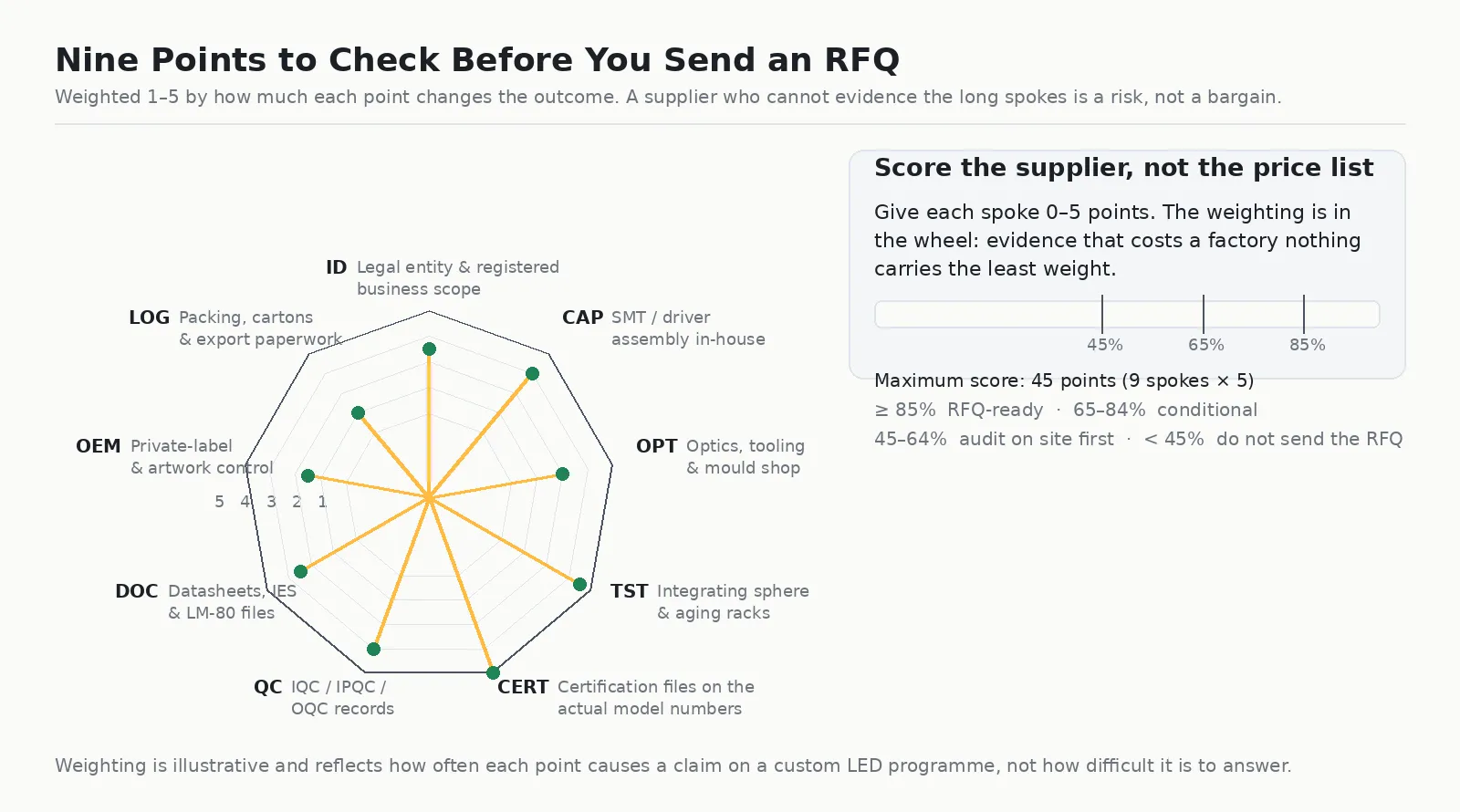
Weighted by how often each point actually causes a claim on a custom LED programme — not by how hard it is to answer.
Here is the core of the article. The nine points below are weighted by how much each one changes the outcome, not by how easy it is to answer. Maximum score: 45.
| Code | Checkpoint | Weight | How to score it 1–5 |
|---|---|---|---|
| CERT | Certification files cover your exact model | 5.0 | 5 = the report names your model number; 1 = you only ever received a cover page |
| TST | Integrating sphere and aging racks | 4.5 | 5 = own equipment plus test data; 1 = “we use a partner lab” |
| CAP | In-house SMT and driver assembly | 4.0 | 5 = own SMT and driver lines; 1 = everything outsourced |
| QC | IQC / IPQC / OQC records | 4.0 | 5 = sample records on request; 1 = “we have QC” with no paperwork |
| ID | Legal entity and registered business scope | 3.5 | 5 = scope includes luminaire manufacturing; 1 = trading or import-export only |
| DOC | Datasheets, IES and LM-80 files | 3.5 | 5 = full pack per model; 1 = a single marketing page |
| OPT | Optics, tooling and mould shop | 3.0 | 5 = mould shop on site; 1 = every new beam angle means an external tool |
| OEM | Private label and artwork control | 2.5 | 5 = documented rebrand SOP and retained samples; 1 = “we just stick a label on” |
| LOG | Packing, cartons and export paperwork | 2.0 | 5 = drop tests and barcode rules; 1 = cartons sourced at the last minute |
| Total | 32.0 | Maximum 45 |

Reading the score
- 85% and above (38+ points) — send the RFQ and run the normal process.
- 65–84% (29–37) — conditional. Close the gaps first, or you will argue about them later.
- 45–64% (20–28) — high risk. Audit on site or by video before you even ask for a price.
- Below 45% (under 20) — do not send the RFQ. You will spend the time on the wrong counterpart.
Note that the heaviest weight is CERT — certificate-to-model mapping — not price and not capacity. The reason is blunt: in this industry, a certificate that does not match the model is the most common and the most expensive failure mode. It never shows up at quotation stage. It shows up at customs, or at project handover, after the deposit has already gone.
Equally important: of these nine, only LOG and OEM are problems money can fix. The other seven take years to accumulate, and a trading house cannot buy them.
The Evidence Ladder: What to Ask For, and When
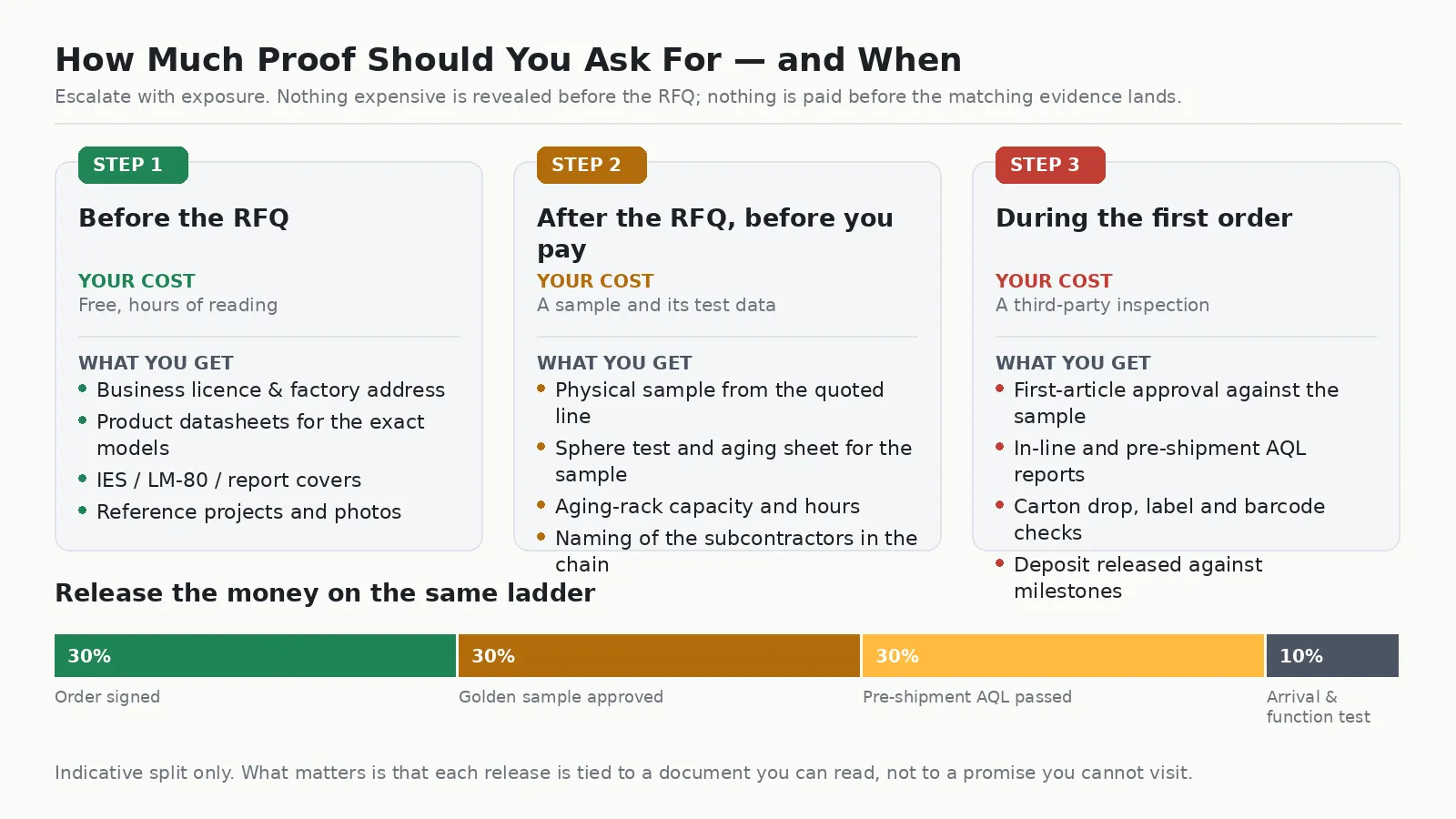
Indicative split only. What matters is that each release is tied to a document you can read, not to a promise you cannot visit.
Beginners make one of two mistakes: asking for “everything” up front, which gets ignored because you are not yet a customer, or ordering a sample immediately and receiving something that does not represent production.
The correct approach is to escalate with your exposure. You have not paid yet, so you should not be asking for expensive things. Once money is on the table, the matching evidence should appear.
Step 1 — Before the RFQ (your cost: a few hours of reading)
- Business licence and the actual production address (registered address is not the same thing)
- Product datasheets for your target models
- IES / LM-80 / report cover pages — at this stage a cover is enough
- Reference projects and installation photos
All of this is free. If a supplier will not hand over these, there is no conversation to have.
Step 2 — After the RFQ, before you pay (your cost: a sample and its test data)
- A physical sample taken from the line being quoted — not “our best model”
- Sphere test and aging sheet for that sample
- Aging-rack capacity and standard duration
- Names of the subcontractors in the chain
This step is the real divide. Note the wording: a sample from the quoted line. A large share of disputes start exactly here — the sample came from the showroom bench, production came from the line, and the two are not the same process state.
Step 3 — During the first order (your cost: one third-party inspection)
- First-article approval against the sealed sample
- In-line and pre-shipment AQL reports
- Carton drop, label and barcode verification
- Deposits released against milestones, not against the calendar
Let the money follow the same ladder
| Milestone | Share | The evidence behind it |
|---|---|---|
| Order signed | 30% | Drawings and specification frozen |
| Golden sample approved | 30% | Signed first-article report + retained unit |
| Pre-shipment AQL passed | 30% | Inspection report with data and photos |
| Arrival and function test | 10% | Your own incoming inspection |
The split is illustrative, not sacred. The principle is not: every release should point at a file you can read, not at a promise you cannot visit.
What a Complete RFQ Pack Looks Like
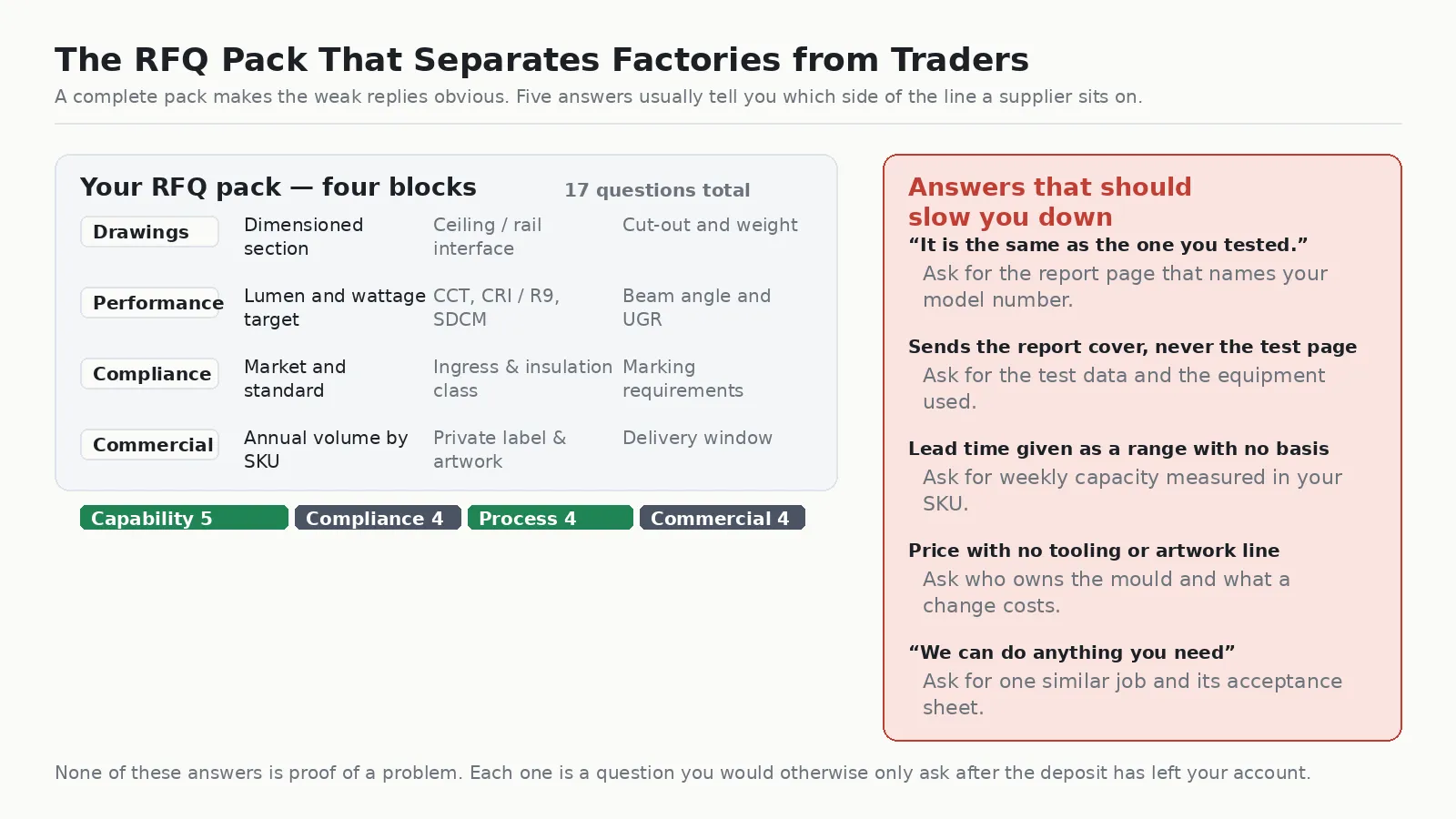
None of these answers is proof of a problem. Each one is a question you would otherwise only ask after the deposit has left your account.
The better your RFQ, the faster weak suppliers expose themselves. A vague reply is only safe in front of a vague question.
A complete pack contains four blocks and 17 questions:
- Drawings — dimensioned section, ceiling or rail interface, cut-out and total weight
- Performance — lumen and wattage targets (not ranges), CCT, CRI / R9, SDCM, beam angle and UGR
- Compliance — target market and applicable standard, ingress and insulation class, marking and nameplate requirements
- Commercial — annual volume by SKU, private-label and artwork ownership, delivery window
Question distribution: capability 5, compliance 4, process 4, commercial 4.
Five replies that should slow you down
- “It is the same as the one you tested.” → Ask for the report page that names your model number.
- The report cover arrives, never the test page. → Ask for the test data and the equipment used.
- Lead time given as a range with no basis. → Ask for weekly capacity measured in your SKU.
- A price with no tooling or artwork line. → Ask who owns the mould and what a change costs.
- “We can do anything you need.” → Ask for one similar job and its acceptance sheet.
Certification: Do Not Stop at the Image

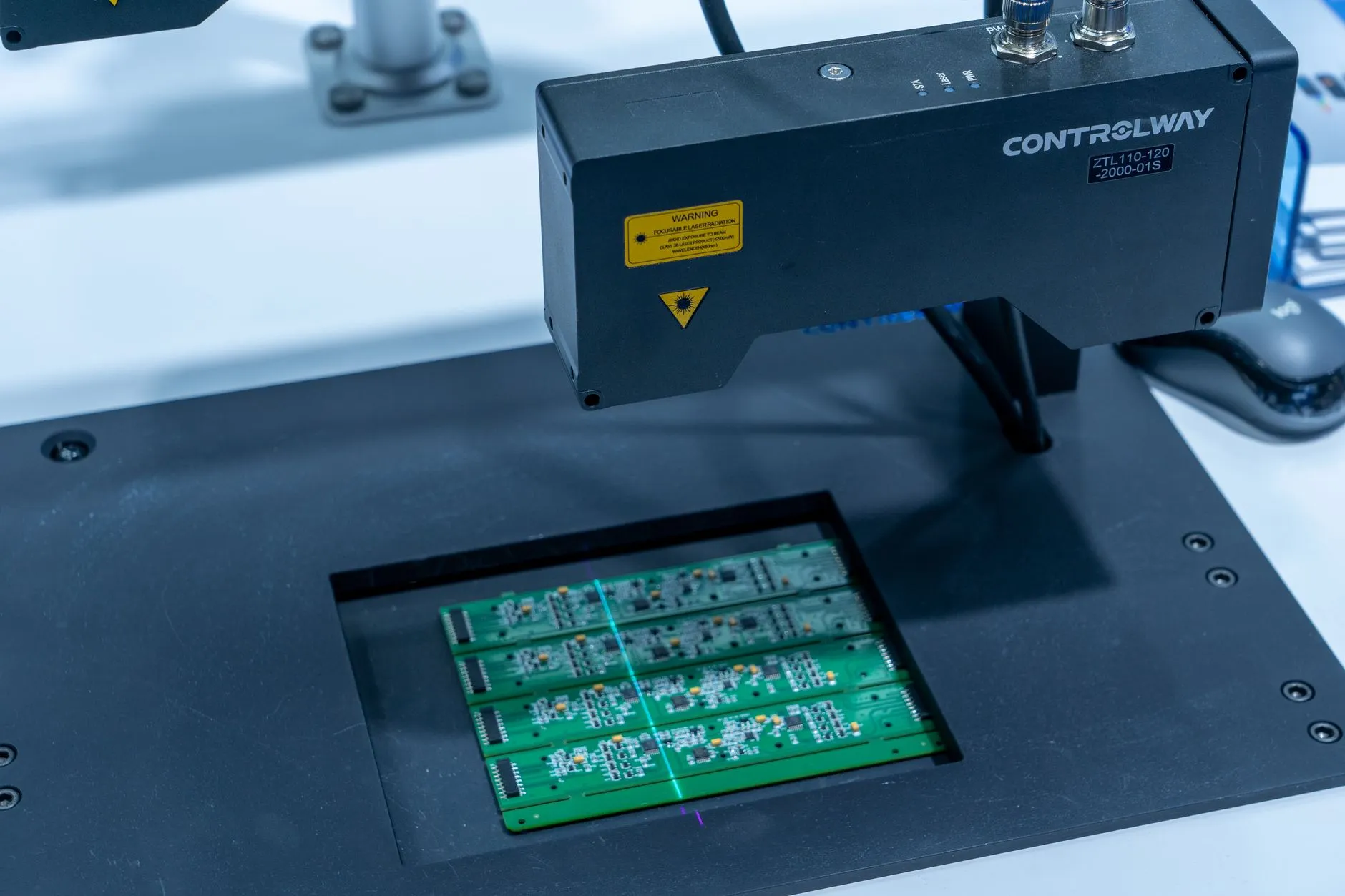
This is the highest-weighted of the nine checkpoints, and it deserves its own section. Three things must be verified.
- Model mapping. Does the report’s model list contain the part number you are buying? It is perfectly normal for several models in one family to share a report — but the list has to be in the report, not written on afterwards.
- Certificate holder. Who holds it — the factory itself, or a trading company? If it is a trading company, then in compliance terms your product is not tied to this plant at all.
- The test pages. Test items, testing body, test date, equipment used. A “certificate” that never goes past the cover is worth nothing at customs.
And the misconception that causes the most damage: “We are ETL certified” is not the same as “the model you want is ETL listed.” The first is a capability. The second is a document. You are paying for the document.
Full certificate sets and model cross-reference tables live in our certifications library; the market-by-market logic is unpacked in the ETL certification guide.
What a Factory Reveals on the Floor

If you do a site visit or a video walkthrough, do not follow the tour route. Follow the evidence route. Four places tell you almost everything.
1. Incoming area (IQC). Look for inspection records and, more importantly, a quarantine zone. A plant with no quarantine area mixes rejects and good stock in the same bins.
2. The line (IPQC). Is there a sealed, signed first-article unit at the start of the line? Is there an SOP at the workstation, or does the operator work from memory?
3. The aging area (TST). Are the racks actually running? Are there position logs? Then ask one question: “How many hours has the batch on the rack right now been running?” If nobody can answer, the aging is decoration.
4. Outgoing area (OQC). Was the inspection report filled in today, or printed in advance? Are the carton labels and barcodes built to the customer’s rule?


How we run those four areas day to day is documented in our quality control process.
Doing It Remotely

No China team, no flight booked — you can still get seven-tenths of the way there. Work in this order:
- Live video call, camera pointing at equipment and record books. Not a edited marketing film. Ask them to walk and talk.
- Have them flip through today’s production and aging logs on camera. Dates must be legible.
- Run one blind sample test. You pick the model, they ship the sample, you send it to a third-party lab and compare against the report they gave you.
- Use an inspection agency for the pre-shipment inspection on the first order. It costs a fraction of a bad first order.
What remote work cannot give you is feel: how tidy the plant is, how competent the operators look, how fast management reacts. Those need one visit.
The 30-Day Plan
| Week | Action | Output |
|---|---|---|
| Week 1 | Score candidate factories on the nine checkpoints; cut the list to three | Score sheet |
| Week 2 | Video walkthrough; request Step 1 of the evidence ladder | Video record + document pack |
| Week 3 | Verify certificate-to-model mapping; send the RFQ pack; request samples | Verification notes + quotations |
| Week 4 | Blind sample test; compare quotes; agree the payment milestone terms | Comparison table + contract clauses |
Do not release a deposit before the end of week four.
What an LED Lighting Manufacturer That Stands Up to Vetting Looks Like
Read every standard above backwards and you have our working day:
- One report per model — we issue a certificate-to-model cross-reference table, not a cover page for you to guess from.
- In-house SMT, drivers and aging — technical questions land on an engineer instead of a sales desk.
- 100% aging — not a few units lit up, but the whole batch on the racks for the full duration, with logs.
- First-article report and sealed sample — before mass production starts, “correct” is written down and signed.
- A rebrand SOP — your brand stays yours, and mould ownership and change costs are stated in the quotation.
We build LED track lighting, LED downlights, magnetic track systems and commercial luminaires, with OEM/ODM customization and a documented quality control process behind every order.

FAQ
Is it worth spending days on this before the RFQ? Yes. A bad first order does not cost you one order — it costs six months and a round of recertification.
A factory will not share the test pages of its certificate. Is that normal? No. Sharing the pages covering your model carries no risk for a legitimate factory. The usual reason for refusing is that the report does not cover your model.
Are trading companies always a bad idea? No. They can be more flexible. But know whether you are buying a service or buying capacity, and price accordingly.
Should I pay for samples? Usually yes. Ask instead that the sample cost be deducted from the production invoice. Suppliers who accept that clause tend to be real factories.
Does a remote walkthrough actually work? Yes — it filters out roughly seven or eight of ten risks. The remainder needs one visit or one third-party inspection.
Can the payment milestone percentages be negotiated? The percentages can. The principle — every release tied to a document — cannot.
How big should the first order be? Small enough that it cannot hurt you, large enough that the factory schedules it properly. Typically a partial container of a single SKU.
How do I know the quoted capacity is real? Ask how many units of that model they made last week. Weekly capacity is a verifiable number; annual capacity is not.
Conclusion

An RFQ is not the first step of sourcing. It is the second.
The first step is knowing who you are talking to. The second is asking the nine questions that matter. The third is tying your money to evidence instead of to a calendar.
Once those are done, the number on the quotation finally means something.
Vetting before the RFQ is a hundred times cheaper than verifying after the goods arrive.
- led lighting manufacturer
- led lighting manufacturer factory audit
- vet a lighting factory
- rfq led lighting
- led factory audit before rfq
- china led lighting manufacturer
- how to check led factory
- lighting supplier vetting checklist

ENCORE Lighting Team · ENCORE
LED Lighting Manufacturer & OEM/ODM Partner
The ENCORE engineering and sourcing team writes about LED track lighting, downlights, magnetic systems, certifications and OEM/ODM manufacturing for B2B buyers and specifiers.