· Custom & OEM Lighting · 20 min read
Written by our factory
OEM Lighting Team ·
LED String and Fairy Lights OEM: Customization Options
What a private label string-light programme can change, what it costs to switch on, and where the electrical limits sit: SPT-2 ampacity and real run lengths, the 80% rule, IP44 versus IP67 seals, and the eight marks a carton must carry before it clears customs.
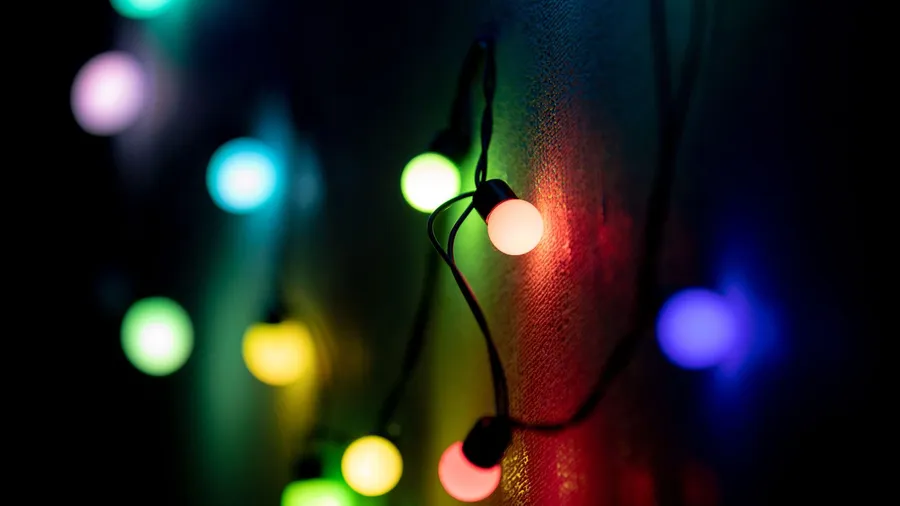
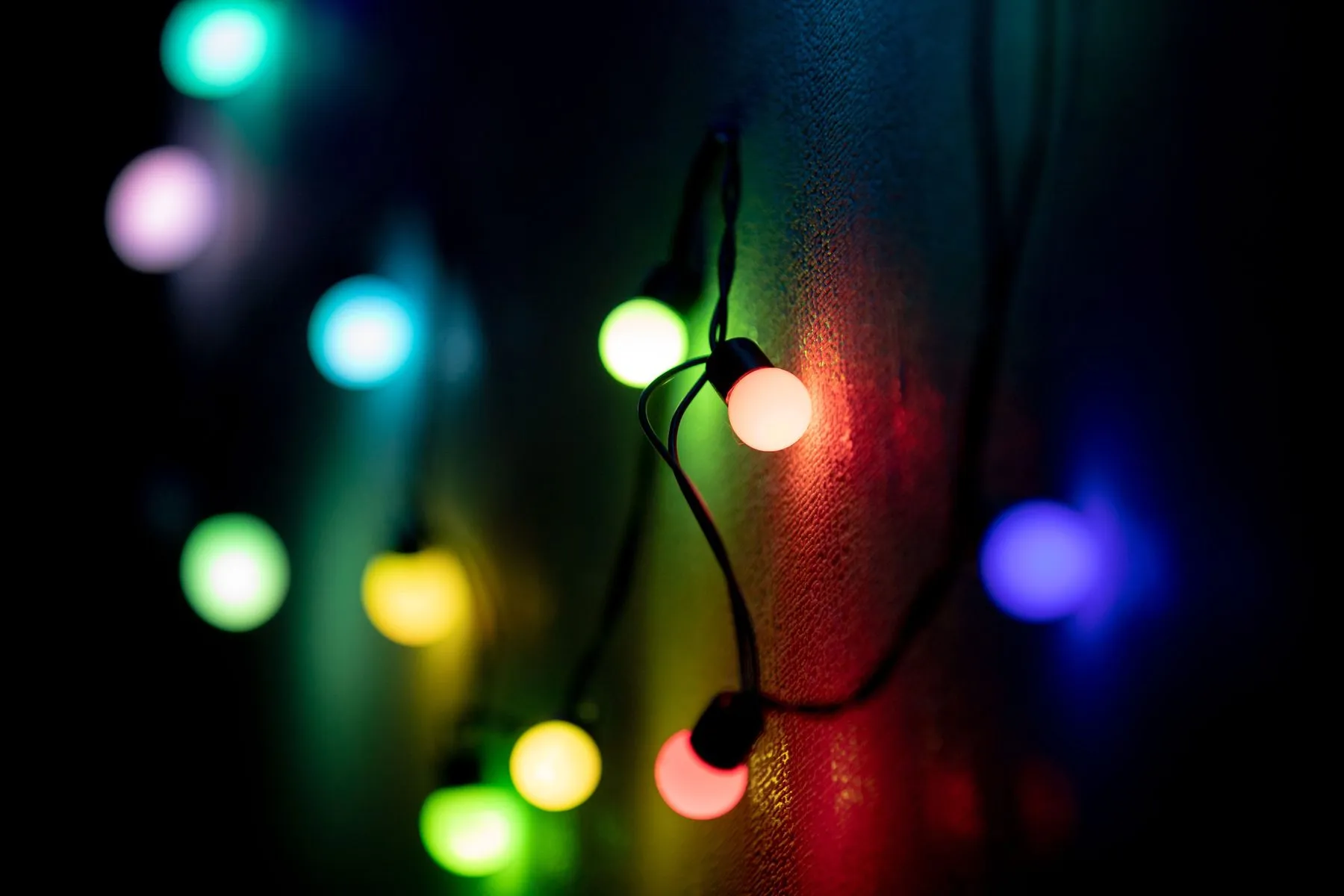
An LED string lights OEM programme can change five layers of the product: what the bulb looks like, how long the run is and how far apart the bulbs sit, what colour the light is, how the set is protected from weather, and what is printed on the carton. Of those five, the first and the last are almost free. The middle three are where quotes diverge, timelines slip and shipments get refused at the border.
This page is written for the brand owner or sourcing manager placing a first or second order — the person who has to explain to a factory what “our version” means, and then defend it to a buyer, a retailer or a customs broker.
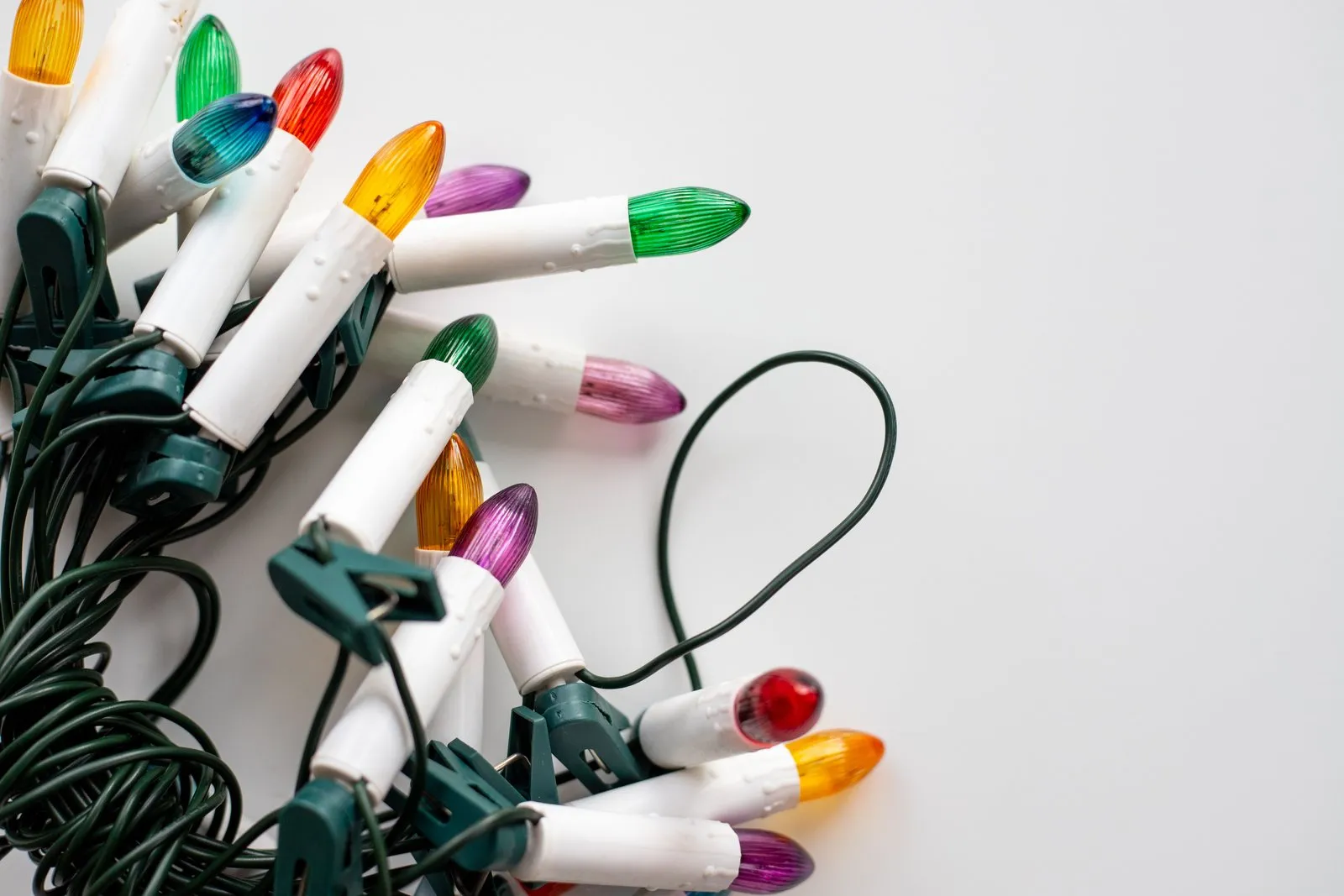
A standard C9 set, photographed flat. Nearly everything a brand can change about a string of lights happens inside this frame: the bulb, the socket, the wire, the spacing, the plug.
The word “fairy lights” is hiding four different products
The same search term covers four product families that are engineered differently, certified differently and priced differently. Say which one you mean before you ask for a quotation, or you will get the price of the cheapest one.
| Family | Typical product | Voltage | Where it lives | What decides the design |
|---|---|---|---|---|
| Mini / fairy | 0.06 W LEDs on 2.5–3 mm cable, 20–100 lights | Battery, USB or low-voltage adapter | Indoors, tabletop, floristry, photo sets | Battery life and cable softness |
| C7 / C9 | E12 or E17 socket, 0.6–2 W LED | 120 V (US) / 230 V (EU) | Rooflines, awnings, market stalls | Ampacity of the wire, UL 588 detail |
| Commercial festoon | S14 lamps on black rubber cable, 15 m–30 m runs | 120 V or 24 V | Patios, beer gardens, hospitality | Drop, impact, water ingress, load per run |
| Permanent / architectural | Extruded profile with an LED tape inside | 24 V, constant voltage | Facades, eaves, coves, signage | CRI, dot-free diffusion, driver placement |
This article’s centre of gravity is the second and third rows: the mains-voltage string that a brand prints its name on and a retailer puts on a shelf. The first row is a different business, and the fourth is covered in OEM linear lighting.
What OEM, ODM and private label actually mean here
Three sentences, because the words are used interchangeably in sales emails and are not interchangeable in a purchase order.
- ODM — the factory already designed, tooled and certified the set. You choose from a menu (length, colour, spacing, packing) and put your brand on it. Fastest, lowest entry volume, and the certificate belongs to the factory’s model.
- OEM — you bring the specification or the drawing. Bulb shape, cap mould, wire colour, plug, controller and packaging can all be yours, and the certificate should name your model rather than the factory’s catalogue number.
- Private label — the commercial layer: your label, your carton, your barcode, your manual. It sits on top of either model. It is also the cheapest layer to change and the one most first orders should start with.
The practical consequence of OEM is money and time spent before the first saleable unit exists: a bulb cap mould, a plug insert, a technical file that names your article. If that cost cannot be spread over a few thousand units a year, ODM plus private label is the honest answer. The full comparison of the two models, including who owns the tooling and who owns the file, is in ODM vs OEM LED lighting; the manufacturing model ladder for decorative programmes is in ODM decorative lighting factory.
The five layers you can customise
1. Bulb, base and socket
The bulb shape sets the silhouette a customer recognises: globe (G45/G50), teardrop C7, faceted C9, Edison-style S14, or a moulded novelty shape. Modern C9 bulbs use a plastic lens over an SMD LED, so the colour comes from the lens and phosphor rather than from dipped glass. That is good news for customisation and bad news for consistency: two lens batches can read as two different shades of red.
Ask for socket temperature data if the set is rated above 1 W per bulb. A ceramic or high-temperature plastic lampholder costs cents more and removes the most common field failure in high-wattage decorative strings.
2. Wire, spacing and run length
This is the layer buyers underestimate. Spacing (the distance between sockets) decides how the set reads on a building: 4 in / 100 mm looks dense and “fairground”, 12 in / 300 mm looks sparse and architectural. Most programmes run 6 in / 150 mm because it splits the difference and keeps the bulb count per metre affordable.
Wire colour is a small decision with an outsized visual effect: black disappears against a dark facade, green disappears against foliage, white disappears against a pergola, clear vanishes on almost everything in daylight and looks like nothing at night until the first bulb lights.
Run length is not free-form. It is bounded by the ampacity of the conductor, which is the subject of the next section.
3. Colour temperature and colour consistency
Warm white sells best in hospitality and residential resale; 2200–2700 K reads as candlelight on a pergola. Retail display and cold climates often ask for 3000–4000 K. For colour sets, the number that matters is not the colour list but the batch consistency: ask what ΔE tolerance the factory holds between bulbs in the same set, and whether the lens tool is shared between orders.
If the programme has to match an existing installation — a hotel that refurbishes floor by floor, or a chain that reorders each season — the colour target must be written into the specification as a measured value (CCT and Δuv), not as a name on a swatch.
4. Water and dust protection
Two ratings cover almost every string on the market. IP44 means splash-resistant: rain on an awning is survivable, a puddle is not. IP67 means the set survives immersion to a stated depth for a stated time, which is what outdoor permanent installation in wet climates actually needs.
The gap between the two is not the bulb. It is the seal: a gasketed socket, a moulded (not screw-together) connector, an O-ring at every joint, and a cap on the tail end. Ask for the seal to be shown in a photograph at the socket and at the connector; a supplier who only sends a certificate and no seal photo has not demonstrated anything.
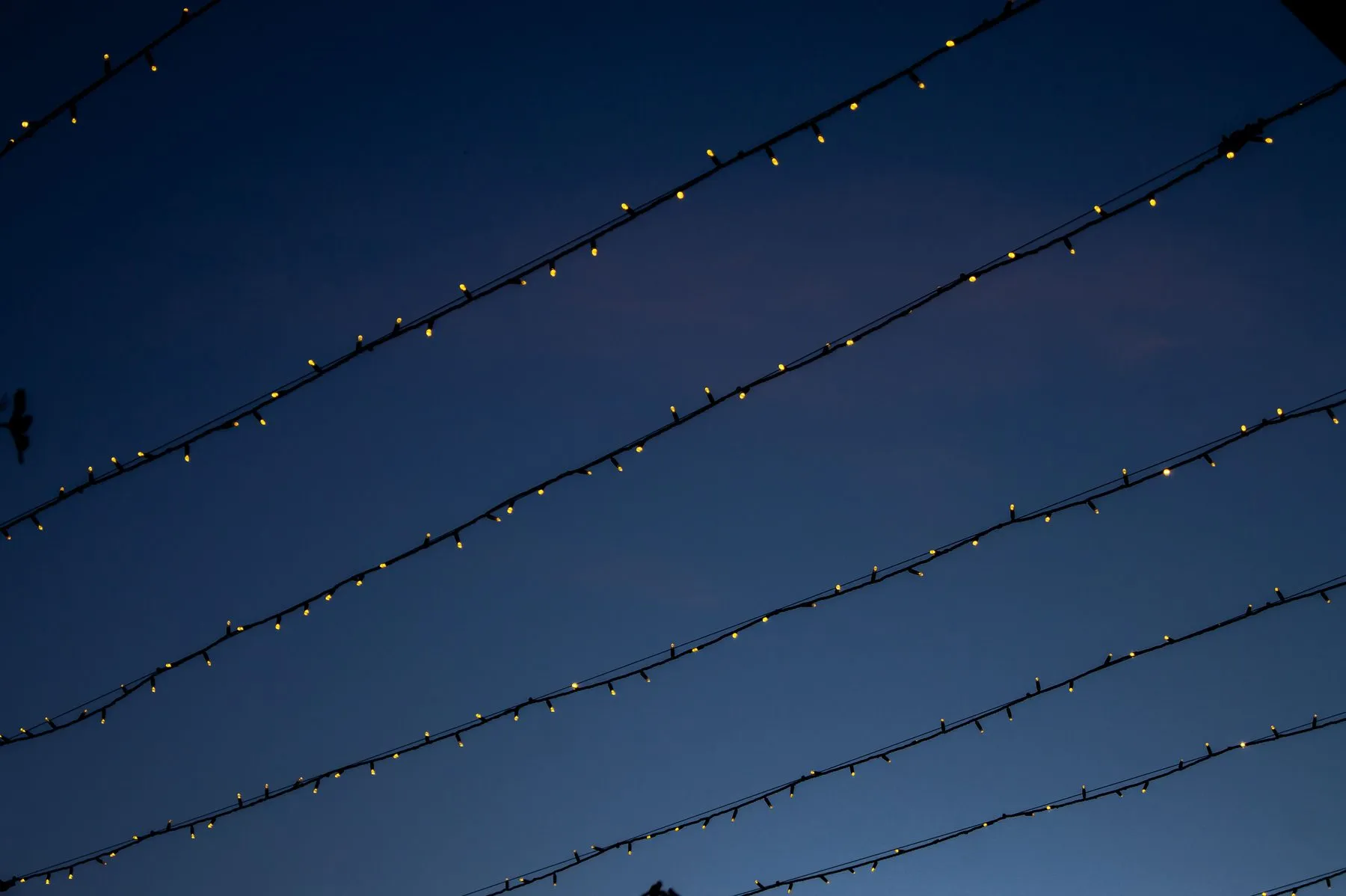
Hospitality is the category where a string’s engineering shows: continuous duty, weather, and a brand that will not tolerate a dark section in the middle of a terrace season.
5. Controls, connector and packaging
Dimming, app control, music sync and scheduling are all available at 24 V and, with more effort, at mains voltage. Each one moves the product from a passive string to an electrical appliance with firmware, which changes the compliance route — EMC testing, FCC Part 15, and in the EU a radio equipment assessment if there is a radio. Say the word “smart” early, not after the sample is approved.
The connector is boring and commercially important: a proprietary moulded connector locks the customer to your catalogue, a standard one lets them extend the set themselves. Neither is wrong, but the decision should be deliberate.
Packaging is the cheapest place to be different. A printed sleeve, a window box, a reusable spool and a branded manual all cost single-digit cents per unit at volume, and they change how the product is photographed, shelved and gifted.
What each layer costs to switch on
No factory can quote “a customised string of lights” because the price lives in the setup, not in the bill of materials. The figure below separates the two: what it costs once, and the order size it has to be spread over.
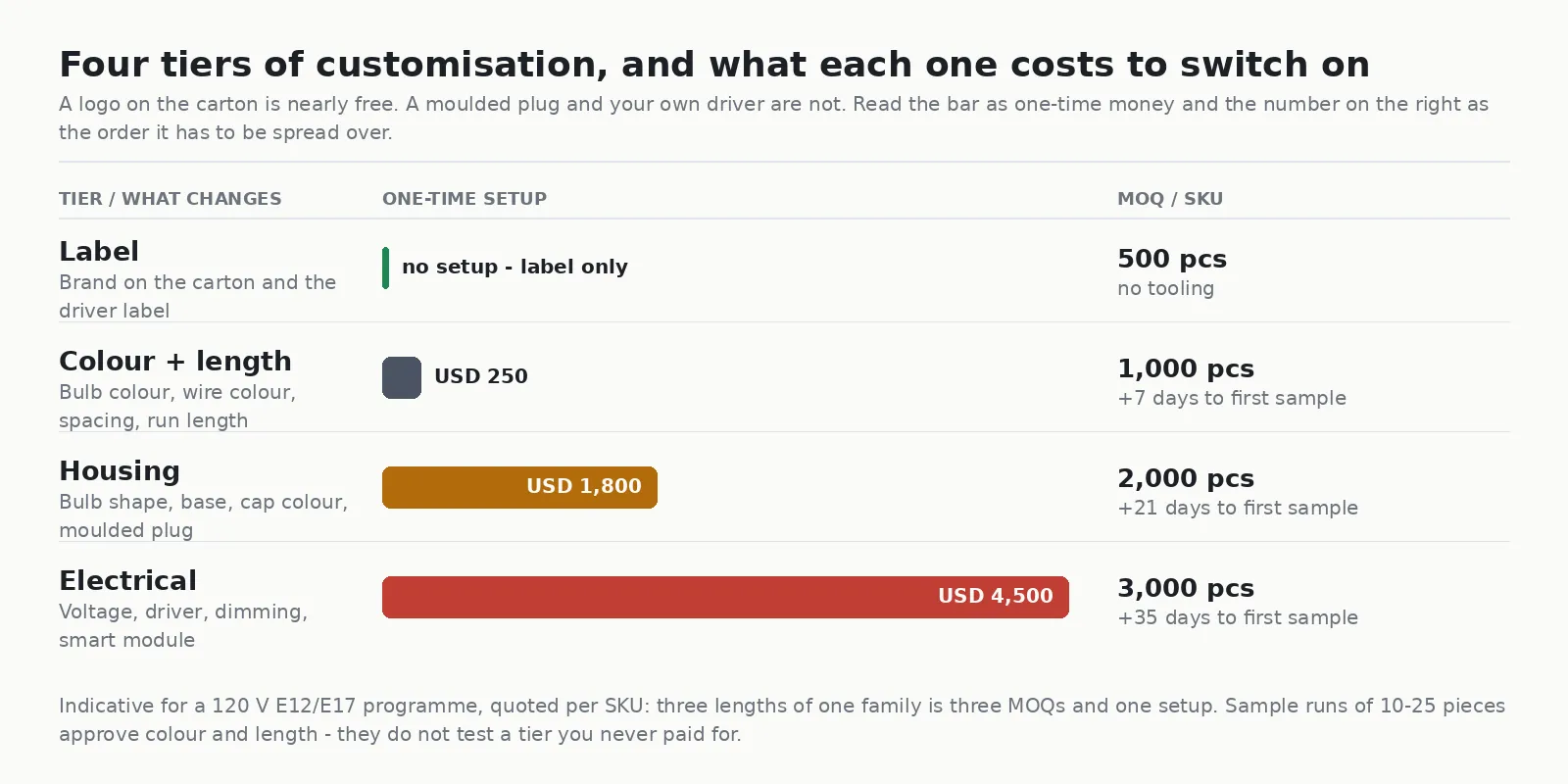
Read it as four gates rather than four prices.
Label. A carton sleeve, a barcode and a brand on the driver label. No tooling, smallest MOQ, no extra days. A first order should almost always start here, even if the plan is to go deeper on the second.
Colour and length. New spacing, new run length, a different wire or bulb colour. Setup is a cutter and a fixture change plus a sample run, which is why this tier is cheap but adds a week.
Housing. A new bulb shape, cap mould, socket or moulded plug. This is where real money starts, and where lead time jumps: a cap tool is weeks before any sample exists, and the certification route usually has to be restarted because the article changed.
Electrical. Different voltage, a new driver, dimming or a smart module. The most expensive and the slowest, because the article, the driver supplier’s minimum and the EMC file all move at once.
Two arithmetic habits keep this honest. First, setup is per SKU, not per family — three lengths of the same bulb is three MOQs and one tooling bill. Second, the sample is not the product: a 10-piece sample run at $250 setup is roughly $25 of setup per unit, which is fine for approval and meaningless as a unit cost. Amortise over the first production order, not over the sample.
The electrical limit: why your run length is not a design choice
A string of lights is one long conductor with a chain of loads hanging off it. The bulbs at the far end run on the same two wires as the bulbs at the plug, so the copper near the plug carries every bulb’s current. That is the whole reason run length has a ceiling.
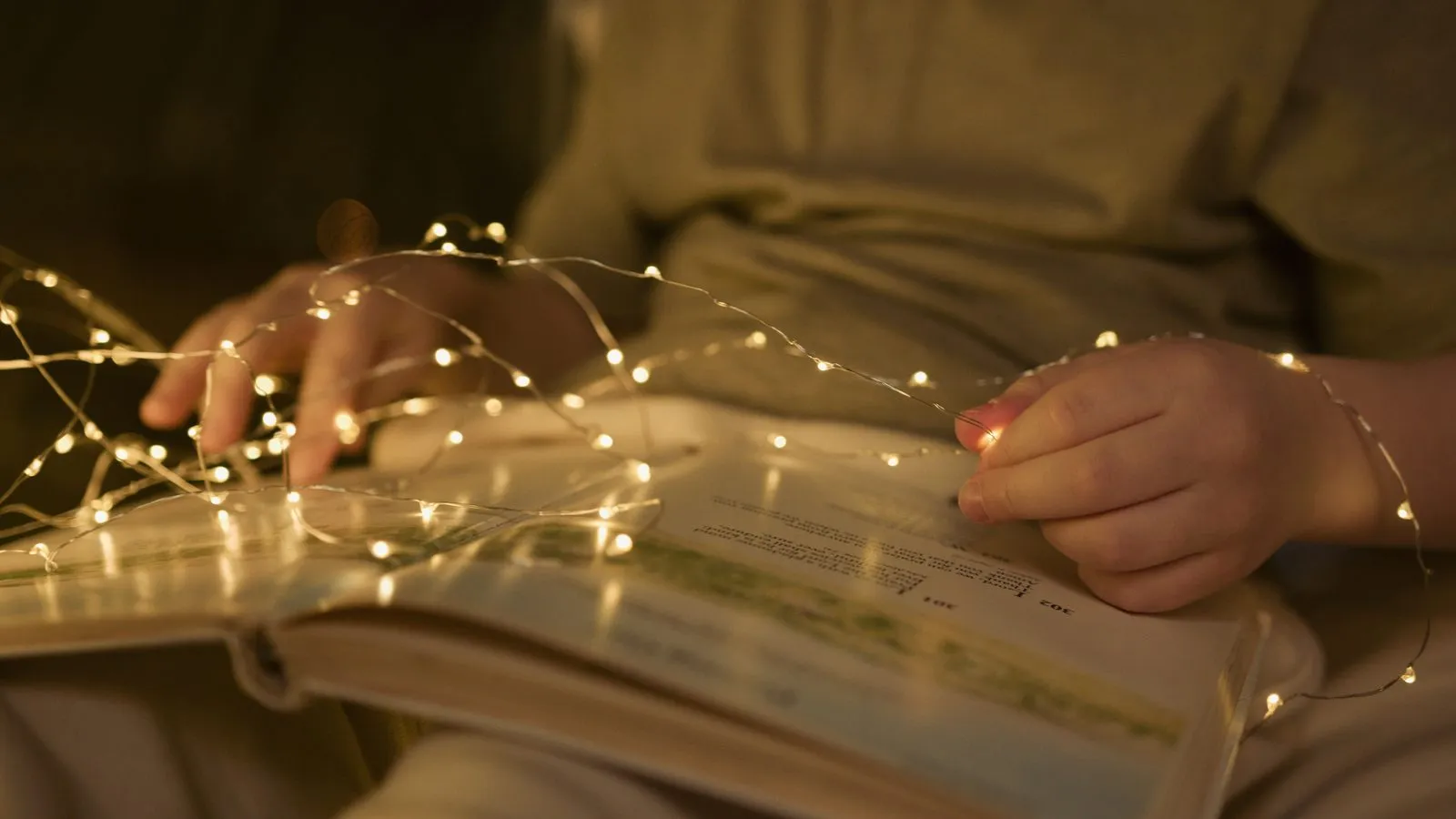
The mini family: 0.06 W per point, thin cable, a few hundred points to a battery pack — and the same ampacity arithmetic applies, just at a much smaller scale.
Take the US wire table used for seasonal lighting, and apply the 80% continuous-load derating that a string of lights, on for hours, deserves:
| Wire | Nominal ampacity | 80% continuous | At 120 V |
|---|---|---|---|
| SPT-1, 18 AWG | 7 A | 5.6 A | ~672 W |
| SPT-2, 18 AWG | 10 A | 8.0 A | ~960 W |
| SPT-1, 16 AWG | 13 A | 10.4 A | ~1,248 W |
| SPT-2, 16 AWG | 15 A | 12.0 A | ~1,440 W |
Now put real bulbs on it. Working with SPT-2 18 AWG — the common commercial choice — and adding 10% for connector and splice losses:
| Bulb | Watts each | Max bulbs per plugged run | Wattage at the plug |
|---|---|---|---|
| S14 filament | 2.0 W | ~427 | ~854 W |
| C9 LED | 1.0 W | ~876 | ~876 W |
| C9 LED | 0.8 W | ~1,085 | ~868 W |
| C7 LED | 0.6 W | ~1,454 | ~872 W |
| Mini LED | 0.06 W | ~14,545 | ~873 W |
Two things fall out of that table, and both are routinely got wrong.
A cheap LED bulb does not double your run length. The wattage ceiling stays roughly where the wire puts it; going from 1 W to 0.6 W buys about 65% more bulbs, not an unlimited string. The limit is copper, not the light source.
Long runs are made by dividing, not extending. A 300 ft perimeter is not one set. It is several sets, each with its own plug, each within its ampacity, joined physically but not electrically. Ask the factory for the maximum connected length of the specific SKU — bulb, spacing and wire included — and put that number on the carton, because the person installing it will chain two sets together if nobody tells them not to.
The same logic runs the other way on 230 V markets: current is lower for the same wattage, so more bulbs fit a run, and the fuse in the plug becomes the real limit. A supplier who quotes you one maximum-run number for both 120 V and 230 V has not understood the question.
The marks, and which ones are not the factory’s to give
A string of lights ends in a lampholder at mains voltage. Every market treats it as an appliance, not a decoration, and each market wants a different paper.
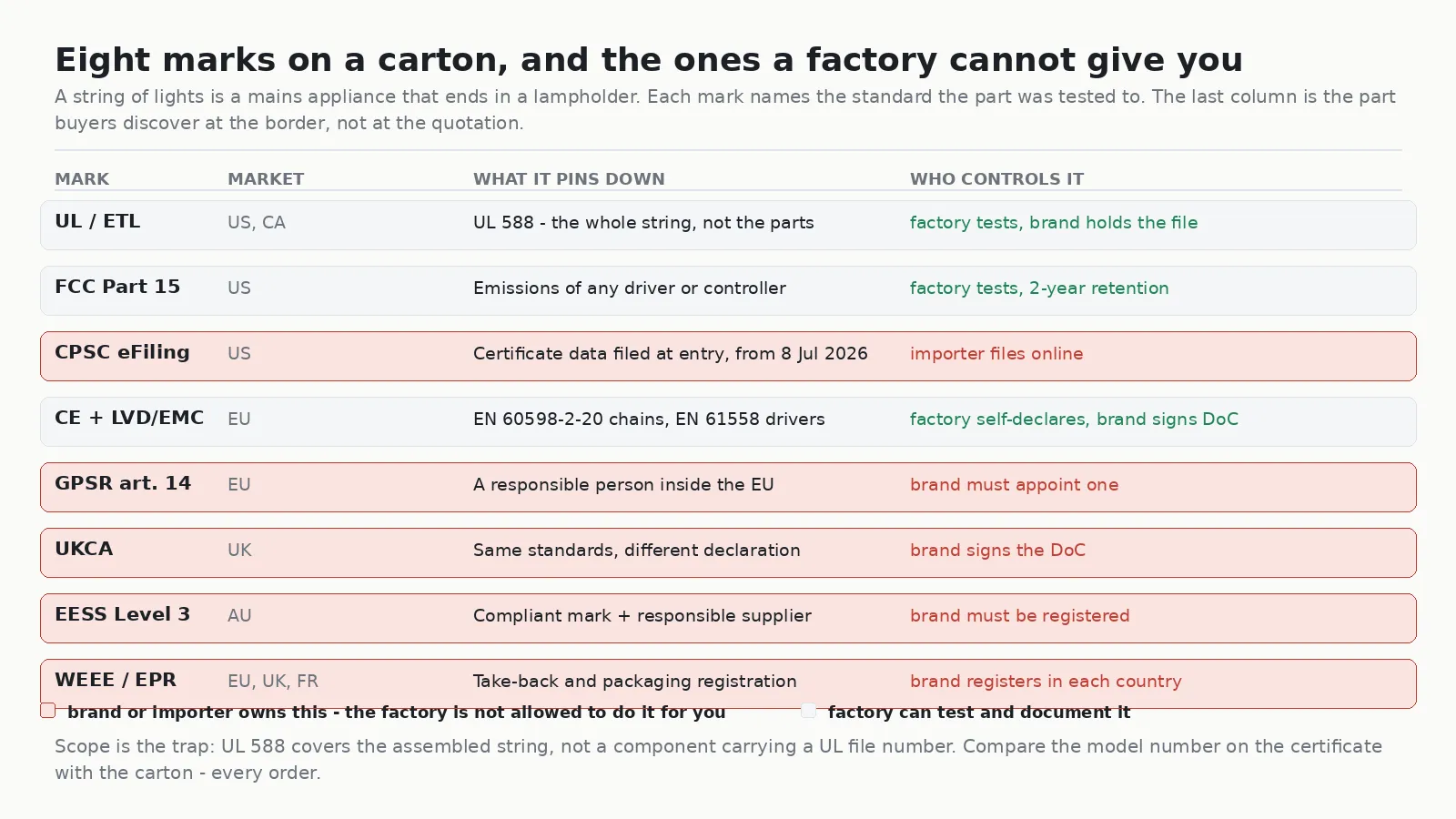
The column that surprises first-time importers is the last one. A factory can test, document and declare. It cannot appoint your EU responsible person, register as the Australian responsible supplier, register your packaging in France, or file your US entry data. Those are importer obligations, and a quotation that implies otherwise is a quotation with a gap in it.
For the US and EU document chains in full — including what a UL 588 report covers and what it does not — see Christmas lights certification. For the factory-floor evidence behind the claims, see what OEM buyers should check.
Where private label string lights actually sell
The specification should follow the shelf, not the catalogue. Four channels, four different answers.
Hospitality and outdoor dining. Long runs, warm white, IP44 minimum and usually IP65 at the connector, dimmable, and a commercial-grade cable that survives a pressure washer. The failure mode is not dead bulbs — it is a section going dark mid-season.
Retail and display. Spacing and colour consistency matter more than run length, because the string is photographed against the product. Neon-style and shaped bulbs are the store-design favourites; this is also where a metal frame with a string wrapped around it becomes part of the purchase order.
Events and wedding venues. Volume, portability and battery products dominate; the buyer is a venue or a rental company, so the same set is bought again and again and the brand on the box matters more than the brand on the wire.
Hospitality permanent install and facades. This is where a string leaves the consumer market and becomes an architectural product with a driver, a control protocol, and a warranty measured in years rather than seasons.
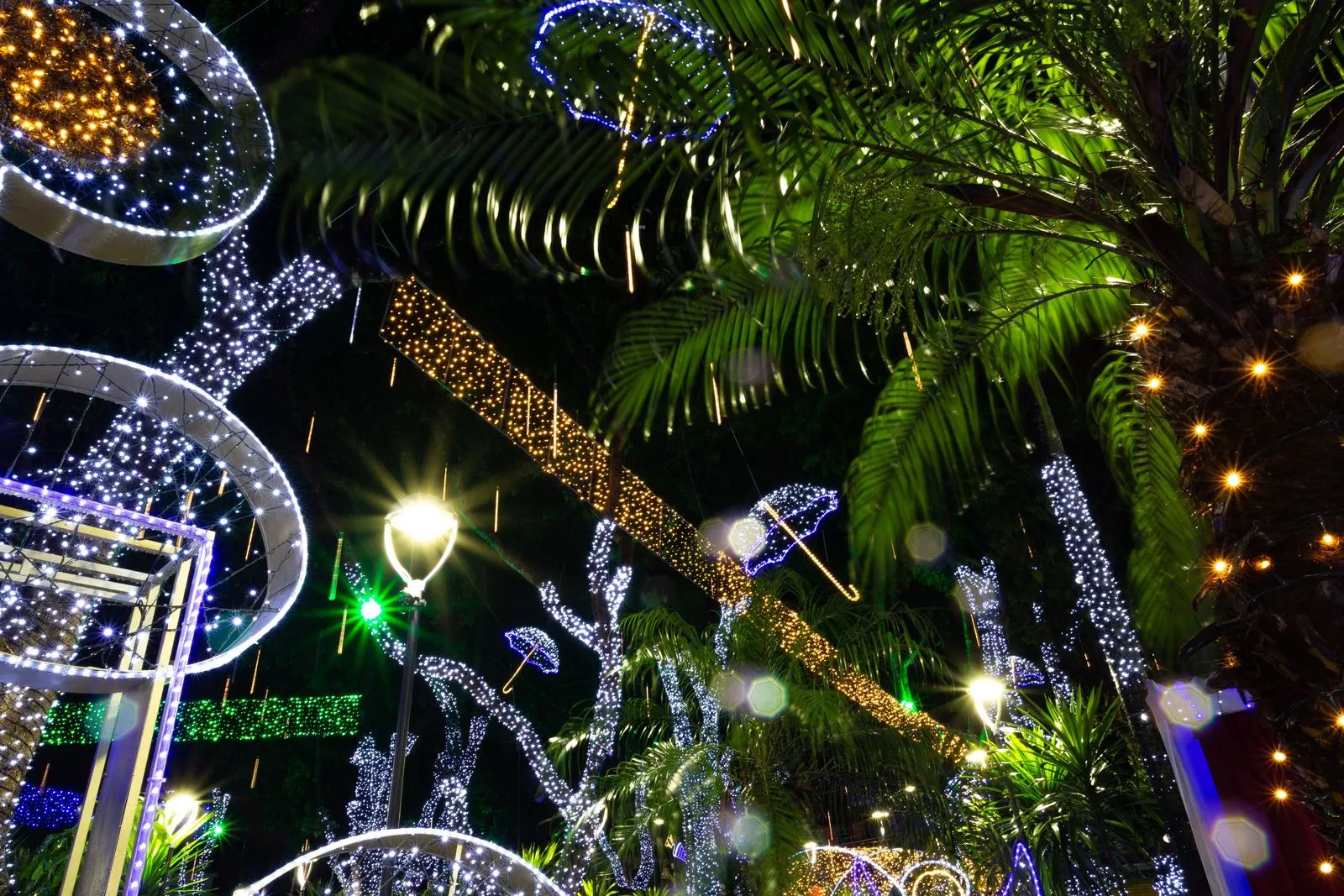
Two different businesses in one picture: the strings are the volume product, the installations are the engineering product.
The same contract manufacturing, on the studio side
A fair question at this point is whether the factory that prints your carton can also make the fixture inside your store. We build decorative and seasonal lighting on the same platform discipline as our architectural range: the same incoming inspection, the same aging racks, the same certificate trail. That is the practical advantage of placing both product families with one manufacturer — one quality system, one file, one person to call when a container is late.
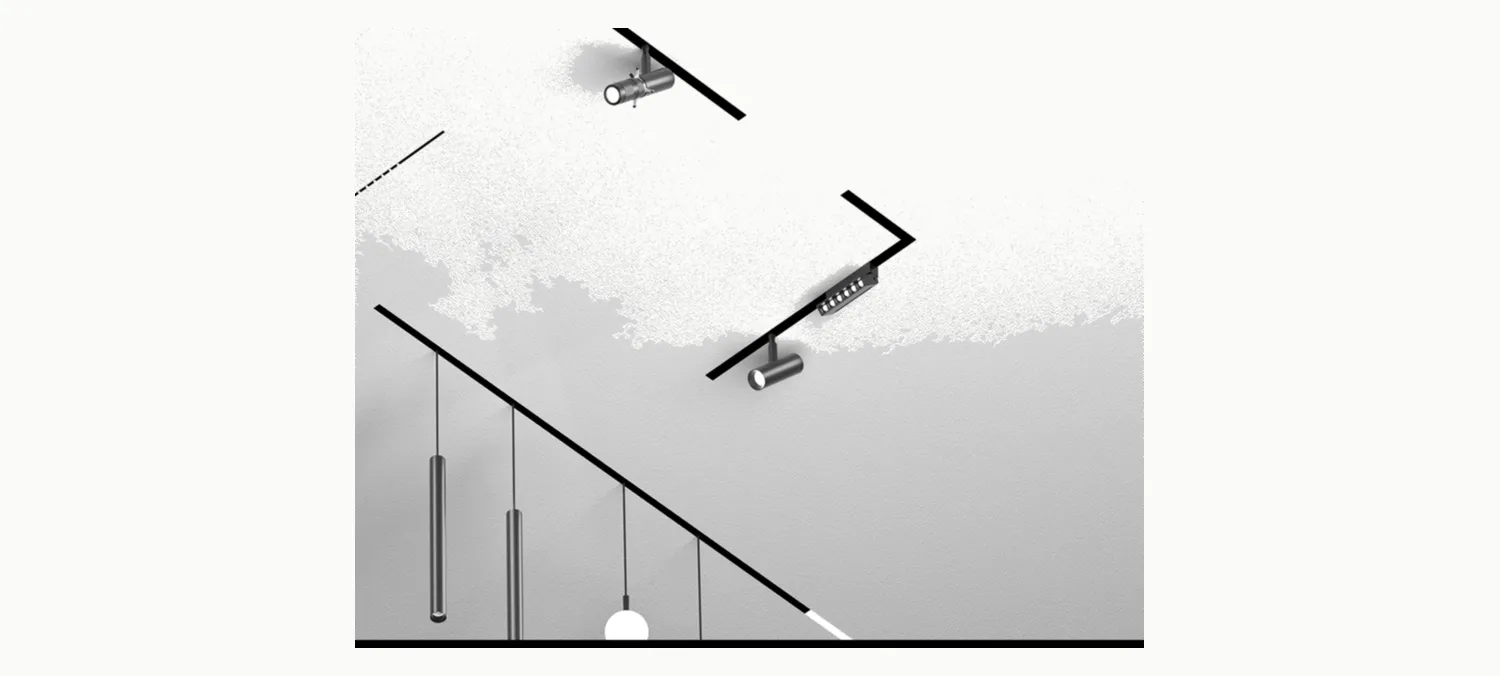
Our magnetic track system — the product family that shares tooling discipline, driver sourcing and QC with the decorative range.
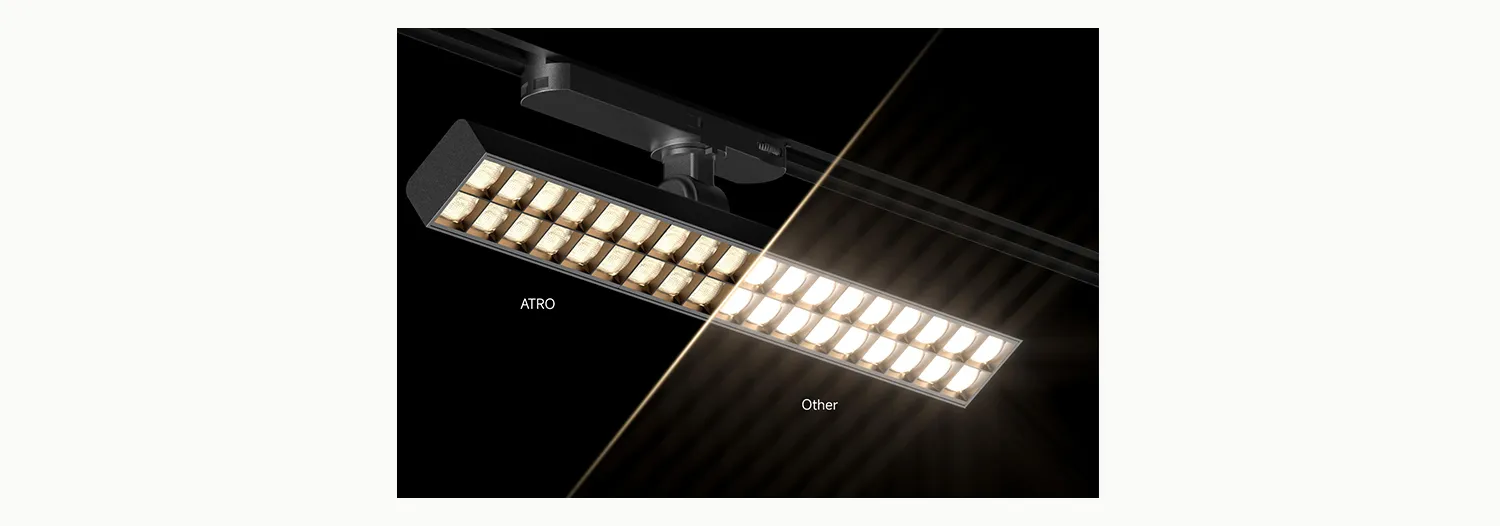
ATRO projector head. Same factory, same driver supply chain, same aging rack as the strings.

Linear and architectural profiles are where a private label programme usually grows to, once the decorative line is selling.
If the second product family is a track or downlight line rather than a string, the custom LED lighting manufacturer overview and the private label lighting manufacturer guide cover the same economics with different fixtures.
How a first string-light programme runs
- Pick the family and the market. Mini, C7/C9, festoon or permanent; 120 V or 230 V; US, EU, UK, AU. Everything downstream depends on this row.
- Fix the layer, not the list. Choose one tier from the figure. Mixing “custom bulb shape” with “custom driver and app” in a first order doubles the file and the timeline for no commercial gain.
- Write the electrical line. Bulb wattage, spacing, wire gauge and insulation, maximum connected length, and whether the set is end-to-end connectable. This line is what stops the sample from being approved and the container from being rejected.
- Ask for the seal and the scope. Photograph of the socket gasket and the connector; certificate with the model number on it; the test report behind the certificate, not just the certificate.
- Sample, then amortise. Approve colour and length on a small run, then move the setup cost onto the first production quantity in writing.
- Freeze the carton last. Artwork, barcode, warnings, country of origin, importer address and the maximum-run statement all live on the box. It is the last thing to approve and the first thing a retailer photographs.
FAQ
What can I customise on LED string lights for my own brand? Five layers: the bulb (shape, base, finish), the wire (colour, gauge, spacing, run length), the light (CCT, colour consistency, dimming), the protection (IP44 to IP67, sealed connectors), and the packaging and controls. Bulb colour, run length and packaging are the cheapest to change; a new mould and a new electrical design are the expensive ones.
What is the MOQ for private label string lights? It follows the depth of the change rather than the product. A label-only programme typically starts in the hundreds of pieces, colour and length changes around 1,000 pieces per SKU, a new bulb mould around 2,000, and a new electrical design around 3,000. The limiting factor is almost always the tool, the print plate or the driver supplier’s minimum — not the assembly line.
How long is the maximum run of string lights I can plug together? It depends on the wire, not the bulb count. On SPT-2 18 AWG at 120 V, with the 80% continuous-load rule, the ceiling is roughly 960 W — about 870 C9 LED bulbs at 1 W each, or about 425 S14 filament bulbs at 2 W each. Always ask for the maximum connected length of the exact SKU and print it on the carton.
Are fairy lights and string lights the same thing? Not commercially. “Fairy lights” usually means the mini family — tiny LEDs on thin cable, battery or USB powered, indoor or sheltered. “String lights” in a B2B context usually means the mains-voltage C7/C9 or festoon family. They use different wire, different sockets and different certification, so a quotation for one will not describe the other.
Does UL 588 cover the bulbs or the whole string? The assembled string — the set as it will be sold, with its wire, sockets, plug and fuse. A bulb that carries its own UL file number does not make the set compliant, and a report naming a different model number does not cover the set you are importing. Compare the model number on the certificate with the carton, every order.
What is the difference between IP44 and IP67 string lights? IP44 survives splashing, which is enough under an awning or on a covered patio. IP67 survives immersion at a stated depth and time, which is the realistic requirement for permanent outdoor installation in wet climates. The difference is in the sockets, the connectors and the end cap, so ask for seal photographs rather than a rating on a datasheet.
Can I use a smart controller on a mains-voltage string? Yes, but it changes the compliance route: the product becomes an item with radio and firmware, so EMC and radio testing join the file, and the controller supplier’s approval becomes part of your evidence. Simpler and cheaper is usually 24 V for smart features, with the mains voltage stopped at a certified adapter.
How long does a string-light OEM programme take? A label-only order on an existing platform is typically weeks from artwork approval; a colour or length change adds a sample round; a new bulb mould adds weeks before any sample exists; a new electrical design or smart module adds the driver lead time and the EMC testing on top. Ask for the timeline per tier, in writing, before you commit to a launch date. The general sequence of a custom LED order is in custom LED lighting lead time.
The short version
- Name the family first. Mini, C7/C9, festoon and permanent are four products, not one.
- Five layers are customisable, and three of them cost real money. Label and carton are cheap; housing and electronics are not.
- Run length is a wire specification. Wattage ceiling ÷ bulb wattage, derated, with the maximum connected length printed on the carton.
- Water protection is a seal, not a code. Photographs of the socket and connector beat an IP number on a datasheet.
- Some marks are yours to earn. No factory can appoint your EU responsible person or file your US entry data.
Send us the market, the family, and the one tier you want to change first. We will tell you which parts of the list are reachable at a first order quantity, what the tooling does to the timeline, and where the certificate route has to restart — before you commit to a launch date. Request a string-light OEM quote →
Read next: LED strip certification for the low-voltage tape file, Christmas lights certification for the document chain in full, what OEM buyers should check for the factory-floor evidence, and when to order Christmas lights from China for the calendar that decides whether the goods arrive before the season. For the architectural side of the same factory, start at commercial lighting and the OEM/ODM services page.
- led string lights oem
- fairy lights manufacturer
- private label string lights
- string lights manufacturer
- oem fairy lights
- spt-2 wire gauge
- max run length string lights
- ul 588 string lights
- ip44 vs ip67 string lights
- fairy lights private label
our factory