· Custom & OEM Lighting · 11 min read

Written by ENCORE Lighting Team
LED Lighting Manufacturer & OEM/ODM Partner ·
Custom IP65 Weatherproof LED OEM/ODM: Specs to Confirm Before You Order
Custom IP65 weatherproof LED OEM/ODM, spec by spec: what IP65 actually tests, where waterproof luminaires leak in the field, the twelve lines to confirm before you place a tooling order, and how those choices move your unit cost and MOQ.
“When you say IP65 waterproof, do you mean the whole fixture, or just the LED module?”
That is the question that turns a three-week quotation into a two-month argument. Every buyer asking for a custom IP65 weatherproof LED OEM/ODM program has the same phrase on the RFQ — waterproof, outdoor, IP65 — and every factory reads it differently. So the first quotation comes back cheap, the second comes back honest, and the difference between them is never the IP number. It is the eleven other lines nobody wrote down.
This guide is that list. It walks through what IP65 actually means, where outdoor luminaires leak in the field, what each specification decision costs you in tooling and unit price, and the twelve lines to confirm before you commit to a mould.
What IP65 actually tests — and what it does not
An IP rating has two digits and they answer two unrelated questions.
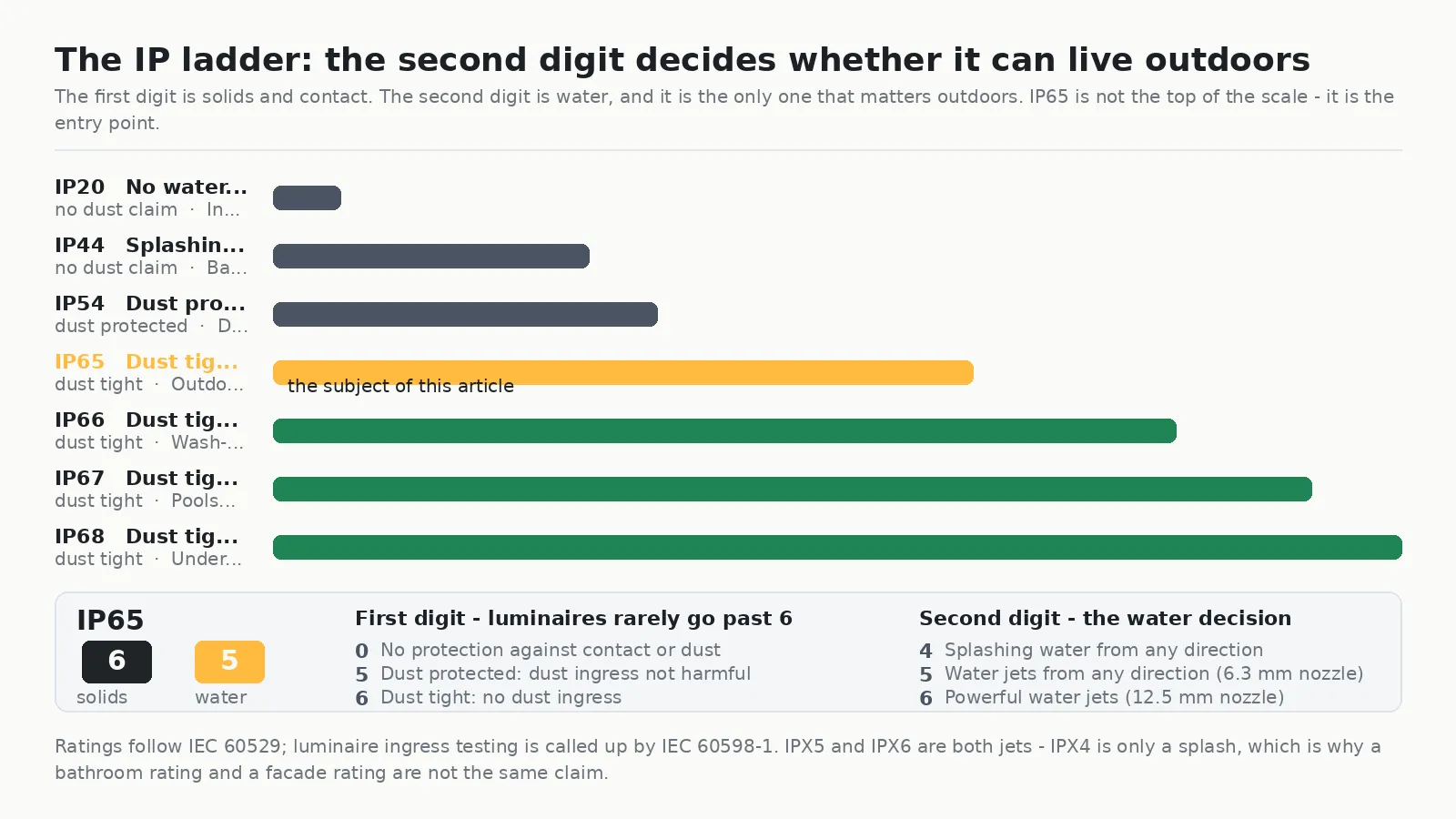
The first digit is solids — dust, and more importantly finger and tool access. The second digit is liquid. IP65 means 6 (totally dust-tight) and 5 (protected against water jets). That is it. Nothing in the rating says:
- what angle the fixture will be mounted at,
- how long it will sit in a salt-laden coastal wind,
- whether the installer will leave a drip loop,
- whether the driver inside is rated for the temperature the housing will reach on a roof in July,
- or whether the gasket survives five thermal cycles a day for ten years.
IP65 is a test condition, not a service life. IEC 60529 tests at the specified level are short — seconds to minutes of jet or spray at a defined pressure and a defined distance. A fixture can pass IP65 in a lab and still be full of water after one Irish winter. That gap is where ODM sourcing projects lose money.
If your project is in a region with a compliance regime of its own, the ingress rating is only half the paperwork — the certificate that names your model is the other half. We covered the Australian and European angles in SAA and RCM certification and CE vs ENEC for LED lighting; the same principle applies to every market: a report that names the factory’s stock model does not protect your product.
Where weatherproof luminaires actually leak
Here is the picture that matters more than the rating.
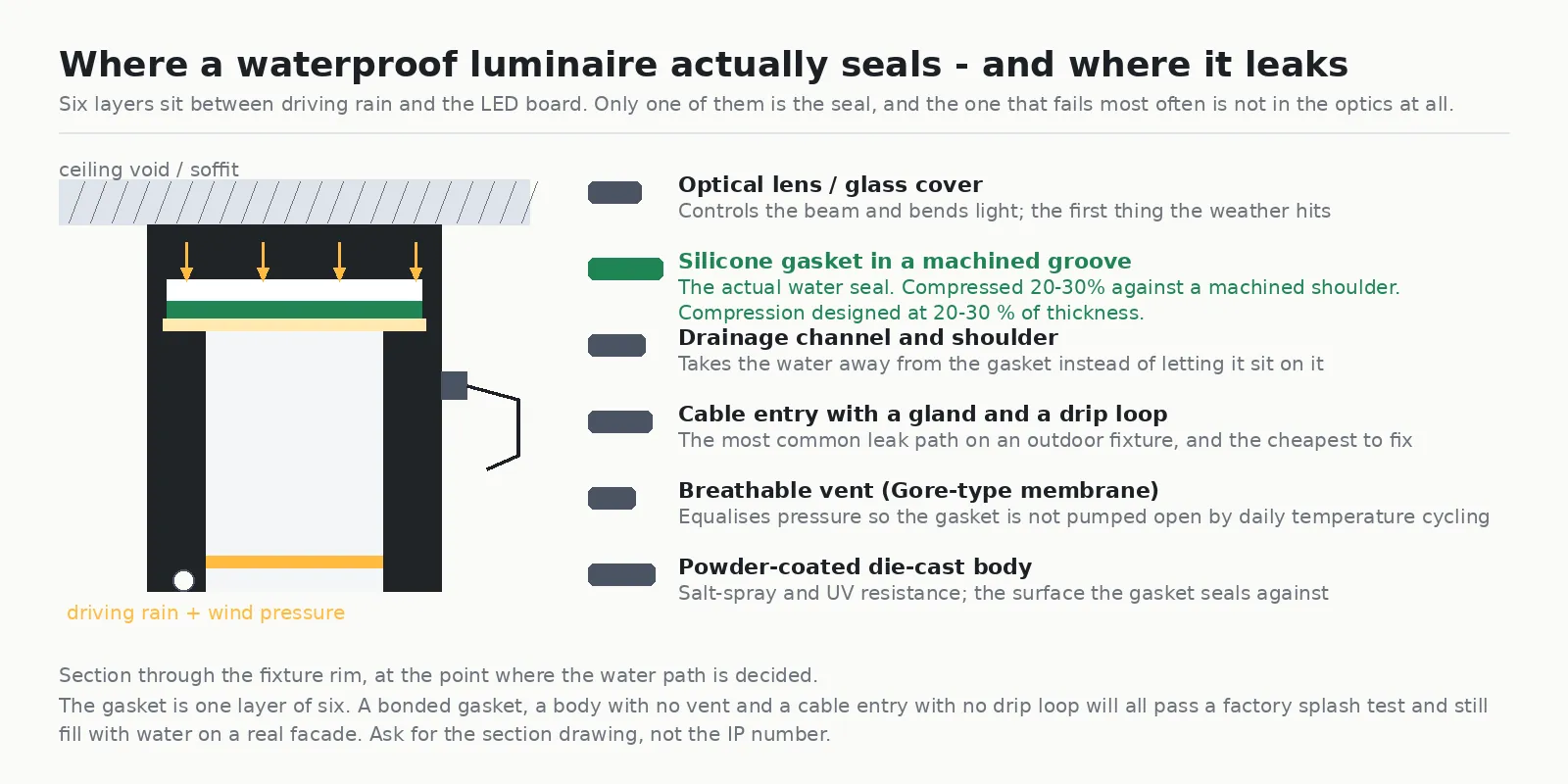
Six layers sit between driving rain and the LED board. Only one of them is the seal — the silicone gasket, compressed 20–30 % in a machined groove. The rest exist either to protect that gasket or to fail before it does.
Three failure modes account for the overwhelming majority of outdoor lighting water damage, and none of them is the optic:
- Cable entry. Most outdoor leaks enter through the cable, not the lens. A gland that is the wrong size for the cable OD, no drip loop on the installation drawing, or a strain relief that lets the installer pull the gland loose — and the fixture fills from the bottom on the first horizontal rain.
- No vent. A fixture that is fully sealed with no breathable membrane behaves like a bellows. It heats up in the sun, pushes air out past the gasket, cools at night, and sucks humid air back in. Ten years of that and the housing has a permanent puddle. A Gore-type membrane equalises the pressure and lets the moisture out without letting the water in.
- Bonded gaskets. A gasket glued into the housing cannot be replaced. When it hardens and cracks in year four, the whole fixture becomes landfill instead of a maintenance item. This is a design decision made at the tooling stage — which is exactly why it belongs on your checklist and not on your warranty claim.

The fix is cheap if you decide it early. That is the entire argument for going OEM/ODM with the specification in hand rather than buying an existing catalog item and hoping.
The twelve lines to confirm before you order
This is the list to paste into your RFQ. It is deliberately ordered: ingress first, then optics, electrical, mechanical, commercial.
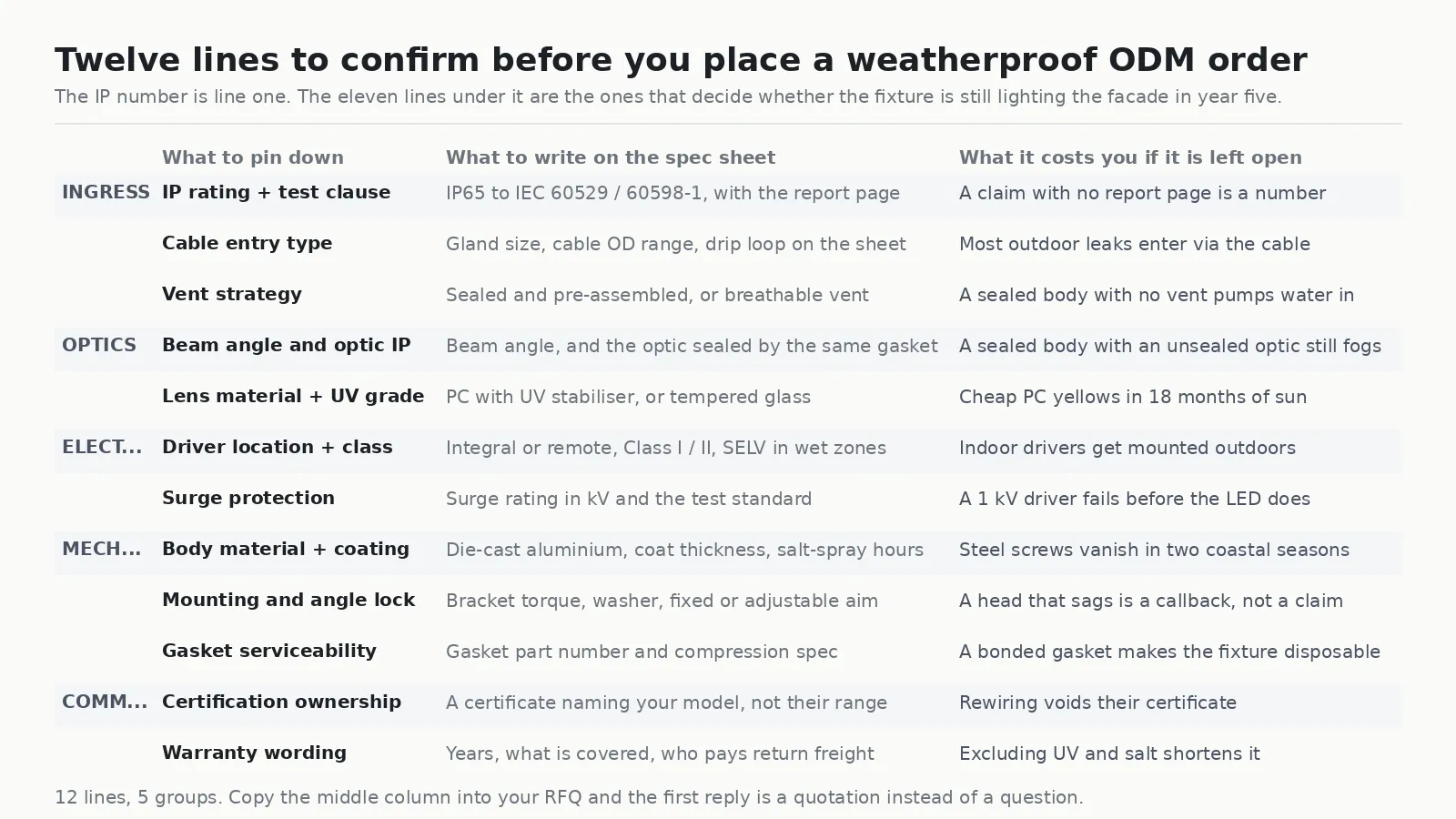
Ingress
- IP rating and test clause. “IP65 to IEC 60529 / 60598-1, with the report page.” A datasheet claim with no report page is a marketing number.
- Cable entry type. Gland size, cable OD range, and a drip loop drawn on the installation sheet.
- Vent strategy. Sealed and pre-assembled, or a breathable vent — state which, and get it on the drawing.
Optics 4. Beam angle and optic IP. The optic has to be sealed by the same gasket as the body, otherwise you have a waterproof housing with a fogged interior. 5. Lens material and UV grade. Polycarbonate with a UV stabiliser, or tempered glass. Cheap PC yellows in about eighteen months of direct sun.
Electrical 6. Driver location and class. Integral or remote, Class I or Class II, SELV in wet zones. A remote driver rated for indoors is legal — right up until a contractor mounts it outside. 7. Surge protection. Surge rating in kV plus the standard it was tested to. A 1 kV driver on a 10 kV coastal line fails long before the LEDs do.
Mechanical 8. Body material and coating. Die-cast aluminium, powder-coat thickness, salt-spray hours. Steel screws vanish in two coastal seasons. 9. Mounting and angle lock. Bracket torque, anti-vibration washer, and whether the aim is fixed or adjustable. An adjustable head that sags is a callback, not a warranty claim. 10. Gasket serviceability. A replaceable gasket part number and the compression spec — so the fixture is serviceable in year five.
Commercial 11. Certification ownership. A certificate naming your model, not the factory’s range. Rewiring the driver voids a certificate issued to their SKU. 12. Warranty wording. Years, what is covered, and who pays return freight. A five-year warranty that excludes UV and salt is a two-year warranty.
Every one of these is a sentence, not a project. But each one you leave open becomes a factory assumption, and factory assumptions default to whatever is cheapest to build.
What the specification costs you
Buyers usually assume that “custom” is a single upgrade price. It is not — it splits cleanly into one-off tooling and per-unit cost, and the split changes the whole conversation.
Work it through on a simple model. Take a base piece cost of $12.40 for an indoor-rated ODM unit and $14.60 for the same fixture built to an outdoor bill of materials — sealed cable entry, UV-stabilised lens, surge-rated driver, heavier coating. Then add the one-off costs an outdoor programme actually carries:
- $1,800 — gasket tool plus the body change needed to cut a proper seal groove
- $6,500 — a new die-cast body mould, if the design has to be yours
- $3,200 — the IP, salt-spray and safety test file for the range
- $900 — engineering, artwork and paperwork, per order
Amortised over volume, the picture looks like this:
| Order size | Indoor ODM baseline | New gasket tool only | New body tool | New body tool + test file |
|---|---|---|---|---|
| 500 pcs | ~$14/unit | ~$20/unit | ~$29/unit | ~$36/unit |
| 2,000 pcs | ~$13/unit | ~$16/unit | ~$18/unit | ~$20/unit |
| 5,000 pcs | ~$13/unit | ~$15/unit | ~$16/unit | ~$17/unit |
At 500 pieces the same fixture can cost two and a half times more depending on how much of it you insist on owning. At 5,000 pieces the spread between the three outdoor routes is barely a dollar. The lesson is not “custom is expensive.” It is that tooling is a fixed cost and fixed costs are brutal at small volumes. If you are launching a new weatherproof range at 500 pieces, reuse an existing ODM die-cast body and tool only the gasket and the seal geometry — do not pay for a new mould. If you are at 2,000+ and the design is genuinely yours, the new body tool is worth it, and by 5,000 the differentiation is nearly free.
That is also the practical reason to start from an ODM platform rather than a blank page. If your first weatherproof product should be a proven design you brand and specify, ODM vs OEM LED lighting is the decision framework to read first. If the design must be yours from the start, our complete OEM LED track lighting guide walks through the six-step custom process end to end.
Two ways a plausible quote goes wrong
Scenario A — the coastal restaurant terrace. A buyer specifies IP65 wall luminaires for a seafront venue and accepts a quote roughly 25 % below the others. The fixtures pass a factory splash test and look perfect on install. Eighteen months later the powder coat has chalked, the untreated steel screws have rusted through, and the driver has failed on three of the twelve units. The IP65 rating was never wrong. The coating, the fasteners and the surge rating were never specified — so they defaulted to the cheapest option that still passed the lab test. The cost of that “saving” was a full re-lamp of the terrace in the second season.
Scenario B — the aluminium canopy soffit. A contractor orders IP65-rated downlights for an exposed soffit, and they start fogging within weeks. The IP65 was real: the housing was genuinely sealed. But the optic was a drop-in module sitting behind the cover without its own seal, so humid air cycled in behind the lens every night and condensed on the coldest surface. The fix was a gasket around the optic — a part nobody had put on the drawing, because the RFQ said “IP65” and stopped there.
Both projects had the right IP number. Neither had the whole specification. That is the entire argument for treating IP65 weatherproof LED ODM as a twelve-line conversation instead of a two-character one.
Confirm the list, then send the RFQ
A weatherproof outdoor range is one of the better ODM categories to build a brand on — the specification is objectively testable, and buyers who have been burned once will pay for a supplier who can prove it. What kills these projects is not the moulding, the optics, or the price. It is the line that was left open.
So before you commit to tooling:
- Decide the service environment (coastal, inland, tropical, cold) and write it into the spec.
- Fix the twelve lines above, and get the ones you care about onto the drawing.
- Ask for the section drawing and the test report page, not the IP number.
- Get tooling and unit cost quoted separately, and model both at your real volume.
- Confirm certificate ownership in writing before the first mould is cut.
If those five things are in place, the factory conversation gets noticeably shorter — and the first quote you receive is a quotation instead of a question. You can see the platform our waterproof and outdoor-capable ranges are built on at ENCORE OEM/ODM services, or start from the commercial lighting collection if you are specifying a project rather than launching a product line.


- LED waterproof light ODM
- LED weatherproof light ODM
- IP65 LED OEM
- IP65 LED luminaire manufacturer
- waterproof LED lighting OEM
- outdoor LED lighting ODM
- IP rating lighting

ENCORE Lighting Team · ENCORE
LED Lighting Manufacturer & OEM/ODM Partner
The ENCORE engineering and sourcing team writes about LED track lighting, downlights, magnetic systems, certifications and OEM/ODM manufacturing for B2B buyers and specifiers.