· Sourcing & Quality · 21 min read
Written by our factory
OEM Lighting Team ·
When to Order Christmas Lights from China: Planning Calendar
Order Christmas lights in June, not October. The reverse calendar from a 20 November display date, the sailing cut-off that costs a week at a time, the 19 CFR 132 duty window, and five levers that still work in October.


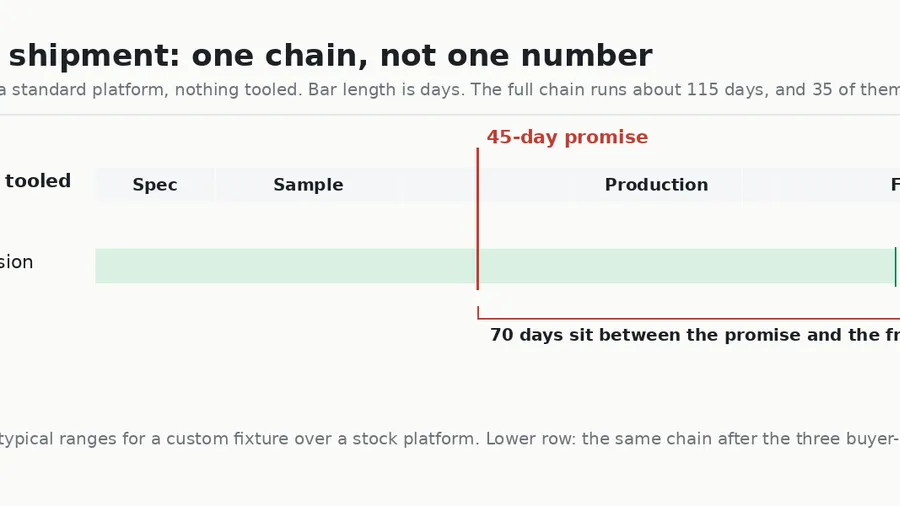
Plan to order Christmas lights from China in June. If the PO has not gone out by the end of August, sea freight is already a gamble and you are buying whatever is left. That is the whole answer; the rest of this article is the arithmetic behind it, and what is still recoverable if you are reading this in October.
Christmas lights are the one category in this industry where the calendar is not a preference. The display date is fixed by your customers, not by you. Everything upstream of it — sampling, production, the sailing, the customs entry — has to fit into the space in front of that date, and the space is thinner than a “35-day lead time” quotation suggests.
This article is the calendar. If what you need instead is how to audit the factory once you have chosen one, that is what OEM buyers should check; if you need the paperwork, that is Christmas lights certification. Same category, three different jobs.
The short answer, by order type
| What you are buying | Order by | Why |
|---|---|---|
| Reorder of last year’s programme, from stock | Late Oct | 12–18 days production, 7–15 direct from stock, courier or air |
| First programme on a tooled platform | Early Jul | Sampling, artwork and a 28–35 day crossing all sit in front of the date |
| Custom colour, wire length, carton artwork | Late Jun | Sample rounds and dieline proofing are where the weeks disappear |
| Anything with your own mould or optics | April–May | Tooling plus certification of the new model, and no way to compress it |
| Fixed-install commercial job (see note below) | Sep–Oct | The product is not the long pole — the installer’s window is |
Note for buyers who run shopping centres, hotels and city displays rather than retail shelves: the lights are rarely what delays you. The rigging crew, the permit, and the access window usually are, and they are booked earlier than the goods. Plan the harvest festival, the switch-on and the take-down in the same document as the PO.

Work back from the display date
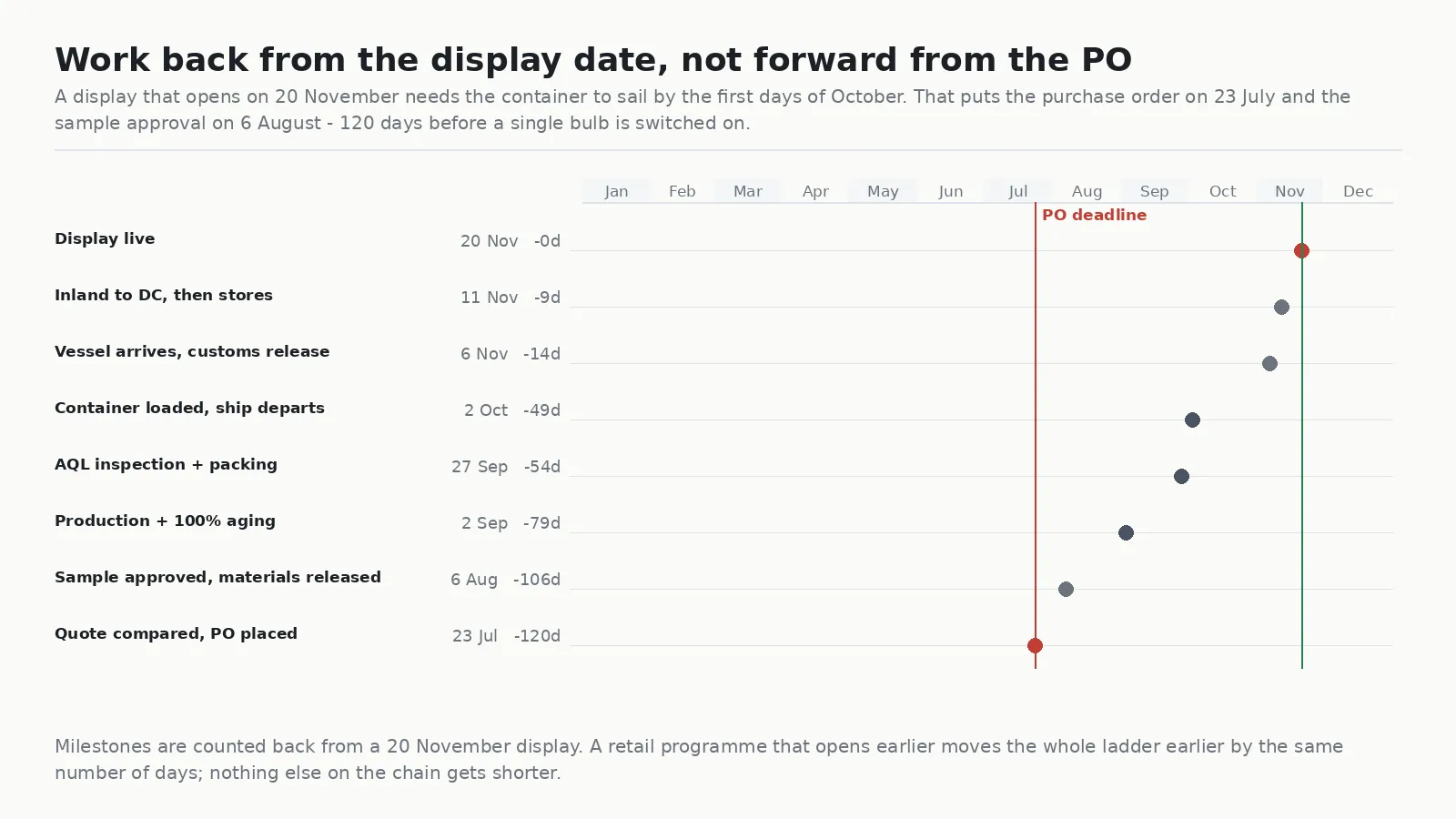
Take a retail or hospitality programme that opens on 20 November — early enough to trade through the whole season, which is why most commercial displays switch on well before the tree goes up at home. Now walk backwards.
- 20 November — display live. Install normally happens in the week before, not overnight.
- 11 November — goods at the DC, then out to stores. Nine days is tight for a multi-site rollout and assumes you booked the transport.
- 6 November — vessel arrives, entry filed, container released. A customs hold adds days you did not plan.
- 2 October — container loaded and the ship sails from Ningbo or Yantian.
- 27 September — AQL inspection and packing done.
- 2 September — production and the 100 percent aging run finished.
- 6 August — sample approved in writing; materials released.
- 23 July — purchase order placed.
That is 120 days from PO to a lit display, and 82–118 of them belong to the goods themselves, depending on how much of the product already exists.
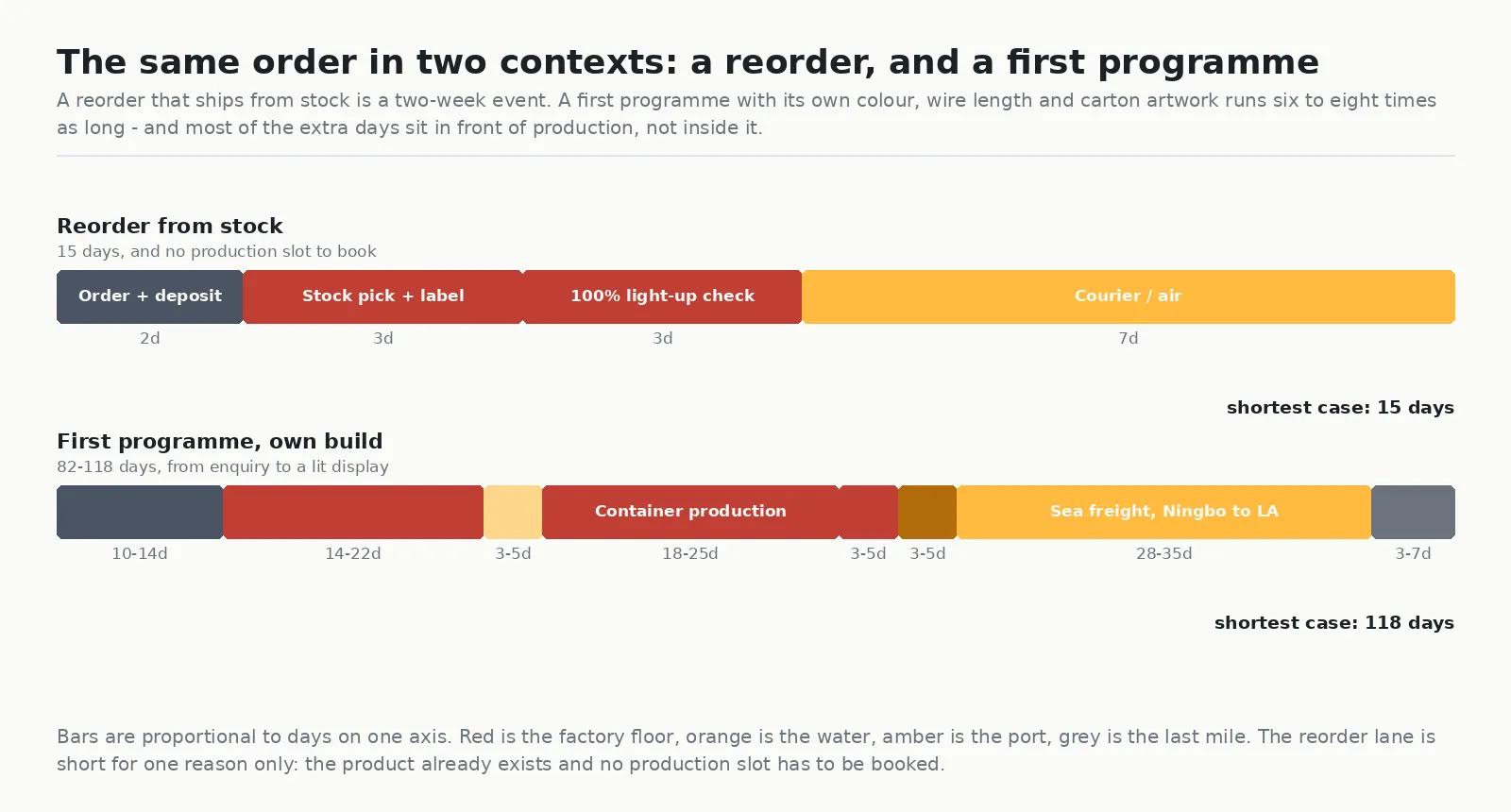
The comparison is the point. A reorder that ships from stock is a two-week event because no production slot has to be booked and no artwork has to be approved. A first programme is six to eight times longer, and the extra days are mostly in front of production, not inside it. Production itself is fairly predictable: 18–25 days for a container of strings on a platform the factory already runs.
Everything that goes wrong, goes wrong in the front half.
The five things that actually set your order date
1. The display date you committed to
Not the date you would like. The date that is already in a marketing calendar or a landlord’s schedule. Every day earlier at the front moves the whole ladder earlier by the same amount; nothing downstream gets shorter.
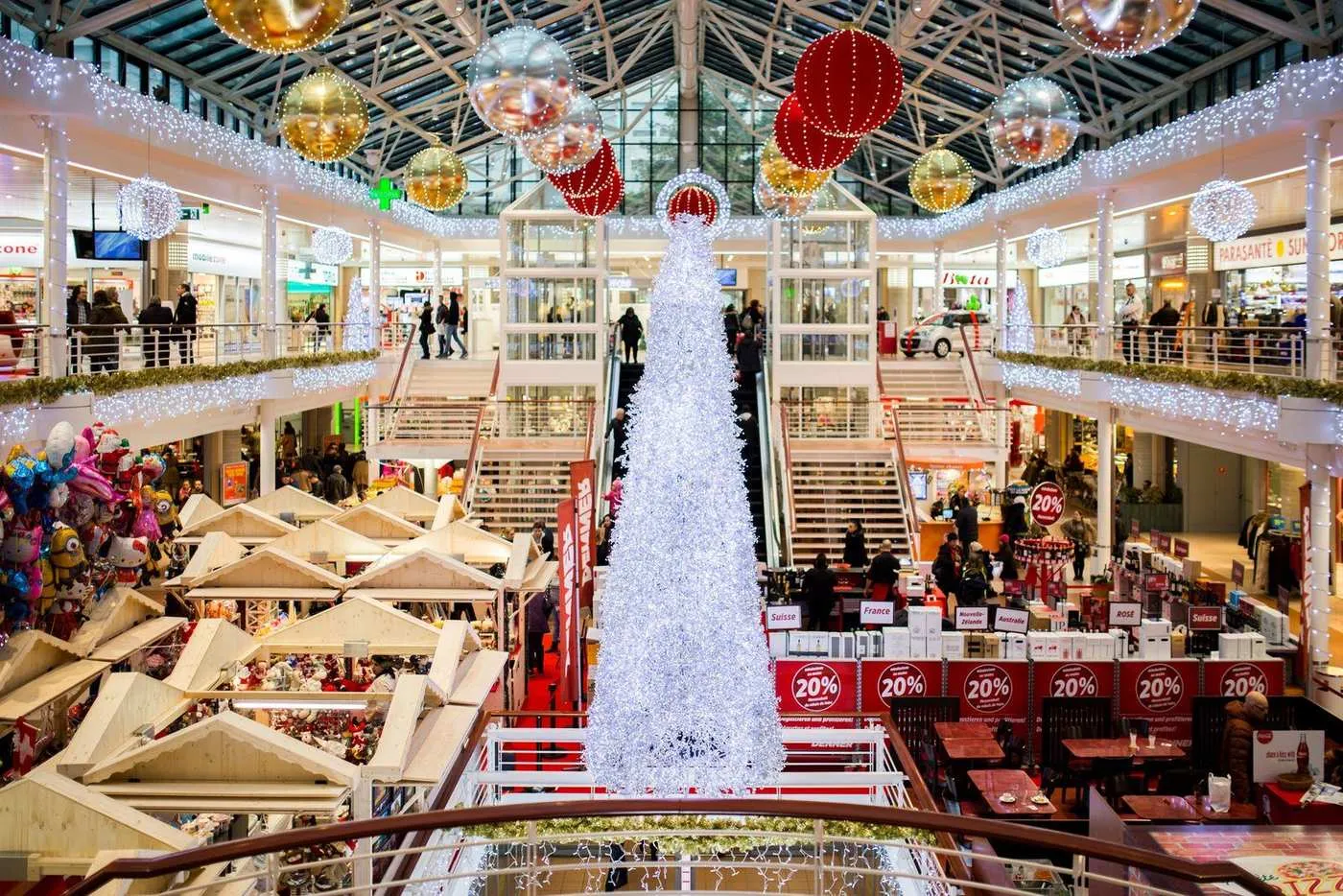
A mall switch-on in mid-November is the case that punishes a late PO hardest: the atrium is booked, the photographer is booked, and an empty tree base is not something you can reschedule.
2. How much of the product already exists
The Christmas light category has a deep catalogue of tooled housings, lampholders and wire gauges that factories run every year. Buying into that catalogue shortens production and removes the certification question, because the model on the certificate already exists.
What stretches the chain is the part people assume is free: your colour, your wire length, your carton. Each one is a separate approval, and each approval is a round trip.

3. The sailing, not the lead time
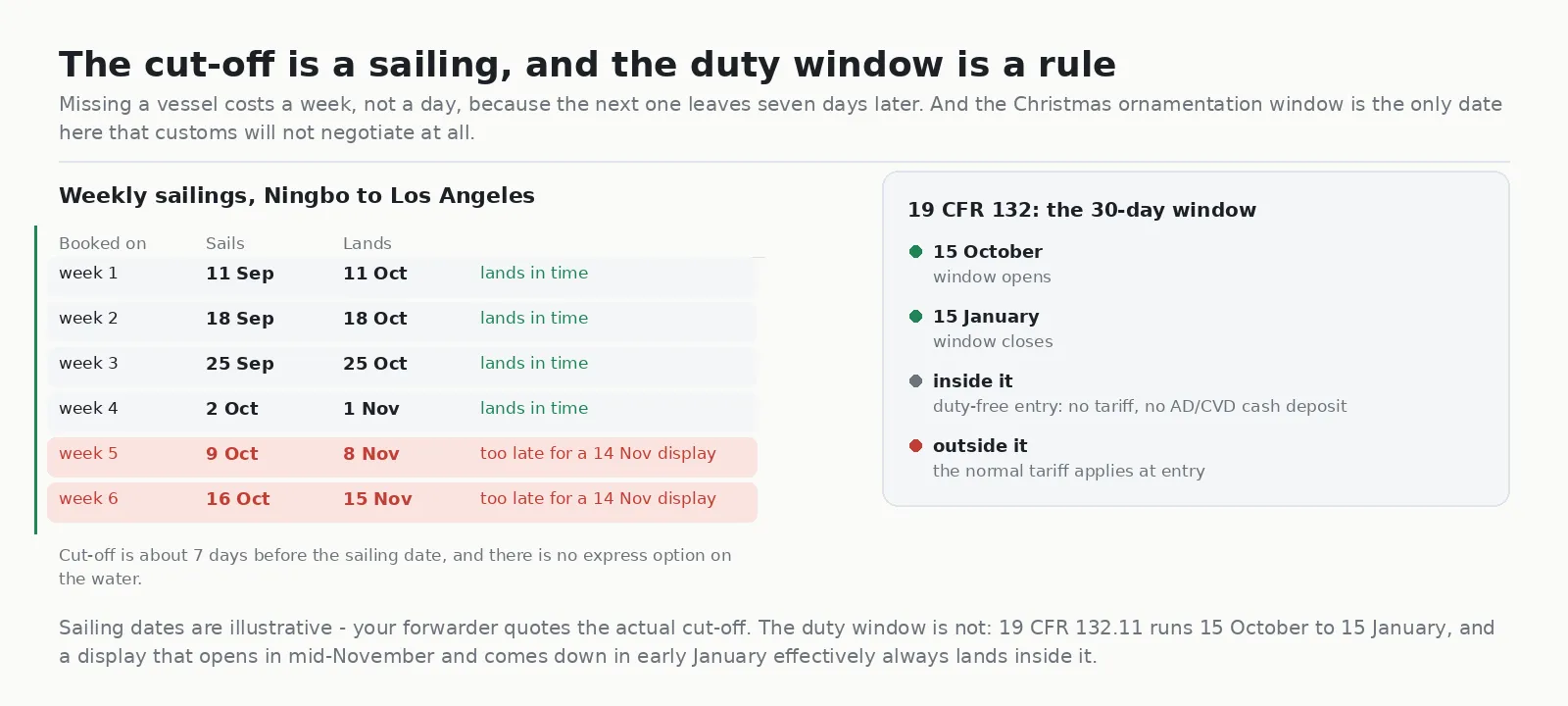
Vessels leave weekly. That is both the good news and the bad news. It means a missed cut-off does not cost you a day; it costs you seven, because the next sailing is a week later and the one after that is another week after that. Two missed weeks in October is a fortnight of display you will not get back.
Container cut-off is roughly a week before the sailing date: gate-in, VGM, and the documents you have not sent yet. In the last week of October, vessels to the US and Europe are also full, so the cut-off you are quoting from last year may already be earlier.
Sea transit itself, port to port, is 28–35 days to the US West Coast, 30–38 to Europe, 18–24 to Australia. Air during the November rush runs 5–8 days door to door and costs several times the sea rate per kilo. It is a repair tool, not a shipping method.
4. The duty window — the one date customs will not move
This is the part most buying calendars leave out and then discover in November. Under 19 CFR 132, Christmas ornamentation and certain other seasonal articles enter the United States free of duty when entered during the 30-day period beginning 15 October and ending 15 January (132.11), provided each shipment is consigned to the importer at the time of entry and is certified as intended for distribution as seasonal goods (132.12).
Two consequences worth planning around:
- A display that opens in mid-November and comes down in early January effectively always lands inside the window, so the entry is duty-free. That is a real saving and it is yours by default — as long as the entry date is inside the window.
- A shipment that lands in early October misses the window by days and pays duty that a week’s delay would have avoided. Buyers who push for the earliest possible arrival sometimes pay for the privilege.
Treat the duty question as a three-way conversation between you, your customs broker and the factory’s shipping desk, not as something the forwarder decides on the day. Misdeclaration is a bigger problem than duty: the goods have a separate and specific HTS question, which is why strings and loose lamps should never share one line on an entry.
5. Chinese New Year, and the January you cannot buy anything
If your programme slips past December, the next container is a February container. Chinese New Year closes the factories for two to three weeks, and the two weeks before the closure are the least useful production days of the year — everyone is shipping, everyone is short of truckers, and everyone is finishing someone else’s order.
The practical rule: never place a seasonal PO in January and expect a March vessel. Either you make the June wave, or you are planning next season.
The twelve-month calendar
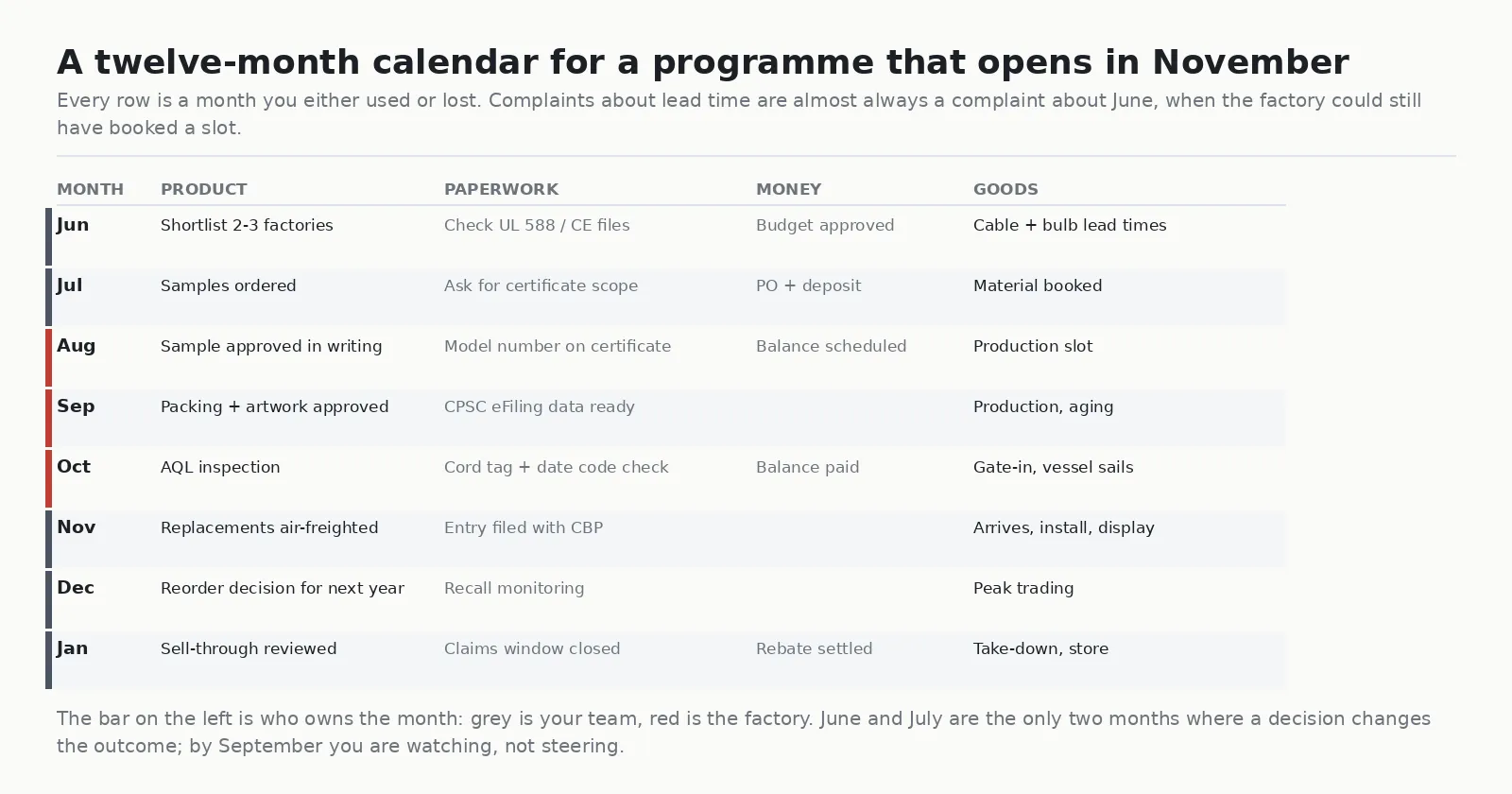
Read the rows top to bottom and it looks orderly. Read the colour bar on the left and it is obvious that the only months where a decision still changes the outcome are June and July. From September onwards you are watching, not steering.
June: decide, shortlist, and get the budget signed
The single most common cause of a late Christmas order is a budget approved in September. Procurement cannot place a PO against money that is not committed, and finance does not commit money for a season it has not yet discussed.
By the end of June you want: two or three factories shortlisted, files checked against the standard that applies in your market, budget approved, and a written date on the calendar for “sample approved or we fall back to stock”.
July: samples, PO, and the slot
Order samples in the first half of July. Sampling on a stock housing is 14–22 days; add courier time. Approve in writing — a photo and a “looks great” on WhatsApp is not an approval you can hold a factory to in September.
Then place the PO and the deposit. This is the step that books a production slot, and slots in September and October fill from July.

August: freeze the specification and the artwork
Sample approved in writing, materials released, dieline and carton artwork approved, and the compliance data package assembled — which includes the model identifier that will appear on the entry file, not only on the certificate.
Freeze means freeze. Every change after this point adds a week, and changes in September cost more than the design was worth.
September: production and the aging run
18–25 days of production plus a 100 percent aging run of five to seven days. The aging matters more than it sounds in a seasonal category: strings are installed in cold, wet, high-wind conditions and switched on for six to ten hours a day for six weeks. A six-hour burn-in does not find the lampholder contact that fails on the third week.

October: inspection, gate-in, sailing
AQL inspection, cord tag and date code check, then gate-in about a week before the sailing. If the factory is still producing in the last week of October, your container is not on a vessel; it is a conversation with a forwarder about space.
November: arrival, install, and the air-freight repair
The goods land, entry is filed inside the duty window, and the last mile delivers. Somewhere in this month, most programmes also air-freight a small percentage — replacements, a store that ordered late, a test batch for a client who only just said yes. Budget for that 5–10 percent share in June, at four to six times the sea rate.

December and January: trade, then decide
Trading is not a planning problem. The planning problem in January is the sell-through review: which SKUs ran out, which sat, what to reorder, what to drop, and whether the supplier who did well in September earned a place on next year’s shortlist.
Do this before the take-down, when the data is still fresh, and do it with the January recall and incident monitoring open in another tab. A recall on a competitor’s string is the best warning you will ever get about a lampholder.
What you can still do if you are ordering late
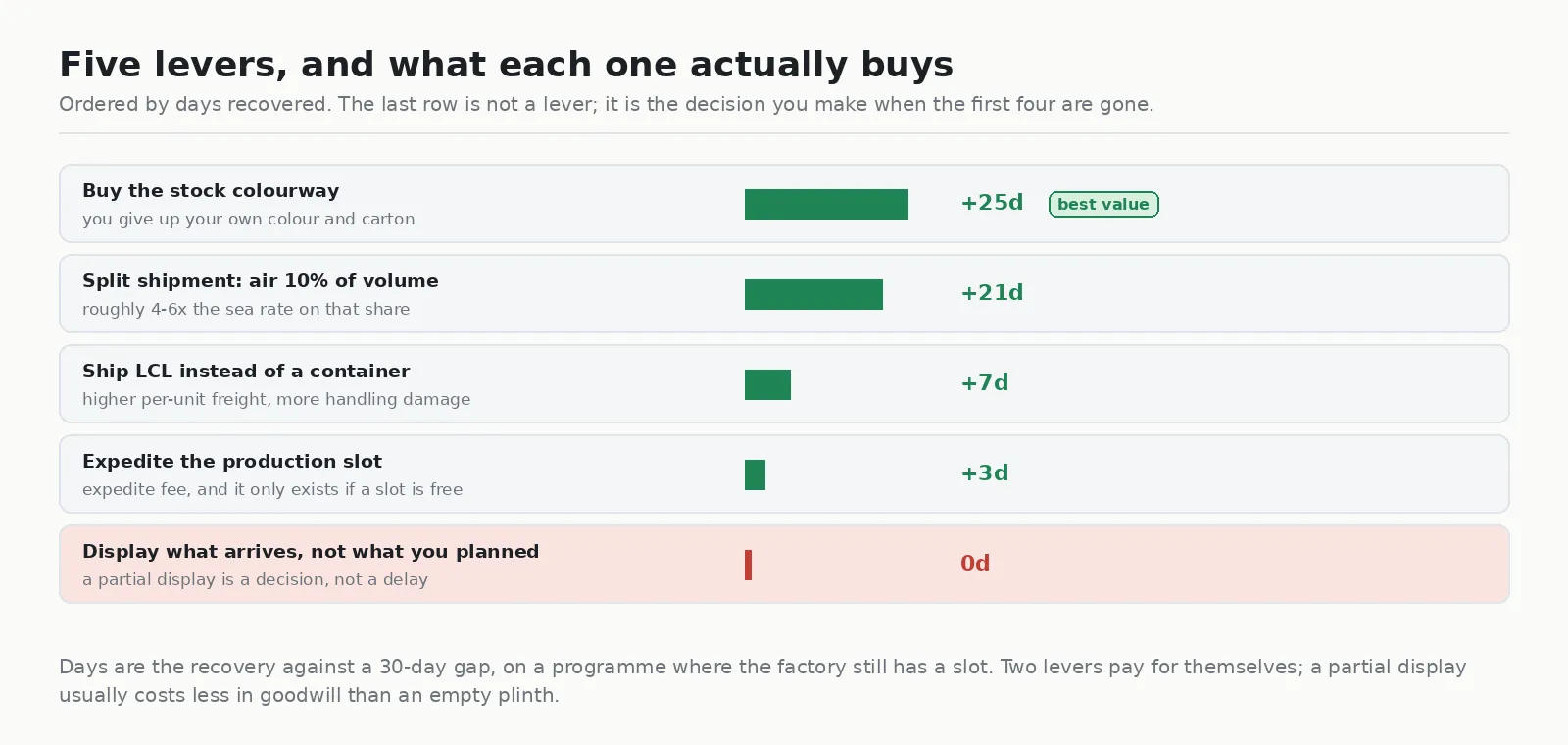
If the PO is late but the display date is fixed, you are no longer choosing a schedule; you are choosing losses. In order of what actually recovers days:
- Buy the stock colourway. Losing your bespoke colour and carton can pull 25 days out of the chain, because you are buying a finished good rather than a build. This is the largest single lever, and the one buyers resist most.
- Split the shipment. Put 10 percent on air and the rest on the sea. You still need the sea arrival for the bulk, but the display opens on time in the windows that matter.
- Take LCL instead of waiting for a whole container. A week earlier, more handling damage, better per-unit freight than air. Suitable for the accessory layer rather than the whole programme.
- Pay for an expedited slot. Worth three days and only if a slot exists. Do not count on it in October.
- Display what arrives. A partial display on the first week and the rest filling in later is a decision, not a failure — and it costs less in goodwill than an empty plinth on switch-on night.

What does not work: refusing to reduce the scope, and taking a “we can do 20 days” promise from a factory that has never shown you a schedule. Ask for the slot in writing, with a date, and ask what the penalty is if it slips. A factory that will not put a date on paper has told you something.
About the other eleven months
Here is the part of this article that is specific to us, and the reason a Christmas piece sits on a commercial architectural lighting site at all.
Most of our work is track lighting, downlights, magnetic systems and linear fixtures for retail, hospitality and museums — the lighting that has to be installed, aimed and photographed properly. All four of those segments have a December problem: the merchandise needs good light and the interior needs to look festive, and the two briefs usually land in the same email in September.
So we plan the year that way. The permanent lighting is specified on a platform we already run, which is why its schedule is a number rather than a promise. The festive layer is specified at the same time, by the same team, so that the strings do not fight the shelf lighting and the switch-on is one date rather than two.
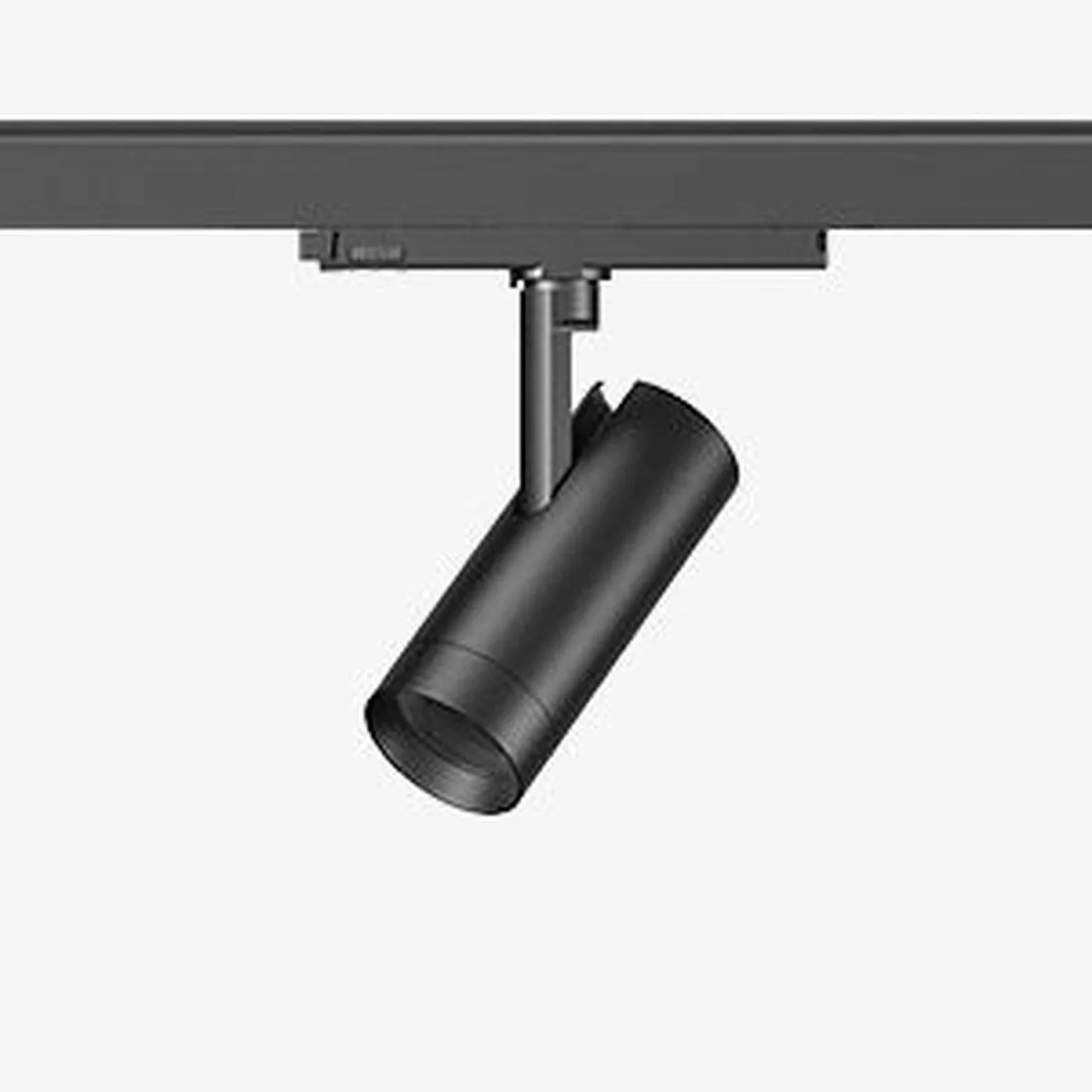
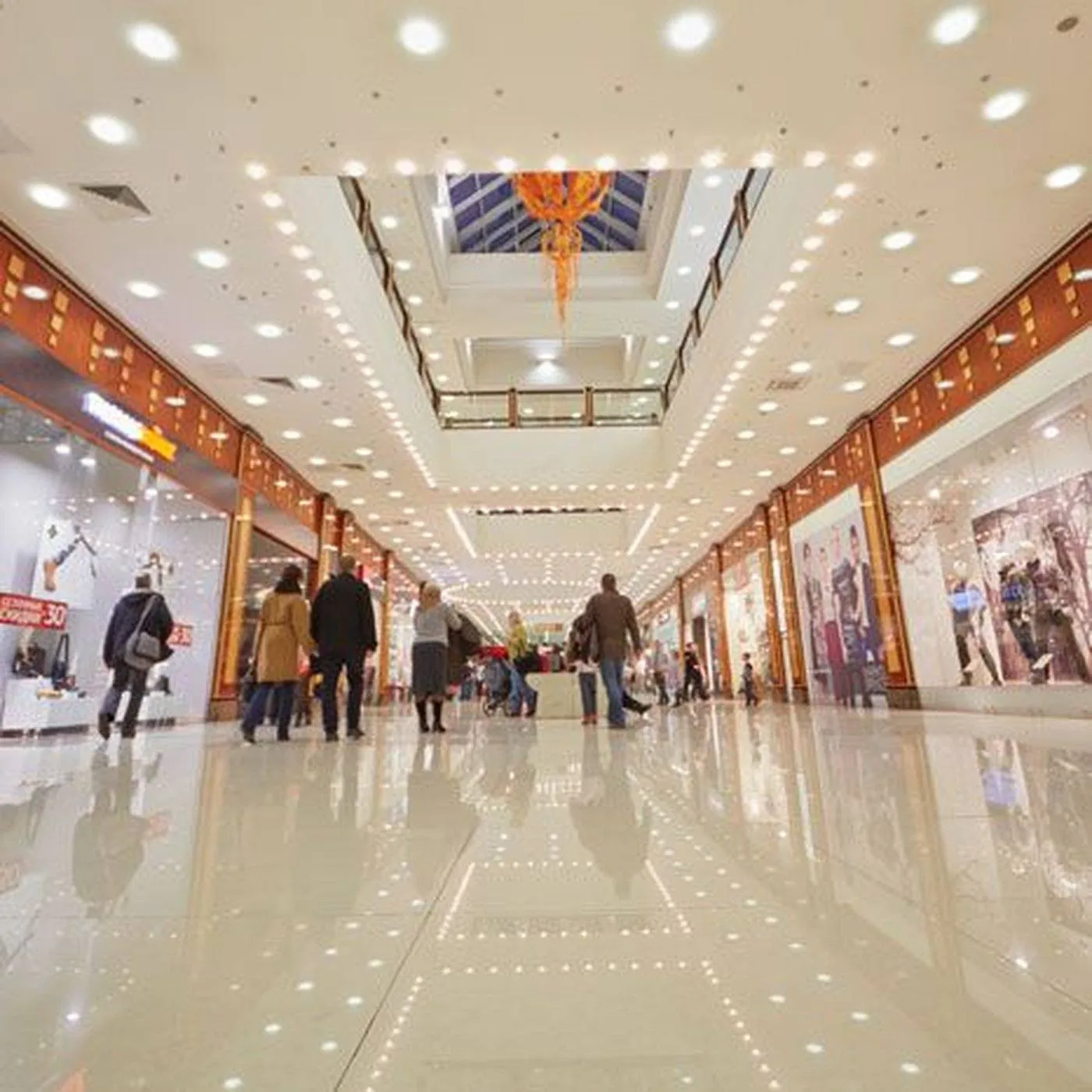
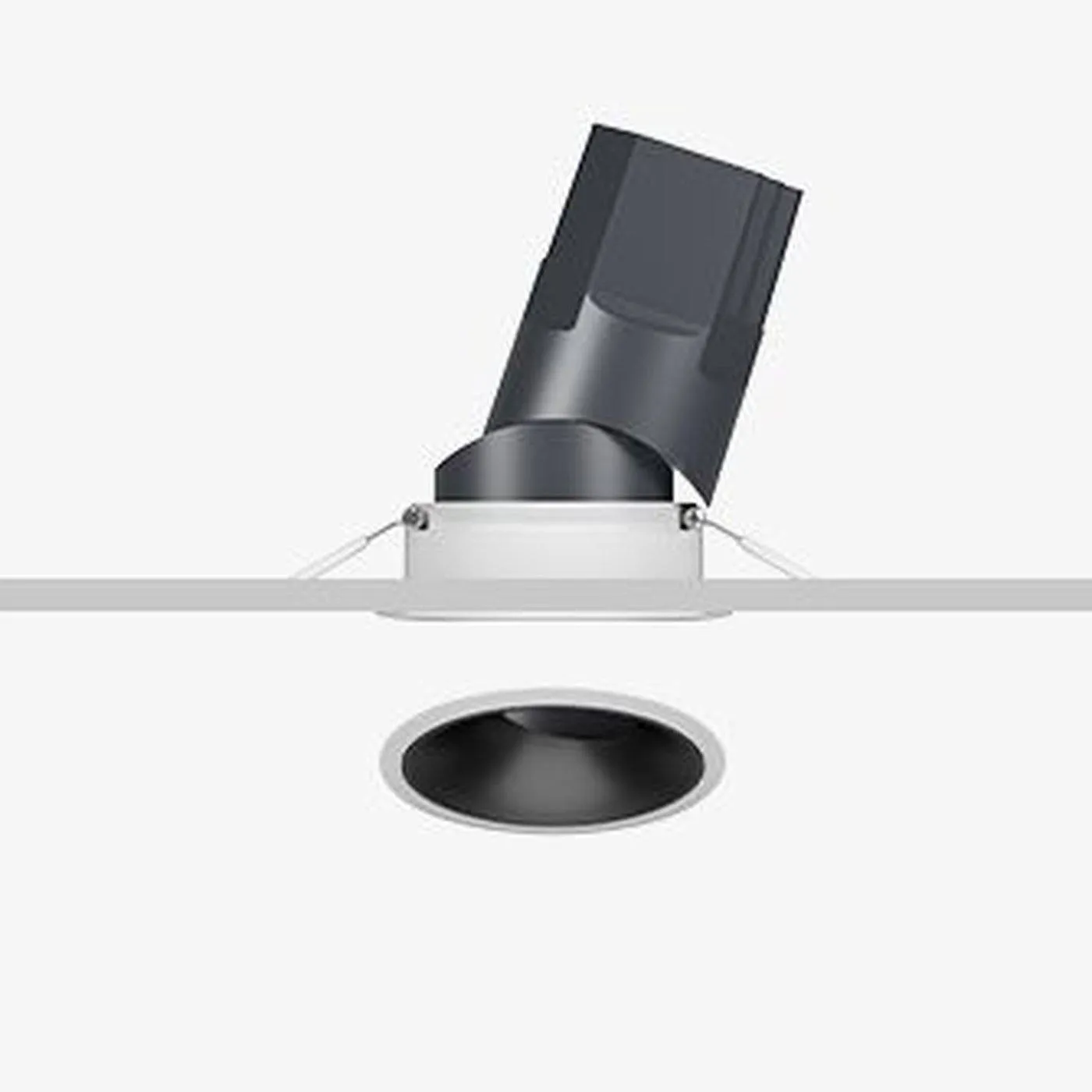
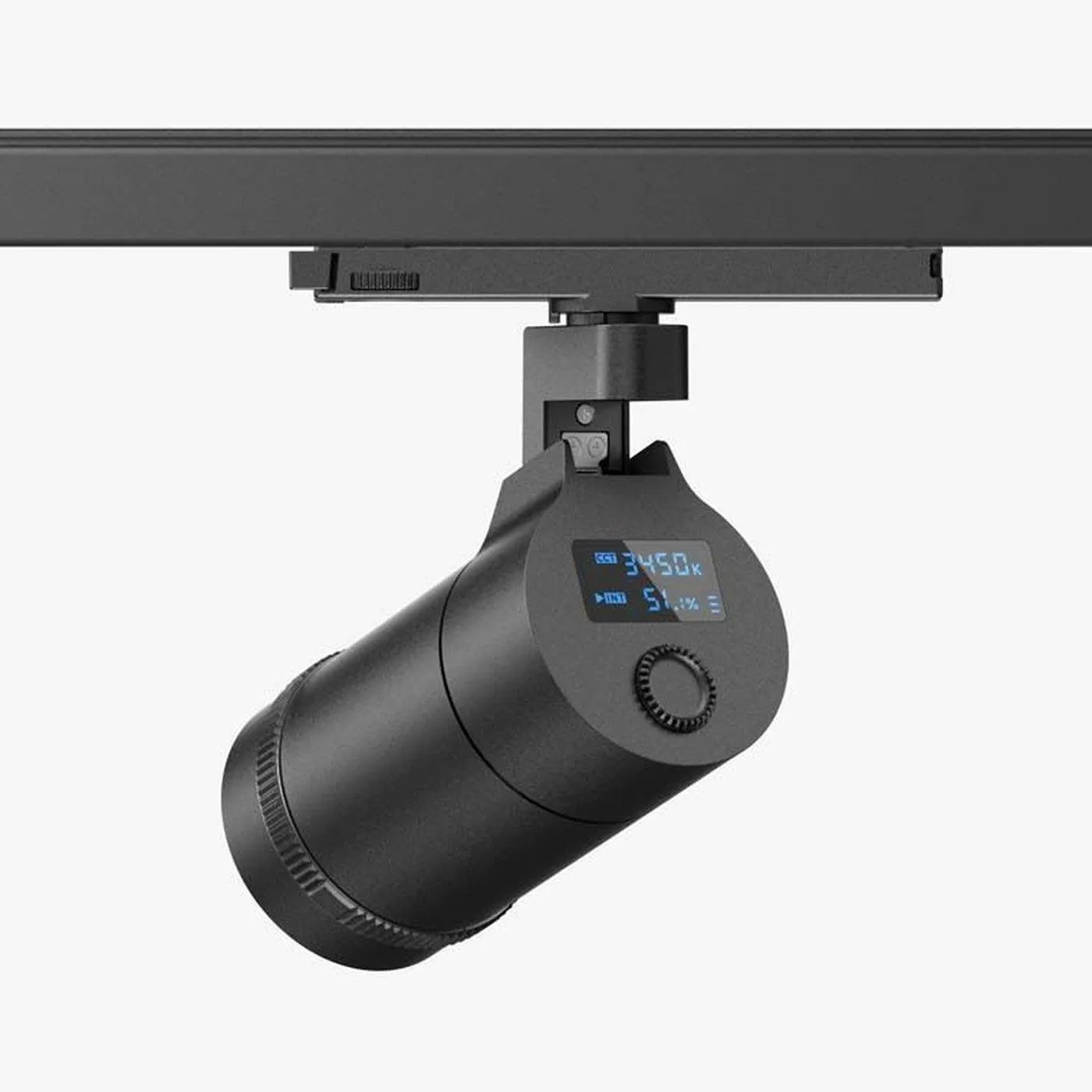
In a retail or hospitality space the layout is usually the same: a track system for the aiming layer over displays and product walls, LED downlights for the ambient floor, magnetic track where the ceiling has to stay visually quiet, and a commercial project package when the whole schedule — permanent plus seasonal — has to be quoted and delivered together.
Two things on that page are worth knowing before any order goes out, seasonal or not.
The tooling question decides the calendar. A fixture family we already run — housing, optic, driver platform, certification — is quoted as a stock or light-custom line, and 18–25 days of production is real. A new mould resets everything: tooling, safety testing, certificate scope, and a four-month minimum. The same logic governs a Christmas string and a recessed downlight, and the track lighting MOQ article walks through what each rung of customisation costs in volume.
The colour has to match. A mall that installs 3000 K shelf lighting and then hangs 4000 K white strings on the same sightline produces the one thing customers notice without being able to name: two whites that disagree. If the festive layer is part of the interior rather than a decoration, spec the CCT and the CRI on the same sheet as everything else.
Where the two briefs should really be one order: a hotel lobby or a department store that wants a coloured wash. An RGBW track spot with an addressable driver carries a warm festive tone in December and returns to neutral white in January — cheaper than buying, storing, installing and disposing of a seasonal layer every year.


FAQ
When should I order Christmas lights from China?
June or early July for a programme that opens in mid-November. The order date is not set by the factory’s production time — 18–25 days for a container — but by sampling, artwork approval, a 28–35 day Pacific crossing and a container cut-off about a week before sailing. Reorders of an existing product can be placed in late October because no slot, artwork or certificate has to be created.
How long is Christmas lights production lead time?
On a platform the factory already runs, 18–25 days of production plus 5–7 days of aging and inspection. Add 14–22 days for sampling, 10–14 days for quotes and specification, and 3–5 days for the inspection and packing gate. Door to door from first enquiry to a lit display in the US is 82–118 days by sea, and 120 days once you include the PO and approval steps.
Can I still get lights if I order in October?
Air freight, a stock colourway, or a partial display. Air is 5–8 days door to door but several times the sea rate per kilo, so it works for 5–10 percent of a programme and not for the whole thing. Buying the factory’s existing colour and carton removes four to five weeks of sampling and artwork, which is usually the only lever that closes a real gap.
Is there a duty reason to time the arrival?
Yes. Under 19 CFR 132, Christmas ornamentation enters the US free of duty when entered between 15 October and 15 January, subject to the consignment and certification conditions in 132.12. Arriving in early October can fall outside that window and attract duty that a week’s delay would have avoided. Confirm the entry treatment with your broker before you book the sailing, not after.
Why is one missed sailing a whole week?
Because liner services run weekly. The next departure is seven days later, and in late October that slot may already be full, which pushes you a second week. Container cut-off, VGM and documentation deadlines sit about a week before the vessel loads, so a “few days late” at the factory converts into two weeks lost at the port.
What is the difference between Christmas lights and permanent commercial lighting on the same schedule?
The permanent layer usually books the rigging and the access window; the seasonal layer books vessels. If a store is being refitted before the season, the refit lighting has to be installed, aimed and signed off first, and the festive strings should be specified at the same time so the colour temperatures match. Ordering them from one supplier does not shorten either chain, but it removes one bid cycle.
Does an aging test really change the delivery date?
It changes what arrives. A 100 percent burn-in of five to seven days finds the lampholder and fuse failures that a short flash test does not, and those failures are found in the factory instead of in week three of a six-week display. The days are real, so they belong in the calendar from the start rather than being removed in September when the schedule gets tight.
The short version
- June for decisions, July for the PO. By September you are watching, not steering.
- 120 days from PO to a lit display, and only about 25 of them are production.
- A missed sailing costs a week, not a day, and October sailings fill early.
- The 15 October window is a rule: inside it, Christmas ornamentation enters the US duty-free under 19 CFR 132; outside it, you pay.
- Late is a set of choices, and buying the stock colourway is the largest one.
If you are planning a seasonal programme alongside a permanent refit, send us the display date, the site count and the CCT you are working in. We will come back with two schedules — the permanent lighting and the festive layer — and tell you which parts of each can actually be compressed. Send the brief →
Read next: what OEM buyers should check at a Christmas lights factory for the product and the audit; Christmas lights certification for the four documents and the market rules; and custom LED lighting lead time for the same chain on architectural fixtures.
- when to order christmas lights from china
- christmas lights production lead time
- christmas lights ordering timeline
- christmas lights lead time
- christmas decoration sourcing calendar
- christmas lights sea freight cut off
- christmas ornamentation duty window
- 19 cfr 132
- commercial christmas display procurement
our factory