· Sourcing & Quality · 18 min read

Written by ENCORE Lighting Team
LED Lighting Manufacturer & OEM/ODM Partner ·
Custom LED Lighting Lead Time: the 75-120 Day Chain
Custom LED lighting lead time runs 75-120 days from enquiry to site. Here is the chain stage by stage, what starts the clock, and which days you can actually move.
A buyer asks the first question on every project: how long is the lead time? The factory answers “30 days.” Both sides are satisfied, right up to the week the container does not sail.
Nobody lied. The word is doing three jobs at once. Custom LED lighting lead time means the days a factory needs to build, the days a project needs to open, and the days a forwarder needs to move a box. Three people negotiate with one word and each of them is holding a different clock.
This article takes the clocks apart, puts them on one timeline, and then sorts the days into two piles: the ones you can move and the ones you cannot.
One caveat before the numbers. Everything below is a typical range, drawn from how custom fixture orders actually run. Use it to understand the structure of a schedule, not as a quotation.
The Whole Chain, One Order
Take a custom fixture built on a platform the factory already runs: same housing family, same optic family, custom shell colour, a tighter CCT bin, a chosen beam angle, a different driver protocol and your own packaging. No new mould. This is the shallow end of custom, and it still runs long.
| Stage | Typical days | Whose clock |
|---|---|---|
| Spec freeze and quotation | 7–14 | buyer and factory together |
| Sample build and approval | 15–22 | factory builds, buyer signs |
| Material procurement | 10–20 | factory, constrained upstream |
| Production and aging | 15–20 | factory |
| Inspection and packing | 3–4 | factory |
| Freight to site | 25–40 | forwarder and carrier |
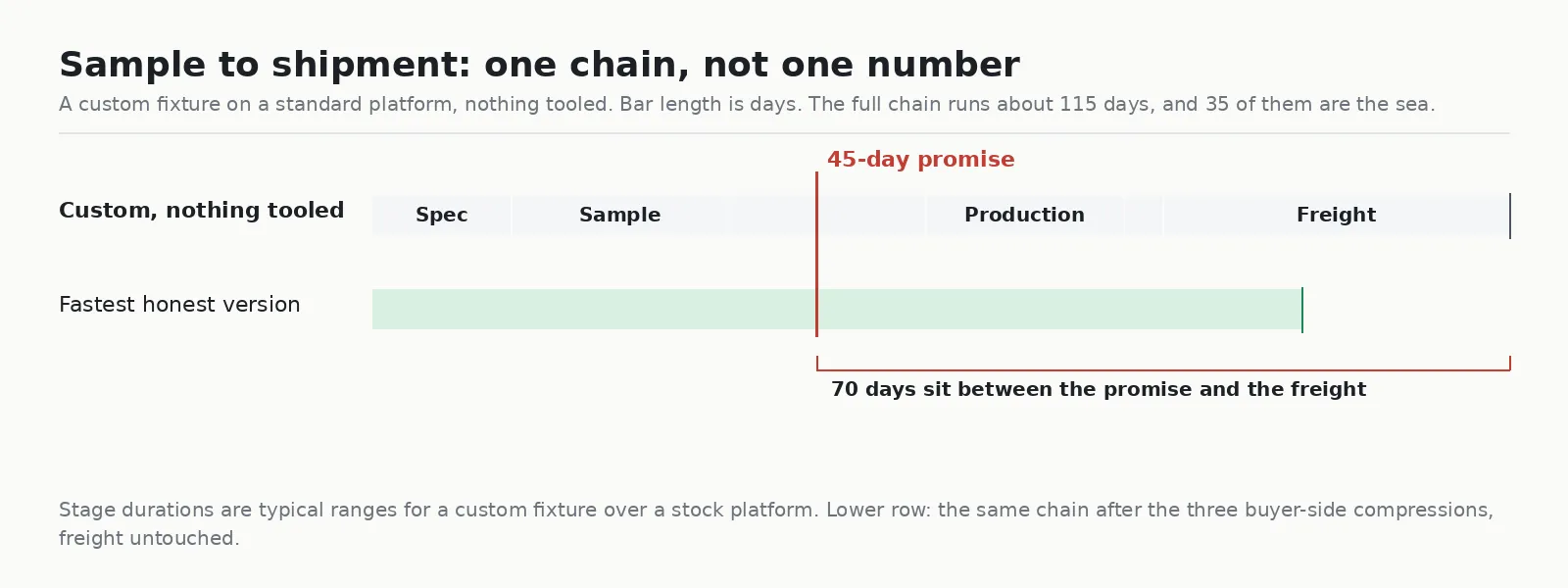
Add it up and you land between 75 and 120 days, with the middle of the range a little past 100.
Now compare that with the number most purchase teams write into their own project plan: materials plus production plus inspection, which is 30 to 45 days. That is exactly the figure the factory quotes, and it is not dishonest — it is the part the factory actually controls.
The other 60 to 70 days never appear on a quotation. They are not hidden; they belong to different parties. But if you reverse-schedule an opening date from a 45-day number, those 60 days arrive as a shock, all at once, usually two weeks before handover.
Day Zero Is the Approved Sample
Most arguments about lead time are really arguments about a single sentence: what day does it start on?
There are at least four candidate starting points in circulation, and they differ by three weeks:
- The day the enquiry was sent. Buyers like this one. Factories never accept it.
- The day the PO or deposit arrived. The most common written start, and frequently earlier than the day the spec was really settled.
- The day the sample was signed off. The moment factory capacity is genuinely committed.
- The day materials landed. Only after a complete kit does the production calendar mean anything.
A factory can only stand behind number three and later. The reason is not evasive: before the sample is signed, too many things can still change. A finish one shade darker, flux one bin higher, a driver swapped to DALI, a foam insert added to the carton — every one of those restarts first-article approval and re-queues the line.
So the industry convention, “25–35 days after sample approval,” is not a hedge. It is a contract term with a requirement embedded in it: the approval has to be in writing.
Three things belong in that approval email: which model, which finish, which drawing revision; that this date is day zero; and that any later change restarts the clock. Written that way, most “late deliveries” evaporate, because most of them are changes that were never charged their true cost in time.
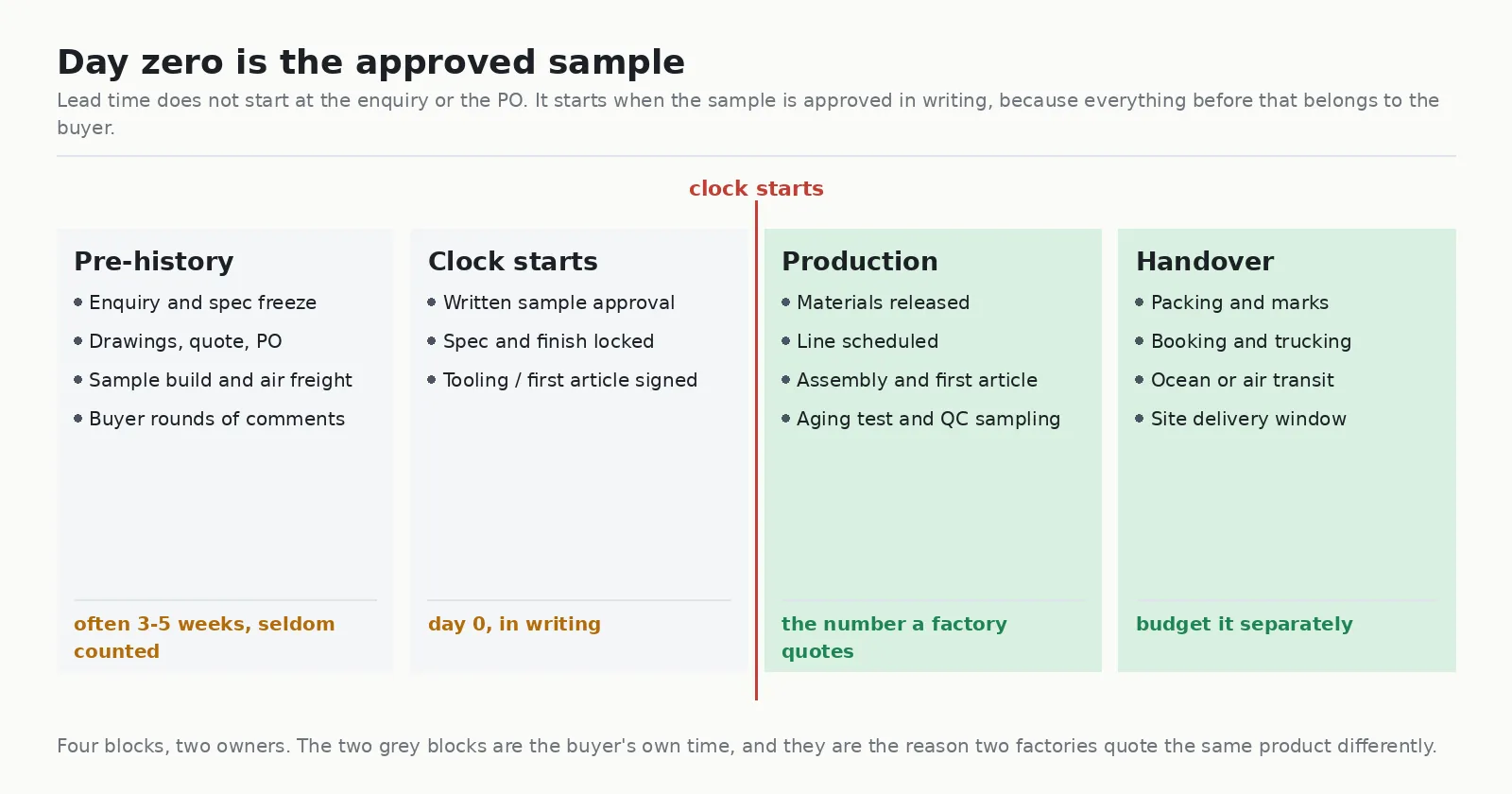
Two grey blocks, two green blocks. The grey ones are the buyer’s own time, and they are why two factories quote the same product three weeks apart.
Sampling Is Slower Than Production
Here is the counter-intuitive part. A sample usually takes longer than the production run it precedes.
Production is scheduled. Sampling is inserted. A sample has to clear engineering confirmation, a hand build or pilot run, assembly, a power and photometric check, photography for the buyer, and then international courier.
The last two steps are where the calendar dies. Courier transit is 3–7 days and internal sign-off is another 3–10. During those ten days nothing moves on the factory floor, but your opening date does.
Then comes the review loop. A designer looks at appearance, engineering looks at parameters, purchasing looks at price, and the owner looks at budget. Four roles, four rounds, roughly a week per round. A 22-day sampling cycle becomes six weeks without anyone doing anything wrong.
What a buyer can do, in order of payoff:
- Name one person who can sign. Not a committee. Committees do not approve samples, they discuss them.
- Give every comment in one round, including the hypothetical ones — “what would it cost if we wanted this darker” — asked at the same time as the real ones.
- Ask for two samples, not one. One to sign, one to keep as the incoming-inspection reference for the bulk order.

Sample approval is a comparison exercise: approved sample versus production. Keep a sealed one, or the argument in six weeks has no reference point.
Materials: The 20 Days Outside Everyone’s Control
When a factory says “our lead time is 25 days,” there is usually an unstated premise: the materials are on the shelf.
Some of the materials in a light fixture are never on the shelf:
- LEDs in a specific bin. Tighten CCT and hold SDCM inside 3 steps and you may be waiting for the next wafer lot.
- A named driver model. Protocol drivers — DALI-2, Casambi, Matter — have the widest swings.
- A non-standard aluminium extrusion. 15–25 days to cut the die, then anodising or powder coating on top.
- Certification-bound cable and terminals. Some markets call for specific temperature or flame ratings, and substitutes are not interchangeable.
The cruelty of this stage is structural: it is outside the factory’s control and still counts against the factory’s clock.
A buyer’s move: fix brand and model on the critical BOM up front, then ask one direct question in the RFQ — which of these are you holding stock of, and which are bought per order? The answer separates a real quote from a hopeful one.
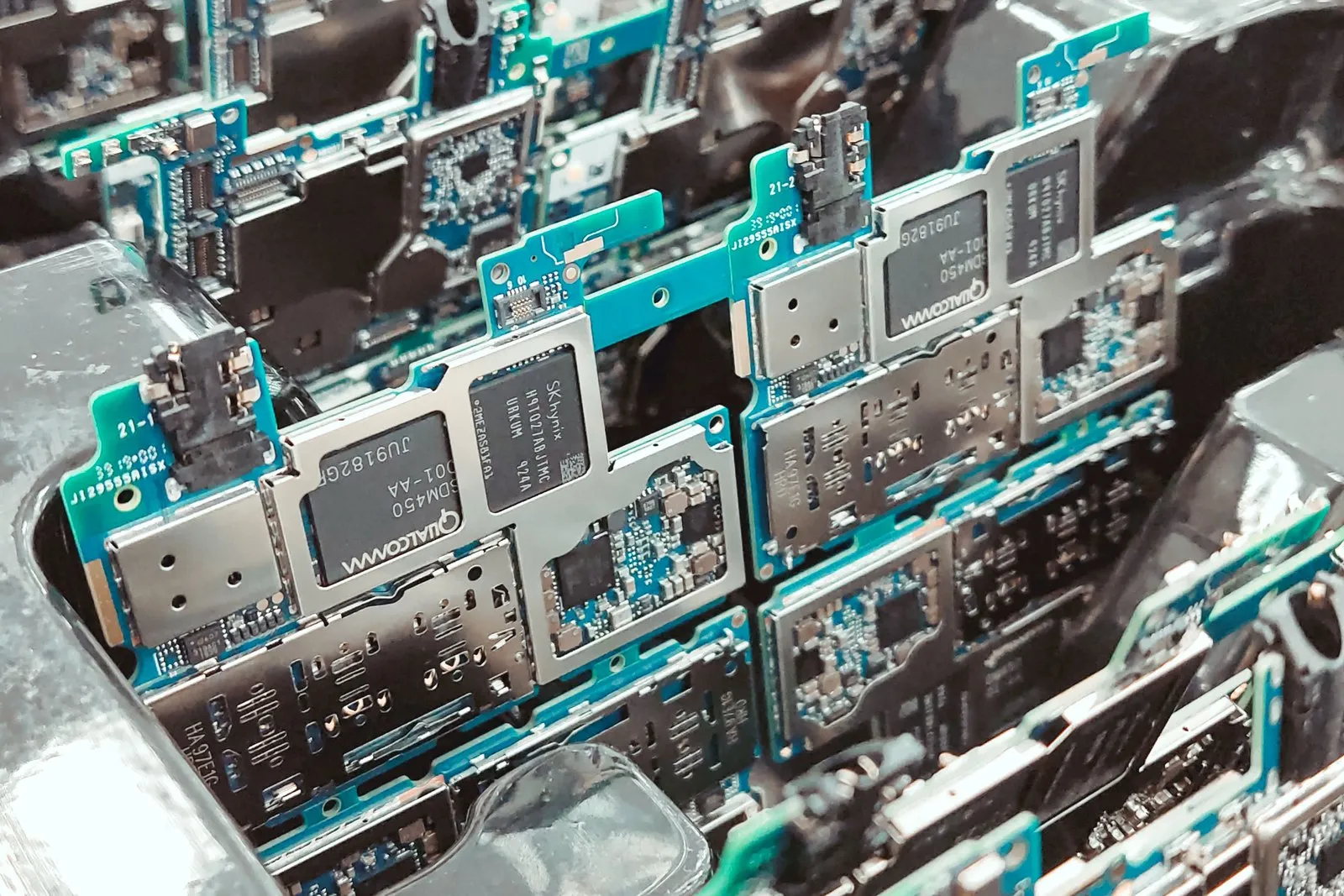
Driver boards are the part of the BOM most likely to arrive late and least likely to be substitutable.
Production: Twenty Days With Very Little Give
Production looks like the soft number. It is the hardest one.
A line’s calendar is set. Your order either occupies a window somebody else vacated or waits for the next round. First article, assembly, aging and photometric sampling run in series. You cannot halve the aging because you are in a hurry, because aging is the step that removes early failures before they reach a ceiling.
Negotiating a shorter lead time is not making the line faster. It is getting your order into an earlier slot. That usually costs an expedite fee, or a substituted material, or both.
Two compressions that genuinely work:
- Stay on the platform. Use a housing and optical engine the factory has already validated, and change only cosmetics and parameters. You skip a whole cycle of first-article iteration.
- Split the delivery. Build the 20% that unblocks the site — lobby, mock-up room, main entrance — and ship the balance later.
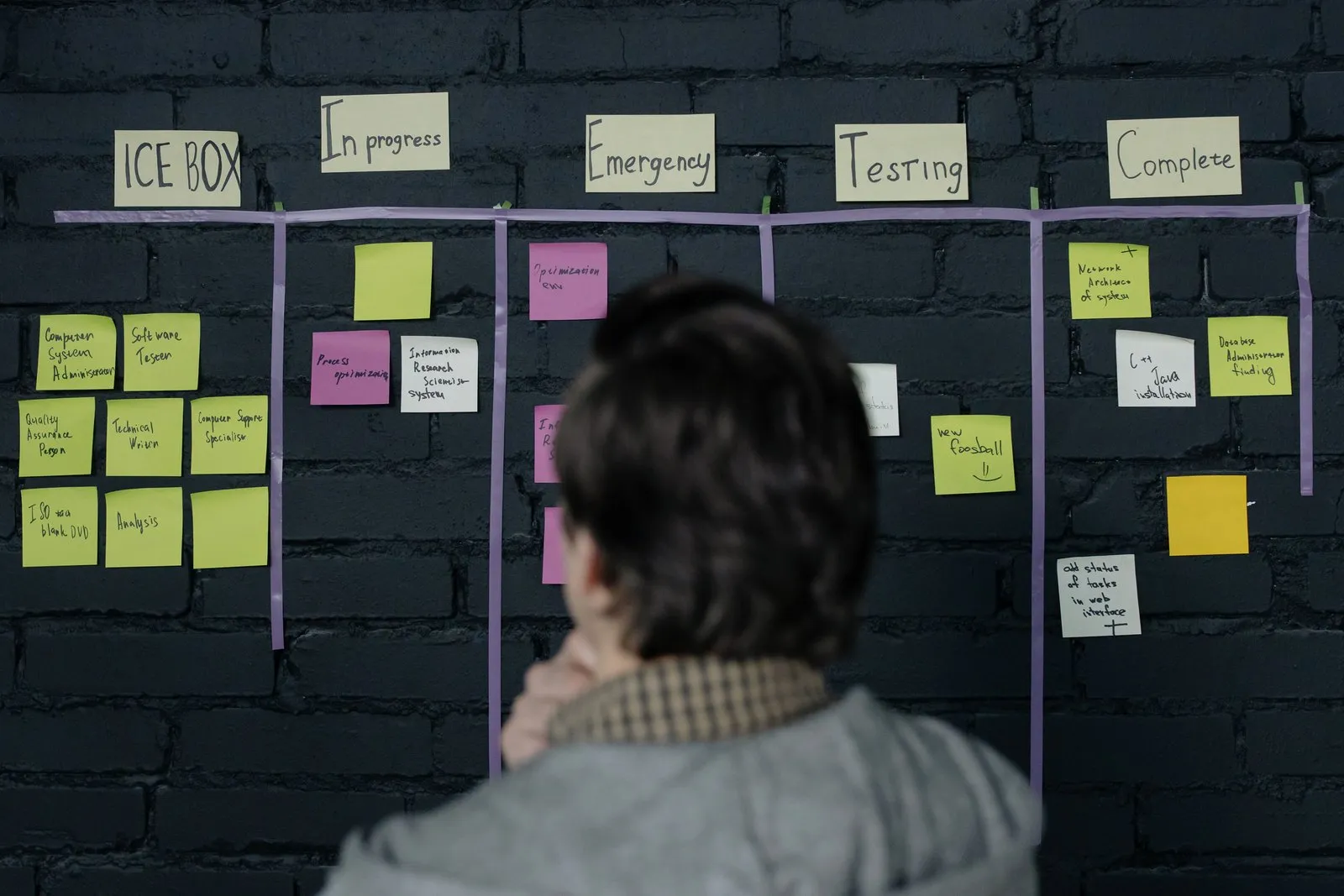
Sequencing is the real currency. An order that arrives before the schedule is frozen gets a slot; an order that arrives after it gets a date.
Testing and Packing: The Days You Should Not Touch
Three to four days covers 100% aging, a photometric spot check and AQL sampling before the carton closes. On a commercial project this is not padding.
Aging runs 4 to 24 hours depending on the specification, and it is the only gate that catches a driver that fails at hour six rather than at minute one. Photometry on an integrating sphere confirms that the delivered flux and CCT match the signed sample. Sampling inspection decides whether the batch ships or is reworked.
Compress this and nothing visible happens for about six months. Then it happens on a client’s ceiling, at your cost, in a building you have already handed over.
Freight: The Stage That Swings
Same pallet, four routes:
| Mode | Door to door | Freight index |
|---|---|---|
| Sea, FCL | 25–40 days | ×1.0 |
| Sea, LCL | 32–48 days | ×1.35 |
| Rail, EU-bound | 25–35 days | ×1.6 |
| Air, loose | 5–10 days | ×6.5 |
Four details behind that table:
- Sea transit is not sailing time. Booking, cut-off, trucking, destination clearance and final delivery all live inside “25–40 days.” Peak-season space shortage pushes the top of the band higher, without notice.
- LCL costs a week you did not budget. Waiting for a container to fill, then deconsolidation at the other end, adds roughly one to ten days. Small custom runs of a few hundred pieces land here, and are usually quoted against an FCL timeline.
- Air freight buys time, not economy. Light fixtures are volumetric cargo — chargeable weight is driven by volume, not by the scale. Loose air freight often runs 10–30% of the goods value. It is a rescue lever, not a shipping strategy.
- Ports are not interchangeable. In a congested month, routing through a second-tier port can save a week, at the cost of an extra inland leg.
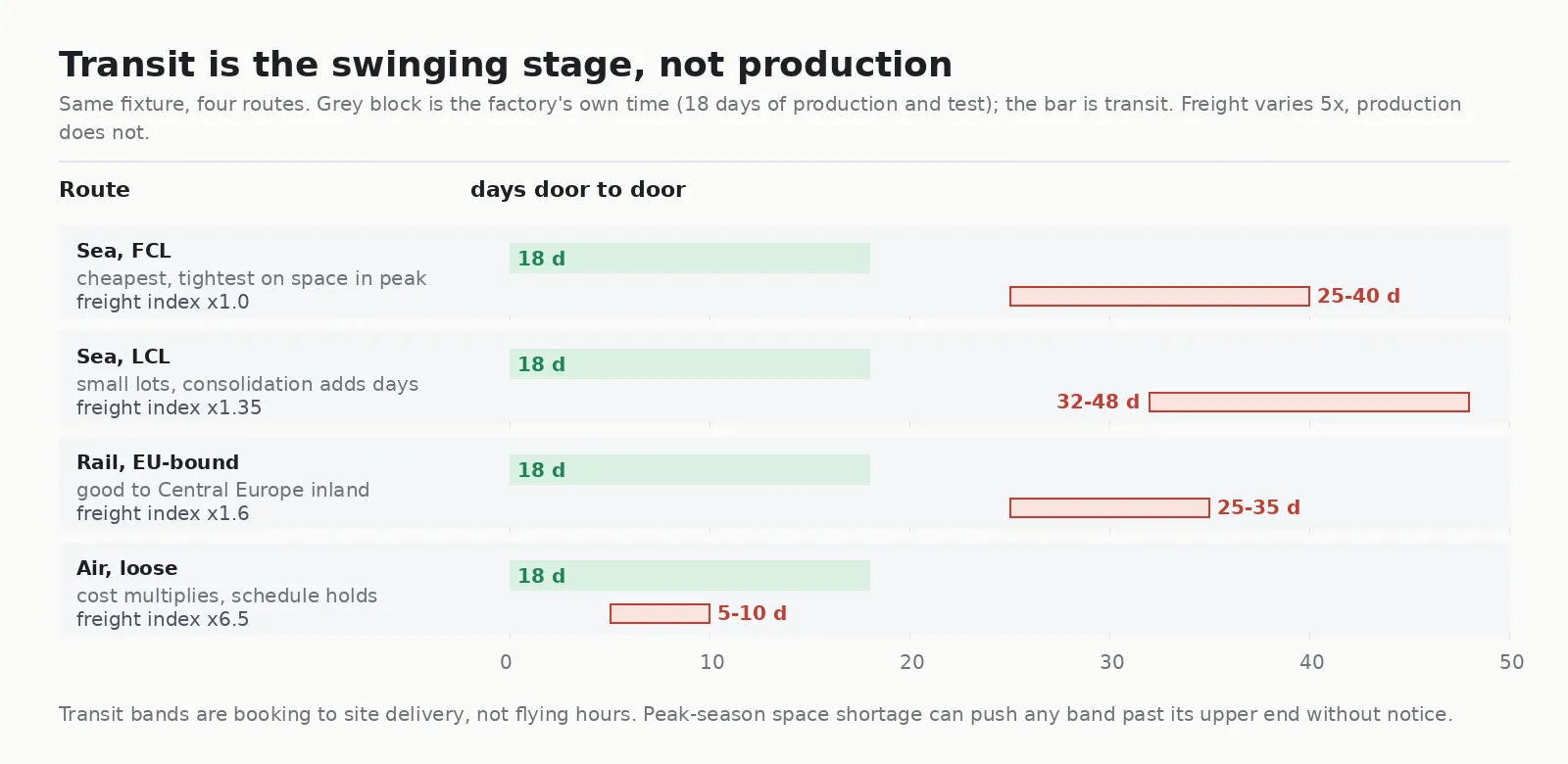
Production is 18 of these days on every row. The bar that changes is the one you have least control over.
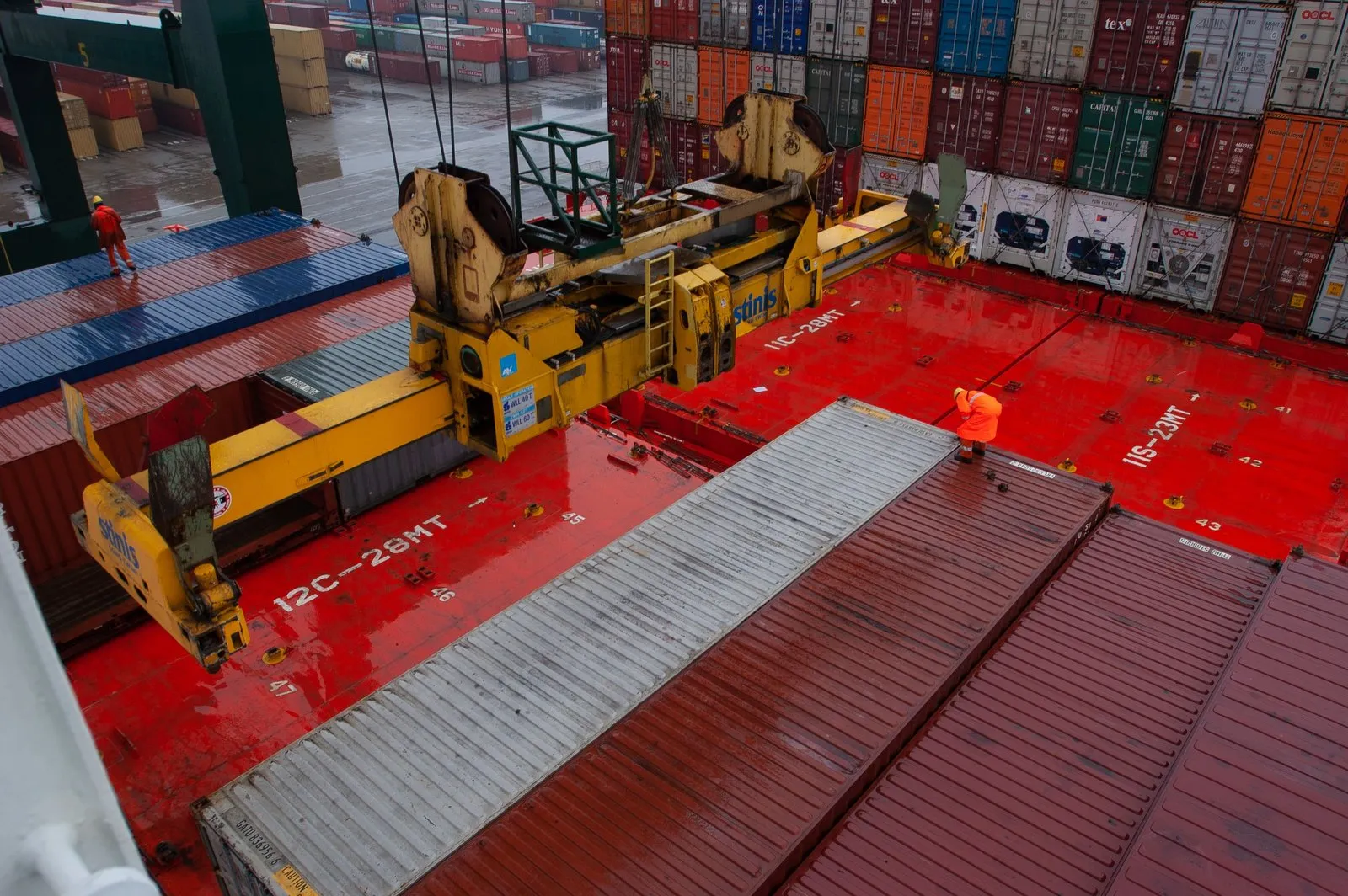
The handover point. Everything to the left of this crane was the factory’s problem. Everything to the right is yours and the forwarder’s.

The Six Weeks a Year You Cannot Promise
The single biggest scheduling hazard for overseas buyers is Chinese New Year, and it is not a one-day event. Six weeks around it are the only window in the year where you can predict that everything will be late: workers travel home, lines run short-staffed, forwarders run out of space, customs slows down.
An order placed two weeks before the holiday can realistically begin production in the second week after it.
Three more predictable disturbances:
- Trade fair season. Engineering and export staff are on the stand, so sampling and approvals slow down.
- Peak season, roughly August to October. Capacity tightens for European and North American winter stock, and rates follow.
- Certification queues. If the product needs a new ETL, CE or SAA test, the laboratory has its own backlog. This step is routinely left out of schedules and routinely costs three to six weeks.
A practical rule: treat 45 days before Chinese New Year as a hard line. A custom order placed after it either pays for priority capacity or accepts delivery after the holiday.
When It Slips: Levers and Wishes
If the date is already at risk, these options are not equivalent. Some recover a fortnight, some recover nothing.
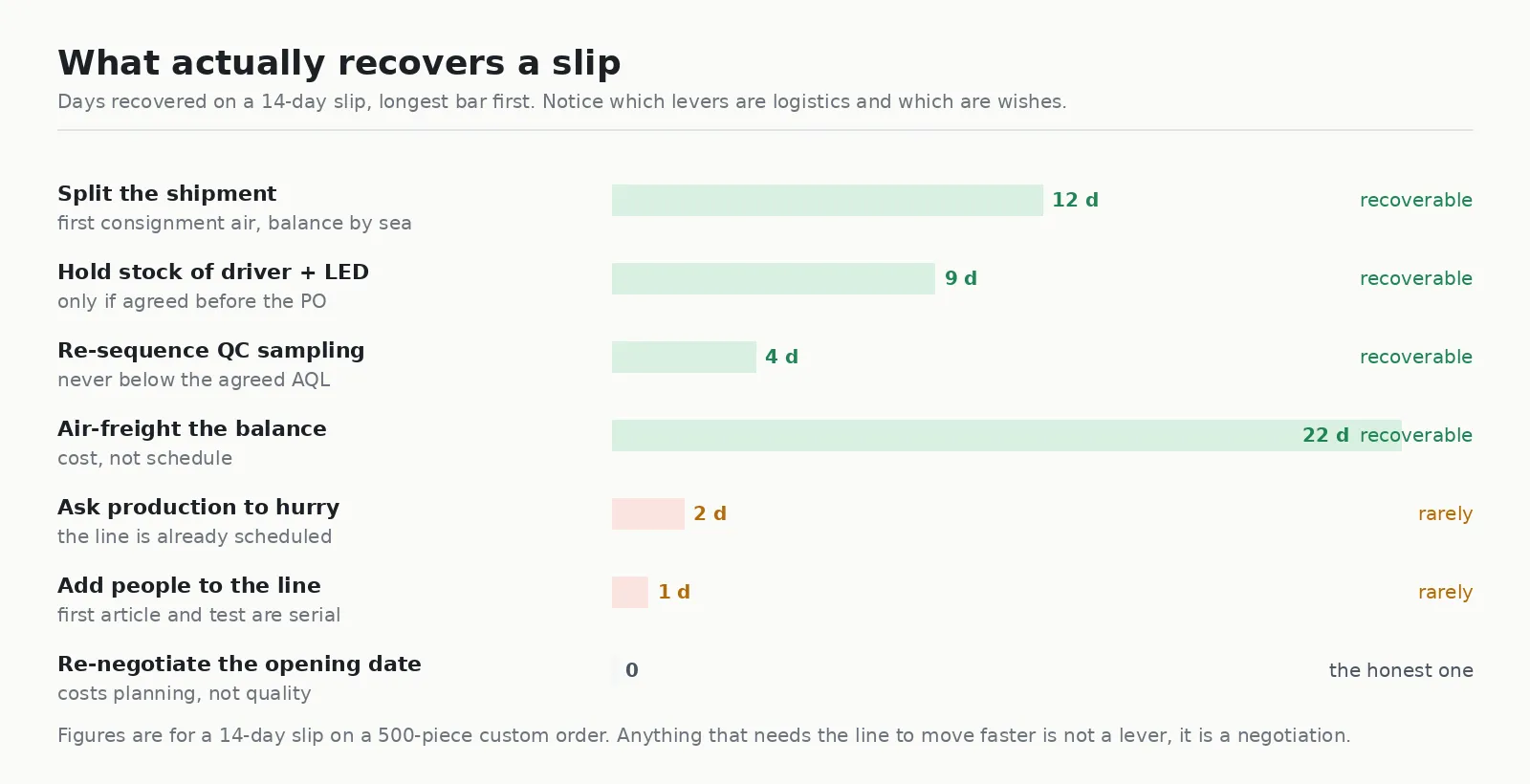
Levers, on the logistics side
- Split the shipment. Fly the finished 20% that unblocks the site; sea the balance.
- Air-freight the remainder. Money for time, typically about three weeks.
- Re-sequence inspection around a fixed opening date. Shorten nothing that affects reliability; move the sequence instead.
Wishes, on the production side
- Ask the line to hurry. The line is already scheduled. Worth one or two days at most.
- Add people. First article, aging and photometry are serial. Headcount does not shorten a serial step.
- Ship now, send the paperwork later. Goods without valid compliance documents do not clear the port. Net negative.
There is one honest move on that list, and it is the one nobody wants to make: re-plan the opening. It looks like surrender. It is actually moving risk from product quality to schedule, which is the only place it can be carried without a return.
Reverse-Schedule It, Then Negotiate
The useful way to use all of the above is backwards. Start at the opening date and subtract:
freight → inspection and packing → production and aging → materials → sampling and approval → spec freeze.
What falls out is your real order-by date, and it is usually three to six weeks earlier than the date in the project plan.

On site, lighting is rarely late alone. It is late because it was ordered against a promise date instead of a reverse schedule.
Seven Questions That Replace “How Long?”
Do not ask for one number. Ask these, and ask for the answers in writing:
- What does your lead time start from — written sample approval, or the PO date?
- Can you quote it in stages — materials complete, production complete, ship date, arrival date?
- Is that figure based on stock materials or on per-order purchase? If a part is short, what is the substitute and what does it cost in days?
- How long is aging, and what is the AQL? These two are where schedule pressure gets silently transferred to you.
- How much do you add for peak season and for Chinese New Year?
- If it slips, what are your recovery options, and who pays for air freight?
- After approval, how does a change re-set the clock? Does re-printing a logo re-queue the line?
A supplier who answers all seven in one email is not necessarily the cheapest. They are the one whose dates you can plan against.

Where ENCORE Fits
We build custom track lighting, downlights, magnetic systems and commercial fixtures on platforms that are already tooled and already certified, which is what keeps the bottom half of that table short. Sample lead time, production slot and shipping mode are quoted as three separate dates, never rolled into one number.
- Track lighting — VEGA, FLEX, IMAX, OVEGA families, with custom finish and optics on existing tooling
- LED downlights — ELLA, Galaxy, DELLA and AVA platforms
- Magnetic track systems and commercial lighting
- OEM/ODM services — what can change without a new mould
- Quality control — the aging and sampling gates that sit inside the production days above
- Series comparison — model-by-model, including which variants share a platform
If you want the sourcing model decided first, our custom vs stock commercial lighting guide maps customisation levels onto both lead time and order volume, and the LED factory QC line walkthrough explains why the testing days are not negotiable. Buyers still choosing a factory should start with how to vet an LED lighting manufacturer before an RFQ.
The Short Version
- Lead time is a chain of six stages, not one number. 75–120 days from enquiry to site on a typical custom fixture.
- The clock starts at written sample approval. Everything before it is the buyer’s time, and it is where most slippage is born.
- Sampling is slower than production, because courier and sign-off are serial and review rounds multiply.
- Production is the least compressible stage. You are buying a slot, not speed.
- Freight swings 5×. It is the largest single variable in the whole schedule, and the one most often left out of the plan.
- Reverse-schedule from the opening date. The order-by date that falls out is the only one that means anything.
FAQ
How long does custom LED lighting take from order to delivery? Around 75 to 120 days for a custom fixture on an existing platform, measured from enquiry to site. The factory’s own portion — materials, production, testing and packing — is typically 30 to 45 days of that. The rest is sampling and freight.
Why is the factory’s quoted lead time so much shorter than actual delivery? Because the quotation covers only what the factory controls. Sampling, buyer sign-off and ocean transit sit outside it. A serious supplier will quote in stages rather than defending one total.
How long does sampling take? 15 to 22 days for the build and photometric check, plus 3 to 7 days of courier and, realistically, another week or two of internal review. Multi-round review is the most common cause of a six-week sampling cycle.
Does air freight really save three weeks? On a Europe or North America lane, yes — roughly 20 to 30 days against sea. The trade-off is cost, often 10–30% of goods value for volumetric cargo such as luminaires. It works as a rescue, not as a plan.
Will Chinese New Year delay my order? If it is placed within about six weeks of the holiday, very likely. Factories wind down before it and ramp up after, and forwarders run out of space on both sides. Treat 45 days before the holiday as a hard cut-off for custom orders.
Can I pay to speed up production? You can usually buy a priority slot, which is worth days rather than weeks. No fee shortens first-article approval, aging or photometry, because those steps run in series and are the evidence your certificate rests on.
Does order quantity change the lead time? Yes, but less than buyers expect, and mostly through materials rather than assembly. A small run may wait for a shared production window; a large one may wait for a wafer lot or a driver shipment. Both effects appear in the materials stage, not the line.
Should the lead time start at the PO? Only if the specification is genuinely frozen at the PO. In practice it rarely is, which is why most factories start the clock at written sample approval and most schedule failures start with a PO date written into a project plan.
- custom led lighting lead time
- oem lighting production time
- custom led lead time
- led lighting lead time
- led sample approval
- factory production schedule
- sea freight transit time lighting
- chinese new year lead time
- custom lighting delivery schedule

ENCORE Lighting Team · ENCORE
LED Lighting Manufacturer & OEM/ODM Partner
The ENCORE engineering and sourcing team writes about LED track lighting, downlights, magnetic systems, certifications and OEM/ODM manufacturing for B2B buyers and specifiers.