· Sourcing & Quality · 16 min read

Written by ENCORE Lighting Team
LED Lighting Manufacturer & OEM/ODM Partner ·
QC for Custom LED Orders: Aging Tests, First-Article & Sampling Plans
A practical LED lighting quality control guide for custom orders: the three QC gates that stop sample drift, how long an aging test should actually run, what first-article approval must confirm, and how to read an AQL sampling plan for an LED lighting batch.
A standard fixture has a datasheet, three years of production history, and a process nobody has to think about anymore. A custom order has none of that. It is the first time the CCT is built, the first time the finish is sprayed, the first time the driver is matched, the first time the optic is tooled.
The first time anything is made, it can be made wrong.
Most buyers treat quality control as the step at the end — pull a few units out of the last carton and look at them. For a standard product that is just about enough. For a custom order it misses where things actually go wrong:
- The first article was never frozen. The sample scored 95 and the shipment scored 80, because nobody wrote down what “correct” meant.
- Aging was skipped or faked. Everything lights up on the bench and the driver starts failing in month two, on site.
- There was no sampling plan. “We check about 5%” turns out to mean five units, and nobody can name the AQL level.
So this guide makes one argument:
Quality on a custom order is not inspected in — it is defined in. Define correct first, then defend it.
LED lighting quality control for a custom order runs through three gates. For each one, this article covers what “done properly” actually looks like.
The Three QC Gates: A Framework
| Gate | Name | When it runs | The question it answers | What it produces |
|---|---|---|---|---|
| Gate 1 | First-Article Approval | Before mass production | Do we agree on what “correct” means? | Signed golden sample + FAI report |
| Gate 2 | Aging / Burn-in Test | After assembly, before packing | Does this batch contain early-life failures? | Aging log with hours, temperature, failures |
| Gate 3 | Sampling Plan (AQL) | At 80–100% complete and packed | Can this batch be released? | Inspection report with AQL data and photos |
The order is not negotiable. Gate 1 defines the standard. Gate 2 removes hidden defects. Gate 3 defends the batch. Skip Gate 1 and Gates 2 and 3 are measuring the wrong thing.
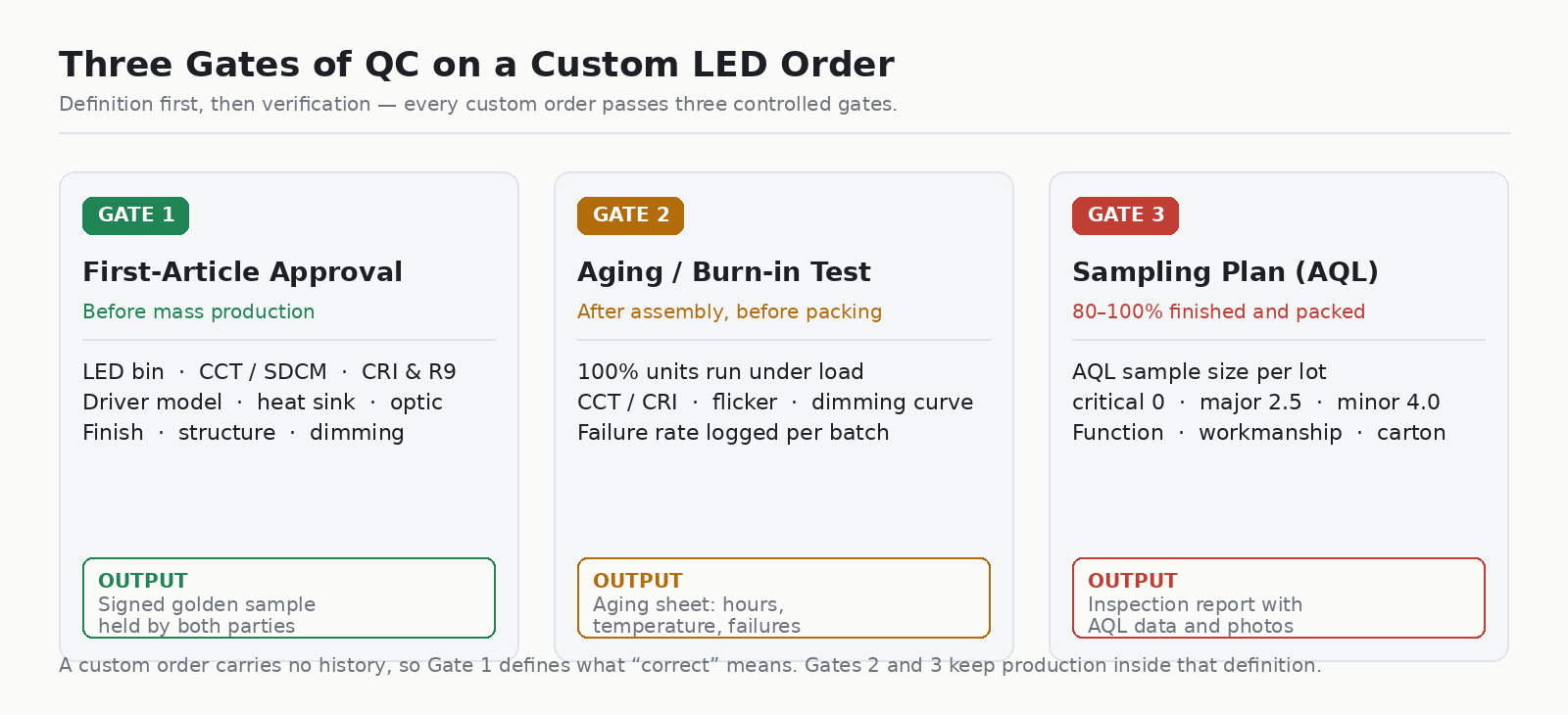
A custom order carries no production history, so Gate 1 is where “correct” gets written down. Gates 2 and 3 keep production inside that definition.
Gate 1 — First-Article Approval
Why it matters more on a custom order than anything else
On a standard product, the definition of “correct” lives in the datasheet. On a custom order, the definition of “correct” lives in exactly one place: the first unit that comes off the line.
If that unit is not approved, sealed and signed, then every operator on the line is working from their own idea of whether that colour is right or that gap is too wide. Sample drift is almost never the factory getting worse. It is the moment nobody defined what “the same” means.
What first-article approval must confirm
- Light source. LED brand and model, the bin code, CCT, SDCM colour consistency, CRI/Ra and — the metric most cheap fixtures quietly fail — R9, the deep-red value that decides how skin tones and merchandise read in retail, galleries and hospitality.
- Driver. Brand and model, constant-current accuracy, dimming capability, dimming curve, flicker.
- Thermal design. Heat-sink material and profile, thermal interface material, temperature rise at rated load.
- Optics. Delivered beam angle versus claimed, beam uniformity, glare control.
- Finish. Colour and texture, anodising or powder-coat process, markings.
- Structure. Mounting method, rotation and tilt mechanisms, sealing design where an IP rating applies.
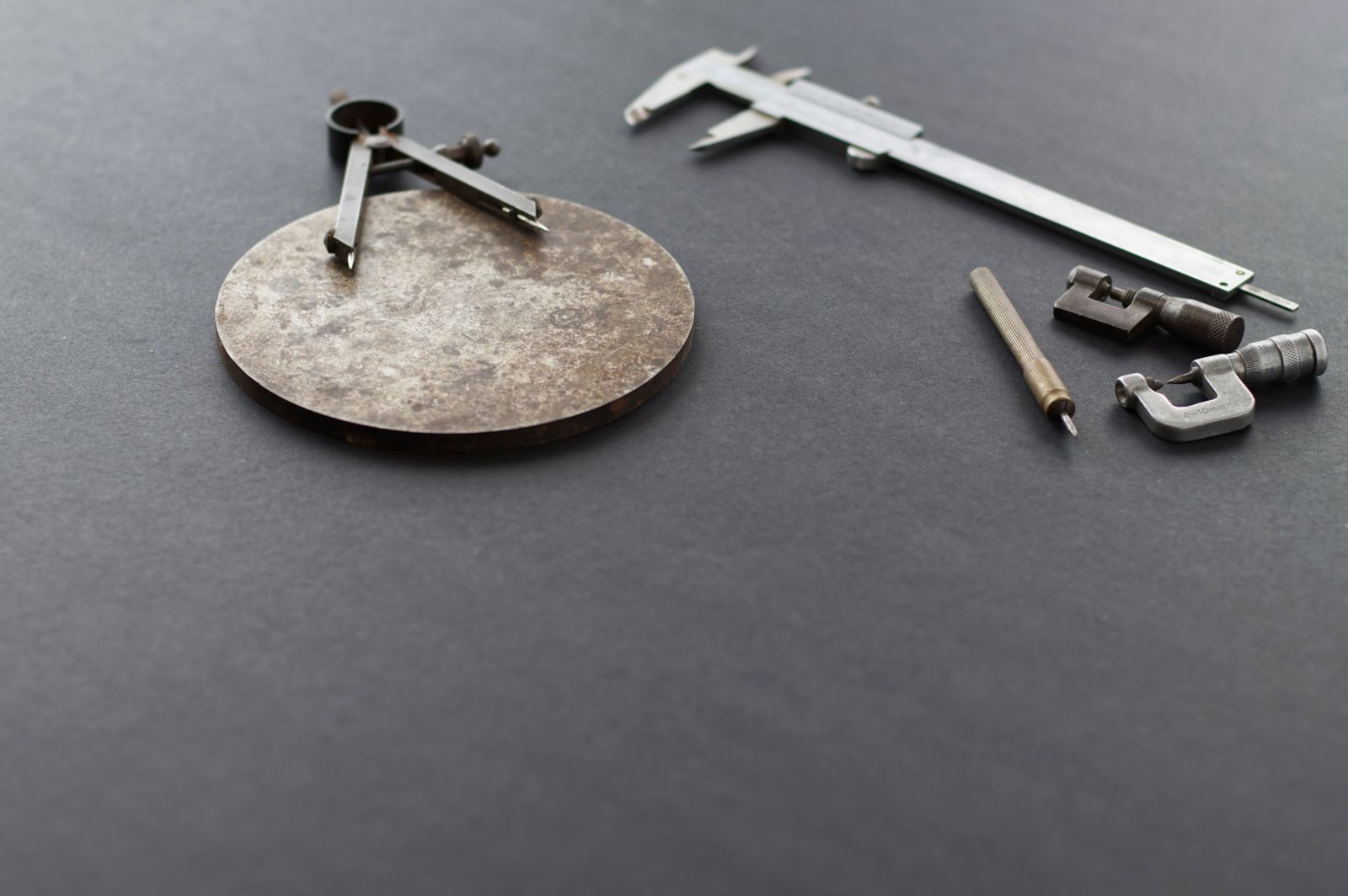
First-article approval is a measurement, not an opinion. Every value on the FAI sheet should be a number you can reproduce.
The golden sample: the cheapest thing in this whole article
The last step of first-article approval is not a nod and an “looks good”. It is:
- A golden sample signed by both parties — one unit each.
- A first-article inspection (FAI) report recording what was confirmed and at what value.
- Those values written into the PO.
Every later argument about colour shift, gaps or feel is settled against those two units. A sealed sample is the only mechanism that turns “I think” into “we agreed”.
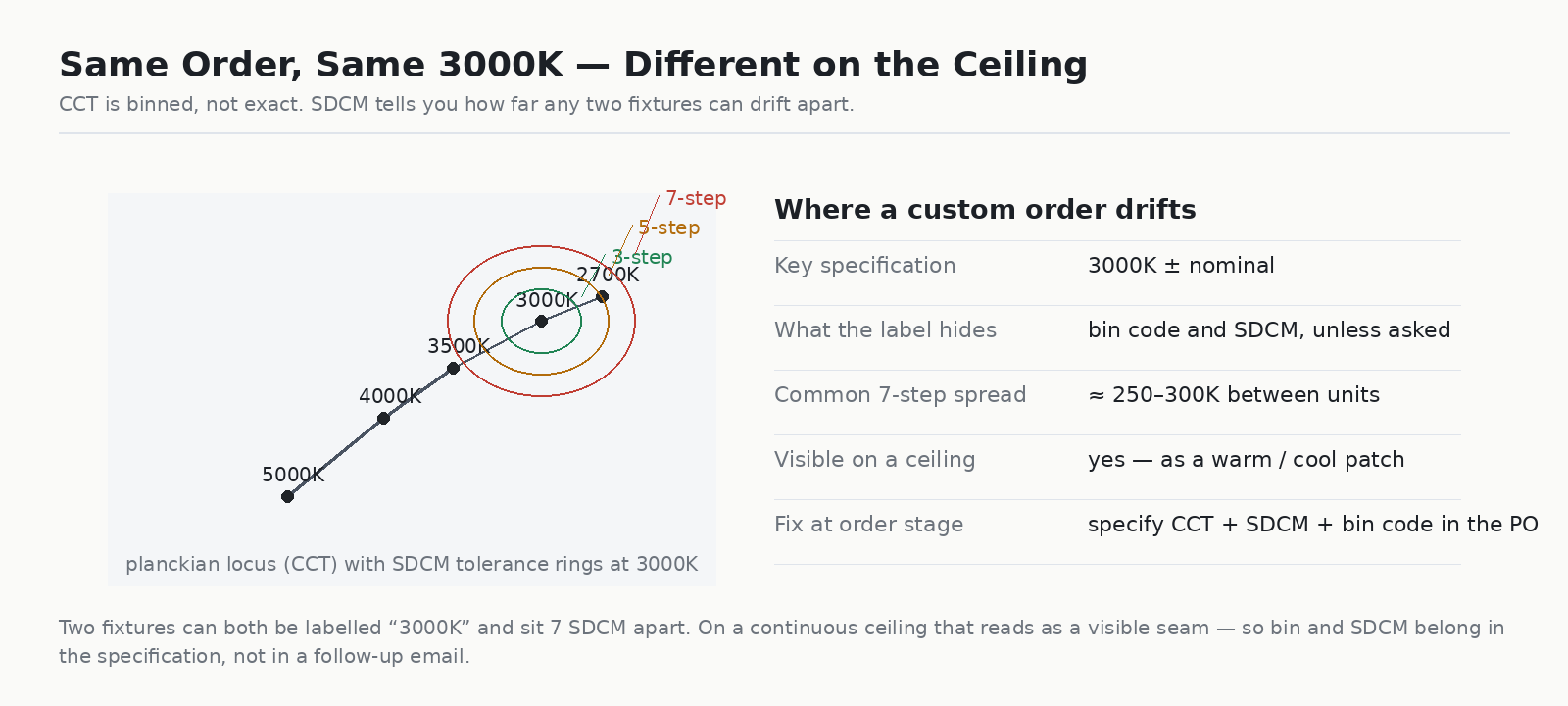
“3000K” is a bin, not a value. Two fixtures from the same order can sit 7 SDCM apart, and on a continuous ceiling that reads as a warm/cool seam.
Gate 2 — Aging Tests
What an aging test is actually measuring
LED fixture failures follow a bathtub curve over time. Failures cluster early — bad solder joints, a driver component, a seal that never seated — then the product settles into a long, flat useful life, then wear-out resumes at the far end.
An aging test exists to buy that high-risk early window before the goods ship. A unit that lights up on the bench may still be one of the units that would have died at hour 200. The only way to know is to already have run it for those 200 hours, in the factory, where it is cheap to catch.
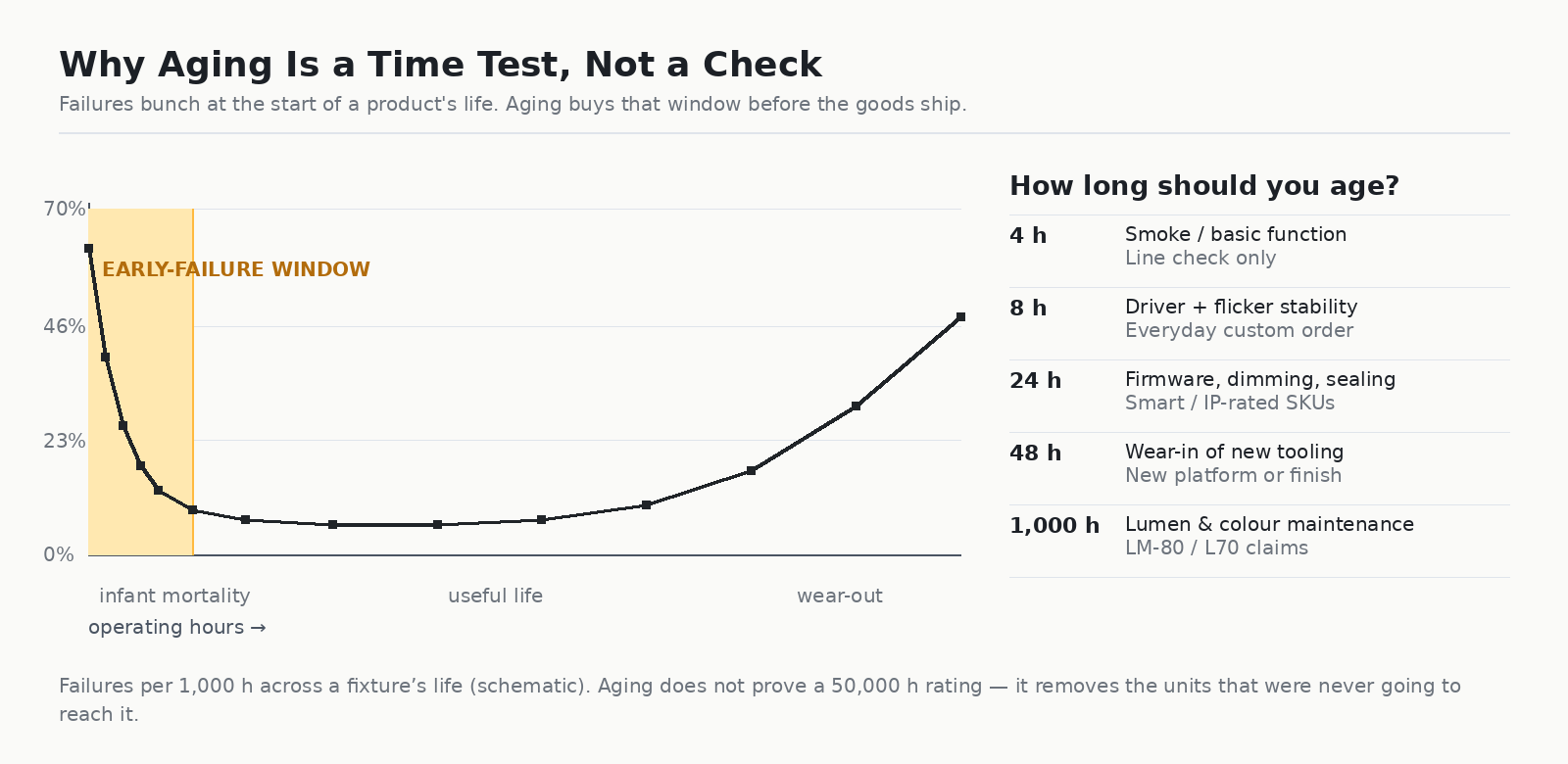
Aging is a time test, not a check. It does not prove a 50,000-hour rating — it removes the units that were never going to reach it.
How long should you age?
| Duration | What it exposes | Where it fits |
|---|---|---|
| 4 h | Dead-on-arrival, basic function | In-line self-check |
| 8 h | Driver stability, flicker | Everyday custom order |
| 24 h | Firmware, dimming behaviour, sealing | Smart and IP-rated SKUs |
| 48 h | Wear-in of new tooling and finishes | New platform or new finish |
| 1,000 h | Lumen maintenance and colour shift | LM-80 / L70 claims |
The number of hours matters less than whether a record exists. “We aged it” is a claim. “Here is this batch’s aging log: 48 hours, 45 °C ambient, 2 failures, quarantined” is evidence.
What “done properly” looks like
- 100% aging, not a sample of it.
- Units run powered and dimming, not merely lit.
- Ambient temperature, duration, failure count and failure cause are logged.
- Re-measurement after aging — CCT, CRI and lumen output — because a fixture that is still settling will shift colour after burn-in.
- Failures are quarantined, never repaired back into the batch.
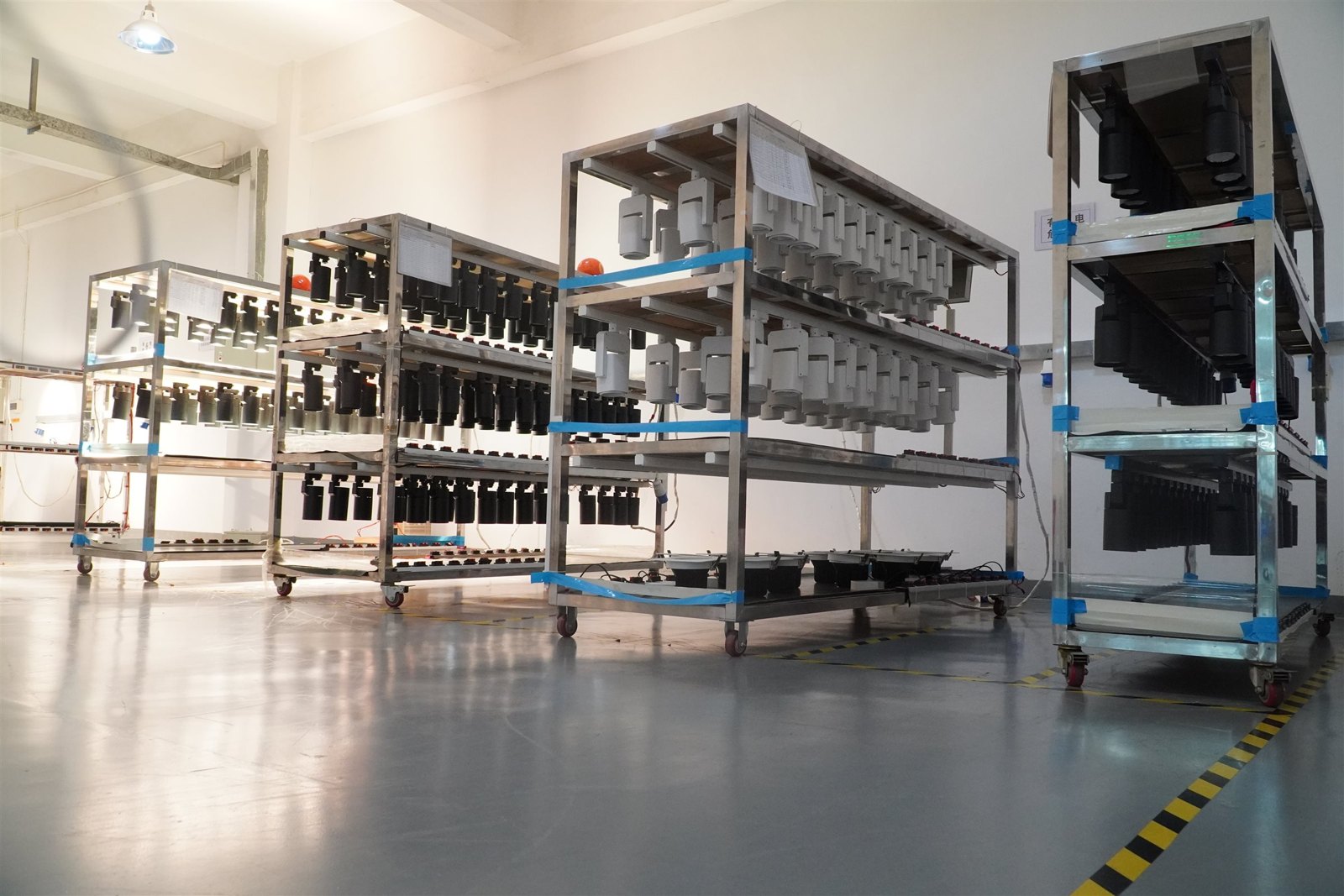
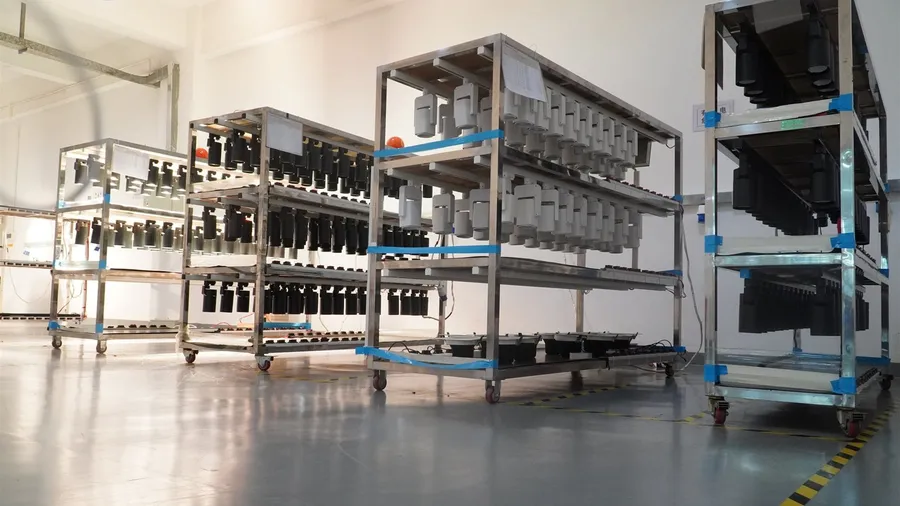
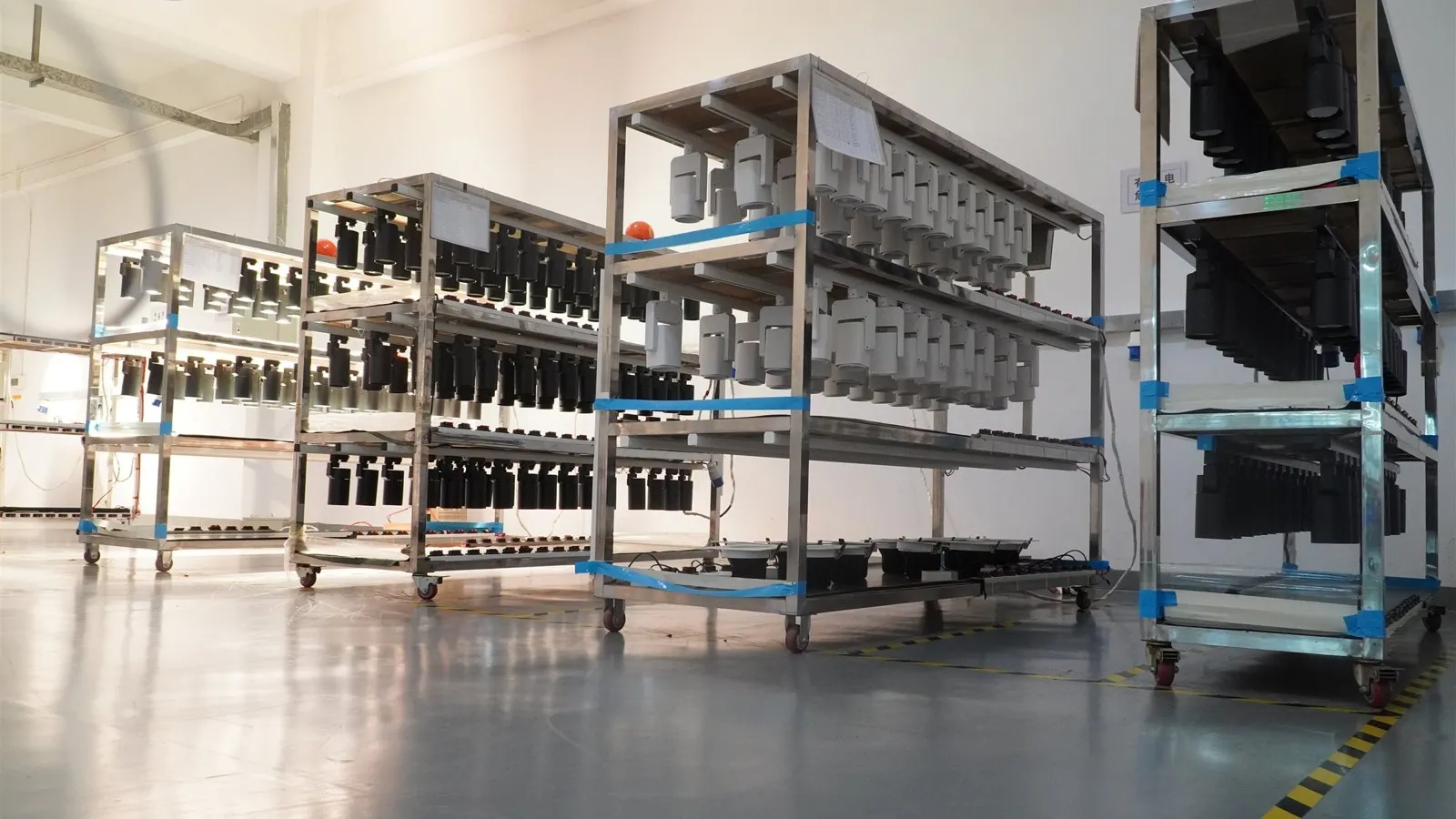
ENCORE’s own aging room: every order runs 100% of units under load before packing, with hours and failures logged per batch.

Quality control on a custom order is three gates in sequence, not one final look at the last carton.
Gate 3 — Sampling Plans and AQL
Why you cannot inspect everything, and why AQL exists
Full inspection is expensive, and some tests are destructive — sealing and life testing cannot be run on the units you intend to sell. Sampling uses statistics to judge a batch at a controlled, known risk instead of an unknown one.
AQL — Acceptable Quality Limit — is the language that controlled risk is written in.
How defects are classified
- Critical — safety, a dead unit, the wrong model. AQL 0. Not one is acceptable.
- Major — function affected, visible at distance. Commonly AQL 2.5.
- Minor — cosmetic only, no functional impact. Commonly AQL 4.0.
AQL quick reference — general inspection level II, single sampling, normal severity
| Lot size (units) | Code | Sample size | AQL 1.5 | AQL 2.5 | AQL 4.0 |
|---|---|---|---|---|---|
| 151 – 280 | G | 32 | 0 / 1 | 1 / 2 | 3 / 4 |
| 281 – 500 | H | 50 | 1 / 2 | 2 / 3 | 5 / 6 |
| 501 – 1,200 | J | 80 | 2 / 3 | 3 / 4 | 7 / 8 |
| 1,201 – 3,200 | K | 125 | 3 / 4 | 5 / 6 | 10 / 11 |
| 3,201 – 10,000 | L | 200 | 5 / 6 | 7 / 8 | 14 / 15 |
Ac / Re pairs: accept at or below the left number, reject at or above the right. Example: a 2,000-unit order is checked on 125 units (code K). At AQL 2.5, release with 5 or fewer major defects; 6 or more fails the lot.
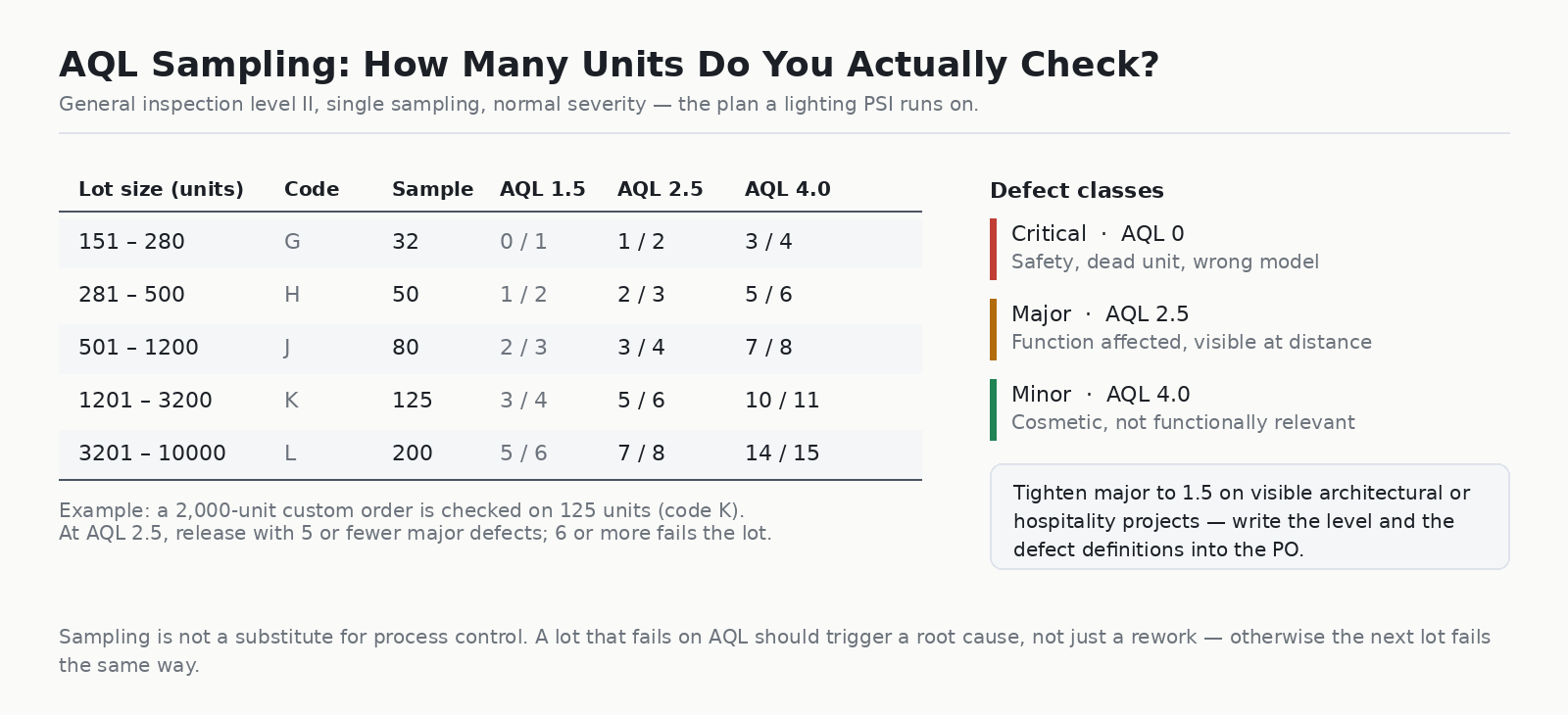
Sampling is not a substitute for process control. A lot that fails on AQL should trigger a root cause, not just a rework — otherwise the next lot fails the same way.
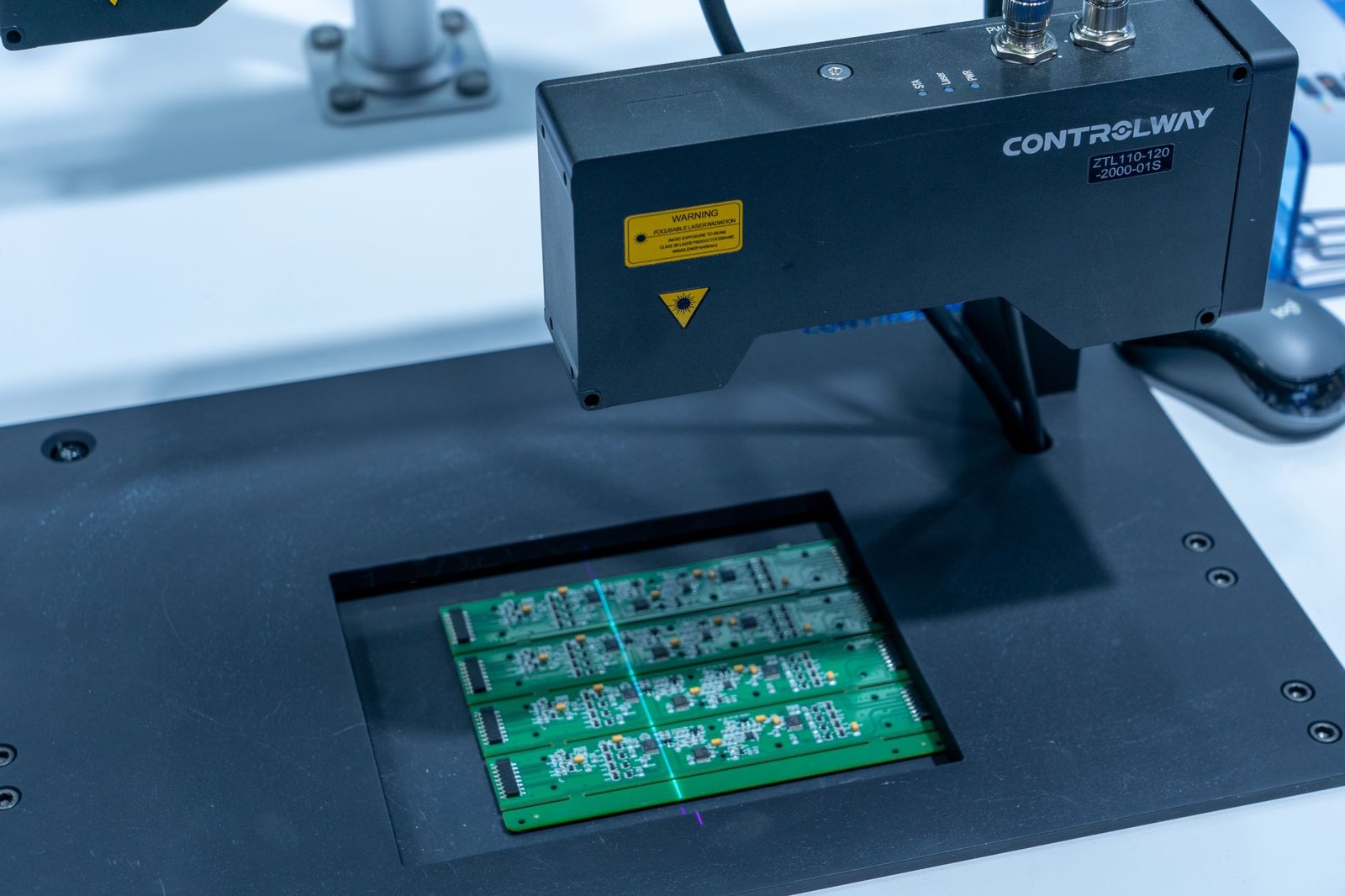
Automated inspection extends coverage, but its output still has to land in a record you can audit against the sample.
How to set AQL for a custom order
- On visible architectural, retail and hospitality projects, tighten major to 1.5 — every unit ends up on a ceiling in plain sight.
- Write the defect definitions down, ideally with accepted / rejected reference photos rather than the phrase “within reason”.
- Sampling samples the process, not just the product. A failed lot should trigger a root cause investigation. If it only triggers rework, the same failure returns next order.
If your order involves fixtures that will sit next to each other on one run, the CCT consistency question is the same one covered in our CCT guide and CRI guide. Both belong in the first-article checklist, not in a follow-up email after the goods land.

A sampling plan is only as good as the report it produces. Ask which document you will receive before the order, not after.
The QC Timeline for One Custom Order
| Stage | Who runs it | What it produces |
|---|---|---|
| RFQ and sampling | Factory | Sample units, specification |
| First-article approval | Both parties | Golden sample + FAI report |
| Mass production (IQC / IPQC) | Factory QC | Incoming and in-process inspection records |
| Aging | Factory QC | Aging log: hours, temperature, failures |
| Pre-shipment inspection | Both parties or a third party | Inspection report with AQL data and photos |
| Release | Both parties | Packing list, certificate model coverage list |
Two calibration points buyers consistently get wrong. First, AQL levels are a product decision, not a factory default — they belong in the PO, signed before production. Second, aging duration belongs in the PO too: “aged before shipping” means nothing unless it specifies hours, temperature, and what failure rate invalidates the batch.

In-process electrical testing is what turns “we test every unit” from a claim into a record with serial numbers, timestamps and a pass/fail column.
Red Flags in Custom-Order QC
- Happy to do a final inspection, reluctant to do a first-article approval — because the first article is where the factory takes on the responsibility of defining the standard.
- Says “we aged it”, cannot produce an aging log.
- Cannot name an AQL level or a defect definition.
- Changes the LED bin without telling you — the single most common root cause of colour shift on a custom order.
- No sealed sample, only “that one you sent us, I remember it”.
- A certificate image with no control number and no model coverage list. Our guide to verifying ETL certification and the CE vs ENEC comparison cover how to check those properly, and ETL, CE (LVD + EMC) and SAA documentation sits alongside the model tables.
How ENCORE Runs QC on Custom Orders
We describe our own process here not as a sales claim but as a concrete reference, so you know what “good” looks like when you audit someone else.
IQC — incoming inspection. Incoming materials are inspected to AQL, and COB LEDs and drivers are stored in constant-temperature, constant-humidity conditions. A bin substitution is treated as a change order, not a purchasing decision.
First-article approval. The first article must pass before mass production begins, and every tool and fixture is adjusted per SOP against that approved unit.
IPQC — in-process control. Self-inspection at each procedure plus random inspection at key stations, with a traceability code per order.
100% aging. Every order runs 100% of units under load on burn-in racks before packing, with duration and failure rates logged per batch.
OQC — outgoing inspection. 100% function and electrical testing, including hi-pot and earth-continuity checks aligned to the standards behind our ETL and CE certification.
In-house photometry. CCT, CRI including R9, lumen output and beam distribution are measured in our own dark room, so the numbers on a specification sheet trace back to a measurement on the finished fixture. If a project has been calculated with a lux calculation, a beam angle calculation or the photometric guide, the file and the test report need to agree.

In-process testing with per-unit records is what makes a batch traceable back to its driver and LED batch — the file you hand over when a client asks.
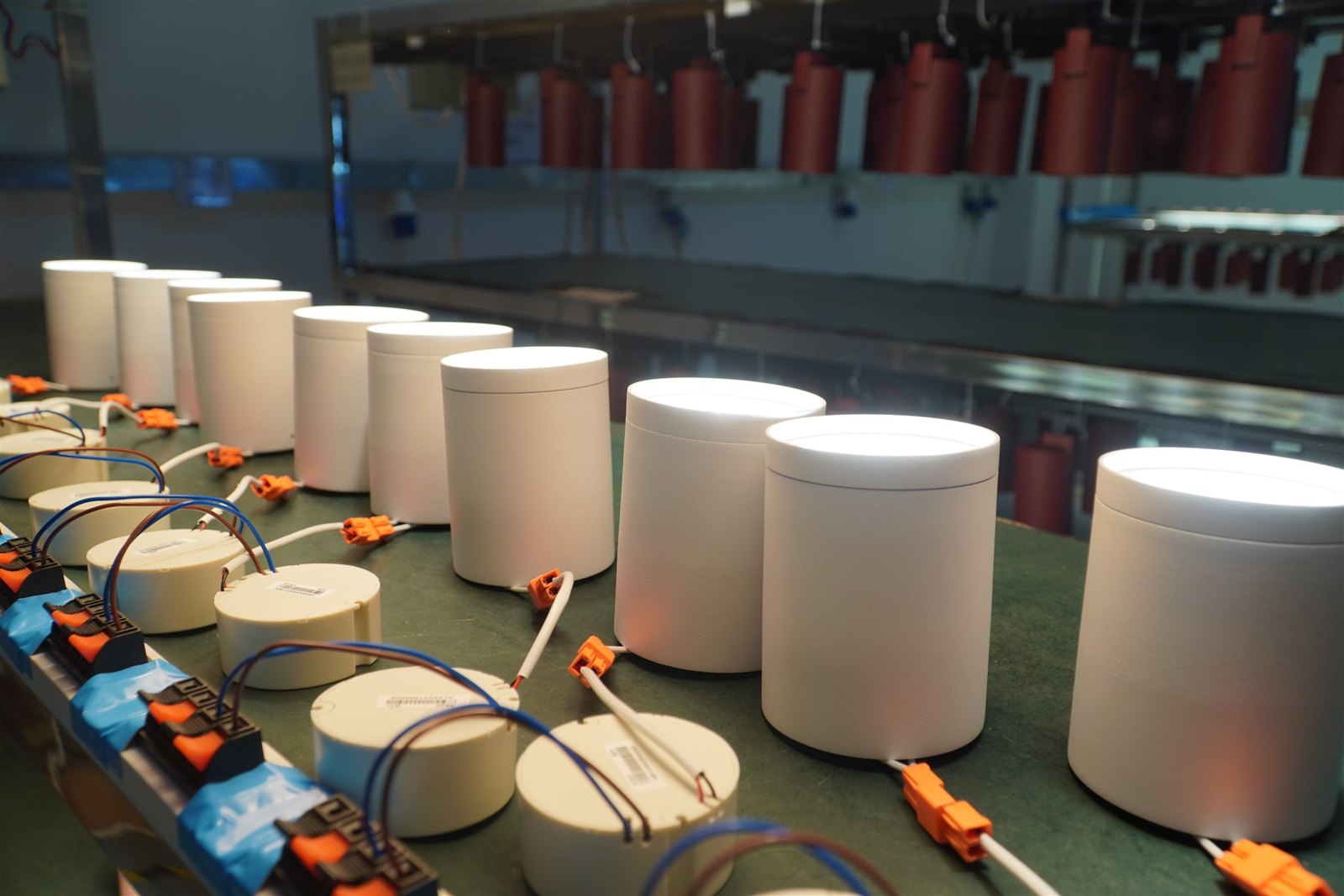
Every unit, every order, on the aging line. The record matters as much as the test.
FAQ
How is QC for a custom LED order different from a standard product? Standard-product QC is about defending consistency. Custom-order QC first has to define correct, then defend it. That is why a custom order starts with first-article approval, a step standard products usually do not need.
How long should an LED aging test run? 8 hours for an everyday custom order, 24 hours for smart or IP-rated products, 48 hours for a new platform or a new finish. Claims about LM-80 / L70 lumen maintenance need 1,000-hour-plus data — that is lumen-depreciation testing, not shipping burn-in. What matters most is the record, not the raw number of hours.
What does first-article approval need to confirm? The light source (brand, bin, CCT, SDCM, CRI, R9), the driver (model, dimming, flicker), thermal design, optics (beam angle, uniformity, glare), finish, and structure. Once confirmed, the unit is sealed as a golden sample and signed by both parties.
What AQL level should I specify for LED lighting? Critical 0, major 2.5 by default and 1.5 on visible architectural or hospitality projects, minor 4.0. More important than the number is writing down the definition of each defect class, ideally with reference photos, before the PO.
Do I need a sealed sample on a custom order? Yes. A sealed sample is the only thing that turns “I think” into “we agreed”, and it settles every later dispute about colour shift, gaps and finish.
Can an aging test replace a pre-shipment inspection? No. Aging removes hidden defects along the time axis; sampling judges the batch you are about to ship. They answer different questions and you need both. The full milestone sequence is covered in our LED factory inspection guide.
Conclusion
Quality on a custom order is not luck. It is definition.
Define correct first — first-article approval and a sealed golden sample. Then use time to filter out the hidden defects — the aging test. Then use statistics to defend the batch — the AQL sampling plan. Get all three gates right and the rework rate stops being a matter of chance.
The next time you approve a custom LED order, do not just ask whether the factory tests. Ask for the three documents that prove it:
“Send me the signed FAI report and the golden sample photo. Tell me the aging hours, temperature and failure count for this batch. And confirm in writing the AQL level and defect definitions we will inspect against.”
Those three answers tell you more than any factory tour.
We build LED track lighting, downlights, magnetic track systems and commercial luminaires in Shenzhen, with in-house photometry, 100% aging, and ETL / CE / SAA / ISO 9001 documentation available per model. Read the full quality control process, see how a custom specification moves from RFQ to certified production on the OEM/ODM page, or send us your specification and we will tell you exactly how we would control quality on your order.
Read next: LED Factory Inspection Guide: What a Buyer Should Check Before PO for the buying-side view — or OEM LED Lighting Manufacturer: 6-Step Sourcing Checklist for the steps before and after QC.
- led lighting quality control
- aging test led lighting
- first article inspection led
- aql sampling plan lighting
- led lighting quality control process
- iqc ipqc oqc
- led driver burn-in
- custom led order qc

ENCORE Lighting Team · ENCORE
LED Lighting Manufacturer & OEM/ODM Partner
The ENCORE engineering and sourcing team writes about LED track lighting, downlights, magnetic systems, certifications and OEM/ODM manufacturing for B2B buyers and specifiers.