· Custom & OEM Lighting · 17 min read

Written by ENCORE Lighting Team
LED Lighting Manufacturer & OEM/ODM Partner ·
Custom LED Drivers for OEM Projects: Dimming and Compliance
A custom LED driver OEM programme, written for the buyer who has to sign the spec: the five dimming protocols and what each one really wires, the topology that matches your fixture, the six compliance documents that prove the driver rather than the logo, and the 69-day serial calendar nobody puts in the quote.
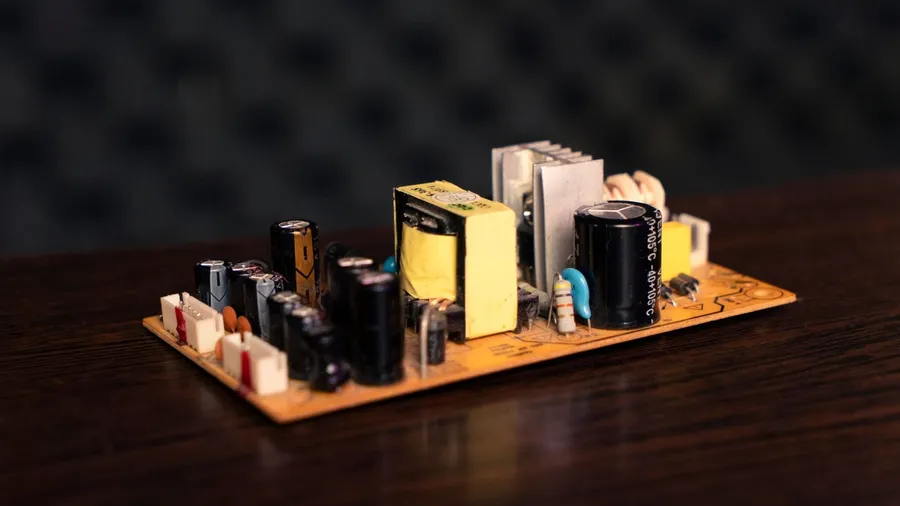
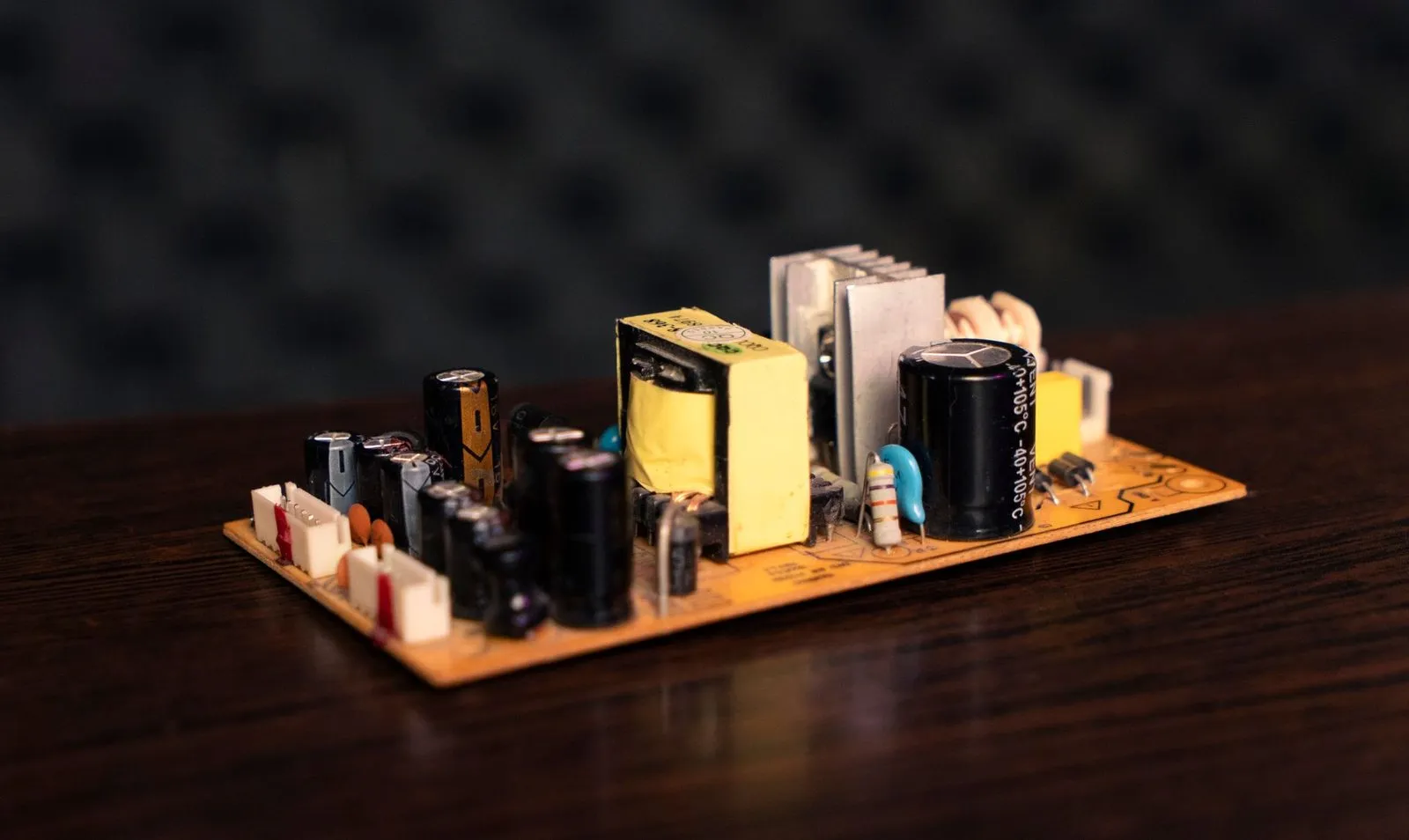
A custom LED driver OEM project goes wrong in one of three places, and none of them is the price: the dimming protocol was written as “dimmable”, the topology was chosen for the driver rather than for the fixture, or the compliance file that arrives with the samples has a different part number on it than the one being quoted.
This guide takes those three in order. It is written for the buyer, engineer or brand owner who has to put a driver into a specification and then stand behind it for five years — not for someone choosing a wall-wart for a strip of tape.
If you are still deciding whether the driver belongs in your scope at all, the OEM/ODM services overview covers the model first. If your project is a full fixture programme, the custom LED lighting OEM and ODM playbook is the parent article; this one goes one level deeper, into the component that decides whether the fixture is any good.
One Decision, Three Circuits
A driver sits between three circuits that must not touch: the mains, the LED string, and the control pair. Everything in this article follows from that.
- The mains side takes 90–305 V, carries the inrush, and is where the surge lives.
- The SELV output is a constant current, matched to the string inside your fixture. Change the chip count and the driver is wrong.
- The control side is where “dimmable” becomes a specific protocol with specific wiring, and where most commissioning failures happen.
An LED driver manufacturer will quote you a driver that satisfies all three on paper. Your job is to make sure the paper describes the thing that will be installed.
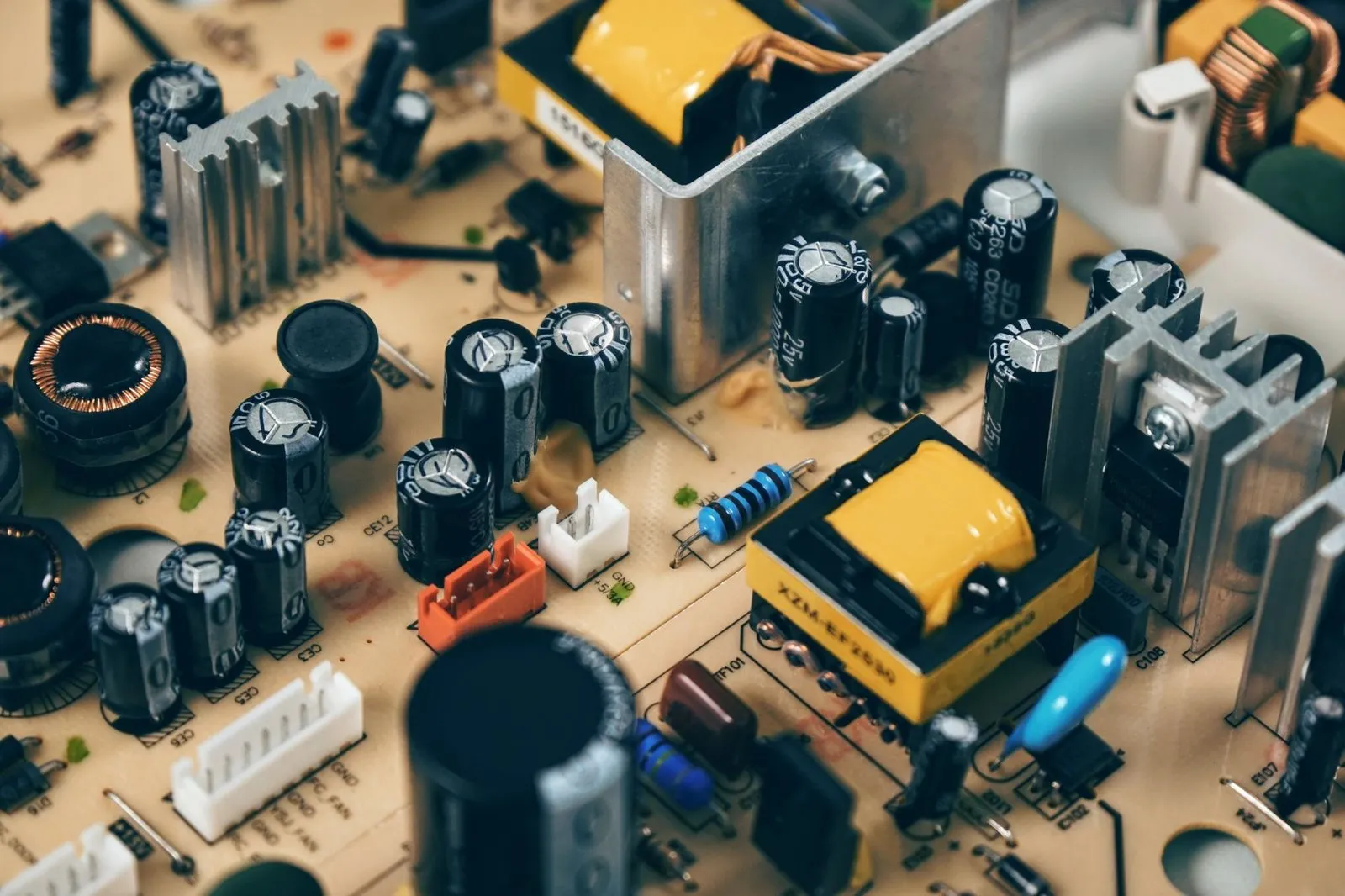
Electrolytics and the choke are your lifetime. The IC gets the credit; the capacitors take the heat.
Dimming: Five Protocols, Four You Will Actually Be Offered
“Dimmable” is not a feature. It is a family of five arrangements, and the one you receive depends on what the factory already has on its board rather than on what your project needs.
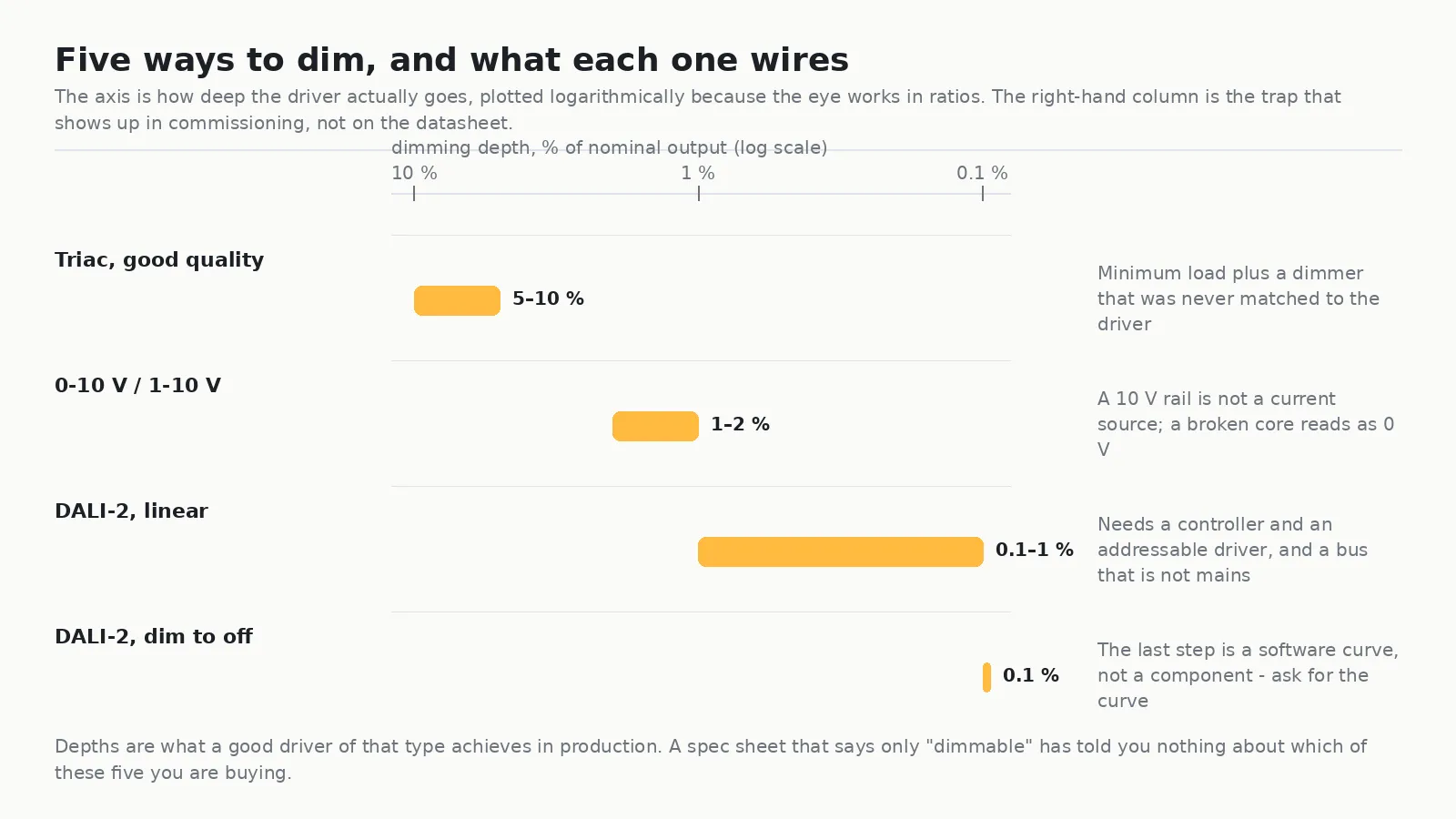
Depth is the honest unit. Log scale, because a jump from 10 % to 1 % is the difference between a room that dims and a room that switches.
Triac and leading-edge: the cheapest, and the one that disappoints
Two wires, in line with the mains, using the dimmer already on the wall. It is what most retrofit projects ask for, and it is where the arguments start, because a Triac driver expects a minimum load and a specific dimmer type. Put a good Triac driver behind a dimmer that was never matched to it and you get flicker at the bottom 20 % of the travel, or a lamp that never quite turns off.
:::tip[What to write instead of “Triac dimmable”] Name the dimmer. “Triac, trailing-edge, compatible with Lutron Diva DVCL-153P at 20 W minimum load, no flicker below 5 % output” is a line a factory can test against. “Triac dimmable” is a line it can interpret. :::
0–10 V: simple, and quietly fragile
Two extra cores, a control voltage, and a resolution far better than most projects need. The fragility is not the protocol, it is the installation: a 10 V rail is a signal, not a current source, so a broken core or a reversed pair reads as 0 V or as a full output. In a suspended ceiling nobody notices until the lighting scene rehearsal.
DALI-2 and D4i: the one that needs a bus, not a dimmer
A DALI line is polarity-free, addressable, and carries 64 drivers per line, and a D4i driver carries its own diagnostics. This is the correct answer for hotels, offices and anything with a building management system — and the wrong answer for a single-room project, because the bus and the controller are now part of your scope.
DMX512, and the radio protocols
DMX is an RS-485 world built for shows and façades: 512 channels per universe, a technician at a console. Matter, Zigbee and Bluetooth live at the other end: no control cables, but the reliability of the radio and the life of the firmware become your brand’s problem.
:::note[The line most spec sheets omit] Two DALI-2 drivers can both say “DALI-2 certified” and behave completely differently below 1 %: one is linear to 1 %, the other follows a logarithmic curve down to 0.1 % and then switches off. Ask for the curve, not the logo. :::
Topology: Match the Driver to the Fixture, Not the Other Way Round
The second decision is what kind of converter sits inside the housing. Five arrangements cover almost every architectural fixture, and the wrong one shows up as either a dimming artefact or a dead driver in year two.
| Topology | Suits | Eff. | Isolation | Where it bites |
|---|---|---|---|---|
| Constant voltage | Tape, parallel runs | ~86 % | SELV | Droop breaks long runs |
| CC, single stage | Heads at 350–700 mA | ~88 % | SELV | Limits dimming depth |
| CC, two stage | Wide-dimming heads | ~87 % | SELV | Kills ripple at 1 % |
| AC direct (linear IC) | Slim profiles, no dimming | ~80 % | Non-isolated | Thin, cheap, undimmable |
| Programmable / NFC | One SKU, many projects | ~88 % | SELV | Range set in the field |

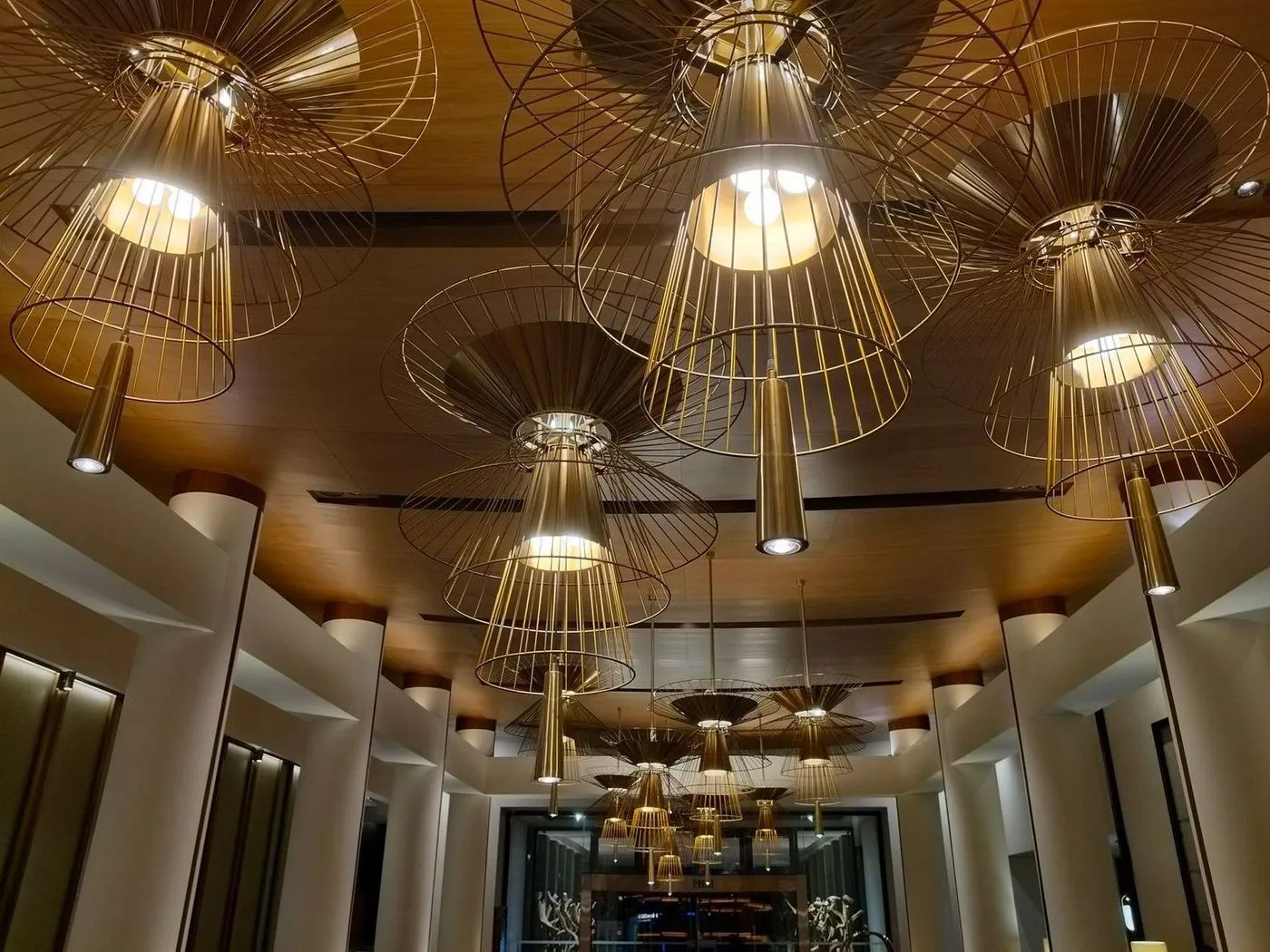
A gallery is where the driver’s dimming floor becomes visible: at 3 % the beam on a painting steps, at 1 % it fades.
Two rules that save projects:
- Choose the topology from the dimming depth, not from the price sheet. A single-stage driver can be honest at 5 % and hopeless at 1 %.
- Freeze the string before you freeze the driver. The forward voltage of your chosen chip and optic sets the output window; a driver quoted against a different bin is a driver you will be re-quoting.
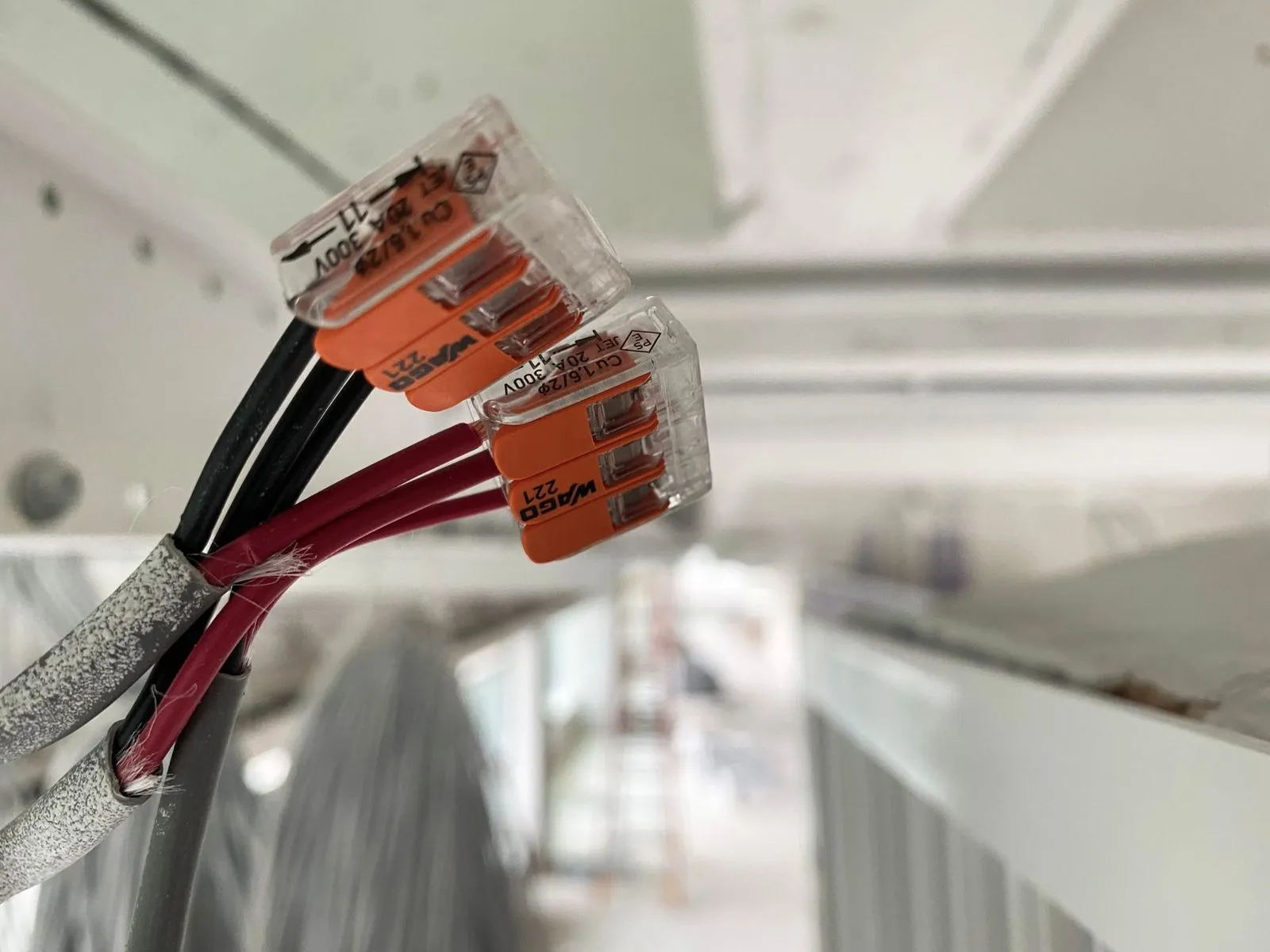
Isolation is bought with iron and space. A track head with a Ø 65 mm body gives the transformer very little room, which is why “isolated, DALI, 1 %, in the head” is a different quotation from the same three specifications written separately.
The Wiring That Decides Whether It Works
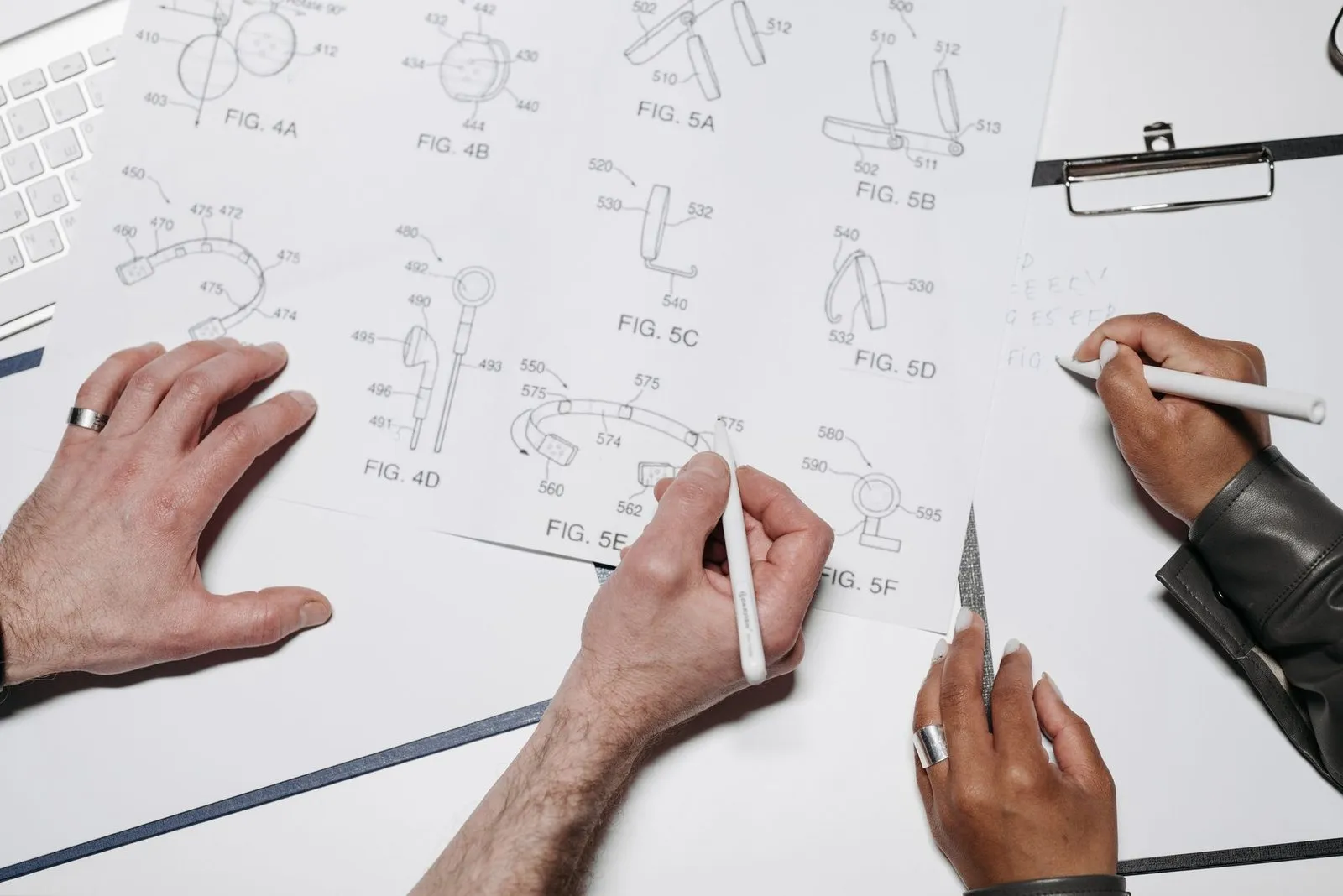
One driver, three circuits, and a drawing nobody reads until commissioning. This is the single most useful page in a driver pack, and it is the one most often missing.
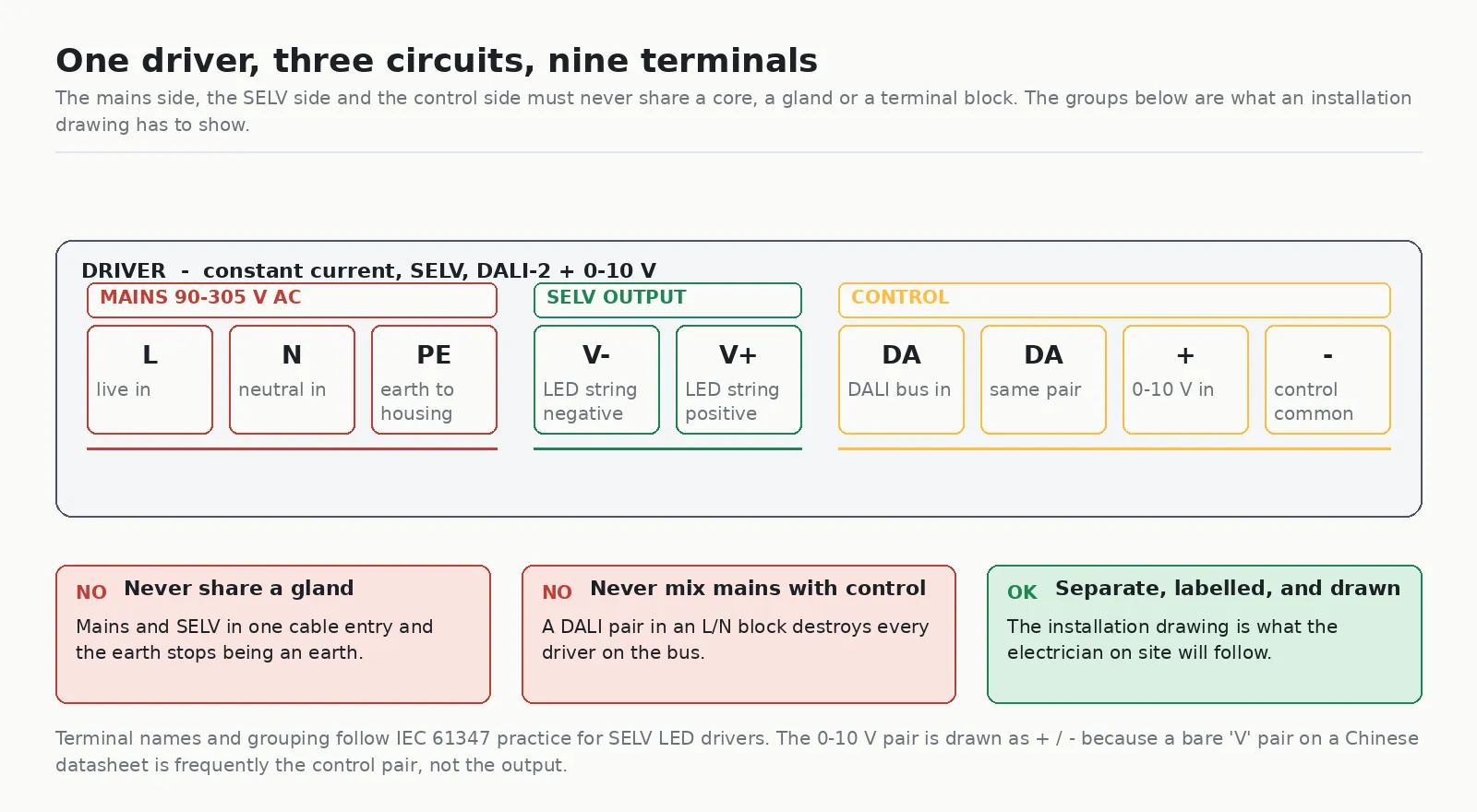

Three failures this drawing prevents:
- Sharing a gland. Mains and SELV in one cable entry and the earth stops being an earth — and the certificate no longer describes the assembly.
- Control on mains terminals. A DALI pair landed in an L/N block destroys every driver on the bus, not just the one that was wired wrong.
- Unlabelled terminals. A “V” pair on a datasheet can be the control pair or the output. Installers guess, and guessing costs a re-visit.
Compliance: The Driver Is the Certified Item
For an architectural luminaire, the safety certificate names the driver family and the assembled fixture. That single fact drives the whole OEM sequence: if the driver part number moves after testing, both the driver report and the luminaire certificate stop describing the thing you are shipping.
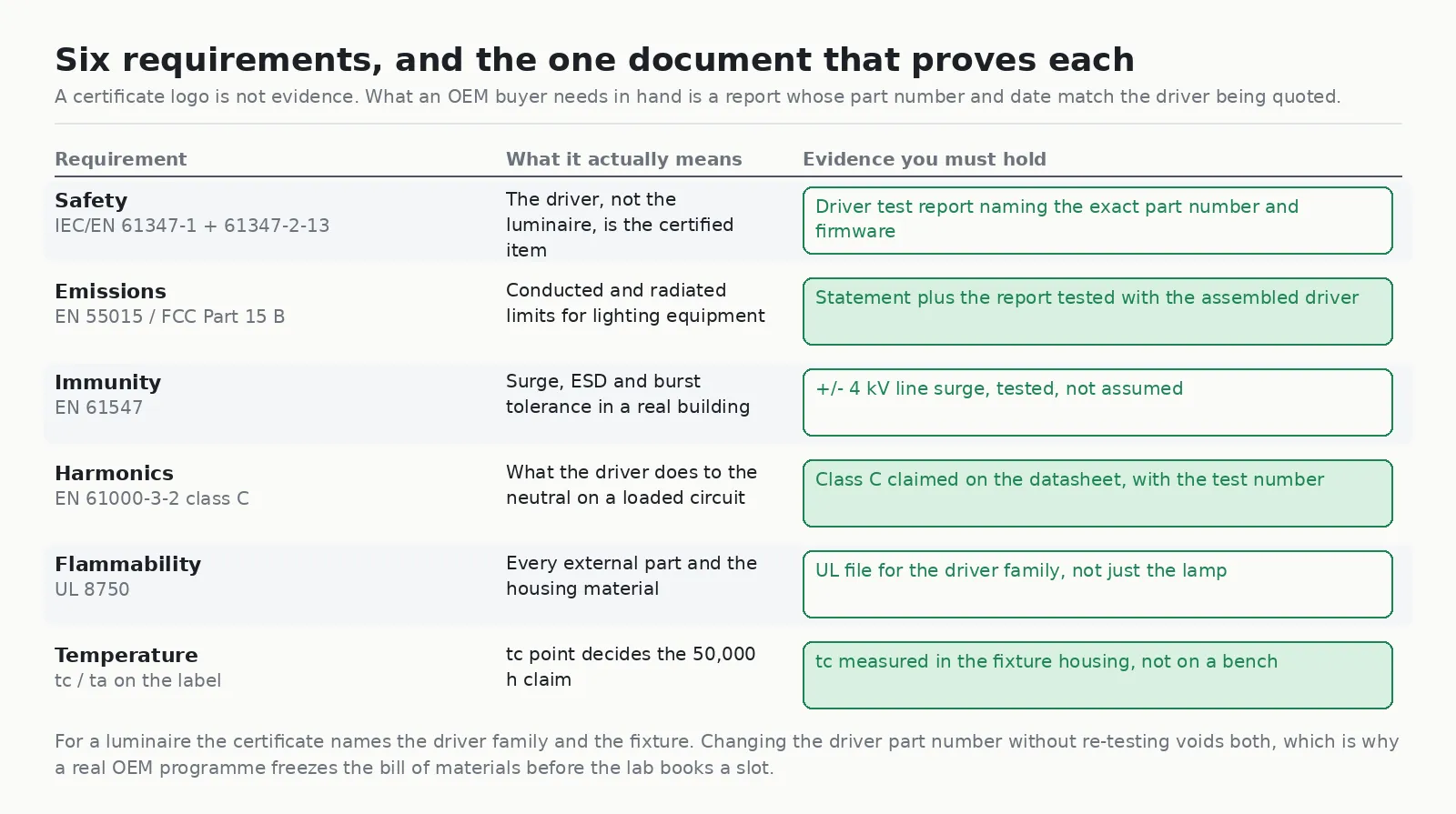
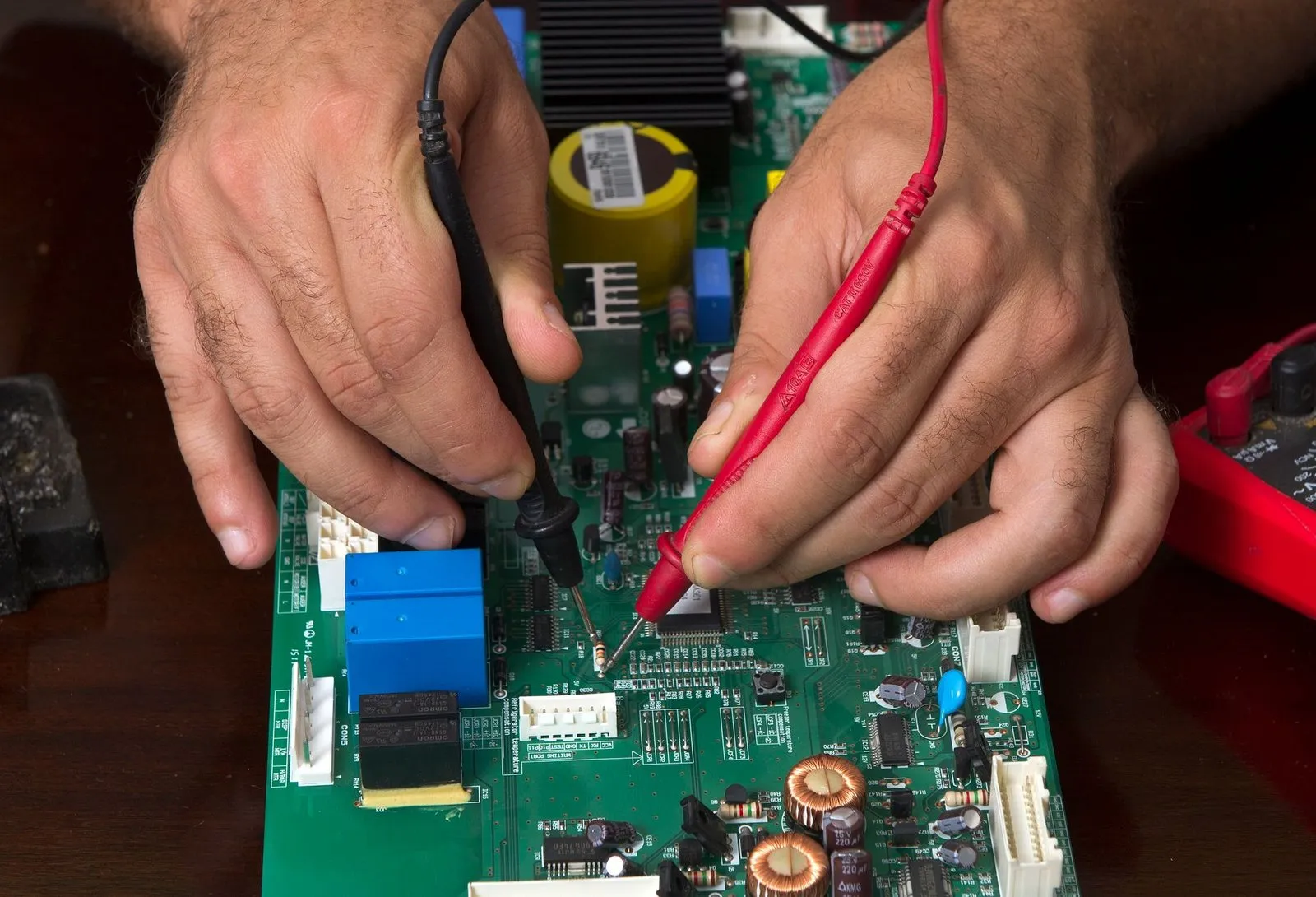
What a buyer should physically hold, in the order an auditor will ask:
- The driver test report naming the exact part number, the standard revision and the date.
- The luminaire report covering the housing, the wiring and the driver together — the assembled article, not two components.
- The label artwork, because tc, ta and the model designation on the label are part of what was certified.
If your project ships to Europe, the CE marking and ENEC guide explains which document a customs officer will actually ask for, and the ETL certification walkthrough covers the North American path. Both rest on the same driver evidence.
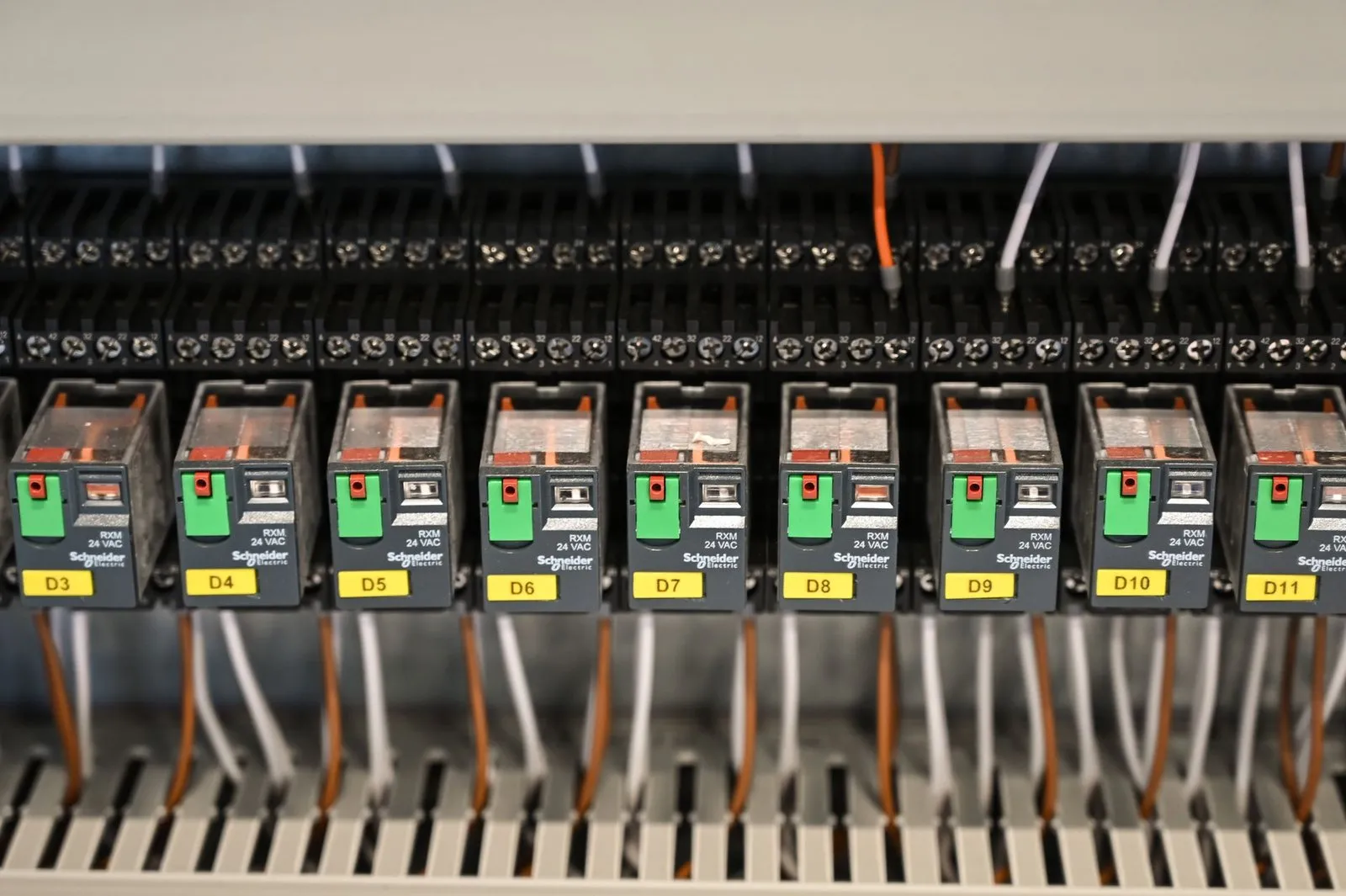
Write the RFQ in Numbers, Not Adjectives
Most driver quotations are wrong because the RFQ was unanswerable. Swap adjectives for eight measurable lines and the replies become comparable.
| Write this | Not this |
|---|---|
| Protocol + controller make | ”Dimmable” |
| Log dimming to 1 % | “Smooth dimming” |
| Flicker at 50 % output | ”Flicker-free” |
| Efficiency at 50/80/100 % | “High efficiency” |
| Inrush, A and µs | ”Surge protected” |
| tc inside the housing | ”Long life” |
| L-L and L-E surge | ”Industrial grade” |
| Block type, cable range | ”Easy to wire” |

The factory vetting checklist covers the questions that decide whether the factory behind the quote can answer these lines at all — before the RFQ, not after the sample.
What a Custom Programme Costs You in Calendar
Nothing on a driver programme is parallel. The lab slot is booked, the pilot run needs the approved label, and the label needs the certified part number.
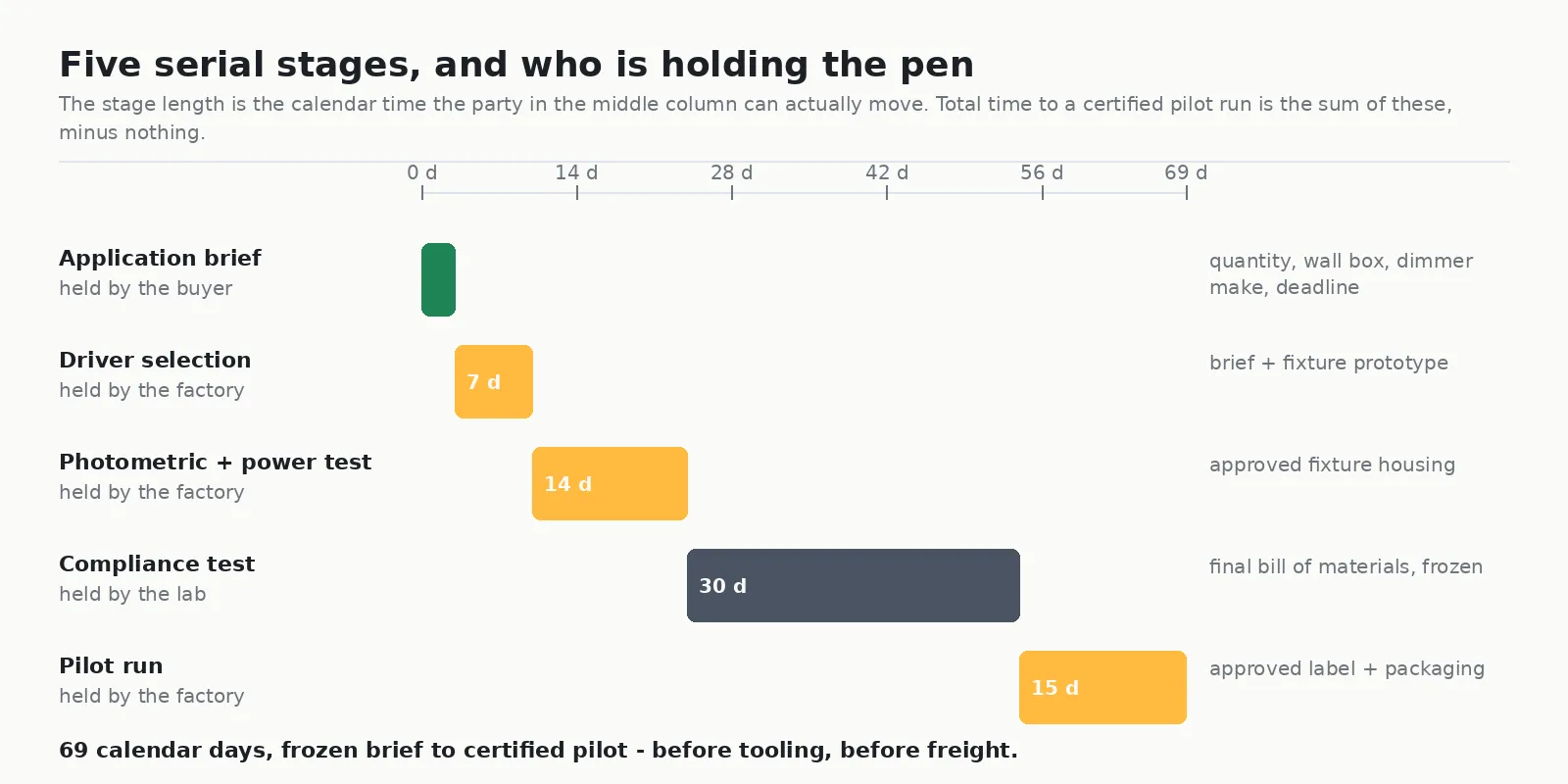

Two consequences for your plan:
- The bill of materials has to freeze at the photometric stage. Every change after that either moves the lab date or invalidates the report.
- The label and the packaging go last, and take longer than they look. Which is also why pilot and QC should be scheduled against the compliance date, not the production date.
Where We Sit in This
ENCORE has been building architectural LED fixtures since 2011 — track heads, downlights, magnetic systems and linear profiles — and the driver is the part we treat as the specification rather than as a purchased item.
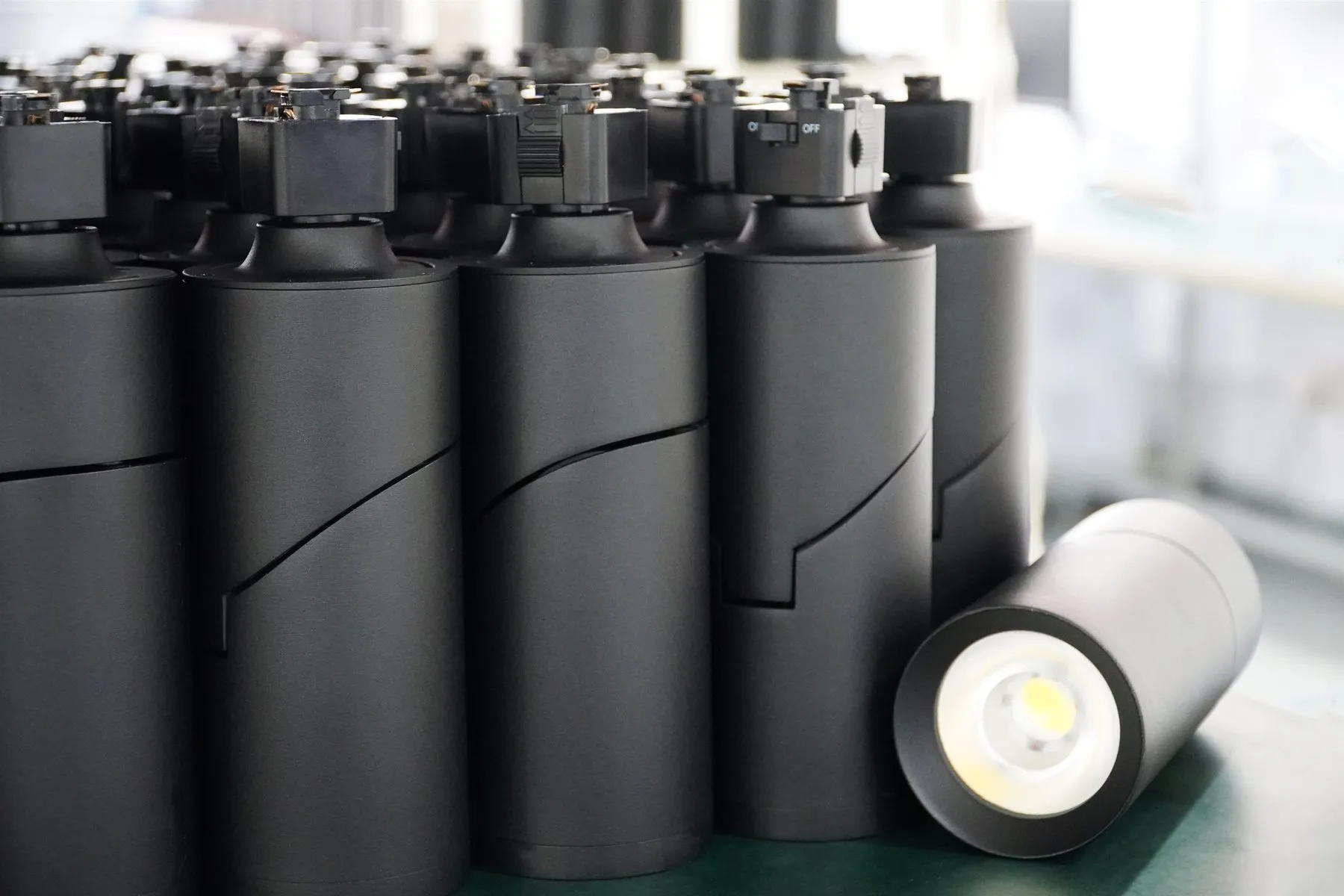
Track heads in batch at the ENCORE factory: the batch is where a driver decision stops being theoretical.
What that means for a custom LED driver OEM project:
- Track lighting — OVEGA and VEGA series heads, 350–1050 mA, dim-to-warm and DALI-2 options, driver in the head for the small bodies and remote for the wide-dimming ones.
- Downlights — ELLA and DELTA recessed ranges, constant current with a remote driver where the ceiling void allows it, and a genuine answer on IC and non-IC housings.
- Magnetic track and linear — MOVIA magnetic systems and commercial linear and downlight ranges, where the driver typically lives in the remote or in the track adapter.
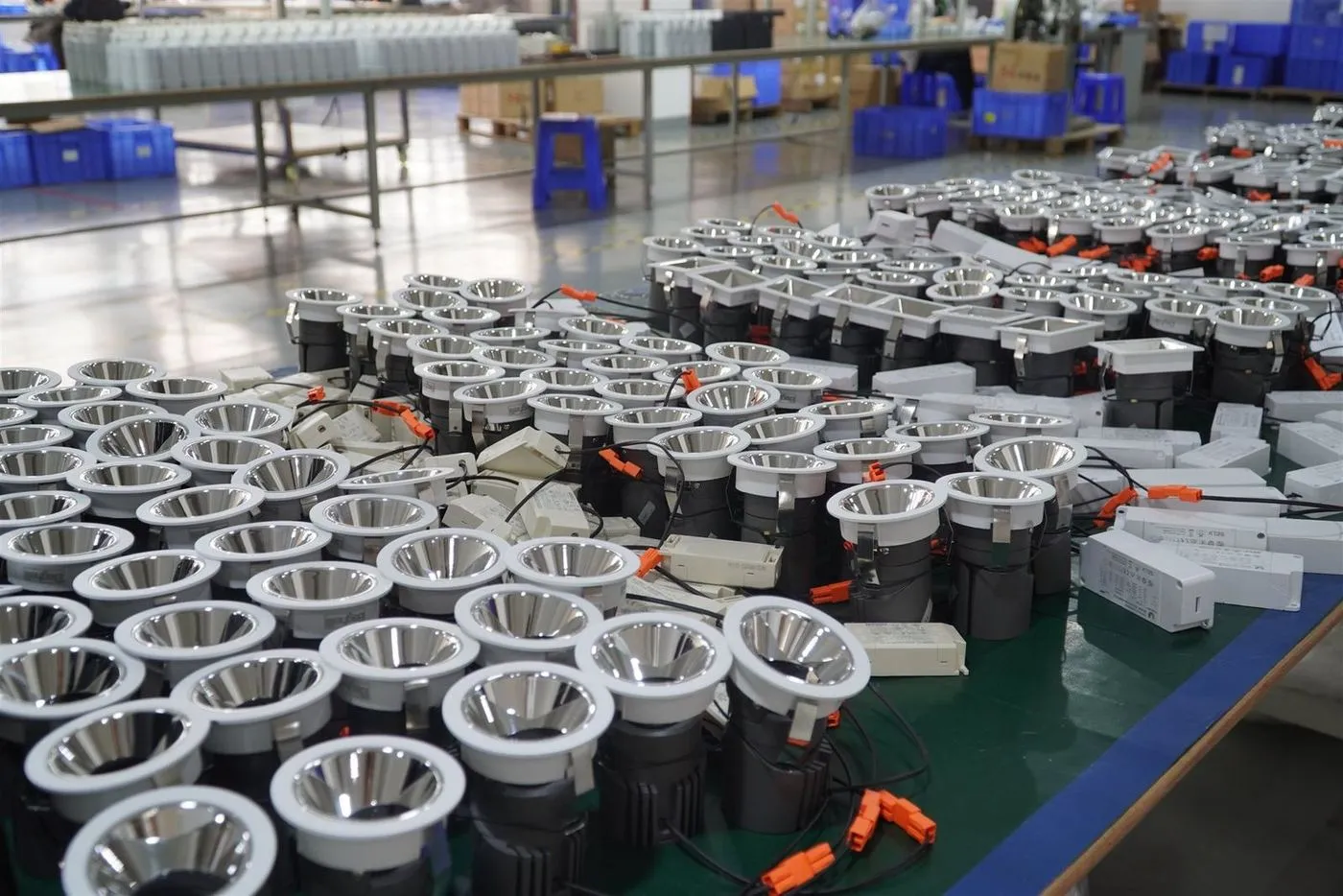
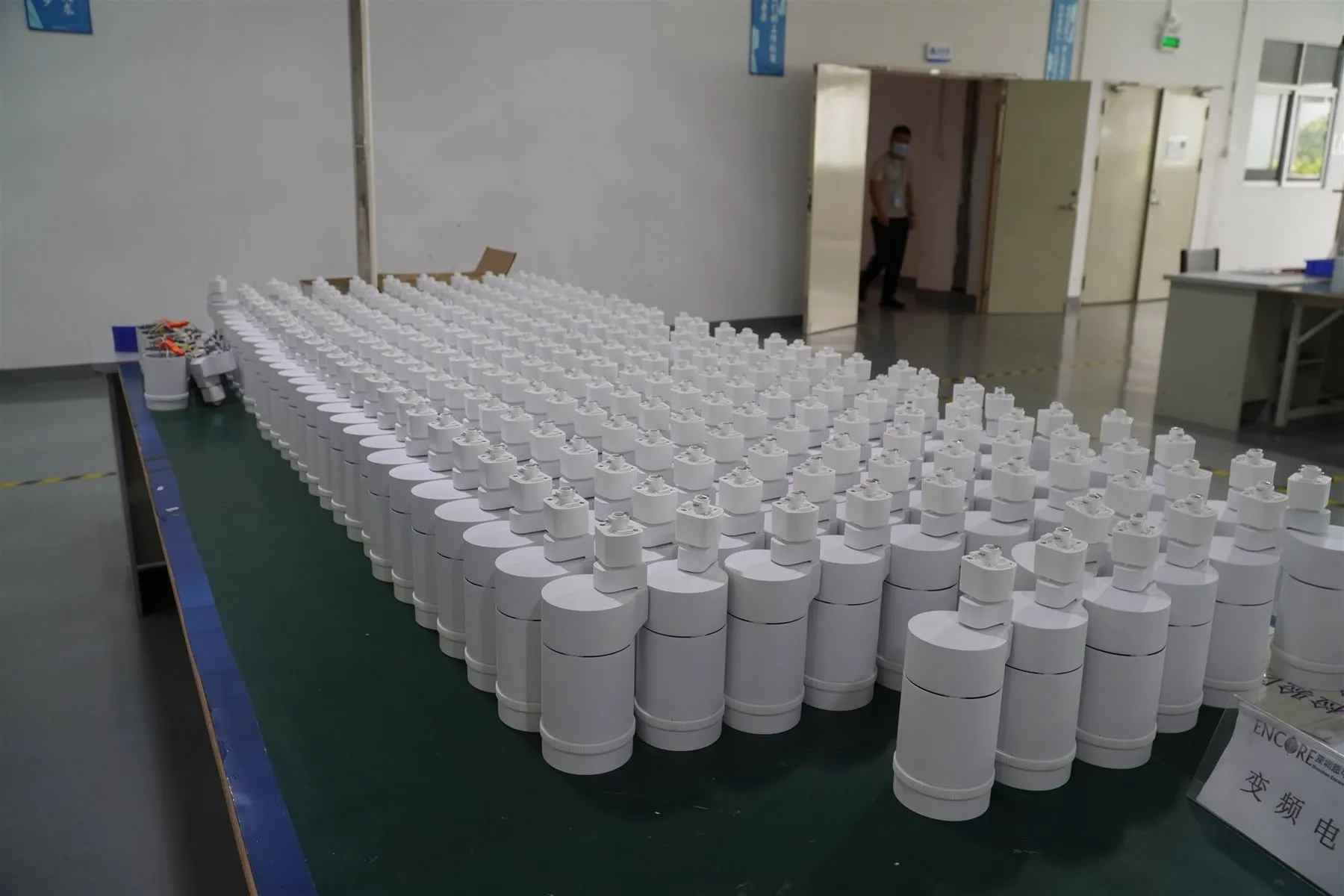
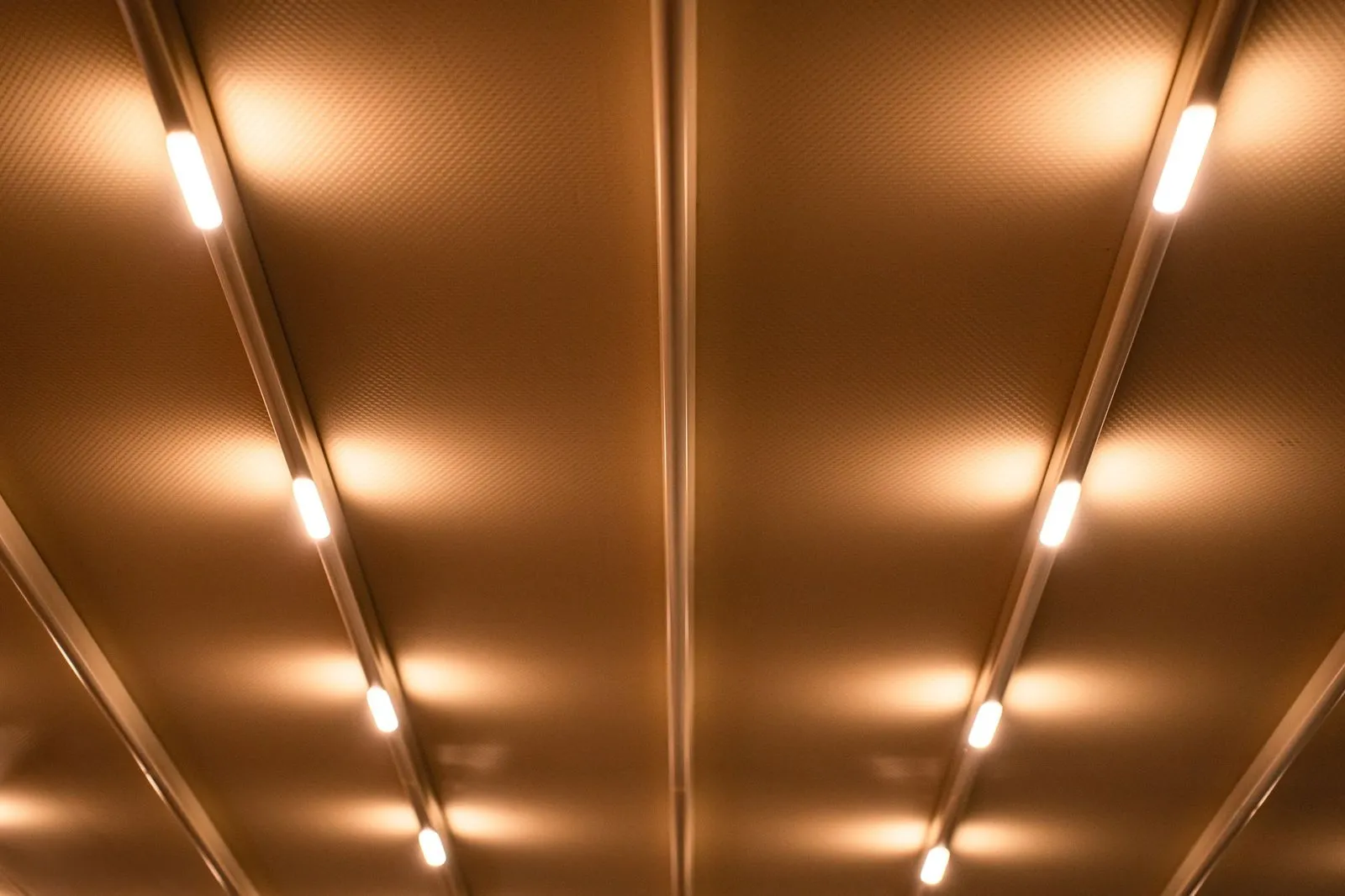
For each of those we will tell you which of the five dimming arrangements your brief actually needs — including when the honest answer is a better-standard Triac driver rather than a DALI bus that nobody will commission. The private label lighting manufacturer guide covers the lowest-effort entry if you only need your mark on an existing, already-certified SKU.
FAQ
What is the MOQ for a custom LED driver OEM order? The driver itself rarely sets the MOQ — the fixture does. Changing a control protocol, a finish or a label on an existing driver platform typically lands at the same unit MOQ as that fixture (commonly a few hundred pieces); a new driver board, a new isolation arrangement or a new output window is a development project, quoted separately, and its cost is recovered over the first production runs. Ask which of those two you are actually buying before comparing prices.
Can you supply a custom driver for our own fixture design? Yes, and it is the more common route for brand owners: the housing, the optical design and the chip selection come from your side, and the driver is specified against the measured forward voltage, the dimming depth and the space available. What we need is the string configuration, the ambient around the driver, the control system make and model, and the target lifetime — the last one decides whether the electrolytics are 105 °C or 130 °C parts.
Is a certified driver enough, or does the whole luminaire need certification? Both, and they are different documents. The driver has its own report (IEC/EN 61347 for Europe, UL 8750 for North America); the assembled luminaire has its own certificate that references the driver. A fixture built around a certified driver that was never tested as an assembly is not a certified fixture, and the importer carries that risk.
What is the difference between 0–10 V and DALI-2 for a hotel project? Wiring and control. 0–10 V needs two polarity-sensitive cores per driver group and gives you one level per group; DALI-2 needs a polarity-free bus, gives 64 addressable drivers per line, and reports failures back to the building system. For a corridor or guest room programme the 0–10 V saving is real; for a lobby with scenes, DALI-2 is usually the cheaper total.
How deep should the dimming actually go? Only as deep as the use case. A hotel guest room wants a comfortable 5 % floor at 2700 K; a museum or gallery wants 1 % or better with no visible step, and pays for a two-stage or logarithmic driver. Depth below 1 % also costs you flicker performance at the low end, so specify both and test both.
Why does my dimmable driver hum or flicker at low output? Almost always one of three things: a dimmer that was not on the driver’s compatibility list, a load below the driver’s minimum, or an electrolytic that is being cooked because the tc point was never measured inside the housing. The first two are installation; the third is a specification failure that shows up in month eighteen.
Do I need a new compliance test if I change the driver part number? Assume yes. The report names the driver family and the fixture; swapping to a different part number — even a better one — means the report no longer describes the article. Minor changes inside the same certified family are sometimes acceptable, but that is a question for the certification body, in writing, before the purchase order.
The Last Line
“Custom LED driver OEM” is not a component purchase. It is three decisions in a fixed order — protocol, topology, evidence — and a calendar that only runs in one direction.
Get those three right and the driver disappears into the fixture, which is exactly what it should do. Get them wrong and every one of them resurfaces at commissioning, in front of the client.
If you have a brief in progress, send it to our engineering team with the string voltage, the control system and the deadline. We will tell you which dimming arrangement it needs, what evidence you will be holding at the end, and how many of the 69 days your schedule can actually absorb.
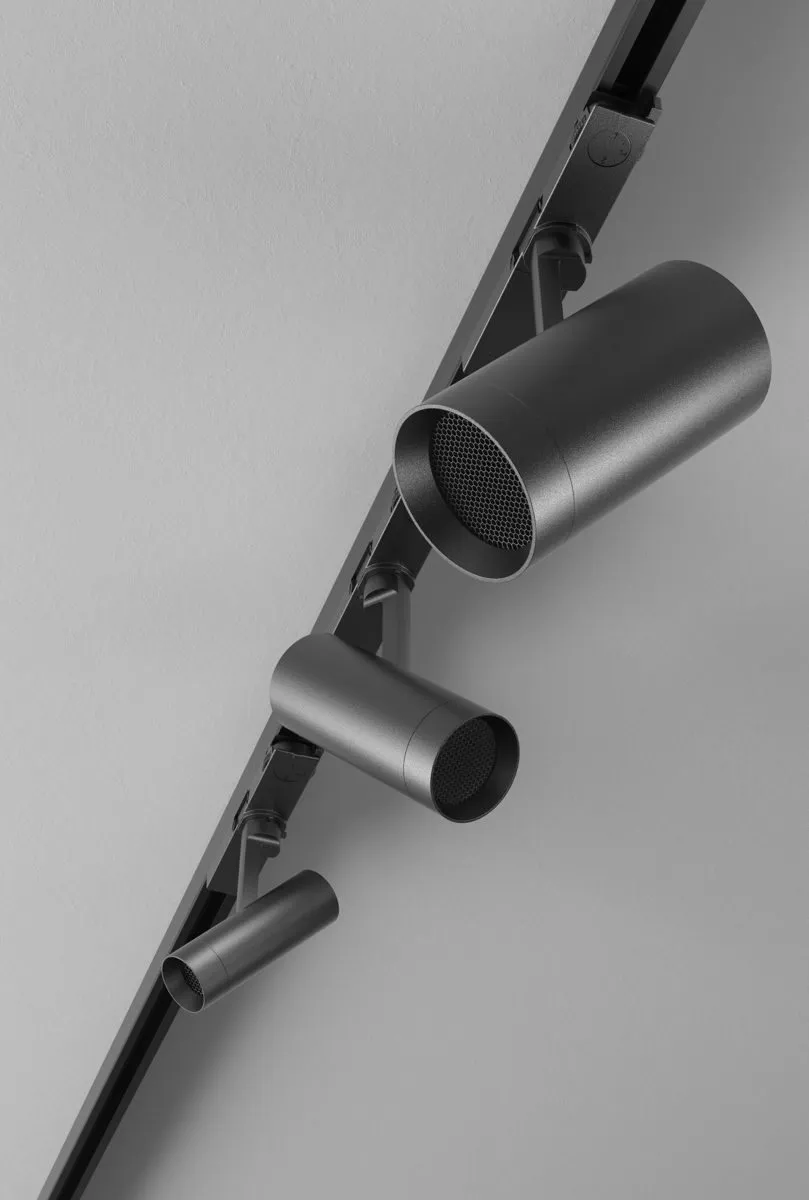
Scale is the constraint: at 65 mm of body there is no room for a two-stage DALI driver, so it moves to the remote box and the drawing has to say so.
- custom led driver oem
- led driver manufacturer
- dimmable led driver oem
- led driver selection
- dali-2 led driver
- 0-10v dimming
- led driver compliance
- selv led driver

ENCORE Lighting Team · ENCORE
LED Lighting Manufacturer & OEM/ODM Partner
The ENCORE engineering and sourcing team writes about LED track lighting, downlights, magnetic systems, certifications and OEM/ODM manufacturing for B2B buyers and specifiers.