· Buying Guides · 15 min read

Written by ENCORE Lighting Team
LED Lighting Manufacturer & OEM/ODM Partner ·
IC vs Non-IC Downlights: Which Does Your Ceiling Need?
IC rated vs non-IC recessed downlights, decided on the ceiling build-up rather than the spec sheet: what IC really covers, clearance rules, temperature limits and cost.
Some buying decisions are decided by a spec sheet. This one is decided by a ceiling.
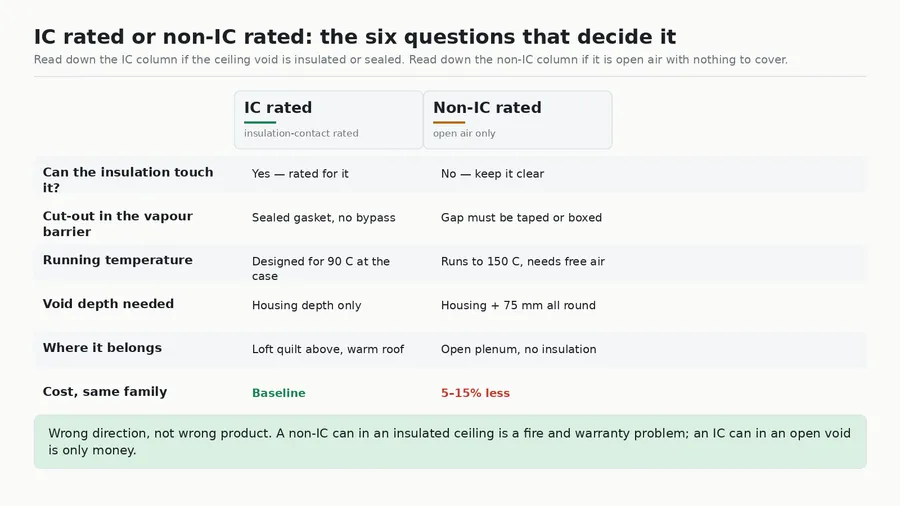
IC rated versus non-IC rated has nothing to do with brightness, beam angle or colour temperature. It is a single question about the hole you are about to cut: is there insulation, a vapour barrier or a sealed air space directly above it? Answer that and the downlight is already chosen.
If you want the two ratings defined end to end — labels, standards, code references — start with our IC and non-IC LED recessed downlight guide and come back. What follows is the version a buyer needs while standing in a loft with a sample in one hand.
What “IC” Actually Covers
IC stands for insulation contact. On a recessed luminaire it is a statement about heat, made in advance, on the label: this housing is designed so that thermal insulation may either touch it or be installed over it without the fixture, the insulation or the building assembly exceeding safe temperatures.
IC is not a North American invention. In Europe the same idea appears as a symbol — a luminaire that may be covered by insulation — instead of the letters IC. Same physics, different paperwork.
Three things follow from that definition, and each one is where buyers get caught:
- It describes a relationship, not a construction. A well-built can with a heat sink is not automatically IC. It is IC when the manufacturer has tested it in contact with insulation and printed that limit on the label.
- It describes the fixture, not the opening. The rating says nothing about the vapour barrier, the cut-out gap or the wiring. Those are the installer’s half of the job, covered below.
- It is a limit, not a promise. An IC fixture is still approved against a maximum ambient at a specific position — usually at the top of the housing. Cover it with 400 mm of quilt and that approval starts to lose its footing.
Non-IC: The Rating Is Still a Good Rating
Non-IC is often read as “the cheap one.” That is the wrong frame. A non-IC luminaire is a fixture designed to run in free air, and it typically does it with a bigger housing, larger heat-sink area and no concern about the upper limit that covering imposes.
In an open plenum — a concrete soffit, a suspended grid ceiling, a service void with nothing above it — non-IC is not a compromise. It is the correct product, it costs less, and it usually lasts longer in that position because it has more metal to breathe through.
The failure mode is never “non-IC was fitted.” The failure mode is non-IC fitted into an insulated ceiling, where the housing cannot shed heat and the quilt keeps it there.
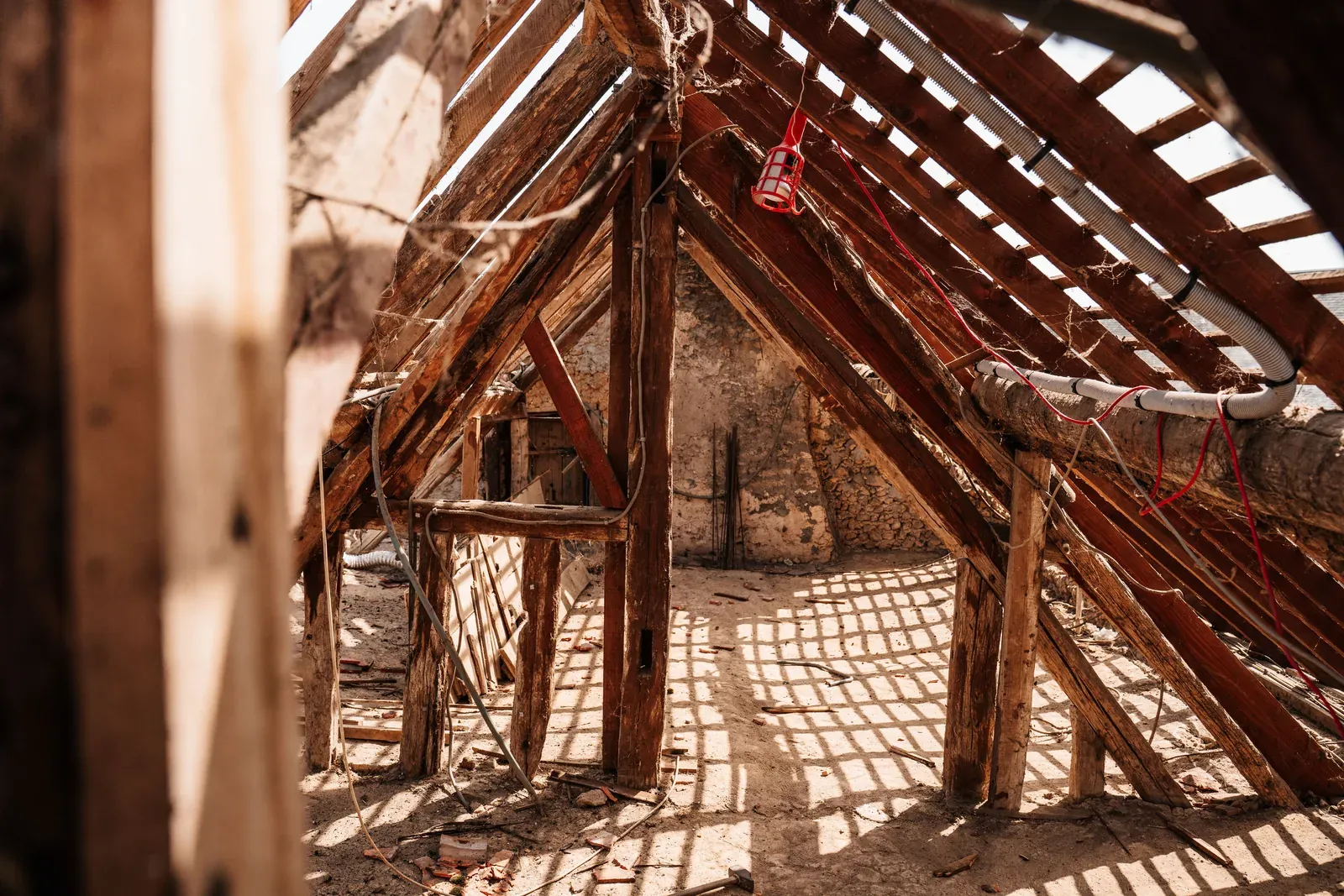
Rafters, wiring, daylight. Before the quilt goes in, every downlight here is interchangeable.
The Same Ceiling, Cut Open
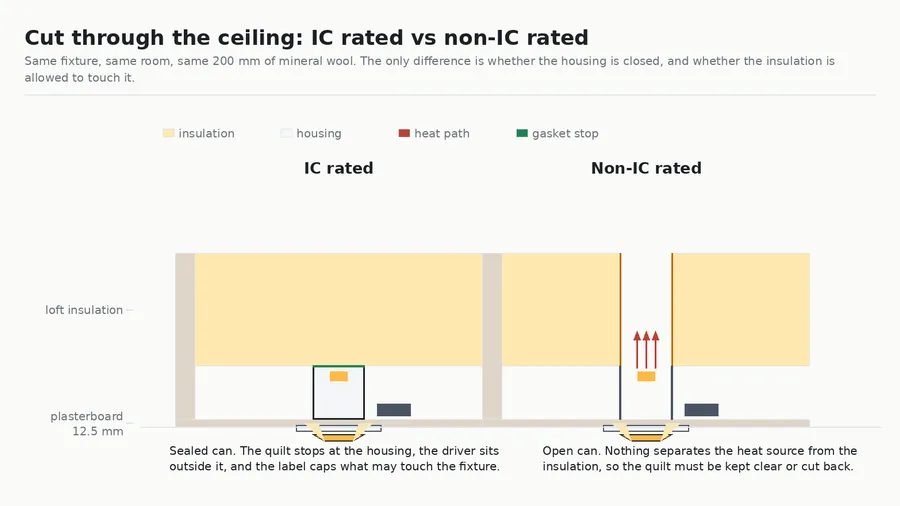
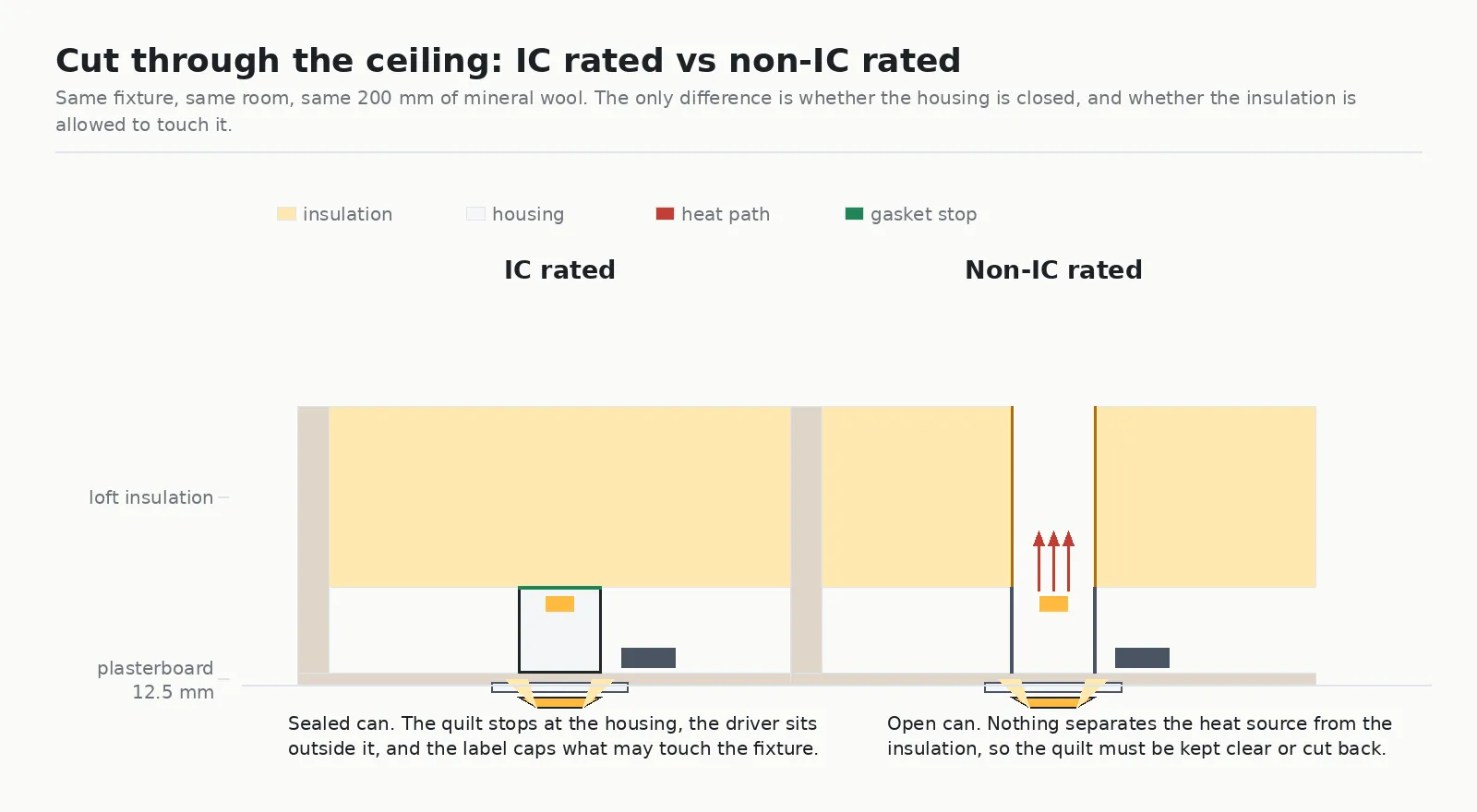
Here is the whole article in one drawing (above). Identical room, identical plasterboard, identical 200 mm of mineral wool. The only change is whether the housing is closed and whether the quilt is allowed to reach it.
Two details in that drawing are worth naming, because they are the ones an inspector looks for.
The crown
An IC housing is closed at the top. That plate is not cosmetic — it is where the thermal cut-out or the thermal protector sits, and it is the position the certificate’s temperature figure refers to. Anything resting on or near it changes the reading that the approval was based on.
The gap in the quilt
A non-IC can needs the quilt cut back. That gap is where the rating lives, and it is also where projects quietly fail: the electrician cuts it back, the insulation contractor follows a day later and fills it in, and nobody is on site to notice both trades did their job.
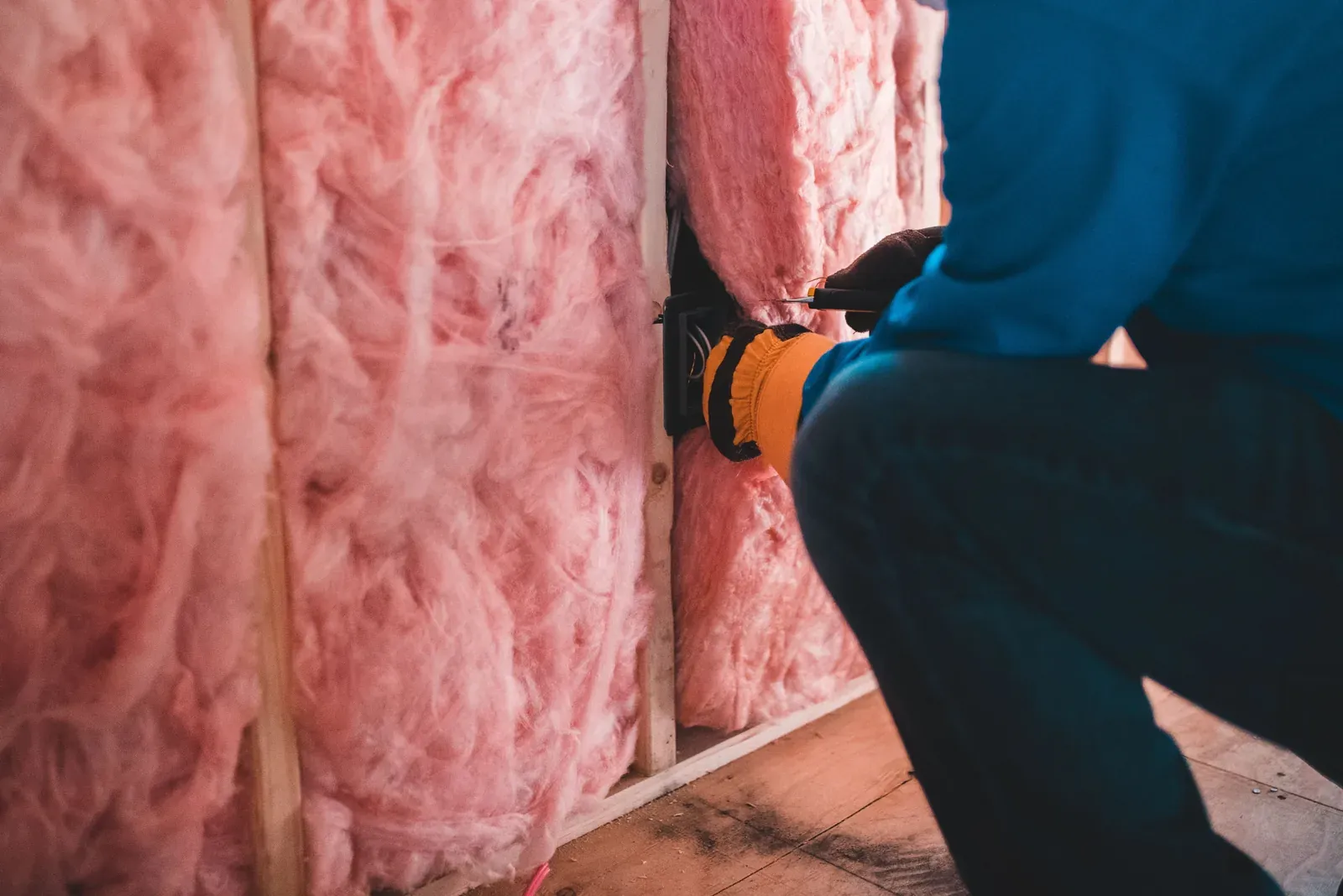
The quilt is packed in by hand, by a different trade, usually a day after the electrician left. Nothing in that sequence protects a clearance gap.
The cheapest fix for exactly that sequence is to buy the IC version in the first place. In most product families the difference is small — often 5–15% on the unit, sometimes less than the cost of a return visit.
Plan View: Where the Quilt Stops
Sections are for understanding. Plans are for doing. From above, with the plasterboard off, the difference is a ring of material.
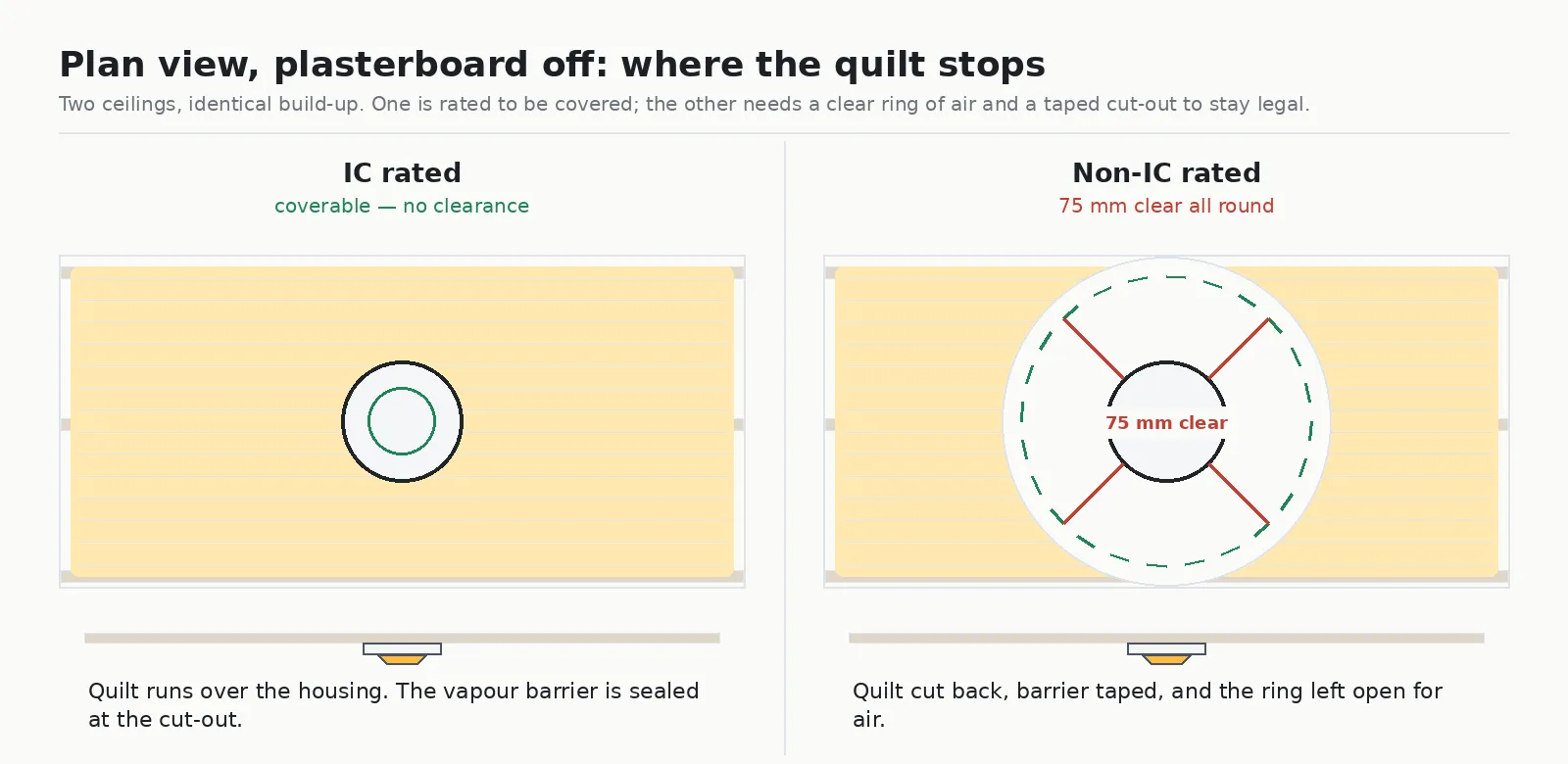
IC: the quilt is continuous, cut-out gasketed. Non-IC: a taped cut-out plus a clear ring, width set by the label.
The clear ring is not a rule of thumb you can invent. It comes off the installation instructions, and where those are silent the local code decides. Typical published instructions ask for something in the order of 75 mm (3 in) of free air around the housing and above it. Treat any number you read here as a placeholder for the number on your fixture’s instruction sheet.
The Numbers That Decide a Spec
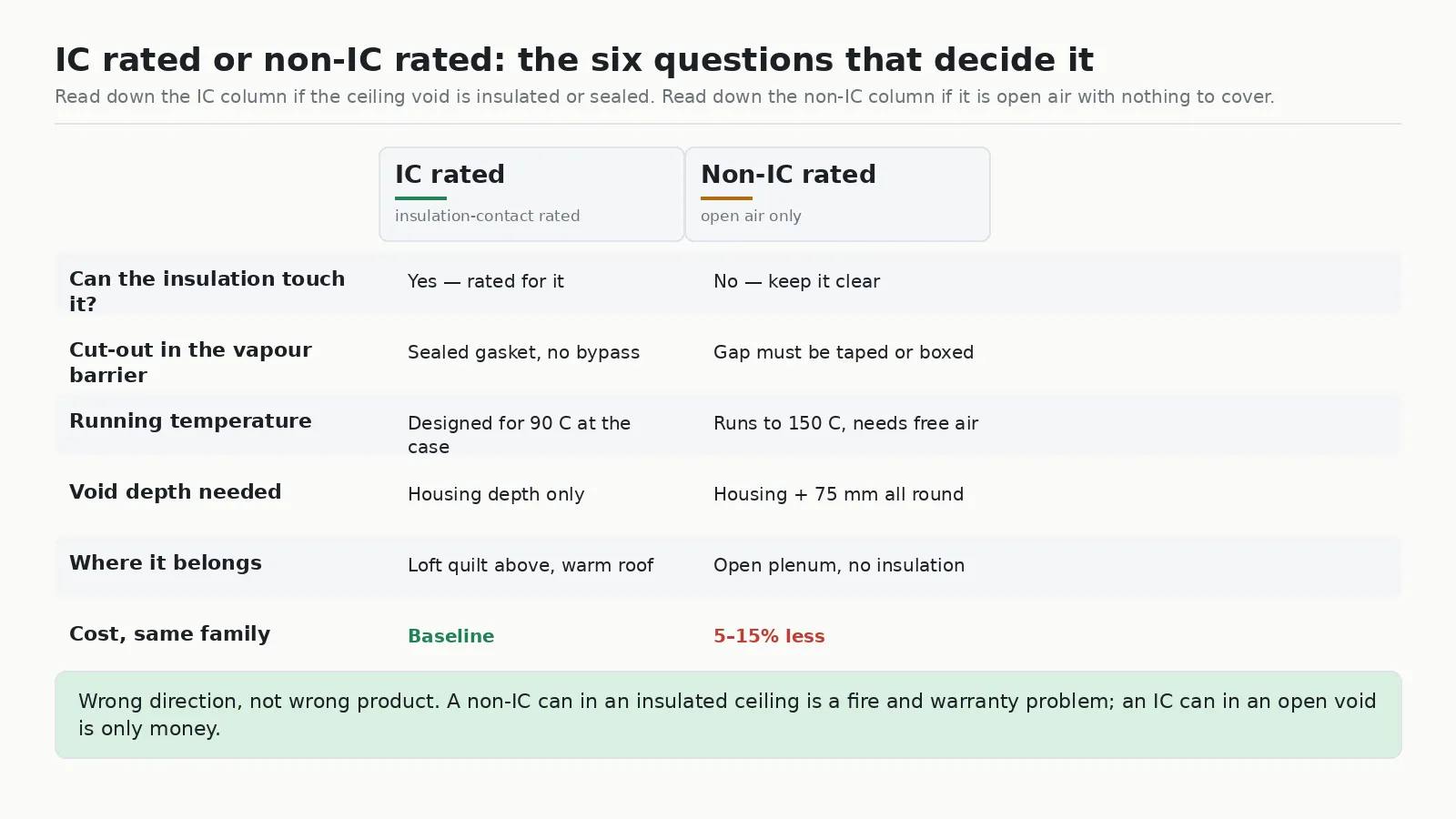
Six rows, and only the last one is about money.
Insulation contact
The deciding row. IC: yes by design. Non-IC: no, and the “no” has to be physically maintained for the life of the building.
Vapour barrier and air sealing
An IC fixture normally ships with a gasket or a sealed trim so the membrane at the cut-out can be closed around it. On a non-IC fixture the cut-out is often simply left open — which is a thermal bypass and, in a cold climate, a condensation risk. In Passivhaus and other airtight detailing the IC housing is usually the only version that can be made continuous without a separate sealed box.
Running temperature
Published limits often sit in the region of 90 °C for a covered IC fixture at its measured point, and up to around 150 °C for a non-IC fixture in free air. Read those as typical label values, not as universal law: the number that matters is the one on the product you are buying, at the position the manufacturer specifies.
Void depth and clearance
IC buys you void depth. A housing that may be covered needs only its own depth plus a little for the wiring. A non-IC housing needs its depth plus the clearance ring in every direction. In a shallow ceiling the IC version is frequently the only thing that fits.
Where it belongs
IC: loft quilt above, warm roof, airtight membranes, retrofits into an already-insulated ceiling. Non-IC: open plenums, fire-rated ceiling assemblies with nothing above, service voids, exposed concrete soffits.
Cost
Non-IC is usually the cheaper unit. It is not the cheaper project whenever the ceiling is insulated, because the difference gets eaten by cut-back labour, sealing work and the risk of a callback.
Where Each One Belongs
A short list that covers most projects:
- Residential — anything under a loft, roof or insulated flat roof. IC, almost without exception. New-build insulation is deep and continuous; those two facts are exactly what the IC rating exists for.
- Retrofit into an existing insulated ceiling. IC in almost every case, because nobody is going to guarantee that the old quilt stays clear of the new can ten years from now.
- Hotel and serviced apartment ceilings with a plenum. Depends on the plenum. Open air with nothing overhead: non-IC is fine and cheaper. Insulated or fire-stopped: IC, and often a fire-rated IC assembly.
- Concrete soffits and exposed slabs. Non-IC. There is no insulation to contact, so you would be paying for a capability nothing on site will use.
- Airtight and low-energy builds. IC every time. The membrane continuity is worth more than the unit saving.
- Ceilings that will be re-insulated later by someone else. IC. Buy the tolerance.
The pattern is not about product tier or budget. It is about whether the rating you buy will still be true in five years, after another trade has been through the building.
How to Verify the Rating Before You Order
A spec sheet with the words “IC rated” in a features list proves nothing. Six checks that do:
- The label on the housing. IC fixtures carry a marking on the can itself, not only on the carton — the installer needs to read it after the box is gone.
- The model number in the certification listing. Look up the certificate or listing and confirm your exact model appears, not the series name.
- The instruction sheet. It should state the maximum insulation coverage, the clearance, the maximum ambient and the lamp or wattage the fixture is approved for. If it does not, the IC claim is decorative.
- The lamp and driver pairing. An IC housing approved with a 9 W LED engine does not become a 20 W IC housing because a bigger driver fits in the ceiling.
- The dimming and driver setup. Badly driven fixtures run hotter. A dimmable IC fixture must be tested with a dimmer that is on the approved list.
- The fire rating, if the ceiling needs one. IC and fire rated are separate properties. An IC downlight in a fire-rated apartment ceiling still needs a tested fire-rated assembly.
If any of the six is unavailable, you are not buying an IC rating. You are buying a word.
What to Write in the Purchase Order
Most of the pain in this category is commercial, not technical, and it happens at handover. Put these in the PO and the argument never starts:
- The fixture family and the exact model code for the IC variant, not “IC option available.”
- The maximum permitted insulation coverage and clearance, copied from the instruction sheet into the order documents.
- The maximum ambient and the wattage the fixture is approved for, with a clause that any change of driver or LED engine voids the IC approval unless re-submitted.
- The gasket, sealed trim and any vapour-barrier accessory listed as included line items, not optional extras.
- The instruction sheet in the language of the installation site, because the person who maintains the clearance ring is not going to read a PDF in a language they do not use.
That last point sounds bureaucratic until a project loses a certificate over it.
Inside the Housing: What Changes Between the Two
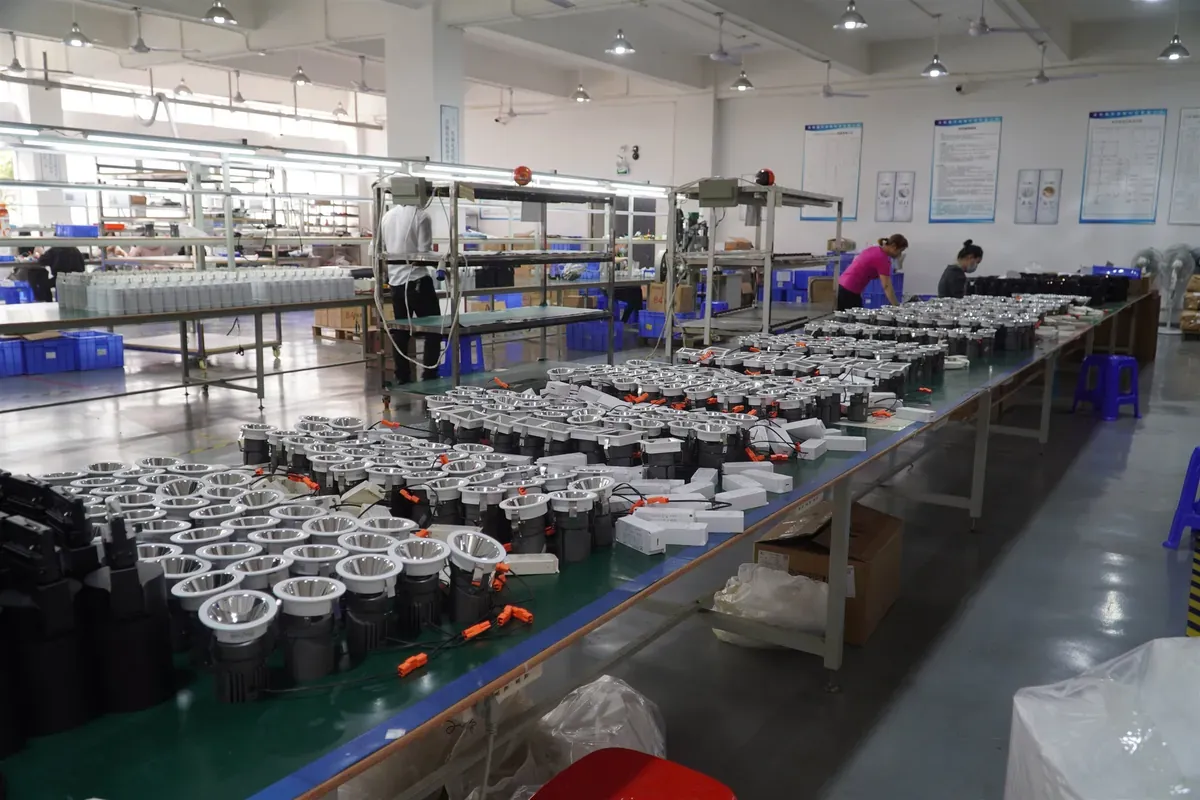
The IC version of a family is rarely the non-IC version with a lid added. In practice the manufacturer changes four things:
- The housing gets a closed crown with a defined thermal contact point, and often a heavier die-cast wall so heat leaves the driver compartment by conduction rather than by convection into the quilt.
- The driver moves outside the thermal path, or drops to a lower output per volume. Same wattage in a smaller can is a different thermal problem.
- The trim and gasket change so that the cut-out can be sealed — a perforated decorative trim is a poor partner for an airtight ceiling.
- The test regime changes. Temperature-rise testing with insulation present is a different, slower, more expensive test than the free-air version, and it has to be repeated when the LED engine changes.
That is why the honest answer to “can you make the non-IC model IC for us?” is usually “yes, but it is a new model and it needs its own thermal test.” A supplier who says it is a sticker is telling you something about their file, not about their product.
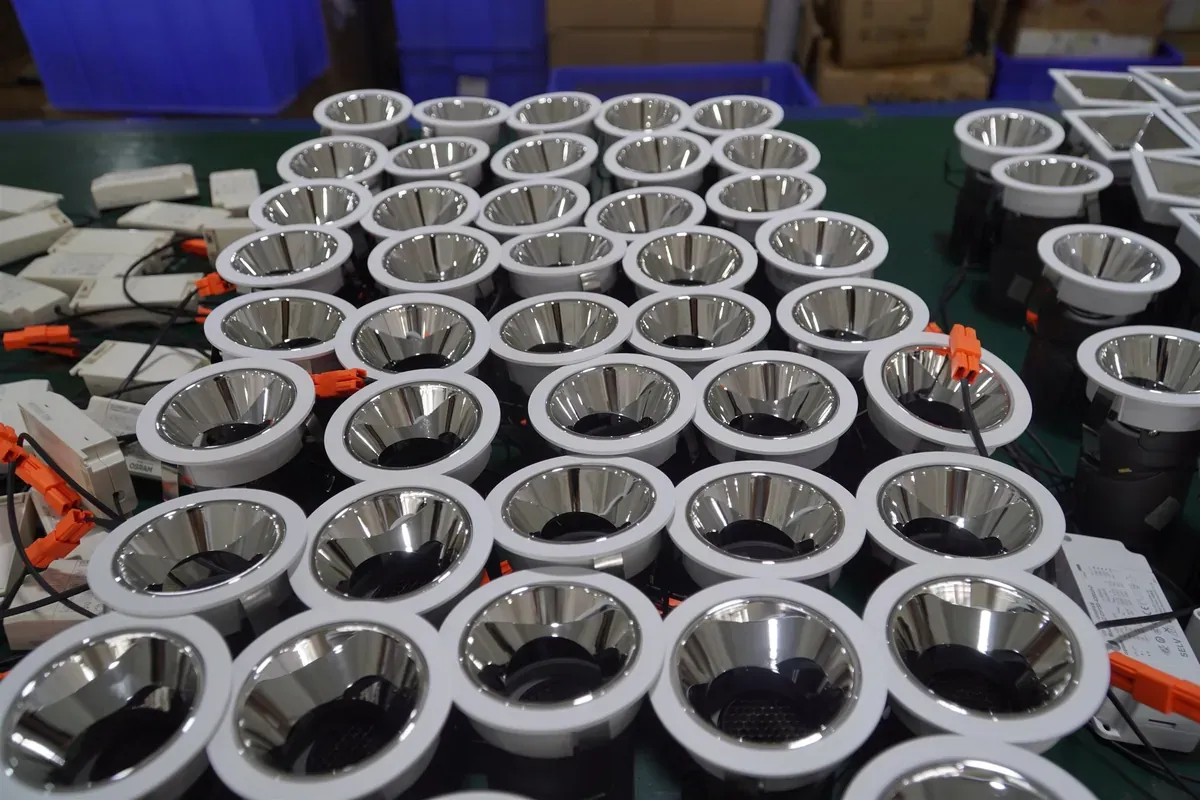
Every one of these will end up above somebody’s head, behind somebody’s insulation. The label is the only part of the fixture the next trade will read.
Comparing Series Before You Choose
Once the rating is settled, the remaining variables are cut-out size, trim depth and driver position — the three numbers that decide whether a housing physically fits the ceiling you have. On ENCORE families the IC variant is a separate model with its own listing entry, so the question to ask a supplier is never “can this be IC” but “which model code in this family is IC, and what does its instruction sheet state”. Our series comparison page lines the families up against each other, and the downlight range carries the full model list.
The Short Version
Choose the downlight after you look up at the ceiling, not before you open the catalogue:
- Insulation, membrane or sealed void above the cut-out → IC. Always, and check the label.
- Free air, nothing overhead → non-IC. Cheaper, cooler, correct.
- Unsure, or the ceiling will change hands → IC. You are buying the ability to be covered, and most ceilings eventually get covered.
If the project needs a specific trim, cut-out, CCT or driver — including a sealed IC variant — our LED downlight range is where the ELLA, Galaxy, DELLA and AVA families live, and our ODM downlight process covers what can change without a new mould. If you are still deciding between sourcing models, our IC and non-IC LED recessed downlight guide is the reference version of this topic.
FAQ
Is an IC rated downlight required by code in an insulated ceiling? The requirement is not usually written as “use IC.” It is written as a temperature limit and an installation instruction: the fixture must be installed per its listing, and the insulation must not create a condition the fixture is not approved for. In an insulated ceiling, a non-IC fixture can only comply if the insulation is kept away from it — which is exactly what an IC rating lets you avoid.
Can I put insulation over a non-IC downlight if I leave a gap? Only within the clearance stated in the fixture’s instructions, and only if the gap is maintained permanently. That is a maintenance obligation, not a one-off installation step, which is why most specifiers stop doing it.
What does “type IC” mean on a light bulb? Nothing, strictly — IC is a rating of the luminaire housing, not of a lamp. When the phrase appears in a product title it is usually a description of the fixture the lamp is sold with, or a mistranslation of a type designation. Ask for the housing label.
Do LED downlights get hot enough to need IC? The LED itself runs cooler than halogen, but the driver is still a heat source, and LED modules are sensitive to the temperature they run at. Covering a non-rated housing shortens driver life long before anything visibly burns. IC on an LED fixture is as much a lifetime argument as a safety one.
Is IC rated the same as fire rated? No. IC concerns insulation contact and temperature. Fire rating concerns the ability of the ceiling assembly to resist fire for a stated period. A ceiling can need both, and one does not imply the other.
Does an IC rated downlight cost much more? Typically 5–15% more than the non-IC version of the same family, though it varies with housing construction and wattage. Weigh it against the labour to cut back and seal around every non-IC fixture, plus the risk of a callback.
Can a non-IC downlight be converted to IC? Not in the field. It requires a different housing, a different thermal path and a different temperature-rise test at the manufacturer, plus a new listing entry for the model. Any supplier who offers it as a field modification is describing a label, not a rating.
What about IC downlights in a bathroom or wet area? The two ratings are independent. A bathroom ceiling above an insulated void may need an IC fixture and an appropriate IP rating. Check both on the same label; one does not cover the other.
- ic rated vs non ic rated led downlight
- ic rated recessed lighting
- non ic rated can lights
- type ic light bulb
- ic rated led pot lights
- recessed downlight clearance
- insulated ceiling downlight
- downlight thermal protection
- recessed lighting buying guide

ENCORE Lighting Team · ENCORE
LED Lighting Manufacturer & OEM/ODM Partner
The ENCORE engineering and sourcing team writes about LED track lighting, downlights, magnetic systems, certifications and OEM/ODM manufacturing for B2B buyers and specifiers.