· Custom & OEM Lighting · 19 min read

Written by ENCORE Lighting Team
LED Lighting Manufacturer & OEM/ODM Partner ·
Private Label vs OEM vs ODM Lighting: What's the Real Difference?
Private label vs OEM vs ODM lighting, explained by who pays for the tooling rather than by definitions: the five-rung sourcing ladder, where your 100 units really land, the two different businesses hiding behind "private label decorative lights", and the volume at which OEM finally pays for itself.
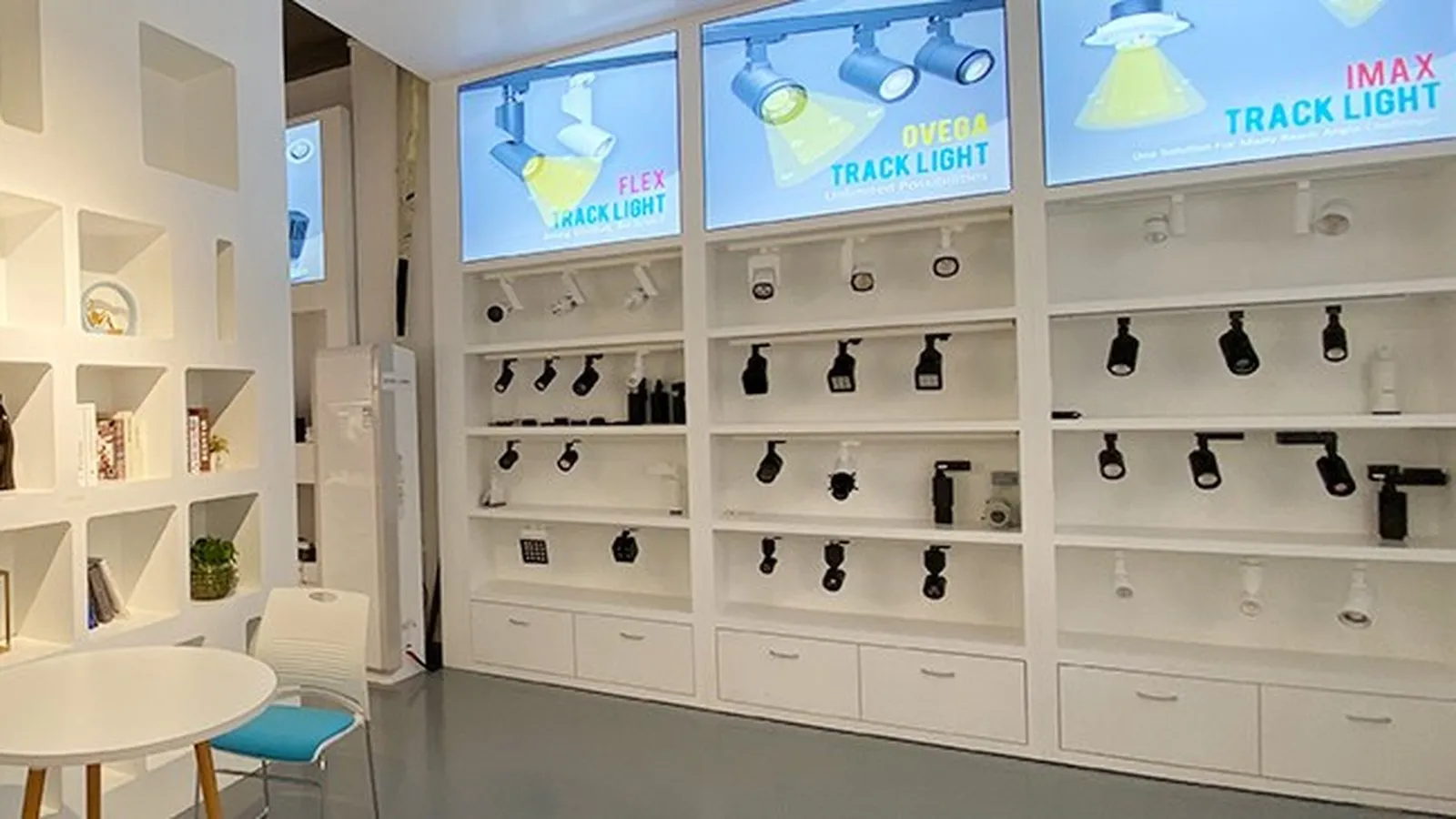
Almost every article on private label vs OEM vs ODM lighting does the same thing: it puts the four terms in a table, says “OEM means you design it, ODM means the factory designs it, private label means you put your name on it”, and closes with “choose what suits you”.
That answer is technically correct and practically useless, because the four words are not four options. No buyer wakes up wanting “an ODM arrangement”. They wake up with a question:
- I only need 200 pieces — can I put my logo on?
- I want a matte black housing. Does that mean a mould?
- What is the difference between white label lighting and private label, and which word should go on my purchase order?
- Do decorative lights and architectural lights work the same way?
So this guide is organised differently. Not by definition — by who carries what.
Here is the thesis the whole article is built on:
Private label, white label, ODM and OEM are not four choices. They are five rungs on one ladder. What decides which rung you are standing on is not your order size. It is who paid for the mould.
Everything below — MOQ, lead time, cost, certification, the gap between decorative and architectural work — grows out of that one sentence.
Three Variables, Not Four Categories
Put the four models side by side and only three things actually change:
- Who owns the design — whose drawing it is
- Who owns the tooling — who paid the one-off cost
- Who owns the mark — whose name goes on the housing
Everything else is a consequence.
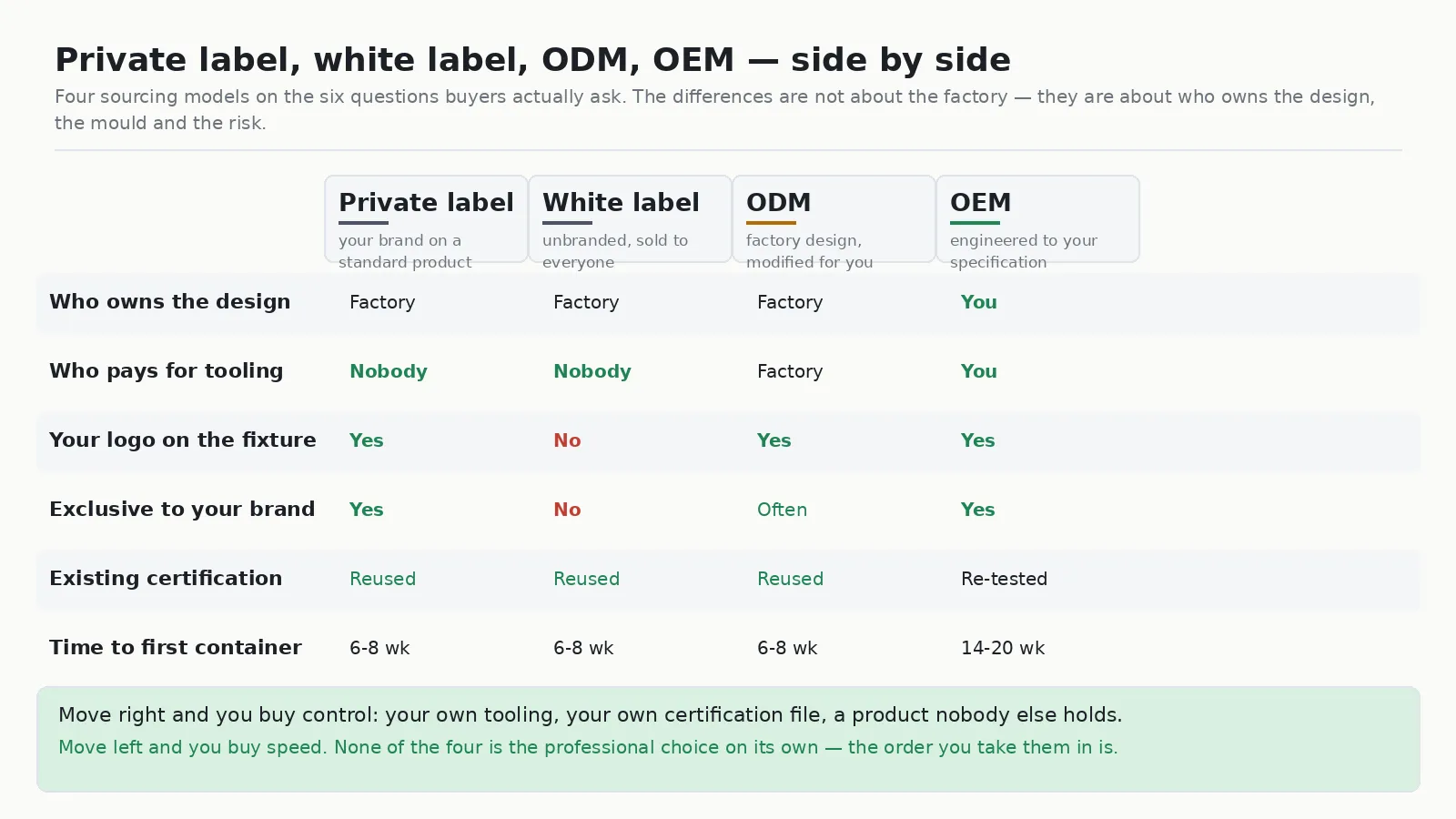
The same four models, judged on the six questions that actually reach a factory’s inbox.
The pair that gets confused the most is private label vs white label. The difference is a single word: exclusivity.
- White label lighting is the same product sold to ten brands. Nobody owns it, so most of the time nobody’s mark is printed on it at all.
- Private label is the same product sold to you — or at least sold to you alone in your market. Your mark goes on the housing, the box and the manual.
That distinction has a commercial consequence that catches people out. Plenty of buyers pay for private label and receive white label goods, because the exclusivity clause never made it into the contract. The product was never the problem. The paperwork was.

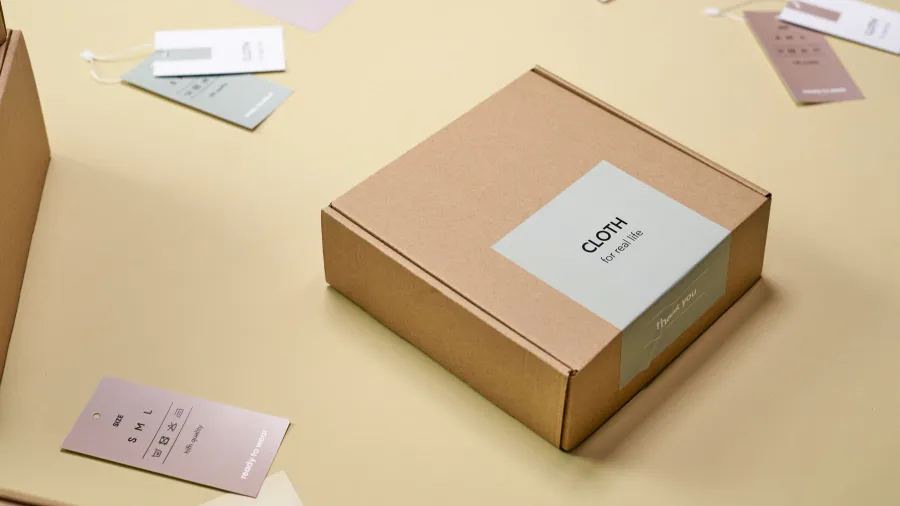
A blank tag is the whole private label proposition in one object: the product exists, the identity is still yours to write.
So when you talk to private label LED light manufacturers, be explicit about which one you mean:
- “Put my name on it, but I know others can buy the same fixture” → say white label, and expect the lowest price
- “This model should be mine in my market” → say private label, and negotiate the territory clause in writing before the deposit
If you are still choosing at the level of “which sourcing model fits my project”, the ODM vs OEM LED lighting comparison isolates that one decision. What follows here is the layer underneath it: the mechanism that produces the MOQ numbers you were quoted.
MOQ Is Not a Threshold. It Is a Division.
“Private label LED light manufacturers — what is your MOQ?” is the most-searched question in this niche and the worst-answered one.
The standard reply is “our MOQ is 100 units”. That sentence contains almost no information, because it does not say what you are allowed to change inside those 100 units.
The correct mental model is arithmetic:
MOQ = one-off cost ÷ batch size.
A factory is not putting a gate up to keep you out. It has a one-off cost that must be recovered across the batch. Below some volume the recovery per unit becomes embarrassing, or the factory simply loses money. The MOQ is simply the smallest batch at which the division still produces a presentable number.
There are four one-off costs, and this list is the point of the whole article:
- Tooling — injection moulds, die-cast dies, extrusion profiles, stamping tools
- Dedicated materials — a bespoke finish, a specific LED bin, a customised driver
- Line changeover — material swap, fixtures, machine setup, first-article approval
- Batch splitting — one model at 600 units is a completely different cost from three models at 200
Three of those four are controlled by the buyer.
- Do not open a mould → MOQ drops to 100–300 immediately
- Use a finish the factory already runs → it does not move
- Stay inside an existing driver’s wattage range → it does not move
- Order one model instead of three → the dilution doubles
Which means that in most real negotiations, “your MOQ is too high” translates to “the thing I asked for needs a mould.” That is a solvable problem. A threshold is not.
The full arithmetic — including the lead time and payment terms that come with each level — is broken out in our MOQ guide for LED track lighting.

The Five-Rung Ladder, and Where 100 Units Lands
Draw the line at “who pays the one-off money” and the four models become five rungs.
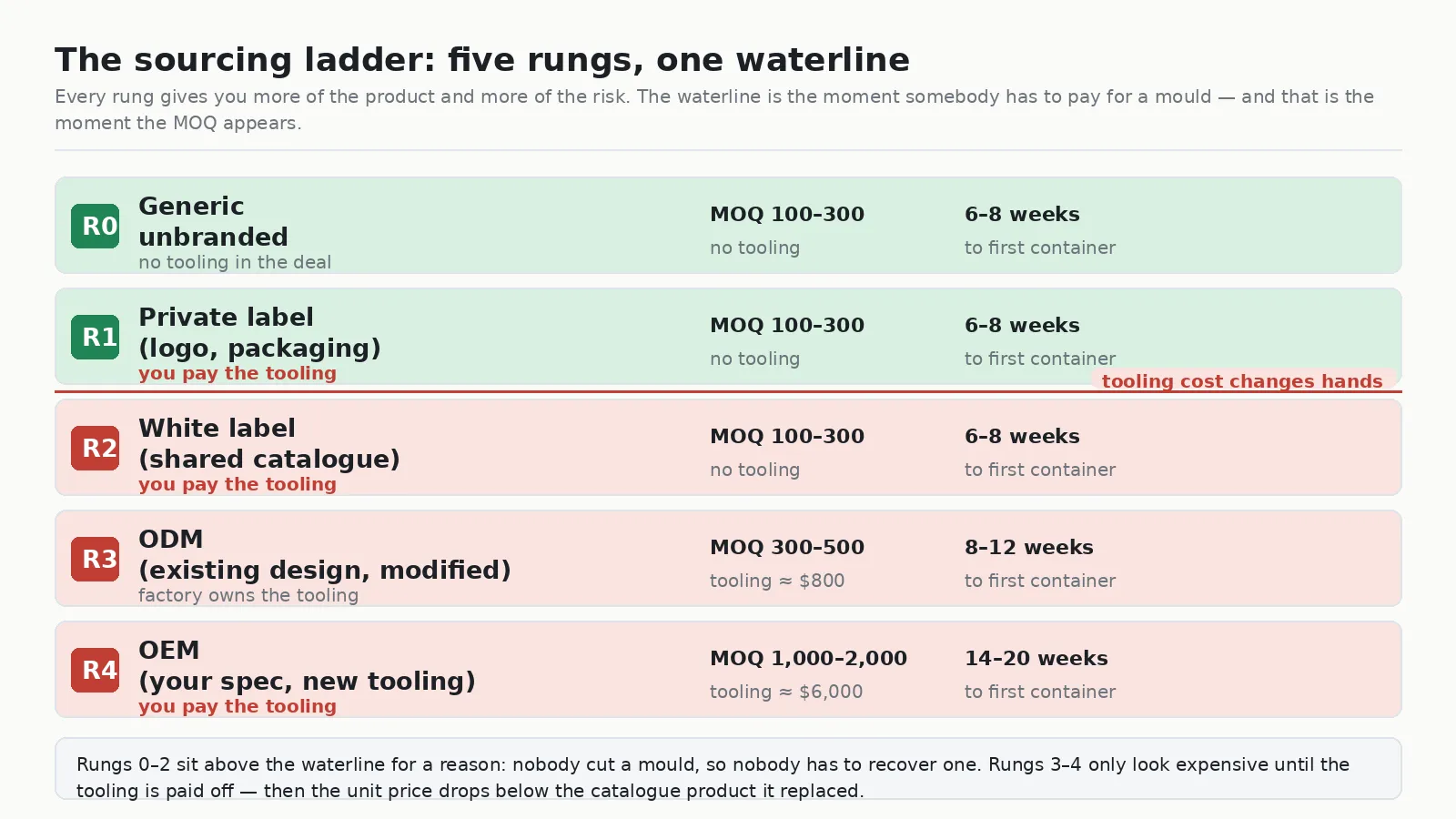
Above the line, nobody cut a mould. Below it, somebody has to recover one — and that is where MOQ comes from.
R0 — Generic, unbranded. 100–300 units, no one-off cost, 6–8 weeks. For market testing and emergency restocking. There is no brand asset being built here.
R1 — Private label. Your logo, your packaging, your manual. 100–300 units, still no one-off cost, 6–8 weeks. The only one-off is plate and die-cut artwork for the carton — small enough that many factories absorb it. This is the lowest-risk way to launch a branded line — and it is how most branded LED track lighting and downlight ranges actually start.
R2 — White label. The same line, the same fixture, no mark. 100–300 units, 6–8 weeks. Useful for distributors and for several small brands sharing one supply chain — a magnetic track system bought unbranded and re-sold under two different names is the textbook case.
— the waterline —
R3 — ODM. Take a factory design and modify the finish, CCT, CRI or beam angle. 300–500 units, roughly a sub-$1,000 one-off, 8–12 weeks. Note what that one-off is: a mould modification or a fixture/jig, not a new mould. The real mould is one rung down.
R4 — OEM. Your drawing, your mould, your certificate file. From 1,000–2,000 units, a several-thousand-dollar one-off, 14–20 weeks. This is the rung where a commercial lighting range becomes genuinely defensible.
The waterline is the single most useful line in this article.
Above it, the buyer never pays for tooling, so the factory can profitably take a small order. Below it, somebody must pay for the mould — and the person who pays for the mould is the actual author of your MOQ. That is the correct answer to “why is the minimum so high?”, and it also tells you exactly which lever to pull.

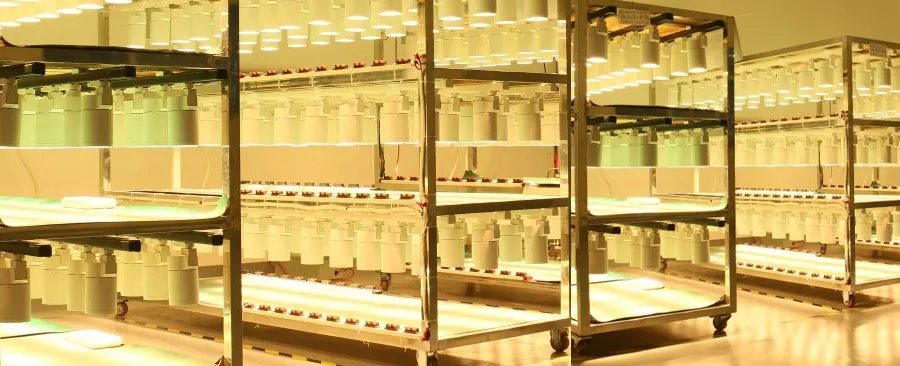
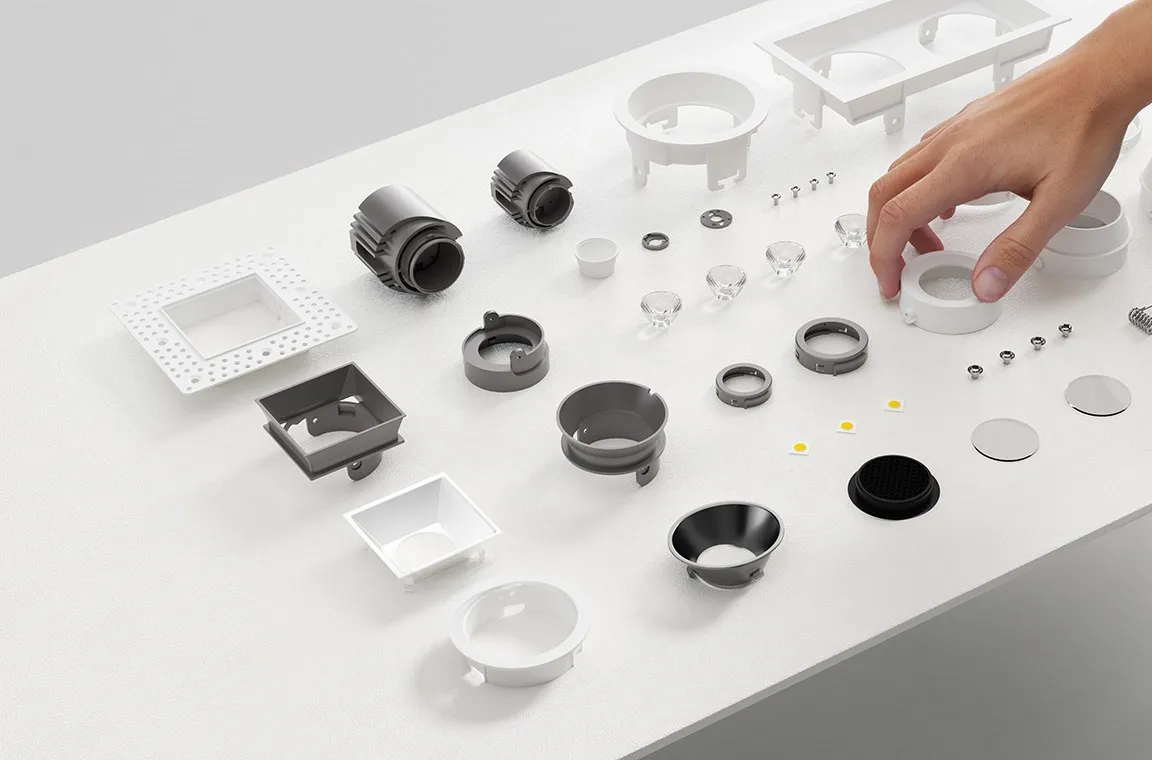
What a private label order actually buys: an existing line, already tooled, already audited. ENCORE has been running this one since 2011.
The Same Five Stages Under Three Contracts
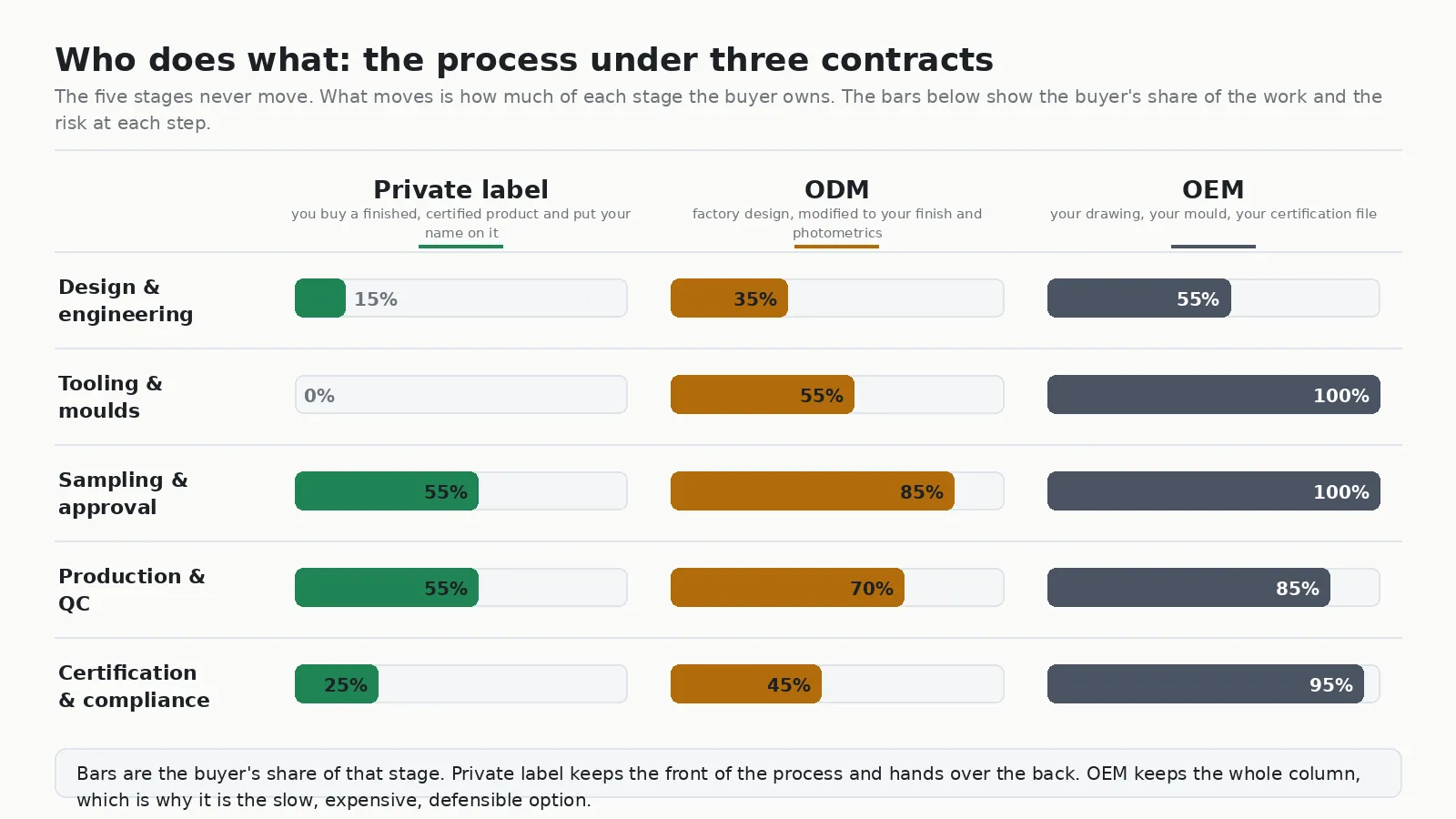
Break the process into five stages and you find that the process never changes. Only the buyer’s share of each stage does.
- Design and engineering
- Tooling and moulds
- Sampling and approval
- Production and QC
- Certification and compliance
A private label buyer holds a thin slice at the front — a little design participation, zero moulds, roughly half of the sampling loop — and hands the rest over. An ODM buyer sits in the middle. An OEM buyer owns nearly the whole column.
Three practical consequences:
- Private label is fast because you are buying engineering somebody already finished. What you skip is not a process step, it is the months of development in front of it.
- OEM is slow because design and tooling are inherently serial. Four to eight weeks disappear before anything is cut, and there is a prototype approval in between that nobody can compress.
- Sampling is the one stage where the buyer is heavily involved in all three models. That is not a coincidence. Sampling is the cheapest place you will ever be allowed to change your mind. A rigorous sample approval saves more money than any inspection performed later.
For the OEM path in full, the OEM LED track lighting guide documents all six steps with realistic timelines. The shorter, four-model version sits in our custom LED lighting manufacturer overview.

Private Label Decorative Lights Are a Different Business
Search private label decorative lights and private label track lighting and you get the same vendors, using the same word. The physics are not the same at all.
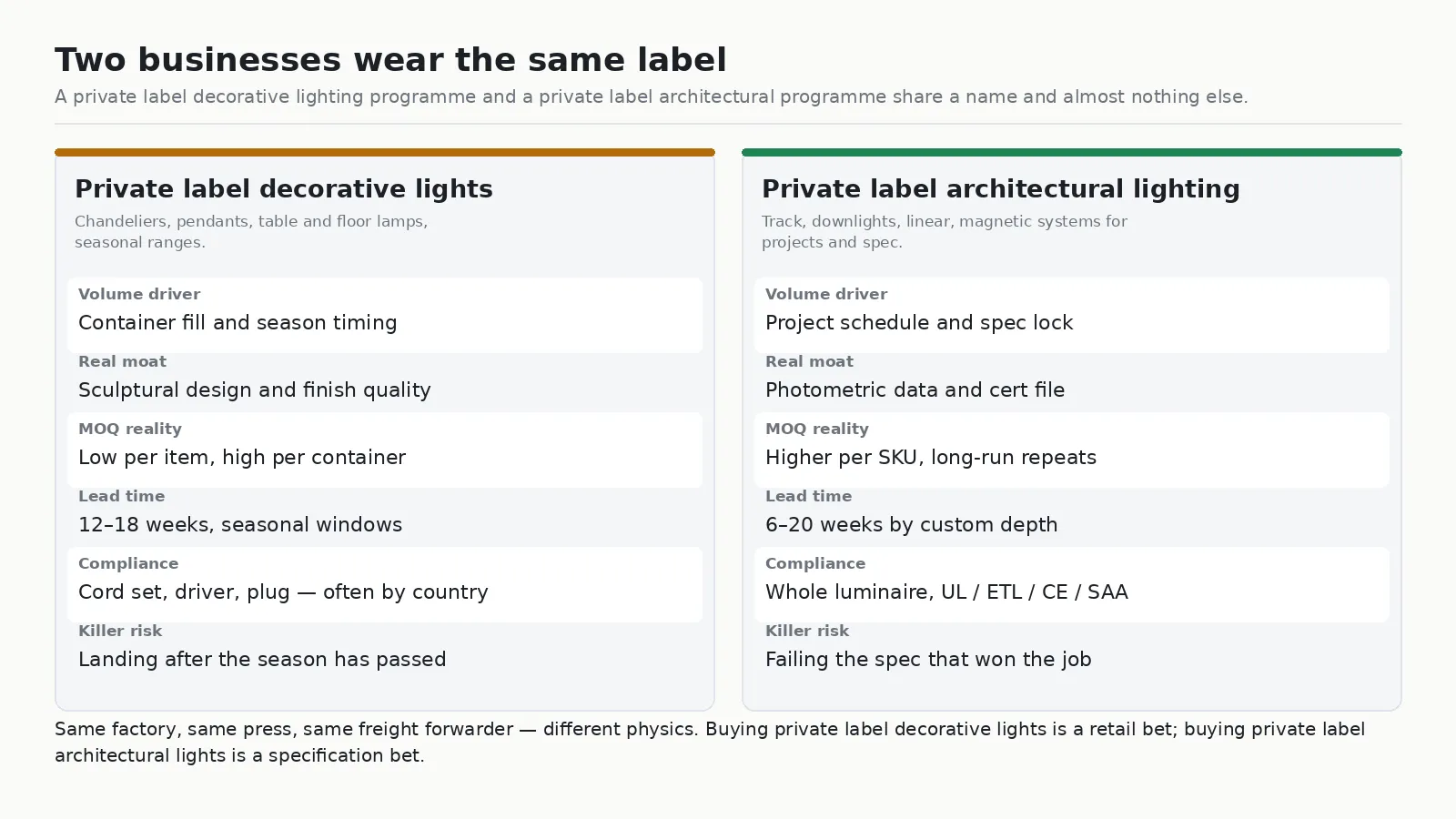
| Decorative | Architectural | |
|---|---|---|
| Volume driver | Container fill, season timing | Project schedule, spec lock |
| Real moat | Sculptural form, finish quality | Photometric data, certificate file |
| MOQ reality | Low per item, high per container | Higher per SKU, long-run repeats |
| Lead time | 12–18 weeks, seasonal windows | 6–20 weeks by custom depth |
| Compliance | Cord set, driver, plug — often country-specific | Whole luminaire: UL / ETL / CE / SAA |
| Failure mode | Landing after the season has passed | Failing the spec that won the job |
Two conclusions worth writing on the wall.
On decorative: the MOQ is quoted per item, but you buy per container. A pendant with a 200-piece MOQ sounds trivial. But a container that must hold twenty designs means your real order is 4,000 pieces. When you negotiate private label decorative lights, always ask whether the MOQ applies per item or per container. The two answers differ by an order of magnitude, and the ambiguity is always resolved against you.
On architectural: the moat is the file, not the fixture. Anyone can make a similar downlight. Almost nobody can hand your client the ETL certificate that names that model, the complete IES photometric file, and the test report showing how it was generated. On a project, that documentation package is what makes the product un-copyable for the length of the job. It is also the most valuable thing a private label architectural programme actually buys.


Why Your Small Private Label Order Costs More Per Unit Than a Big OEM One
Here is the counter-intuitive part, and it follows directly from the division.
- Private label route: no mould, so material plus labour is around $9 a piece, plus an order-level fixed block (engineering, artwork, compliance paperwork) of roughly $800. At 300 pieces: 9 + 800 ÷ 300 = $11.67 a piece.
- OEM route: a several-thousand-dollar mould, and a piece cost that drops to roughly $7.40 because the design is optimised for your part, plus the same $800 order-level block. At 1,500 pieces, against a $6,000 mould: 7.40 + 6,800 ÷ 1,500 = $12.93 a piece.
At 1,500 pieces, the OEM unit cost is still higher. The mould has to be amortised before the cheaper piece price wins.
The crossover sits around 4,250 pieces.
That is why a factory says “start with private label, talk to us about a mould when volume arrives”. It is not stalling. It is showing you the arithmetic. The maths for a genuinely different product — one that can command a different price rather than a cheaper one — is a different sum entirely, and our custom track lighting manufacturer guide handles that case.
These figures are illustrative planning ranges used to expose the mechanism, not a quotation. Real numbers depend on the fixture, the finish, the mould and the market.

How to Ask So You Get The Right Answer
What you ask determines what you are told. Three rewrites.
Do not ask: “What is your MOQ?”
Ask: “If we do not change the mould — only the logo and the packaging — what is the MOQ? We are not opening a mould at this stage.”
The first half gives the factory a range it can actually answer; the second removes the thing that was inflating the number. Factories hear “no mould” and immediately quote you a much lower figure, because for the first time the question is answerable.
Do not ask: “Can you do better on the price?”
Ask: “If we consolidate three models into one, what happens to the MOQ and the unit price?”
On some products, narrowing the range is the discount. If you want to cut the price, cut the choices.
Do not ask: “Do you do private label?” — every factory says yes.
Ask: “Do you sell this model to anyone else in my market, and what would an exclusivity clause cost?”
That single question is the whole difference between white label lighting and private label, and it forces the answer into writing.
Three Rules, and You Can Stop Reading
One: if private label can solve it, do not buy OEM. Ninety per cent of what buyers describe as a custom requirement — logo, colour, CCT, CRI, beam, packaging — sits above the waterline. Run a private label cycle first. Find out which SKU actually sells. Then pay for a mould for that one.
Two: only pay for OEM when “cannot be copied” is itself the business. If your advantage is channel, price or service responsiveness, the mould is an expense. It becomes an asset only when customers buy from you because of the product itself — and when that product carries its own certification and photometric file.
Three: decorative watches the calendar; architectural watches the paperwork. One demands a decision eighteen weeks before the season; the other demands the certificate and the IES file in hand before you sign the contract. Treating them as the same purchase is how both go wrong.
Before you send the first RFQ for any of the four models, the factory vetting checklist covers the questions that decide whether the factory behind the quote is real. If the programme involves branding, compliance or packaging, the private label lighting manufacturer guide is the deeper companion piece.
FAQ
What is the difference between private label and white label lighting? Exclusivity. White label lighting is the same product sold to many brands, usually with no mark printed on it at all. Private label is the same product sold to you, or to you alone in your market, carrying your mark on the housing, the packaging and the manual. The product is often identical — the difference lives in the contract.
Do I need tooling for private label LED lighting? No, and that is the whole point of the model. You are borrowing engineering and moulds the factory already owns. Your one-off costs are limited to print plates and packaging die-cut artwork, typically tens to a few hundred dollars. Any requirement that forces a new or modified mould moves you to ODM or OEM territory.
How low can a private label MOQ actually go? It depends on how much customisation you give up. No mould change, an existing finish, an existing driver wattage range and a single model can land at 100–300 units. Every additional variable pushes the number up, because it adds changeover and dedicated material to the one-off block.
How much more expensive is OEM than ODM? An order of magnitude on the one-off. ODM mould modification or jig work usually runs in the hundreds to low thousands of dollars; a new OEM mould typically runs several thousand, and can reach five figures for complex tooling. On unit cost, OEM is often more expensive at low volume — the crossover in our worked example sits around 4,250 pieces.
Why is the lead time so different between the models? Because the number of serial stages is different. A private label order of 6–8 weeks is essentially scheduling, production, inspection and freight. An OEM order of 14–20 weeks spends the first four to eight of those weeks on design and tooling before production begins.
Does a private label product need its own certification? Usually not, if you are only changing the logo, the packaging, a housing colour or a CCT option already inside the certificate’s scope. The factory’s existing certificate can be reused. Changing the mould, the optical structure, the driver circuit or the model designation does trigger retesting — and that retesting is one of the real costs that separates OEM from private label.
How should I calculate MOQ for private label decorative lights? Per container, not per item. Work out how many designs a full container needs, divide the container volume by the number of designs, and you have the volume each design must carry. Only then can you judge whether the per-item MOQ you were quoted is realistic for your range.
Is money spent on private label wasted if I move to OEM later? No, but plan for the transition. On the first order, ask who owns the packaging artwork, whether the manual and carton design leave room to add a model name, and what the lead time and cost would be if you later open your own mould. Handled that way, the packaging assets carry over and the certification path can be mapped in advance.
Conclusion
“Private label vs OEM vs ODM lighting” has a table for an answer and a line for an insight. The line is this:
Which side of the waterline you stand on is decided by who pays for the mould.
Start above it. Build the brand on a product that already exists and is already certified. Prove which SKU sells. Then pay for the mould — and at that point OEM stops being a cost and becomes an asset nobody else in your market can copy.
If you are weighing up a private label or OEM programme for track lighting, downlights, magnetic track or decorative ranges, see how our OEM/ODM service works or talk to our engineering team with your volumes and target market. We will tell you which rung of the ladder your brief actually needs — including when the honest answer is that you do not need a mould yet.
- private label led light manufacturers
- private label vs oem vs odm
- white label lighting
- private label decorative lights
- private label lighting manufacturer
- odm vs oem lighting
- custom lighting manufacturer
- lighting private label guide

ENCORE Lighting Team · ENCORE
LED Lighting Manufacturer & OEM/ODM Partner
The ENCORE engineering and sourcing team writes about LED track lighting, downlights, magnetic systems, certifications and OEM/ODM manufacturing for B2B buyers and specifiers.