· Custom & OEM Lighting · 25 min read

Written by ENCORE Lighting Team
LED Lighting Manufacturer & OEM/ODM Partner ·
Commercial Lighting Manufacturer: Custom vs Stock, Lead Time & MOQ
How to choose a commercial lighting manufacturer: the six customisation levels behind "stock or custom", the five stages that make up a real lead time, and why MOQ is a price curve rather than a gate. Includes a project-window decision table and a copy-ready RFQ checklist.
There are three questions every commercial lighting buyer asks a factory, usually in the same email:
- Is this stock, or is it custom?
- How long is the lead time?
- What is your MOQ?
And there is one answer that ends the conversation badly: “We can do either, 30 days, 100 units.”
Because those three questions are not independent. They are three links on the same chain. Lock one down and the other two have to move:
- Choose stock and you accept the CCT, beam angle, finish and packaging that already exist — plus batch-to-batch variation.
- Choose fully custom and you accept one-off tooling and engineering, and the minimum order and lead time that come with it.
- Demand a short lead time and you must give ground on either the stock range or the variables you are allowed to change.
This guide is a decision map for commercial projects — retail chains, hotels, offices, supermarkets, restaurants, showrooms, and the track, downlight and linear systems that go in them. By the end you should be able to take your own project sheet and say: which fixtures have to be custom, which have to be stock, what lead time to plan for, and how to structure the minimum order conversation.
In commercial lighting, lead time and MOQ are not two numbers a factory gives you. They are two consequences of the customisation depth you chose.
One thing up front: the lead times, minimum-order bands and price figures in this article are indicative industry ranges for B2B commercial LED lighting programmes. They are here to make the mechanism visible, not to quote any specific factory. Price tooling, volume breaks and dates against a written quotation.
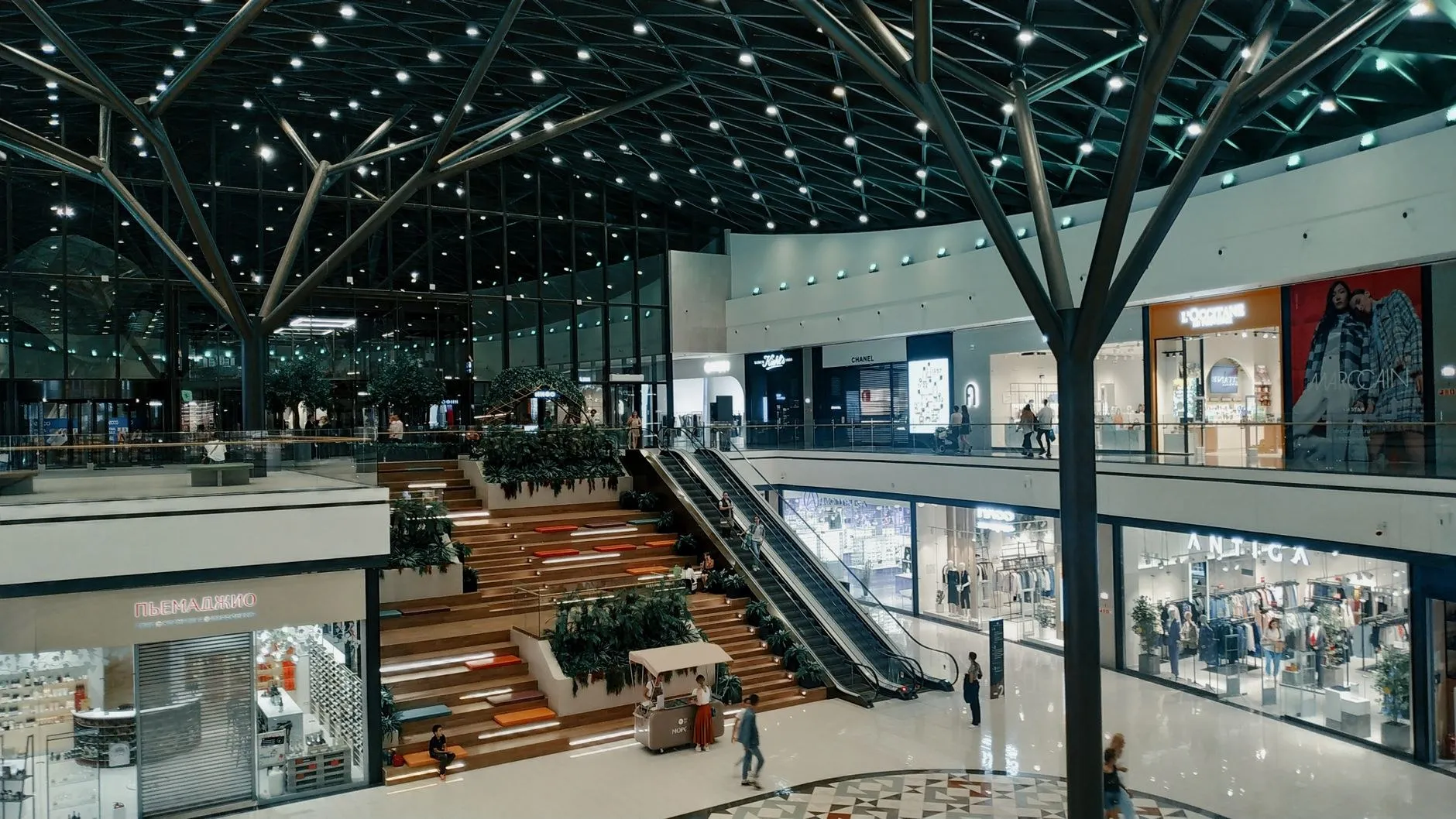
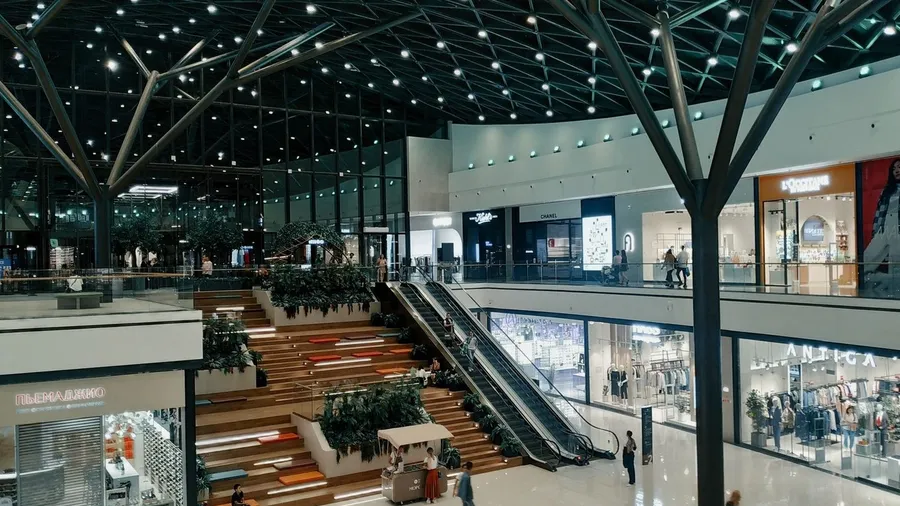
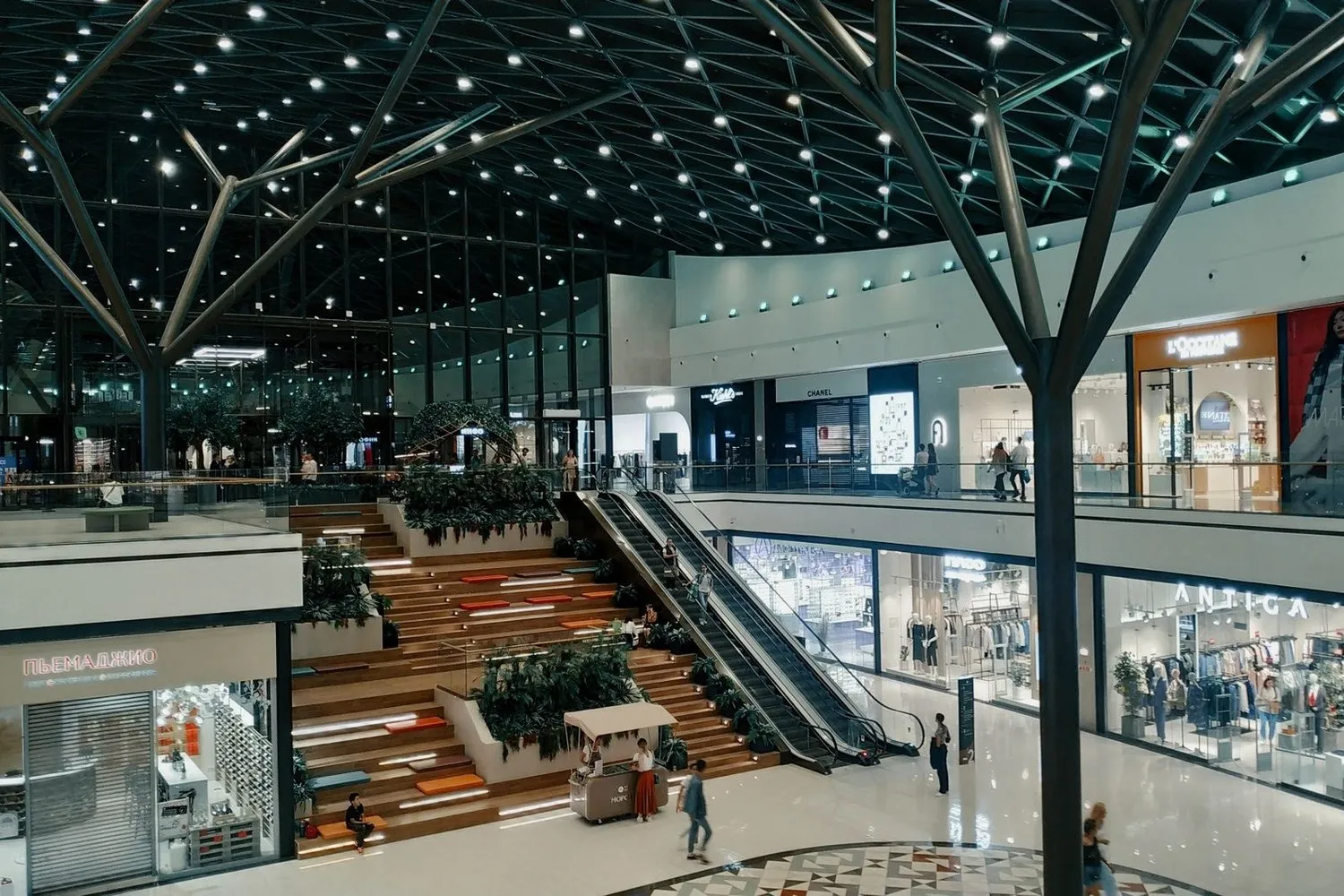
A shopping mall ceiling is a good reminder of what “commercial” means: not one fixture, but thousands of the same fixture, all delivered before opening day.
What a Commercial Lighting Manufacturer Actually Supplies
The phrase gets used loosely, so let us separate a commercial lighting manufacturer from a residential fixture factory. Commercial lighting serves commercial premises, not homes: retail, hospitality, offices, supermarkets, restaurants, museums and galleries, healthcare and education, airports and transit hubs.
The difference is not the look of the fixture. It is these four things:
| Dimension | Residential lighting | Commercial lighting |
|---|---|---|
| Buying pattern | Single units, retail | Project-based, in bulk, with installation |
| What is measured | How it looks | Illuminance, uniformity, glare, CRI, energy |
| Delivery driver | Whenever | Tied to the fit-out schedule and opening date |
| Responsibility | Swap it yourself | Commissioning, warranty, certification, egress and fire |
A genuine commercial lighting manufacturer therefore sells four things, not one:
- A system of products — track lights, magnetic track systems, downlights, commercial luminaires and the electrical and control platform they share.
- Project-level engineering — optical simulation, IES photometric files, circuit and dimming design (TRIAC, 0–10V, DALI, Casambi, Matter).
- Evidence of market access — certificates that name your SKU: ETL/UL for North America, CE for Europe, SAA/RCM for Australia.
- A schedulable delivery promise — not “we have stock”, but “your consignment comes off the line in week X and sails in week Y”.
Hold those four in mind. Everything below — custom vs stock, lead time, MOQ — is a project variable, not an inventory variable.
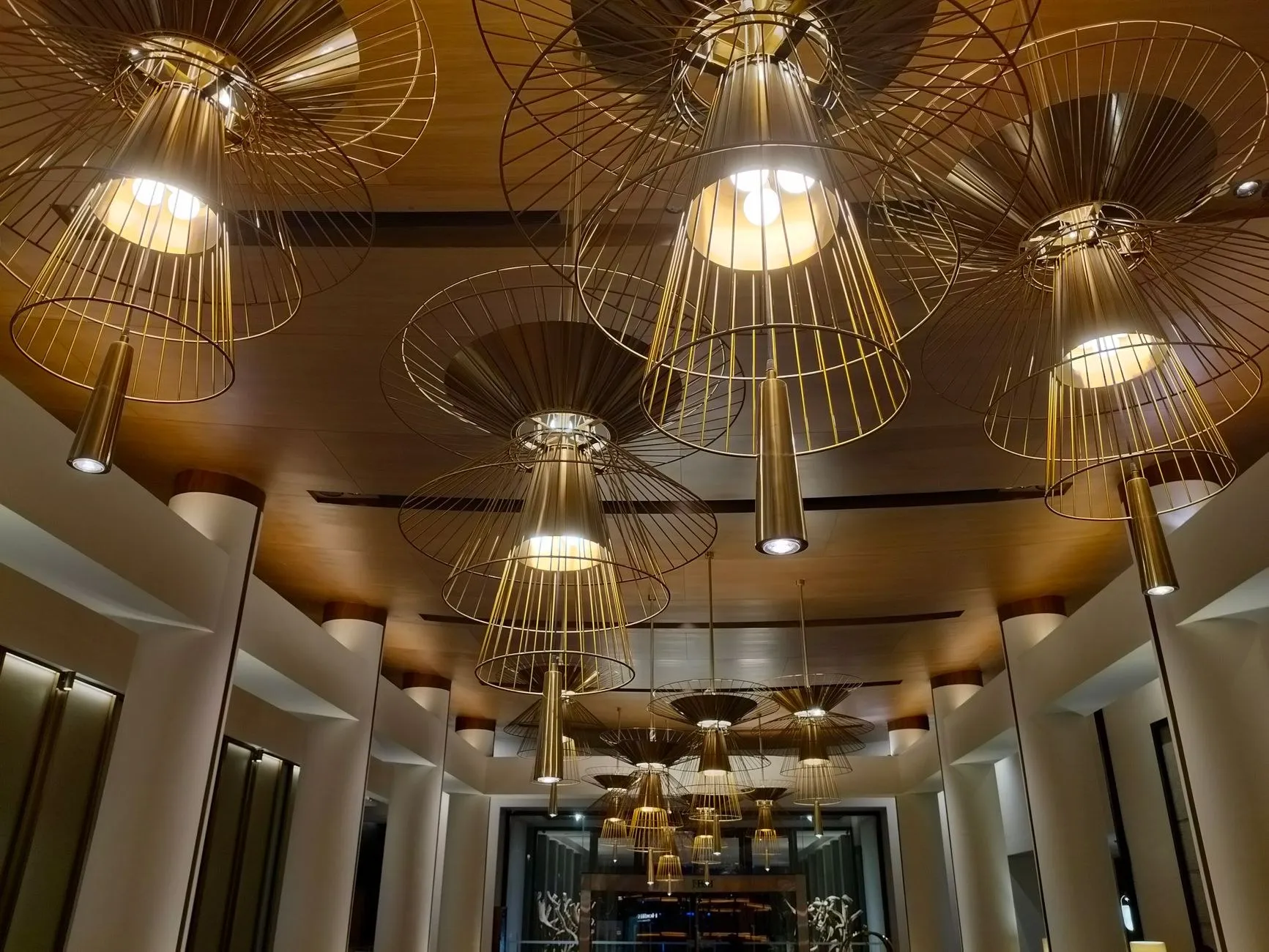
Hospitality projects are where customisation earns its keep: a lobby fixture is often the only thing a guest remembers about the ceiling.
Custom vs Stock: Six Levels, Not Two Options
“Stock or custom” never resolves because both sides treat it as a binary. It is a ruler with six levels on it. The level sets the cost, and the level is what sets your lead time and your minimum order.
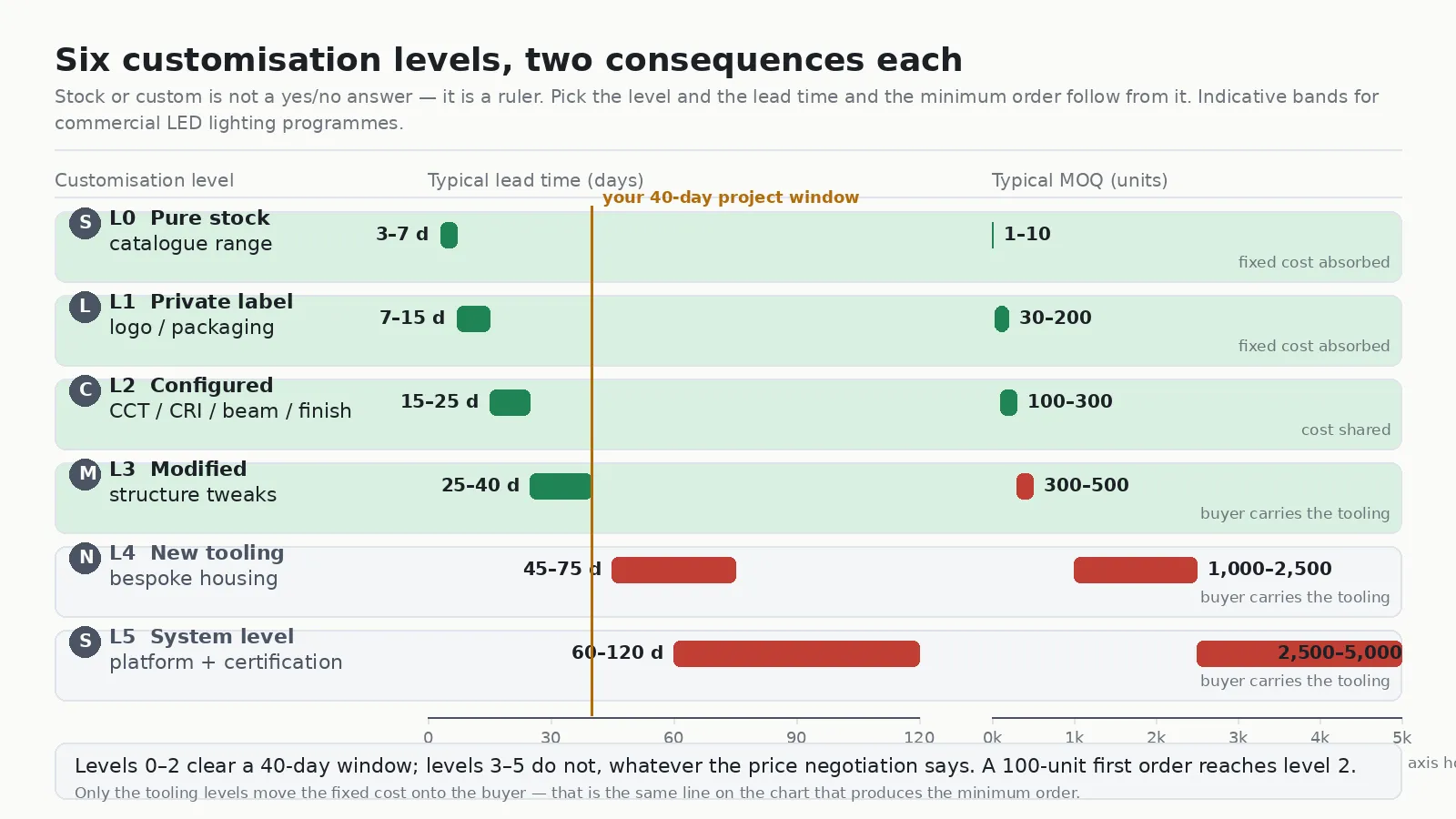
Six levels, two consequences each. A 40-day project window reaches levels 0–3; a 100-unit first order reaches level 2.
Level 0 — Pure stock
Standard items from the current catalogue: fixed wattage, fixed CCT (say 3000K / 4000K), fixed beam angle, usually black or white, standard carton.
- Lead time: 3–7 days if in stock
- Typical MOQ: from a few units
- Trade-off: your project bends to the fixture, and batches may vary in colour and optics
- Best for: replenishment, samples, emergency fills, non-visual areas (back of house, storage, stair cores)
Level 1 — Stock plus private label
No structural change — only the parts that cost little or nothing to change: logo silk-screen or laser marking, printed carton and manual, CCT and beam angle chosen from existing ranges, driver wattage selection.
- Lead time: 7–15 days
- Typical MOQ: a few dozen to about 200 units
- Trade-off: barely moves the cost structure, but you must choose from the ranges the factory already runs — no decimal-point CCT
- Best for: brands going to market, distributors building a label, standard circuits in chain stores
If this is the route you want, our private label lighting manufacturer guide walks through what a label can and cannot cover.
Level 2 — Configured platform
Take a platform the factory has already validated and change the variables that affect materials but not structure: CCT specified exactly (2700K / 3500K), CRI 90 or 95, SDCM ≤ 3 colour binning, a beam angle from the available optics (15° / 24° / 36° / 50°), cut-to-length rails, a specified RAL finish, and a dimming protocol (0–10V / DALI / TRIAC).
- Lead time: 15–25 days
- Typical MOQ: usually 100–300 units
- Trade-off: the BOM is re-planned and materials are bought in, so both lead time and minimum order step up together
- Best for: hotel guest rooms and public areas, branded retail, office fit-outs
Level 3 — Modified standard
Small changes on top of an existing tool: trim diameter and cut-out adjusted, mounting changed from recessed to surface or vice versa, a deeper anti-glare baffle, a redesigned reflector angle and finish, a different cable exit position.
- Lead time: 25–40 days
- Typical MOQ: usually 300–500 units
- Trade-off: a new first article and optical validation, possibly a tooling modification or a new jig
- Best for: projects with hard glare or mounting constraints, or fixtures that must fit millwork and ceiling details precisely
Level 4 — New tooling and bespoke housing
New die-cast housing, extrusion profile, injection-moulded optics, all tooled from scratch. The appearance and brand language are entirely yours.
- Lead time: 45–75 days including tooling and first-article approval
- Typical MOQ: usually 1,000 units and up, depending on tool complexity
- Trade-off: one-off tooling and engineering from roughly USD 5,000 to well over USD 50,000; the tooling cost is often amortised into later orders
- Best for: chain brands enforcing one look, or projects that need differentiation a competitor cannot buy from the same catalogue
Level 5 — System-level customisation
Not one fixture but the whole system: track topology and power feed arrangement, magnetic module combinations, driver and control protocol integrated into the building management system, and the system re-tested for certification (ETL / CE / SAA).
- Lead time: 60–120 days
- Typical MOQ: project-based, calculated on the system and circuit count
- Trade-off: the heaviest engineering load, plus certification test fees and calendar time
- Best for: hotel groups, large retail chains, flagship projects needing central control and a single commissioning pass
The six levels side by side
| Level | What changes | Typical lead time | Typical MOQ | Who carries the one-off cost |
|---|---|---|---|---|
| 0 | Nothing | 3–7 days | a few units | factory (already amortised) |
| 1 | Branding, packaging | 7–15 days | 30–200 | factory |
| 2 | CCT, CRI, beam, finish, dimming | 15–25 days | 100–300 | shared |
| 3 | Structure, optics, mounting | 25–40 days | 300–500 | buyer |
| 4 | Everything, new tooling | 45–75 days | 1,000+ | buyer |
| 5 | System plus certification | 60–120 days | by project | buyer |
This table is the core of the whole article. Read it backwards and it becomes a scheduling tool: if your opening date is 40 days away, the deepest level your project can reach is level 3. If you want the level 4 look, you either start three months earlier or accept a higher unit price to amortise the tooling faster.
If your project involves a track system specifically, the custom track lighting manufacturer guide maps the same decision onto track components.
Lead Time: Five Stages in Series, Not One Number
Procurement teams treat lead time as a single figure. It is actually five stages in series, and skipping any one of them is how projects slip.
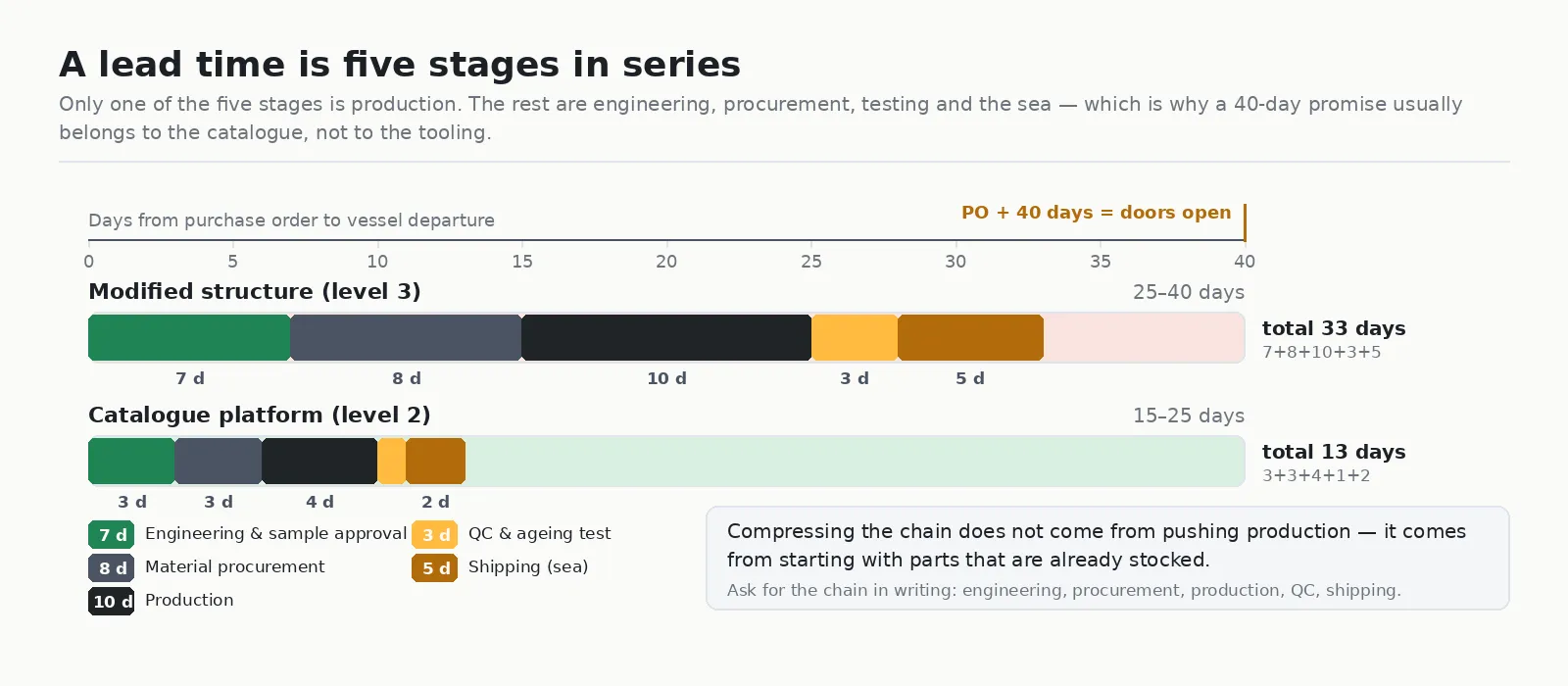
The same scope, run on catalogue parts and on modified parts, produces a 12-day and a 33-day chain. Production is only 10 of those 33 days.
Stage 1 — Engineering and sample approval. Optical simulation, mechanical confirmation, driver matching, sample build and shipping, buyer sign-off. This is the stage most often underestimated. A sample takes 3–7 days in transit to an overseas buyer, and internal sign-off takes another 3–10 days. Approval often takes longer than production.
Stage 2 — Material procurement. Standard materials 3–7 days. Custom-binned LEDs, a specific driver IC, a non-standard aluminium extrusion or a certification-specific cable can take 10–30 days. Upstream shortage is the most common lead-time killer in LED lighting.
Stage 3 — Production. Standard orders 7–15 days; orders with painting, printing, assembly and ageing 15–25 days. Add 20–50% during peak season and around Chinese New Year.
Stage 4 — QC and ageing test. 100% ageing plus sampling inspection before shipment is standard on commercial projects. Ageing itself runs 4–8 hours up to 24 hours, then inspection and packing, usually 2–5 days. Do not compress this stage. What you save here comes back as field failures.
Stage 5 — Shipping. Sea freight to North America or Europe is roughly 25–40 days including booking and port handling. Air freight is 5–10 days at a materially higher cost. Rates and space tighten sharply in peak season.
So is a 40-day lead time possible?
Yes — but decided by scope, not by negotiation. To land inside 40 days you can only do these things:
- Stay at level 0–2, using a platform the factory has already validated.
- Constrain LEDs, drivers and cable to specifications the factory already stocks.
- Compress sample approval by naming one decision-maker and signing off in one pass.
- Ship by air instead of sea, and accept the freight cost.
Conversely, if the project needs level 4 or 5, 40 days is physically impossible. Any supplier who promises it is moving the risk downstream — a slip, a downgraded spec, or a skipped certification test.
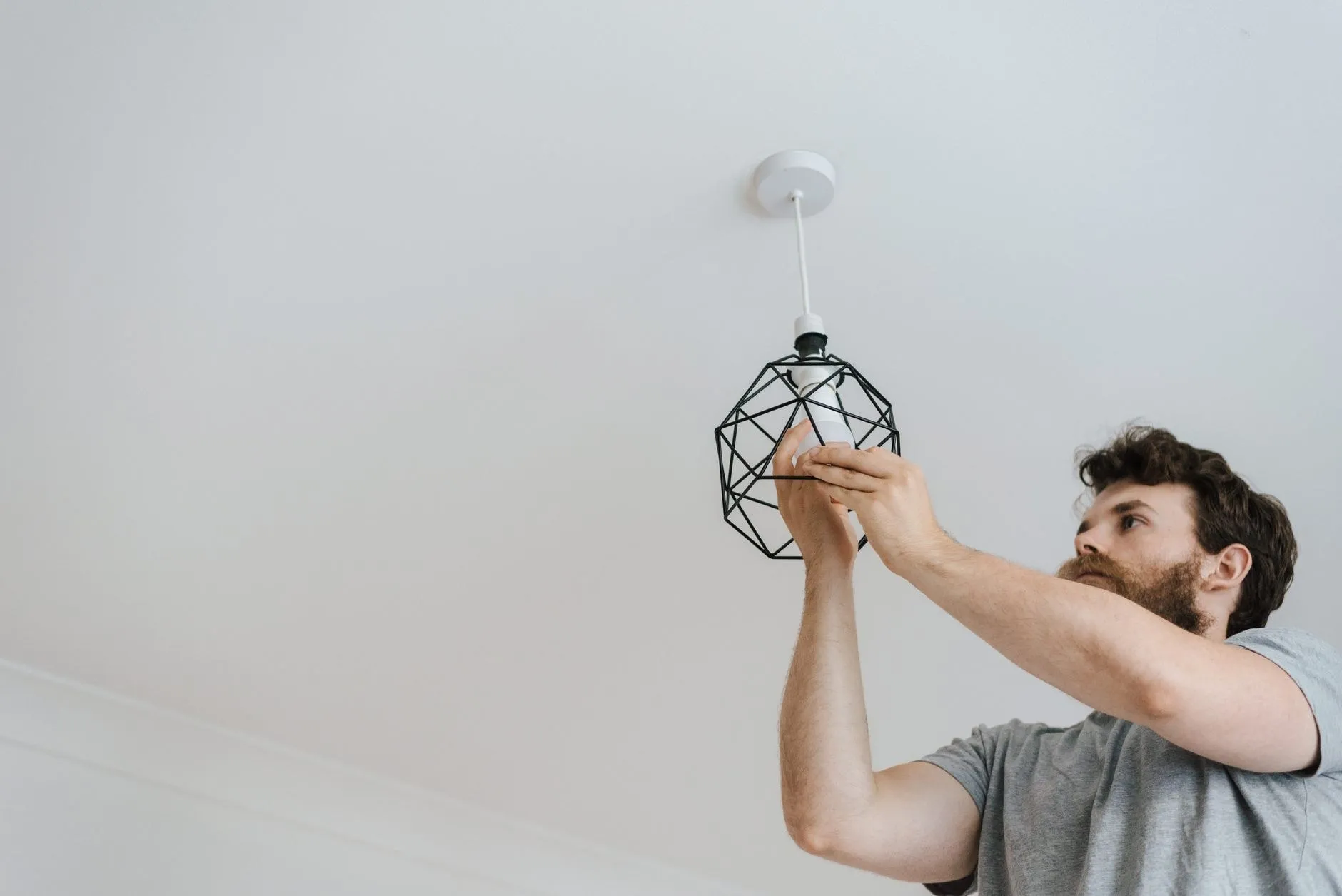
On site, the lighting is rarely late on its own. It is late because it was ordered against a promise date instead of a reverse schedule.
Three practical rules for lead-time negotiations
- Schedule backwards, not forwards. Start from the fit-out or opening date and subtract: freight → inspection → production → procurement → engineering. The date that falls out is the real one.
- Ask for the lead time in stages. A capable factory will commit in writing: materials complete X days after sample approval, production complete Y days, shipment Z days. A single total number usually means no production planning exists.
- Split the delivery. Large projects can take a first consignment early (mock-up room, main entrance, trading floor) with the balance later. That relieves schedule pressure and cash pressure at the same time.
MOQ: Where a Minimum Order Actually Comes From
MOQ is not a gate a factory puts up. It is the price of the change you are asking for.
Part of the cost of any order does not change with quantity, and that part must be spread across every unit made. In commercial lighting there are at least three such costs:
- Tooling and fixtures — new die-cast moulds, extrusion dies, injection-moulded optics, painting jigs, packaging dies. This is the expensive one, routinely tens of thousands of dollars.
- One-off engineering — mechanical design, optical simulation, driver matching, IES files, sample iterations, and certification testing (the test and report fees for ETL, CE or SAA).
- Production changeover — stopping the line, changing material, re-setting, first-article approval. The labour and lost time is the same whether the run is 100 units or 1,000.
Divide those fixed costs by the unit price and you have the mathematical origin of an MOQ. The higher the fixed cost as a share of total cost, the larger the minimum batch has to be. The lower it is — say, because nothing is tooled — the lower the MOQ.
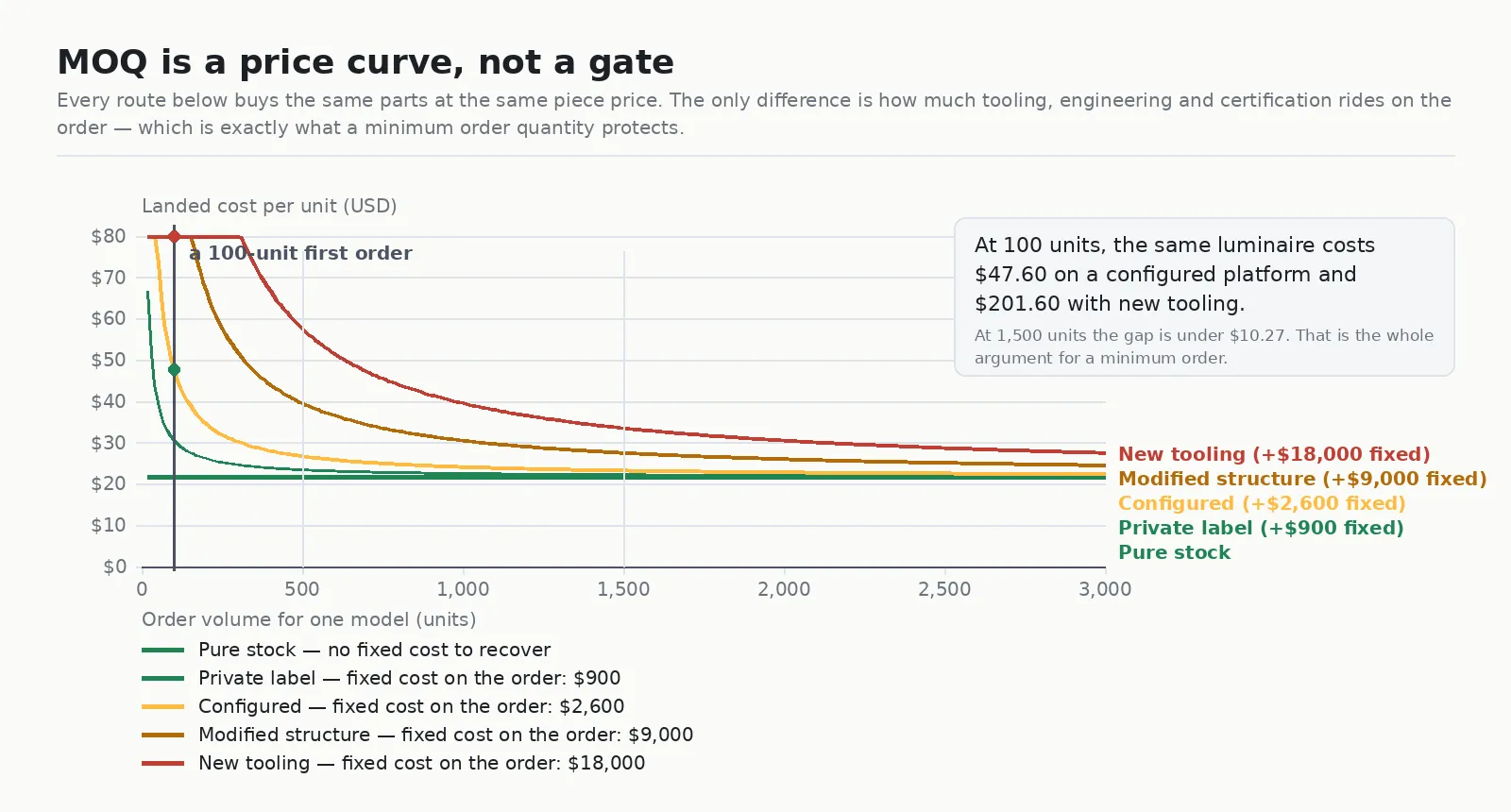
Every route buys the same parts at the same piece price. Only the fixed cost differs — which is exactly what a minimum order quantity protects.
This also explains a genuinely counter-intuitive behaviour: why the same factory quotes an MOQ of 50 units to one buyer and 1,000 units to another. It is usually not because the second buyer is small. It is because the second buyer is asking for a deeper change.
How to negotiate an MOQ: attack the fixed cost, not the unit price
Most buyers open with “can you get it down to 100 units?” That attacks the result, not the cause. Attack the three fixed costs instead:
- Pay or share the tooling. If you fund the mould, the factory no longer needs an MOQ to protect itself, and the minimum comes down.
- Stay on an existing platform. Accept the current mould and optics; change only CCT, beam, finish and packaging.
- Bring repeat volume into the first conversation. Committing to “if this batch passes, there is the same fixture across X stores this year” lets a factory lower the first MOQ, because the fixed cost amortises across a visible pipeline.
- Accept split deliveries. One production run, several collections. The factory amortises once, and you carry less inventory.
- Share materials across models. One LED, one driver and one optic serving several fixtures reduces the number of materials that need buying in.
- Accept standard packaging. A custom printed carton has its own die and its own minimum. Plain cartons with a label are far cheaper to start.
What a first order actually buys
This is the most misunderstood part. When you place a few hundred units for the first time:
- You do get the correct optics and appearance, real certification coverage, real production-line quality, and a bill of materials that can be repeated.
- You do not get the lowest unit price, the shortest lead time, or the freedom to change anything at will. The first order price necessarily contains the amortised fixed cost.
- What you are really buying is one validated product that can be copied. The point of a first order is not to save money. It is to freeze the solution.

Most of the fixed cost is spent before a single fixture is made: approvals, samples and validation. That is what a minimum order is paying for.
Putting All Three on One Project Sheet
Combine custom-vs-stock, lead time and MOQ and you get a decision tool you can copy directly:
| Your project constraint | Level | Lead time to expect | MOQ to expect | Note |
|---|---|---|---|---|
| Needed in 3 weeks, no changes | 0–1 | 3–15 days | a few dozen | use the factory’s stock parameters |
| 1–2 months, brand look and specified optics | 2 | 15–25 days | 100–300 | usually the best value layer |
| 2–3 months, special mounting or anti-glare | 3 | 25–40 days | 300–500 | leave time for first-article approval |
| 3 months plus, bespoke structure and brand language | 4 | 45–75 days | 1,000+ | book tooling capacity early |
| Half-year programme, whole system and central control | 5 | 60–120 days | by project | certification testing needs its own slot |
Use it like this: write down the opening date first, then read upwards. The first level that fits is your ceiling. Doing it the other way round — picking the look and then demanding the date — is the single most common reason commercial lighting projects slip.
What to Ask a Factory (Copy-Ready RFQ)
One good enquiry removes two rounds of email. Give all of this at once.
Project information
- Project type and end client (retail / hotel / office / supermarket / showroom), number of stores or floors
- Fit-out date and opening date — the one variable that cannot be traded
- Quantity, and the expected call-off schedule
Product information
- Fixture categories and quantities (track / downlight / magnetic / commercial)
- Wattage, CCT, CRI, SDCM, beam angle
- Mounting type, cut-out size, ceiling type and ceiling height
- Dimming protocol and control system
- Finish and colour to RAL
- Packaging format (plain or branded carton)
Commercial information
- Target market and the certifications required (ETL/UL, CE, SAA/RCM)
- Whether the factory must supply IES photometric files and a sample
- Expected lead time, and whether split delivery is acceptable
- Whether you will fund tooling in exchange for a lower MOQ
Three questions worth asking every supplier
- “Which level does this specification fall into — an existing platform, or does it need new tooling?”
- “Can you state the lead time in stages: procurement, production and shipment separately?”
- “If I give you the full year’s volume now, where does that put the first MOQ?”
How ENCORE Handles This
We build commercial LED lighting in Shenzhen — track lighting, downlights, magnetic track systems and commercial luminaires — for retail, hospitality, office and museum projects. When a buyer sends us a project sheet, here is what actually happens:
- We map the request against our existing tooling first, and tell you plainly which lines need a mould and which do not.
- We quote three price breaks — typically 100, 500 and 1,000 units — so the cost structure of your minimum is visible before you commit.
- We return the lead time in stages, with the shipping leg shown separately, so you can schedule from the fit-out date backwards.
- We run the same first-article approval and ageing process on a small first order as on a large one. Small orders do not get a lighter QC process.
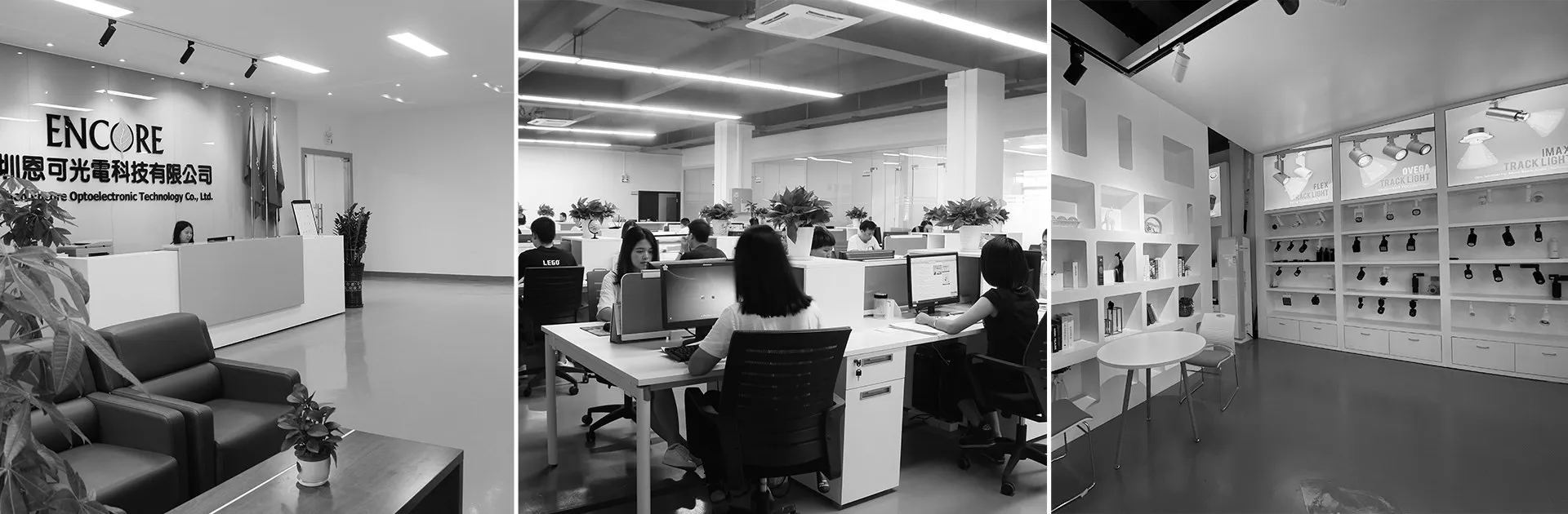
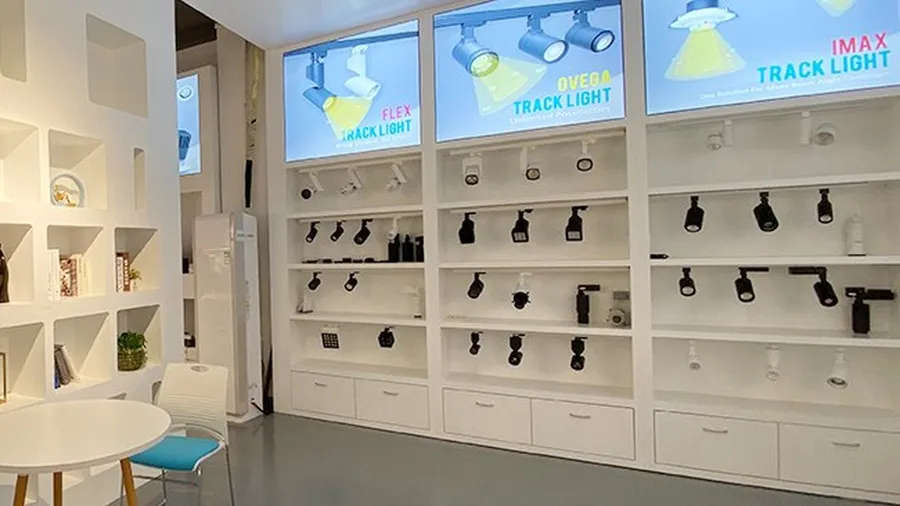
Our own facility in Shenzhen: reception, the engineering office where specifications are turned into drawings, and the showroom wall where customers compare optics before they commit.
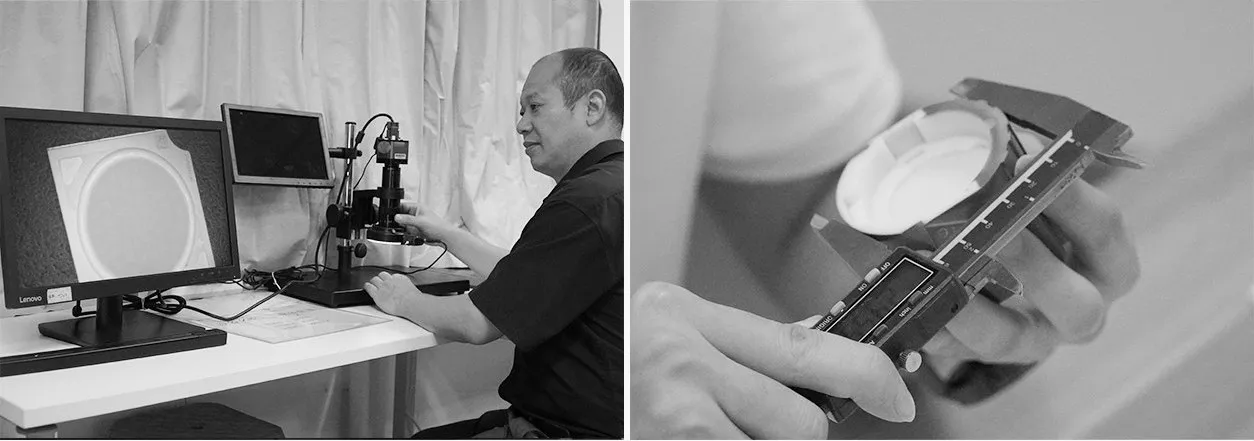
IES photometric files are generated in our own lab. That is the test of whether a supplier can support a lighting design, not just ship boxes.
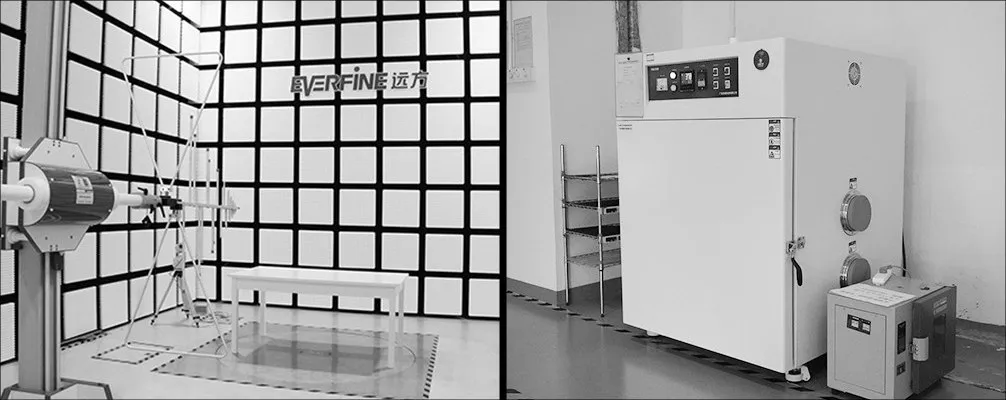
EMC chamber and ageing oven on site. Certification is a process a factory owns, not a document it forwards.
If the change you want does need tooling, we will say so and show you the number, rather than quoting a large MOQ without explanation. Read the full quality control process, see how a specification travels from RFQ to certified production on the OEM/ODM page, or send your project sheet and target market and we will tell you exactly which levels your first order can reach. Request a commercial lighting quotation →
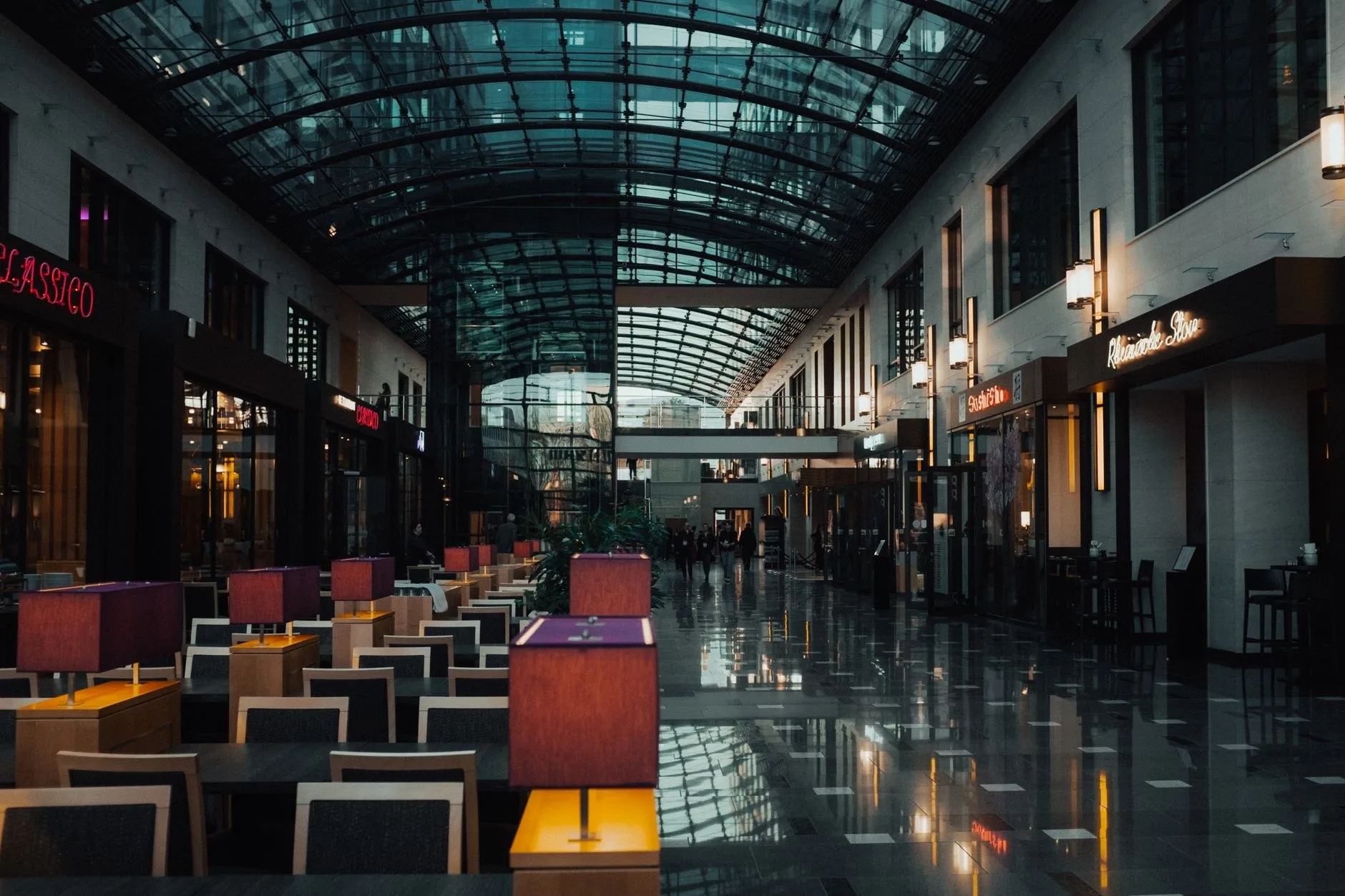
Where Each Level Belongs in a Real Building
The levels are not abstract. They map onto the spaces in a typical commercial project.
Retail and supermarket. Sales floors need high uniformity and tight colour consistency across very large fixture counts, so level 2 configuration is usually enough — the difference between two stores must not be visible. Back-of-house areas should be level 0.
Hotel and hospitality. Public areas are where the brand shows, so level 3 or 4 is common for feature fixtures, while guest-room downlights stay at level 2 to keep the repeat-order lead time short.
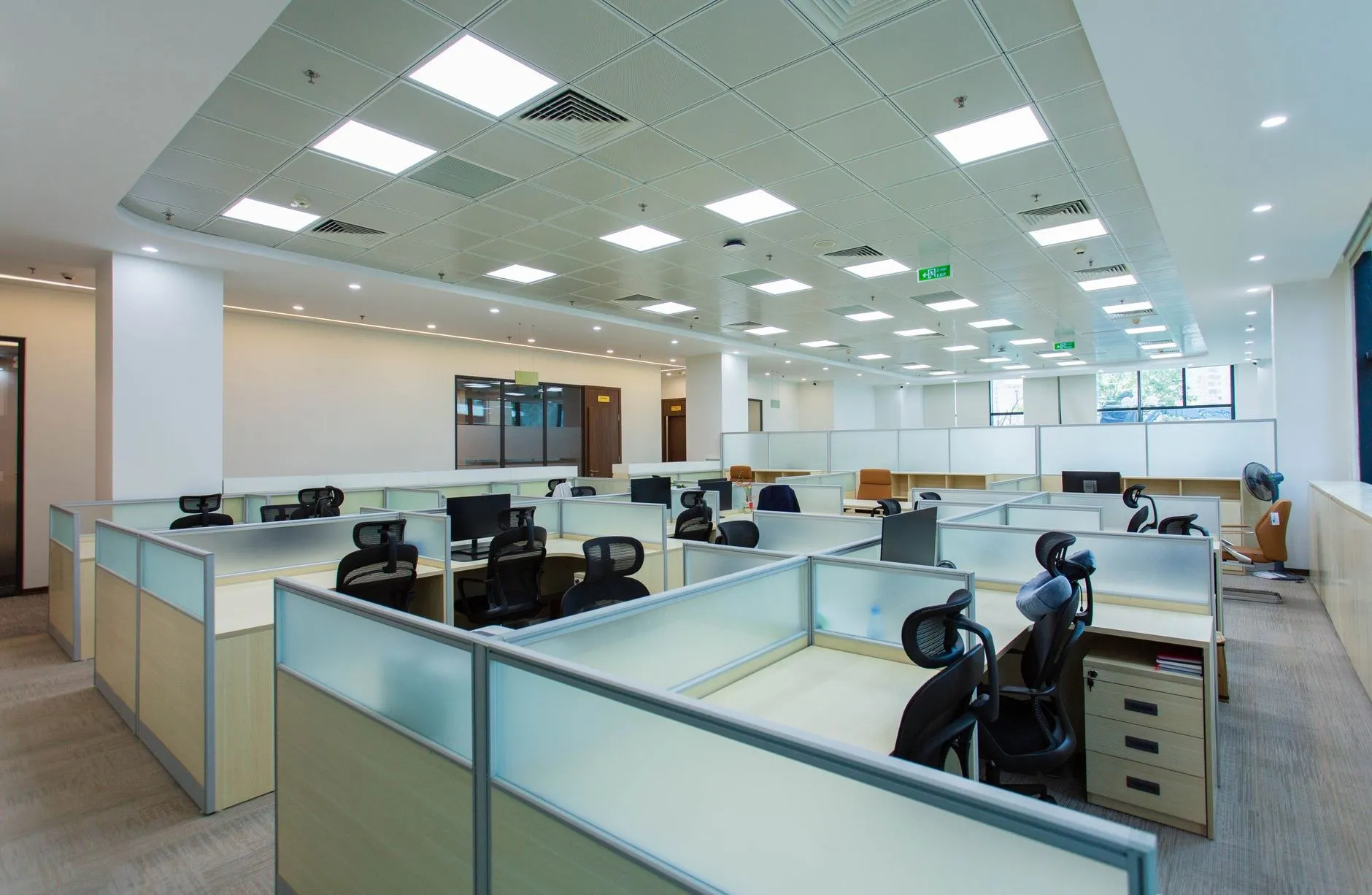
Office and workplace. Glare control, uniformity and daylight integration dominate the specification, and the fixture itself is usually a catalogue platform at level 2 with a specified CCT and a DALI or Casambi control layer.
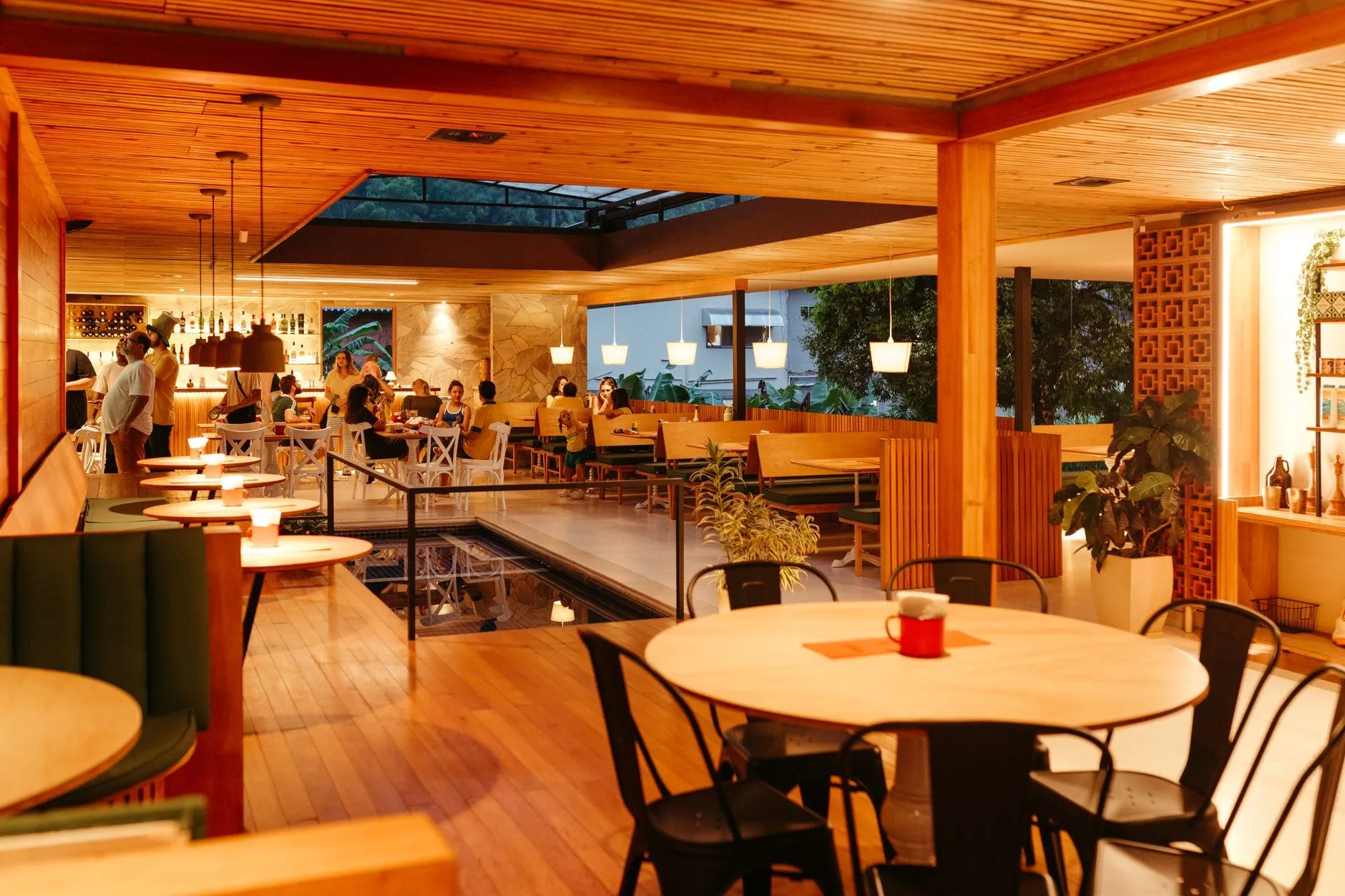
Restaurants and bars. Low CCT, high CRI and sharp beam control matter more than efficiency, so level 2–3 with a warm-dim driver is the norm.
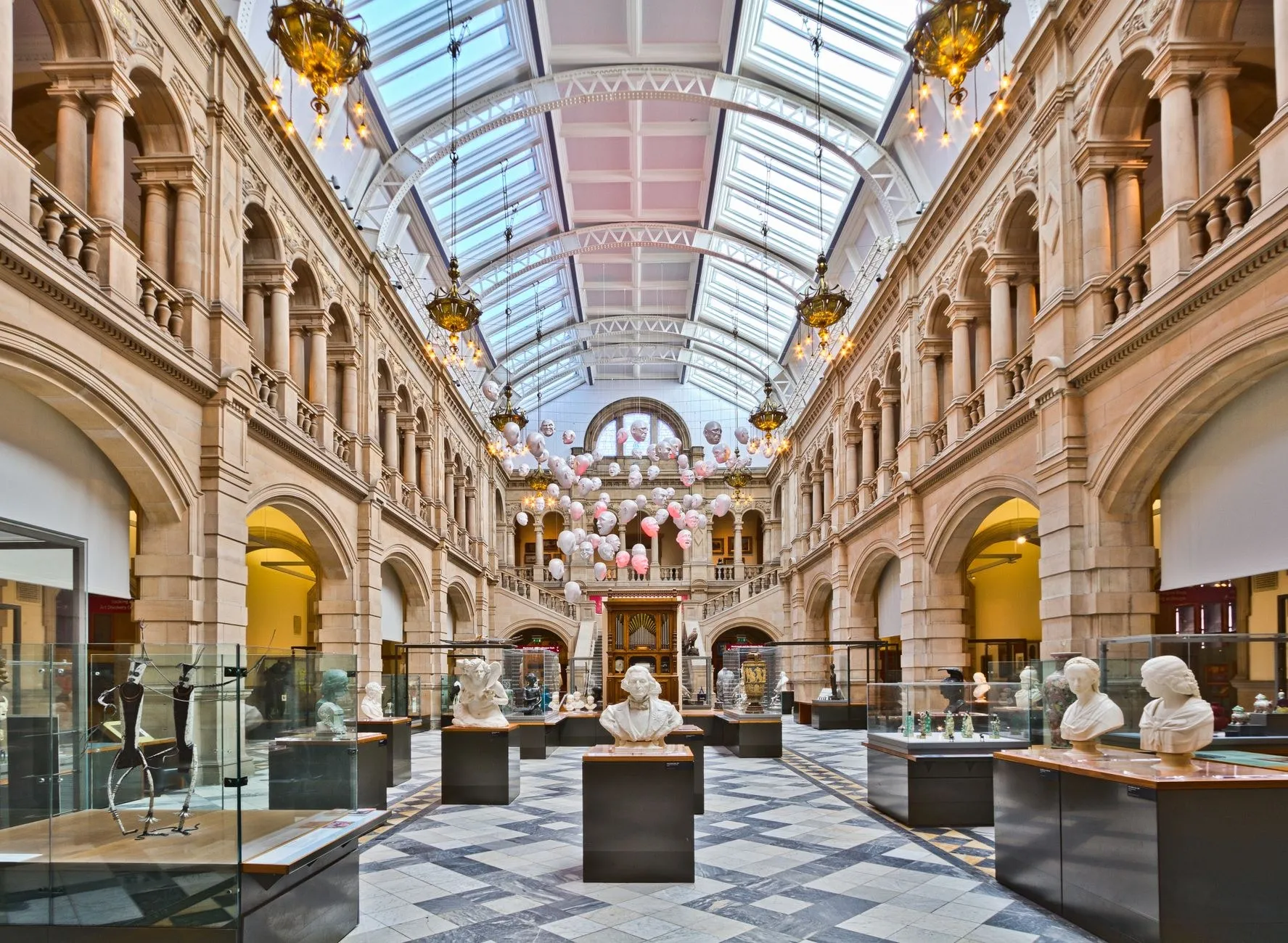
Museums, galleries and showrooms. Conservation limits on lux and UV, plus a need for tunable, precisely aimed light, push these projects to level 4 or 5 and to the longest lead times in the table.
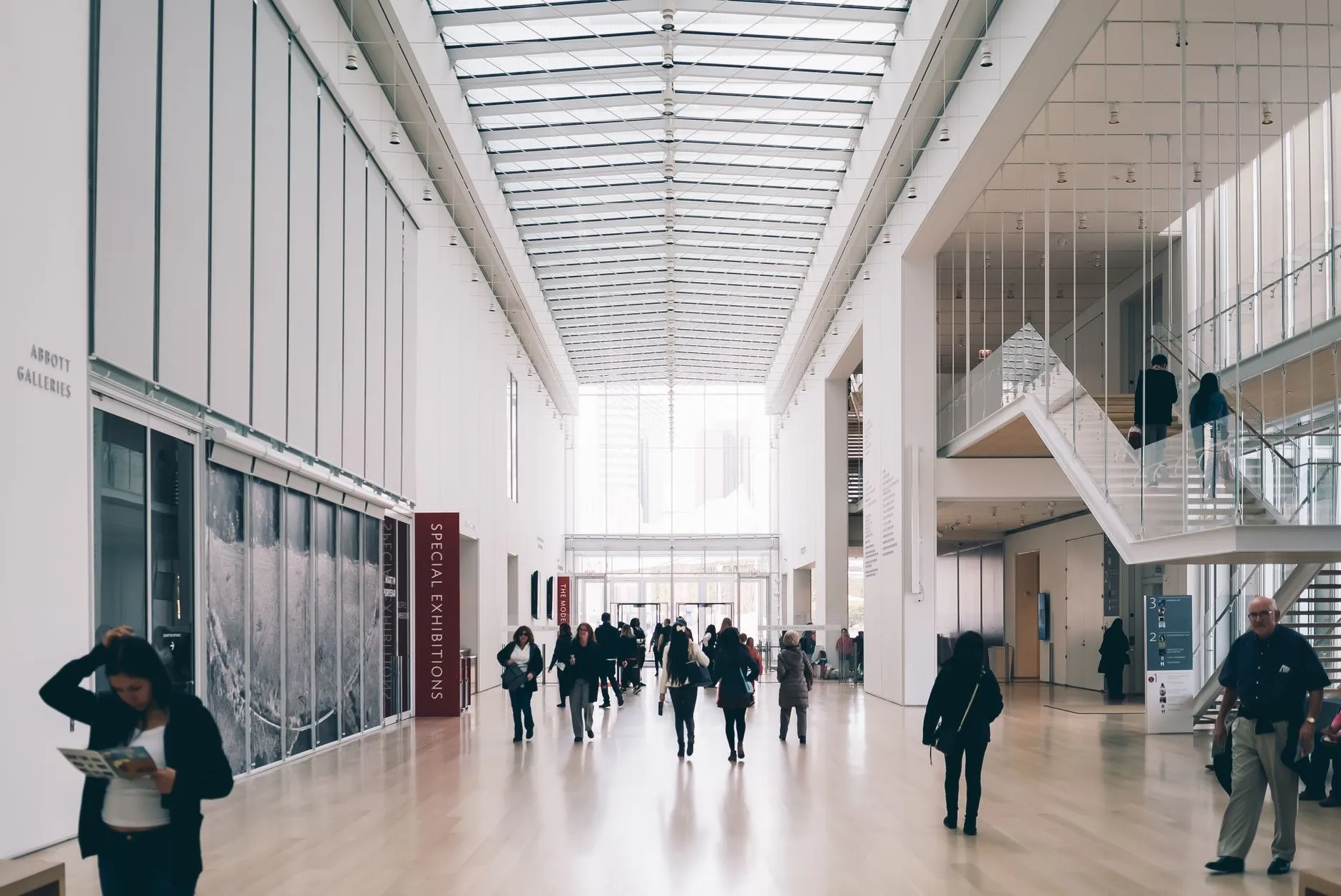
Meeting and conference spaces. Camera-friendly colour rendering plus dimming integration means a configured platform plus a control protocol, and the control layer is usually the part that adds lead time, not the fixture.
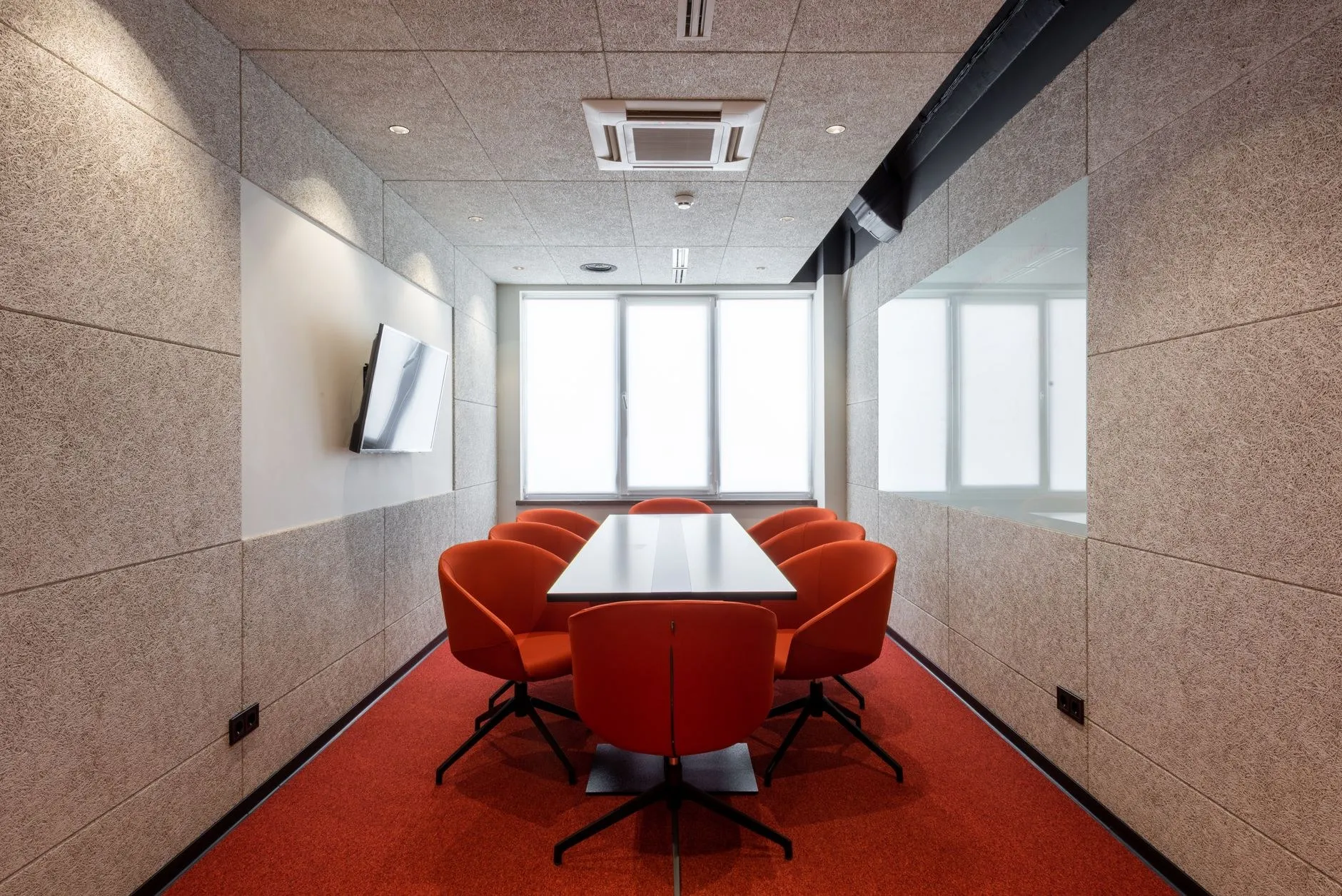
The through-line is simple: the more public the space, the deeper the customisation; the more hidden the space, the more it should be stock. Decide that per zone before you talk to any factory, and the MOQ and lead-time conversation becomes arithmetic instead of argument.

FAQ
What is the difference between a commercial lighting manufacturer and a residential one? A commercial lighting manufacturer sells project capability, not just fixtures: system-level products, optical and control engineering, certificates that name your SKU, and a schedulable delivery promise tied to a building programme. A residential supplier sells product off a price list.
Is stock always cheaper than custom for commercial lighting? Not necessarily. A stock fixture is cheaper per unit, but if its optics or CCT do not suit the project you may pay for it later in extra quantity, rework or unacceptable visual inconsistency. Compare total cost of ownership, not unit price.
Is a 30-day lead time the industry standard? Thirty days is only typical when the project sits at level 0–2 and materials are in stock. Above level 3, 40–75 days is a normal range, and level 5 programmes run 60–120 days.
Does an MOQ of 100 units mean I can only buy 100? An MOQ is the smallest production run, not the smallest collection. You can run 100 units through the line and collect them in several shipments.
If I pay for tooling, does the MOQ drop to one unit? It will not drop to one, but it can fall sharply. Tooling funding removes the one-off investment problem; what remains is the economics of material buying and line changeover, which still has a minimum batch.
Do commercial lighting projects need certification? Yes. They typically involve commissioning, acceptance and liability traceability, so certificates must be issued against your actual SKU, not the factory’s general range. Our guides to ETL certification and SAA and RCM for Australia cover the evidence chain in detail.
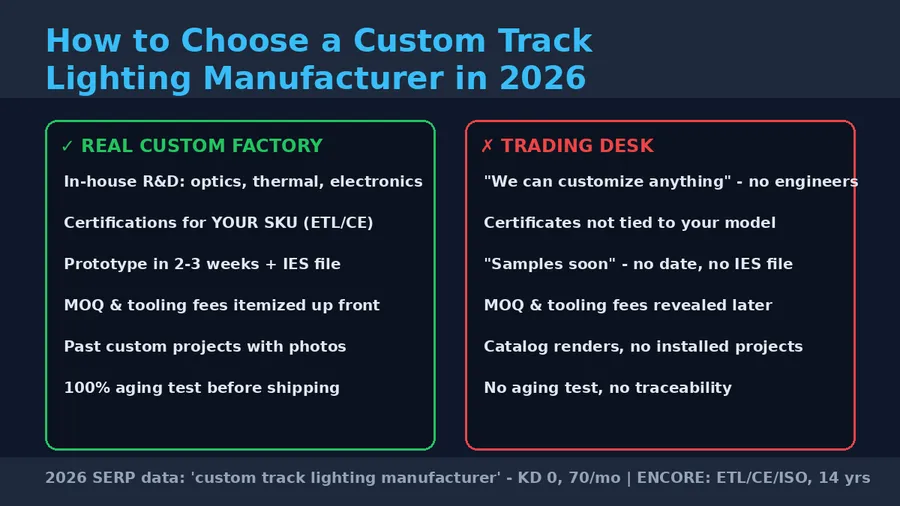
Can a custom manufacturer supply IES photometric files? A genuine project-oriented factory can. IES files are a required input for lighting design software such as DIALux or AGi32, and asking for them is one of the fastest ways to tell an engineering supplier from a trading desk.
How do I compare two suppliers quoting different MOQs? Put both quotes against the six-level table and check which level each one is really pricing. A 100-unit quote at level 2 and a 100-unit quote pretending to be level 4 are not the same offer.
Conclusion
Back to the three questions, and the accurate way to answer them:
- Stock or custom? Not a binary — ask which level it falls into. The level sets the cost, and the cost sets the lead time and minimum order.
- What is the lead time? Not one number, but a chain of five stages. Ask for it in writing, stage by stage, and schedule backwards from your opening date.
- What is the MOQ? Not a gate, but a quote for the one-off cost of the change you requested. Attack the fixed cost, not the unit price.
In commercial lighting, the buyers who get projects delivered on time are rarely the ones who negotiate hardest. They are the ones who state their project constraints, customisation depth and volume rhythm clearly in the first conversation. Give a factory those three things and it can return an executable price and an executable schedule.
Need to fix the level, lead time and MOQ for your commercial lighting project? Send us the project sheet and your opening date, and we will work backwards into a staged schedule.
Read next: MOQ Demystified: What “100 Units” Really Means in Custom Lighting for the deep dive on minimum orders, or Custom LED Lighting Manufacturer: OEM/ODM Services for how a project travels from RFQ to certified production.
- commercial lighting manufacturer
- commercial lighting supplier
- custom vs stock lighting
- commercial lighting lead time
- commercial lighting MOQ
- commercial LED lighting
- retail and hospitality lighting
- project lighting procurement

ENCORE Lighting Team · ENCORE
LED Lighting Manufacturer & OEM/ODM Partner
The ENCORE engineering and sourcing team writes about LED track lighting, downlights, magnetic systems, certifications and OEM/ODM manufacturing for B2B buyers and specifiers.