· Track Lighting · 11 min read

Written by ENCORE Lighting Team
LED Lighting Manufacturer & OEM/ODM Partner ·
Why Is Track Lighting Hated? (And How to Do It Right)
Track lighting gets a bad rap: harsh glare, four bright spots on the ceiling, kitchen shadows. The fixture is rarely the problem — beam angle, aiming and optics are. Here is how lighting professionals fix every common complaint.
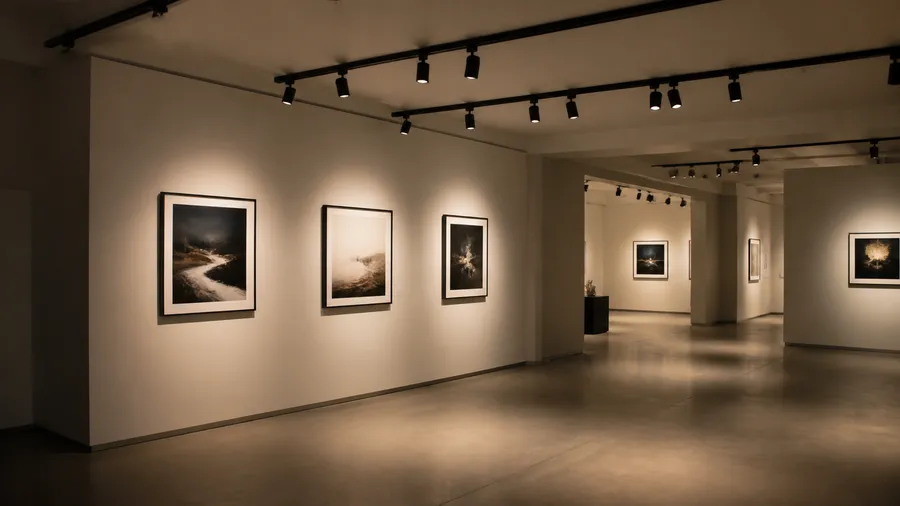
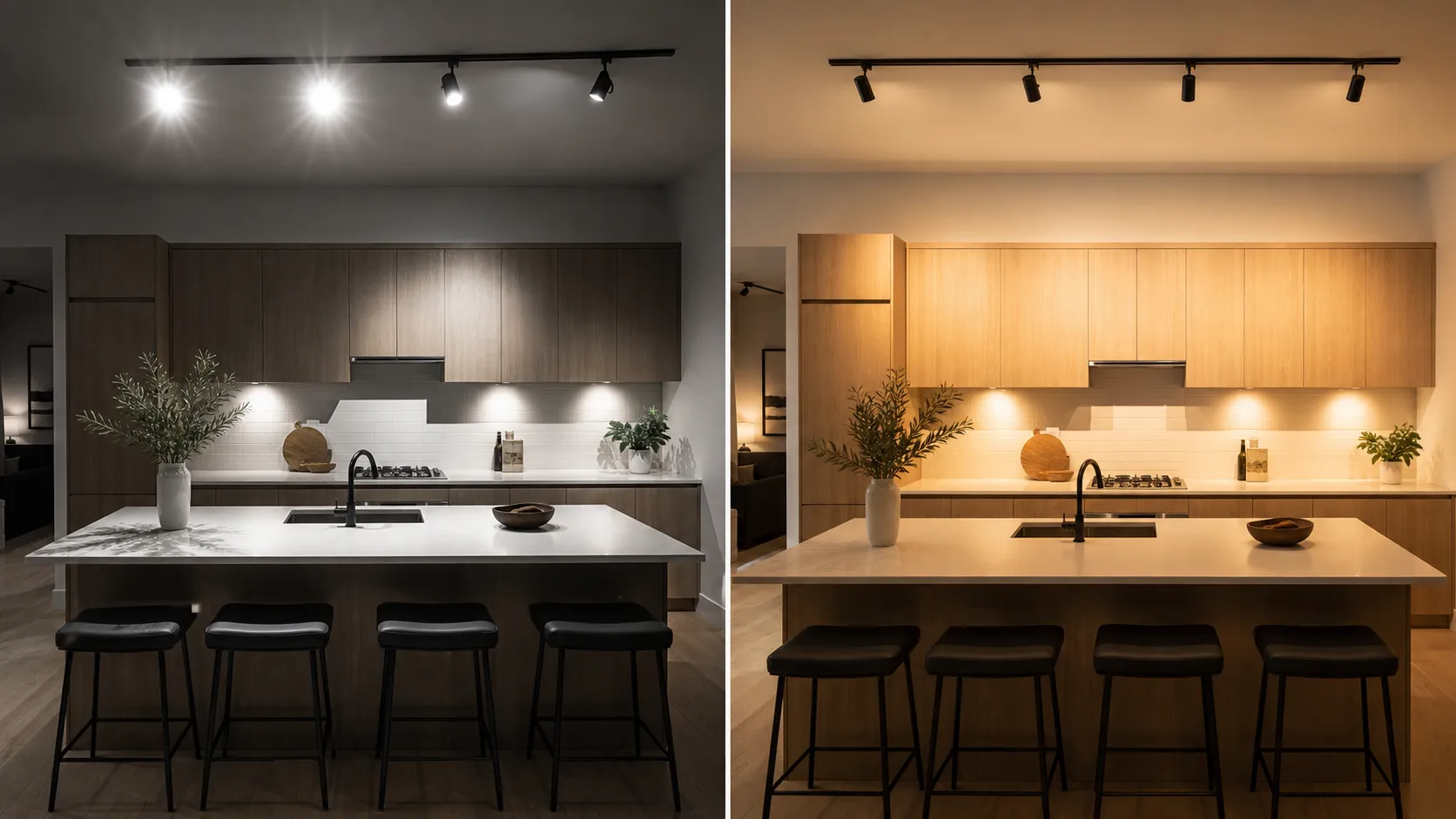
Ask an interior designer why they avoid track lighting and you will hear the same four complaints: “it looks like four bright spots on the ceiling”, “it glares into my eyes”, “it makes the kitchen counter unworkable”, and “it reminds me of the 1980s”. Search the term why is track lighting hated and you will find thousands of homeowners repeating the same phrases.
Here is the part most articles skip: nearly every complaint is an installation and specification error, not a failure of the technology. A properly specified track system is still the most flexible way to light a gallery wall, a retail display, or a kitchen island. This guide explains the physics behind each complaint and how to fix it — written by a manufacturer of museum-grade track lighting, not by a decor blog.
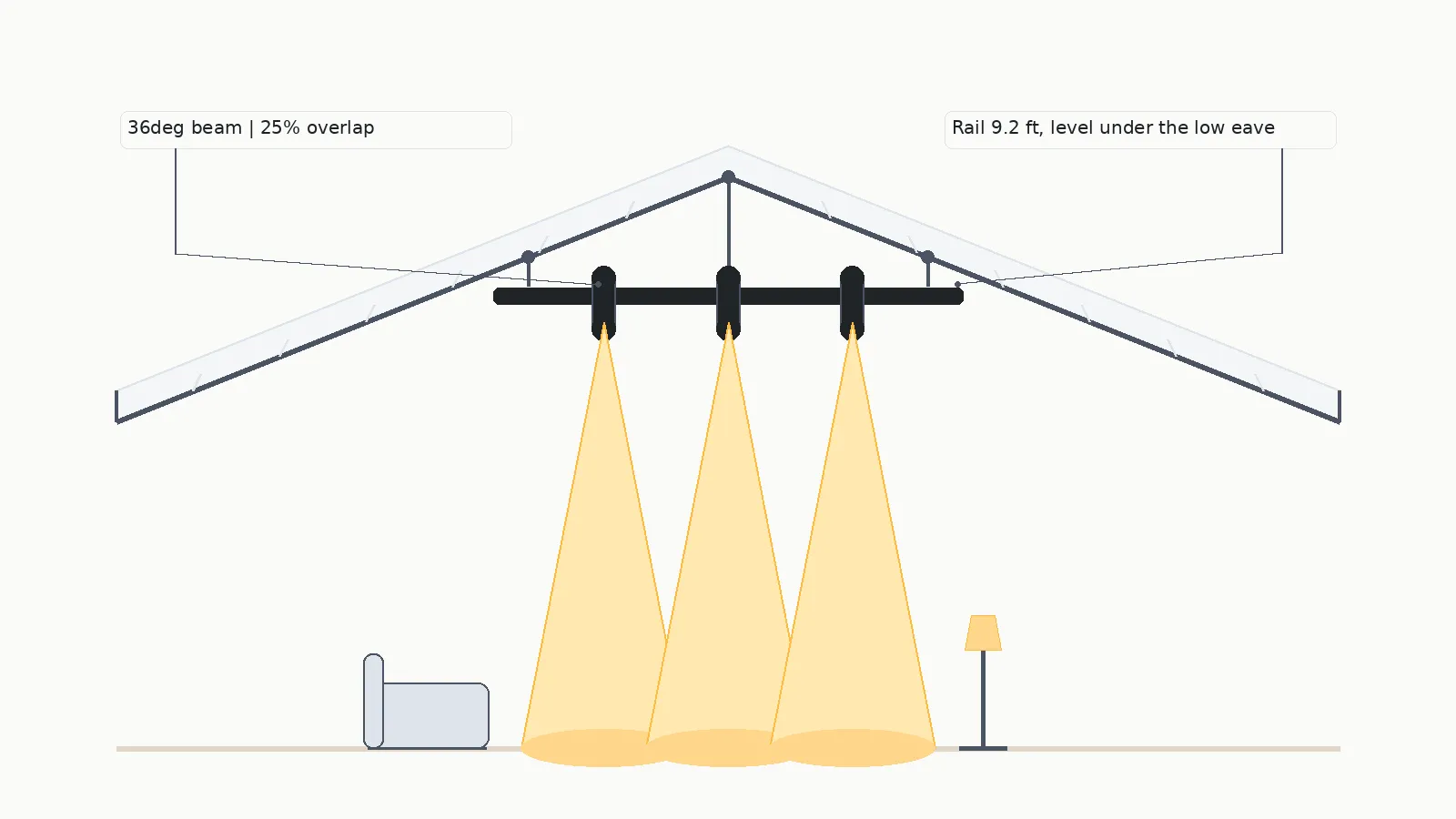
A sloped ceiling does not need a sloped rail. Hang the rail level under the low side, keep the heads plumb, and let the beam angle set the spacing.
The four bright spots problem: it is a beam angle issue
The single most common photo attached to track-lighting hate is a ceiling with four or five small, intense pools of light and a dark room around them. The homeowner bought “LED track lights” without looking at the beam angle, and the default head shipped a 24° spot (or narrower) that concentrates all its output into a small circle.
Lighting designers choose beam angle by task, not by habit:
| Beam angle | Typical use | Effect |
|---|---|---|
| 10°–15° spot | Artwork accents, display cases | Tight, dramatic highlight |
| 24°–36° narrow/medium | Countertops, dining tables, general accent | Focused task light with some spill |
| 36°–60° flood | Ambient fill, wall washing, corridors | Soft, even pools |
| 60°+ / wall wash optics | Room-wide ambient, grazing walls | Nearly shadow-free |
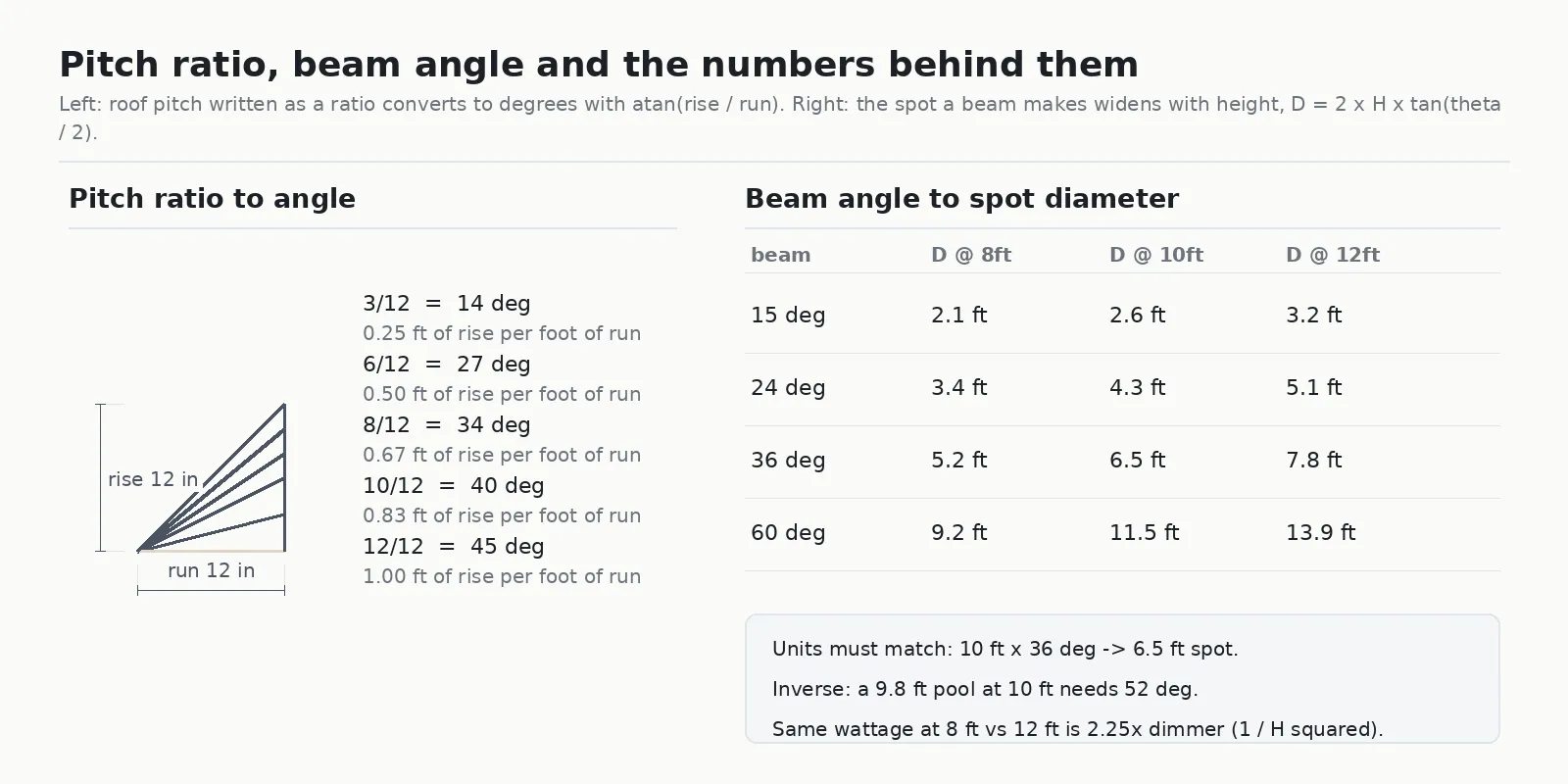
Every number here is computed: pitch as atan(rise / run), spot width as 2 x H x tan(angle / 2). The same formulas are used for the drawings in this article.
If a room is lit by four 15° spots, the room is dark and the spots are blinding — that is not track lighting failing, it is a beam angle specification failure. The fix is a mix: flood heads for ambient, narrow heads only where you genuinely need a highlight, and enough heads to cover the surface.
The related searches around track lighting beam angle (chart, diagram, “what does 60 degree beam angle mean”) confirm this is the exact confusion people are trying to resolve. Our beam selection guide on the track lighting product page explains which angles suit which room, and you can calculate the exact beam spread at your own mounting height in seconds.
Glare: why track heads end up in your eyes
The second complaint — “the light shines straight into my eyes” — is an aiming and shielding failure. Track heads rotate 360° and tilt 90°, which is a feature and a trap: a head aimed at eye level from across the room is a glare source, not a light fixture.
Three engineered fixes separate professional track lighting from cheap commodity heads:
- A deep anti-glare angle (40° cutoff or better). The lamp sits recessed inside a cone so you cannot see the source from normal viewing angles.
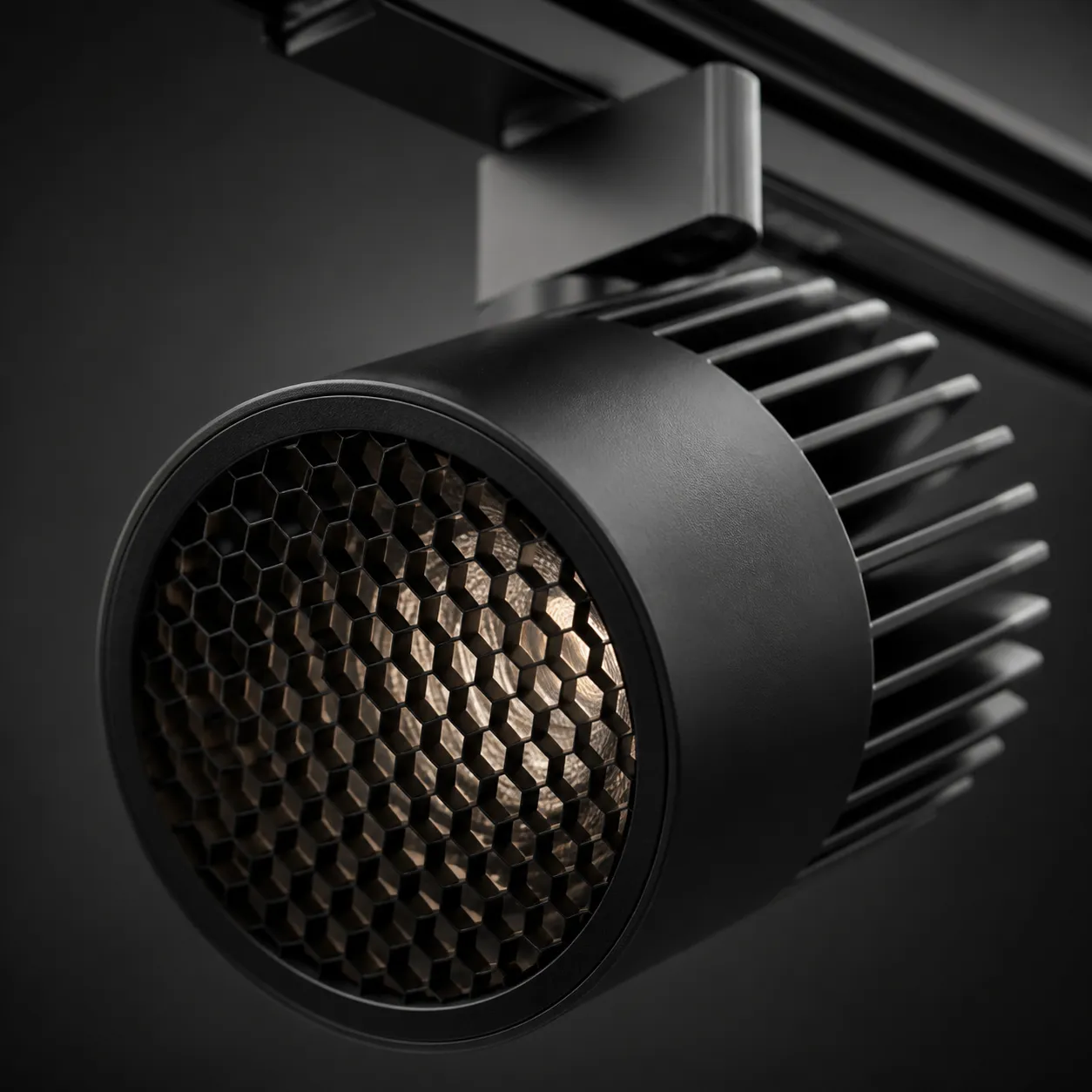
- Honeycomb louvers. An optional cell grid that blocks light emitted sideways, cutting glare further and protecting artwork from UV-adjacent radiation.
- UGR control. The Unified Glare Rating quantifies discomfort glare; UGR < 16 is the museum/office-grade threshold, while UGR < 19 is the common commercial minimum. Many fixtures never state a UGR at all — that is the first red flag.
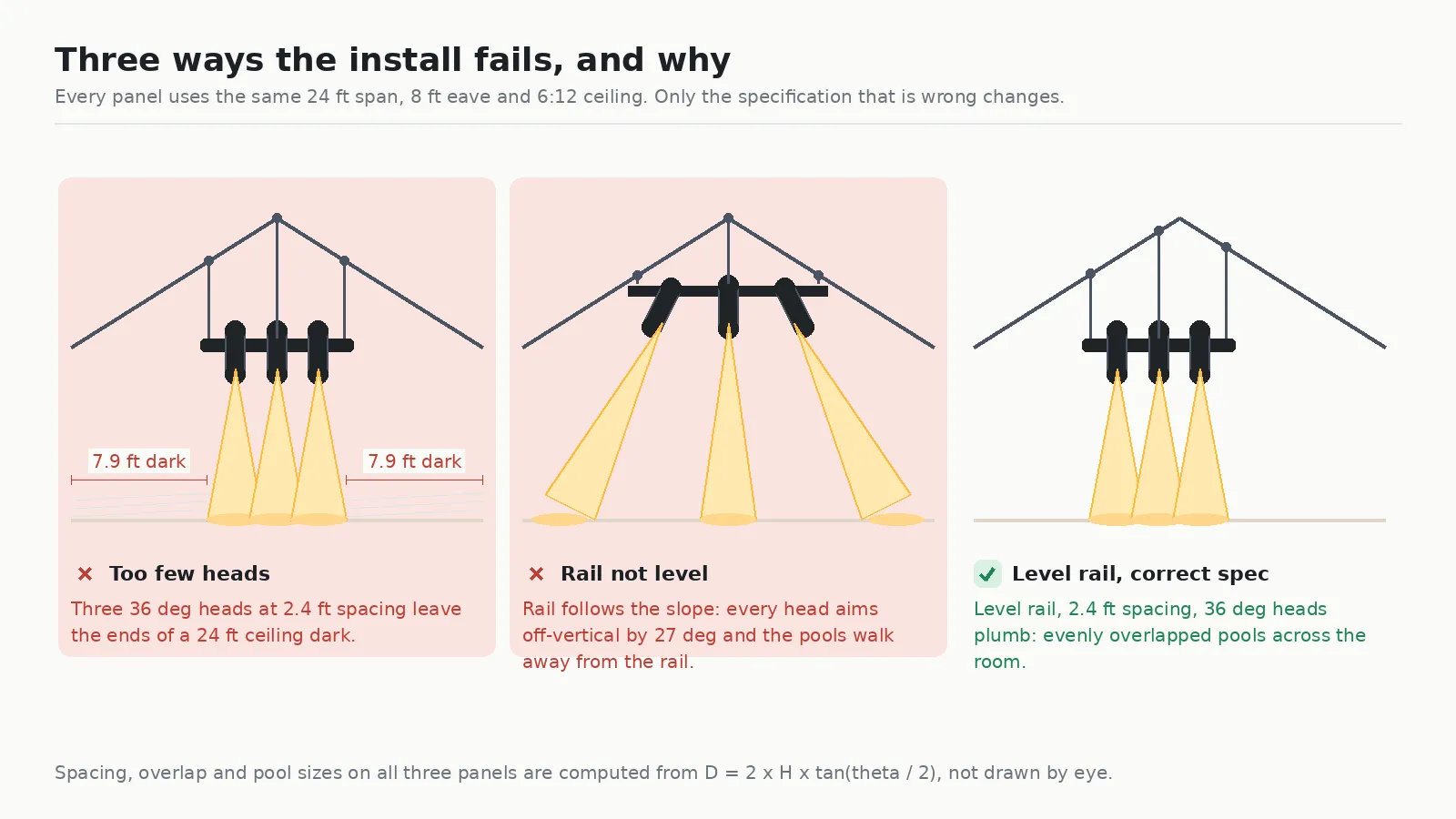
Same room, same ceiling, three specifications. Only the right-hand panel keeps the pools where the drawing says they should be.
A fixture that cannot tell you its UGR, its beam-angle tolerance, or its CRI is a fixture you cannot spec. If a designer says they “hate track lighting” after specifying those, they were probably sold 24° spots without optics.
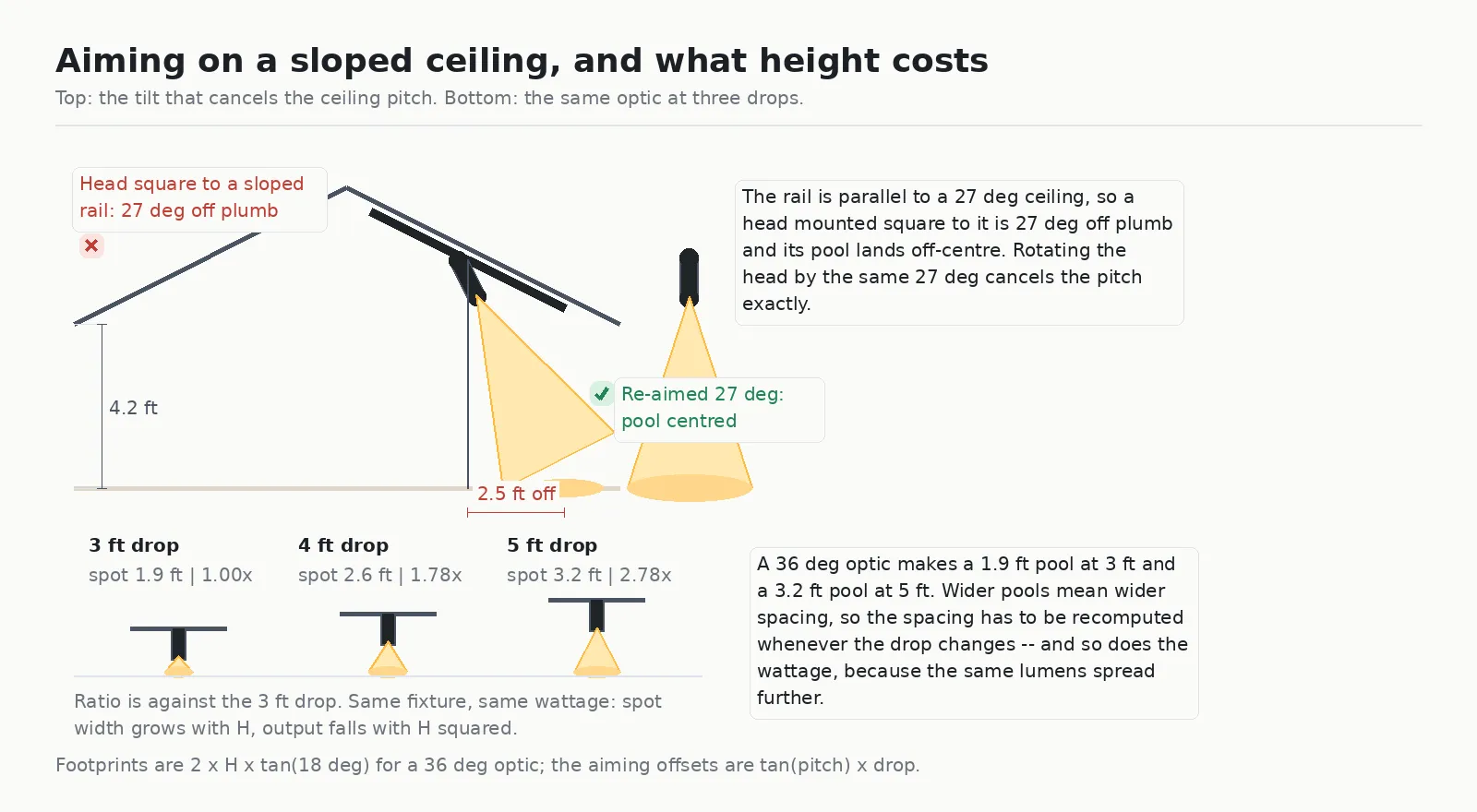
Aiming has to cancel the pitch. Height then decides both the pool width and how much of the output actually reaches the surface.
Kitchens: the shadow complaint is a layering problem
“Track lighting ruined my kitchen” usually means one thing: the homeowner put three narrow spots over the island and nothing else, then wondered why the counter shadow made chopping dangerous.
Kitchens need layered light:
- Ambient: wide-beam or wall-wash heads bouncing light off the ceiling and cabinets — this is what kills the “cave” feeling.
- Task: 24°–36° heads aimed at the prep surface from the correct side (aim from in front of the user, not behind them, or your own body creates the shadow).
- Undercabinet strip light for the back-of-counter work zone, which no ceiling fixture can reach.
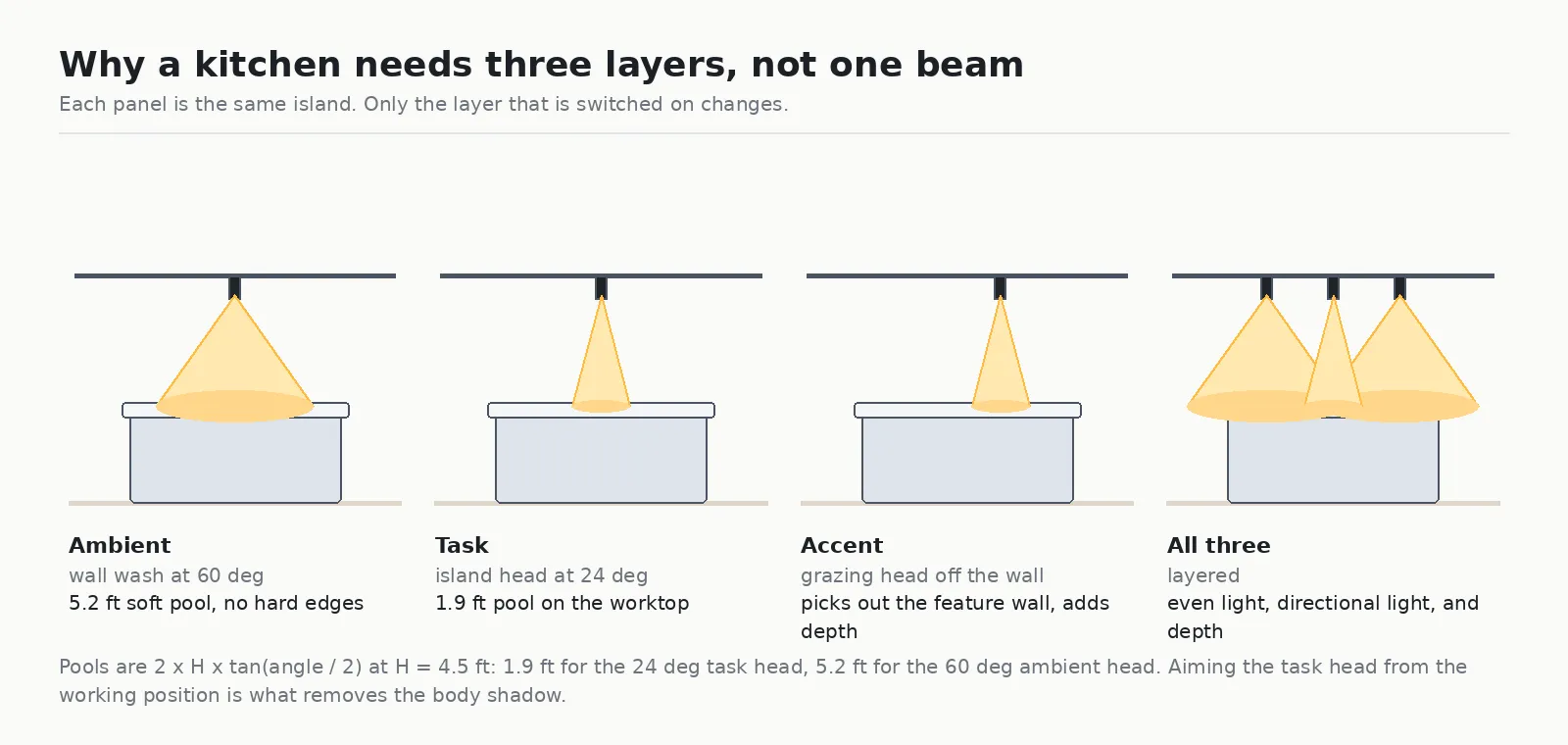
Layering is not a styling preference. Each layer solves a different problem: fill, task light, and depth.
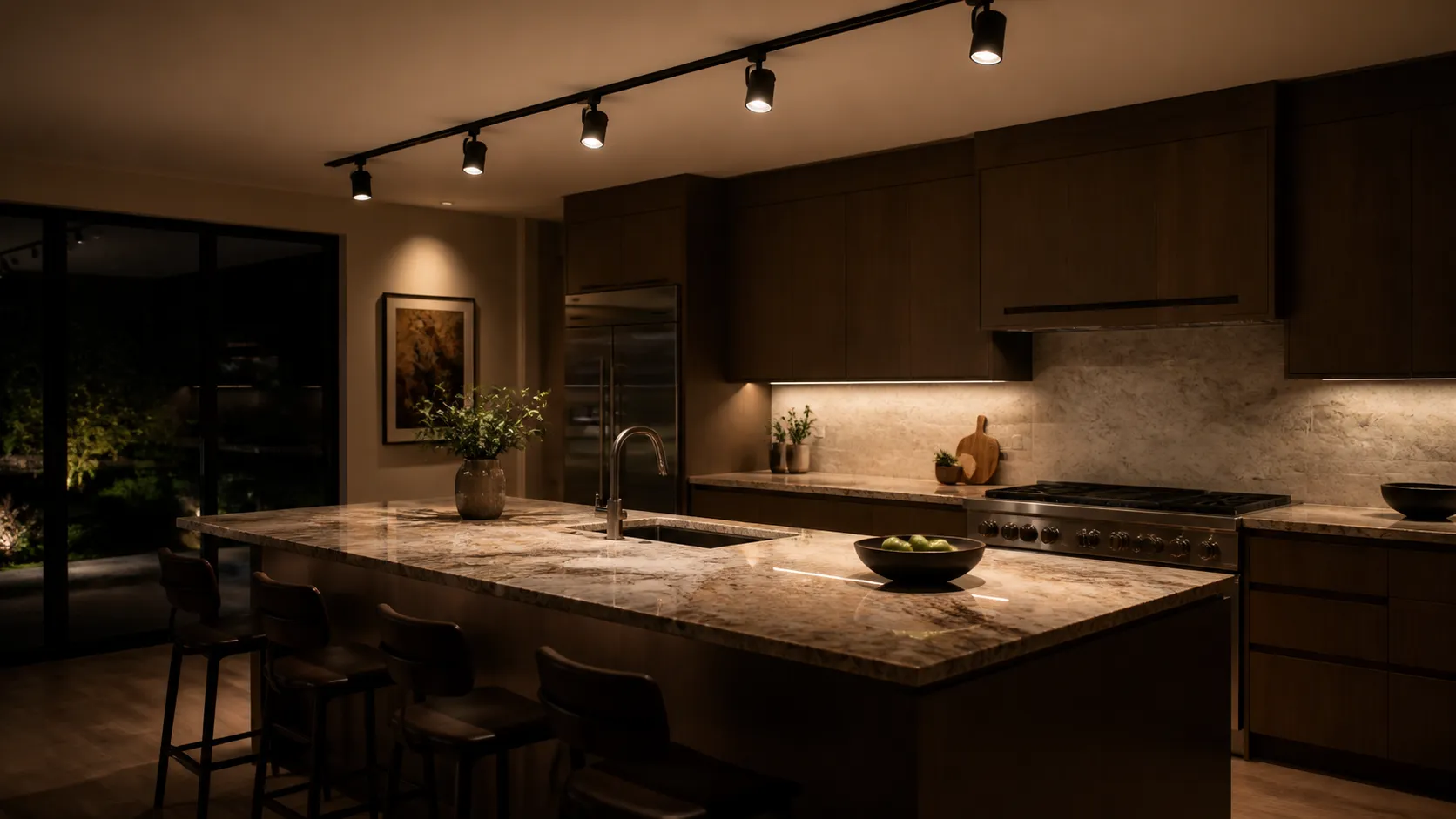
Asked whether track lights are good for the kitchen, the honest answer from a lighting engineer is: yes, if you mix beam angles and aim them from the working position; no, if you install four narrow spots and call it a day.
Cheap fixtures deserve the hate
Part of the reputation is earned. A $15 track head typically has:
- Low CRI (70–80): colors look flat, food looks grey. Museum-grade is CRI ≥ 95 with strong R9 (red rendering).
- Uncontrolled flicker: invisible to the eye, but it causes headaches and shows on video.
- Plastic optics that yellow within a year.
- No thermal design: LEDs driven hot lose brightness (and color accuracy) quickly.
When people say “I hate track lighting”, they are often accurately describing a $15 fixture. The failure is the specification, again — this time the component quality. Reputable manufacturers publish CRI, R9, SDCM (color consistency), UGR and lumen data. Ours are on every product page because we want you to check them.
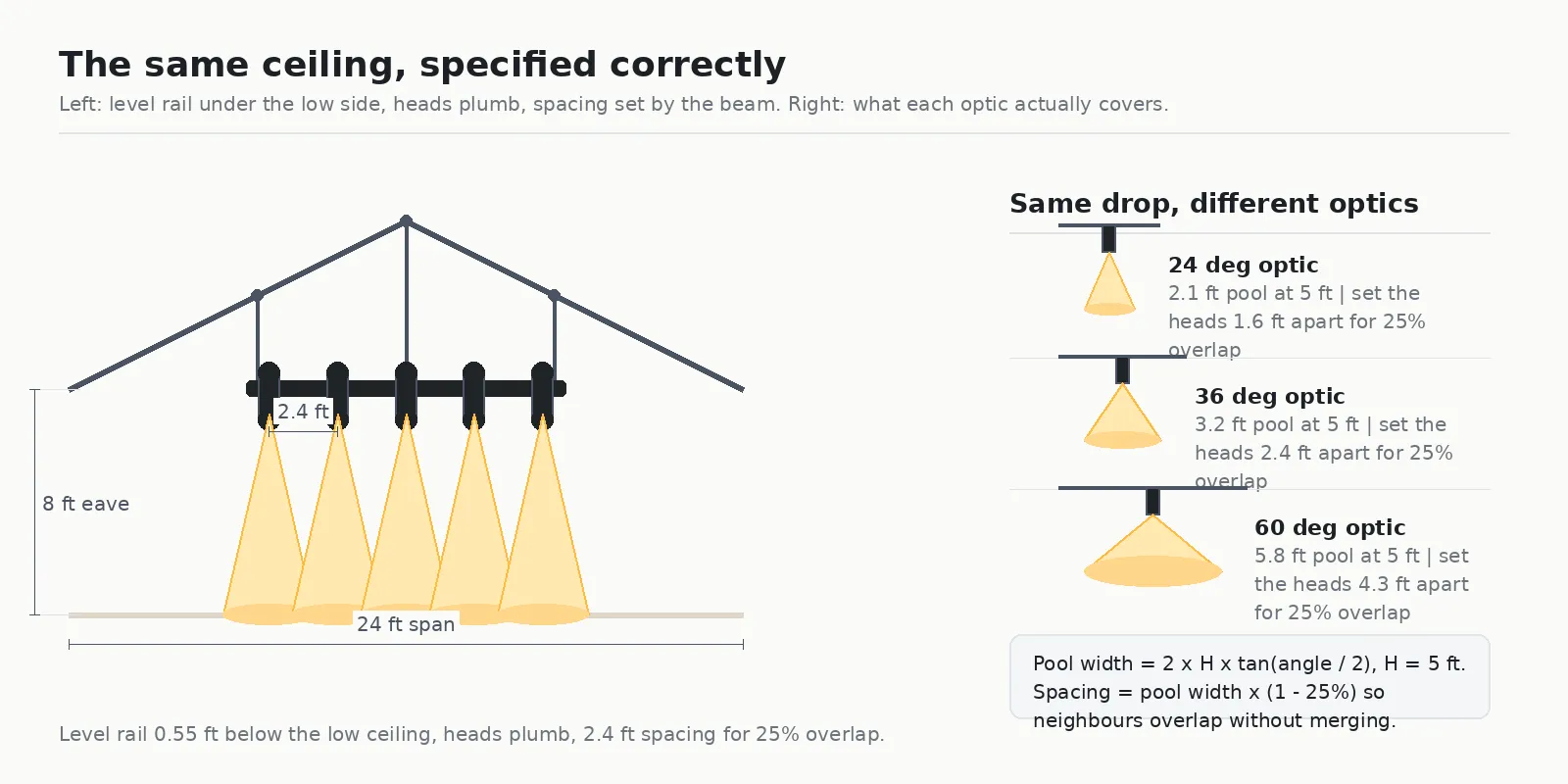
The correct version of the hero drawing, with the optics that produce each spacing. Choose the optic first, then the spacing follows from it.
How to do track lighting right: five rules
- Mix beam angles. Never light a room with one angle. Floods for ambient, narrows for accents.
- Layer. Ambient + task + accent. Track lighting is a system, not a single row of spots.
- Aim from the working position. Light should come from where the user stands, never from behind them into their eyes.
- Spec the optics, not the wattage. UGR < 16, CRI ≥ 90 (95 for art), SDCM ≤ 3, and a stated cutoff angle.
- Dimm everything. A track system without dimming is a hotel lobby; with dimming it becomes a mood system.
Modern alternatives: magnetic track systems
The “1980s” association comes from clunky H-track fixtures with visible springs and exposed lamps. The modern replacement — and the fastest-growing segment in architectural lighting — is the magnetic track system: a slim 5–20 mm rail with magnetic, tool-free heads that can be repositioned in seconds.
Magnetic systems solve the two historical annoyances: they look architectural (not industrial), and changing the lighting layout takes seconds instead of an electrician’s visit. See the magnetic track lighting range for the 5 mm, 15 mm and 20 mm profiles.
FAQ
Are track lights good for the kitchen? Yes, when you mix a wide ambient beam with 24°–36° task heads aimed from the working position, and add undercabinet light for the deep counter zone.
What are the disadvantages of track lighting? The real ones: exposed lamps can glare if not shielded, it demands deliberate aiming (it will not look right by accident), and cheap heads have poor CRI and flicker. All three are specification problems, not design flaws.
What is better than track lighting? For accent flexibility, nothing beats a rail system. For uniform general light, recessed downlights win. Most quality residential and gallery schemes use both: downlights for ambient, track for accents and art.
What is the modern replacement for track lighting? Magnetic track systems with tool-free adjustable heads. Same flexibility as classic track, a fraction of the visual mass, and relocatable fixtures.
How do I stop track lighting from glaring? Specify heads with a 40°+ cutoff or honeycomb louvers, keep UGR below 16 for living spaces, and aim heads at the surface you want lit — never across the room at eye level.
Can track lights be LED? Yes — LED is now the standard. Look for CRI ≥ 90, SDCM ≤ 3, and a stated UGR to distinguish professional-grade heads from commodity ones.
Track lighting is not the problem. Beam angles without a plan, aiming without a working position, and fixtures without optics data are the problem — and every one of them is fixable.
Need help specifying a track system for a gallery, a kitchen or a retail project? Contact our engineers — we publish photometric data and will tell you honestly when track lighting is the wrong tool.

ENCORE Lighting Team · ENCORE
LED Lighting Manufacturer & OEM/ODM Partner
The ENCORE engineering and sourcing team writes about LED track lighting, downlights, magnetic systems, certifications and OEM/ODM manufacturing for B2B buyers and specifiers.