· ENCORE · Custom & OEM Lighting · 11 min read
ODM vs OEM LED Lighting: Which One Is Right for Your Brand?
ODM vs OEM LED lighting explained: what each sourcing model means, how ODM existing-design branding and OEM custom manufacturing differ on cost, lead time and flexibility, and which one fits a startup brand versus a multi-location chain project.
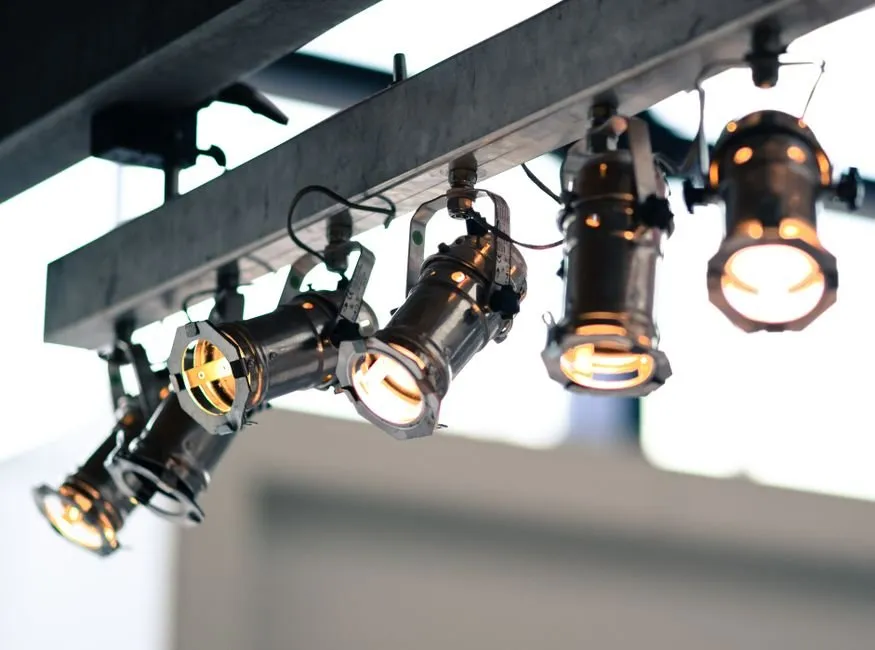
When you are ready to launch a lighting product line under your own brand, the first question every factory asks is: OEM or ODM? The two words get used interchangeably, but they describe very different sourcing models — and picking the wrong one costs you either money, time, or control.
Here is the short version up front:
- ODM (Original Design Manufacturer) means the factory already designed the product. You take an existing catalog design, customize the branding and a few specs, and sell it as your own. Fast, low-cost, low-risk.
- OEM (Original Equipment Manufacturer) means the product is engineered to your specification. You own the design and the brand; the factory builds it. More control, more lead time, usually tooling cost.
In this guide we break down exactly what each model means, compare them on cost, lead time and flexibility, and give you a clear rule for whether a startup brand or a multi-location chain project should go OEM or ODM. If you already know you want a fully custom product, our complete OEM LED track lighting guide walks through the 6-step process in detail.
What Is ODM in LED Lighting?
ODM stands for Original Design Manufacturer. In the LED lighting world, an ODM factory designs, engineers and manufactures products on its own, and then offers those existing designs to buyers who want to put their own brand on them.
When you source ODM, you are not inventing a product. You are choosing from the factory’s catalog — track lights, downlights, magnetic systems, commercial fixtures — and customizing the parts that are cheap to change:
- Branding — your logo, your packaging, your user manual
- Finishes — housing color, material, coating
- Photometrics — beam angle, CCT, CRI options already supported by the design
- Accessories — lens, trim, track adapter variants already in the catalog
Because the core engineering, tooling and certifications are already done, an ODM project moves fast. The factory has production tooling, tested optics, and certified driver platforms — you are mostly picking options, not solving problems.
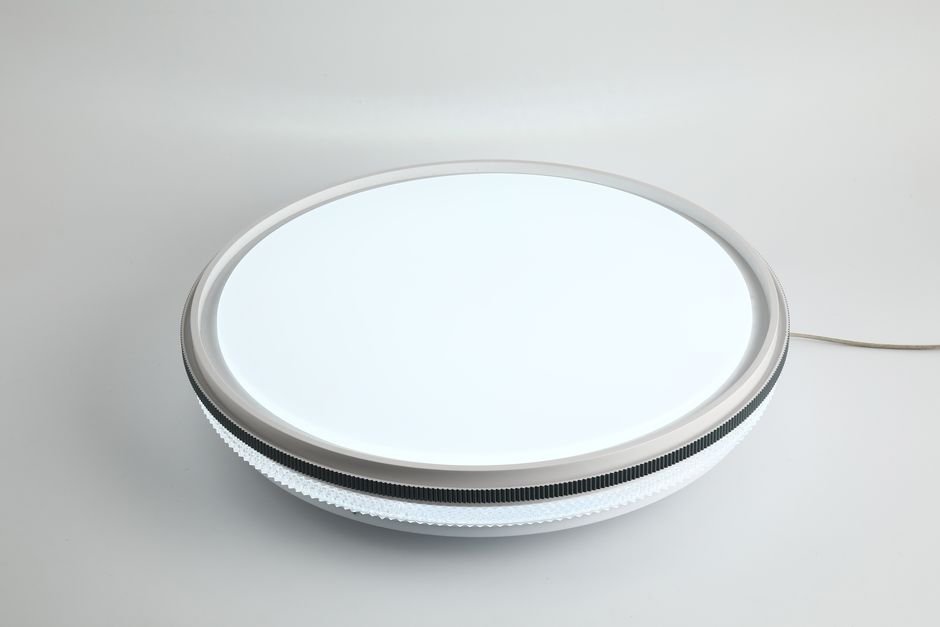
ODM means starting from a proven, already-designed fixture and adapting it — faster and cheaper than building a new one.
What Is OEM in LED Lighting?
OEM stands for Original Equipment Manufacturer. Here the roles flip: you define the product, and the factory manufactures it to your specification.
In a true OEM project, the design is yours. You bring the spec sheet — dimensions, wattage, CCT, CRI, beam angle, driver protocol, housing material, compliance market — and the factory’s engineering team turns it into a buildable, certifiable product. This usually means:
- New or modified tooling — injection molds, die-cast dies, extrusion profiles
- Custom optics — a reflector or lens engineered for your beam distribution
- Custom driver and electronics — dimming protocol, power, control integration
- Your own certification — test reports and certificates naming your SKU
- Your brand on everything — housing, packaging, manual, compliance labels
OEM gives you a product that no one else can copy from a catalog. But it costs more, takes longer, and locks you into minimum quantities that absorb the tooling investment. The full sequence — spec → prototype → approval → mass production → QC → shipping — is what our OEM track lighting guide documents step by step.
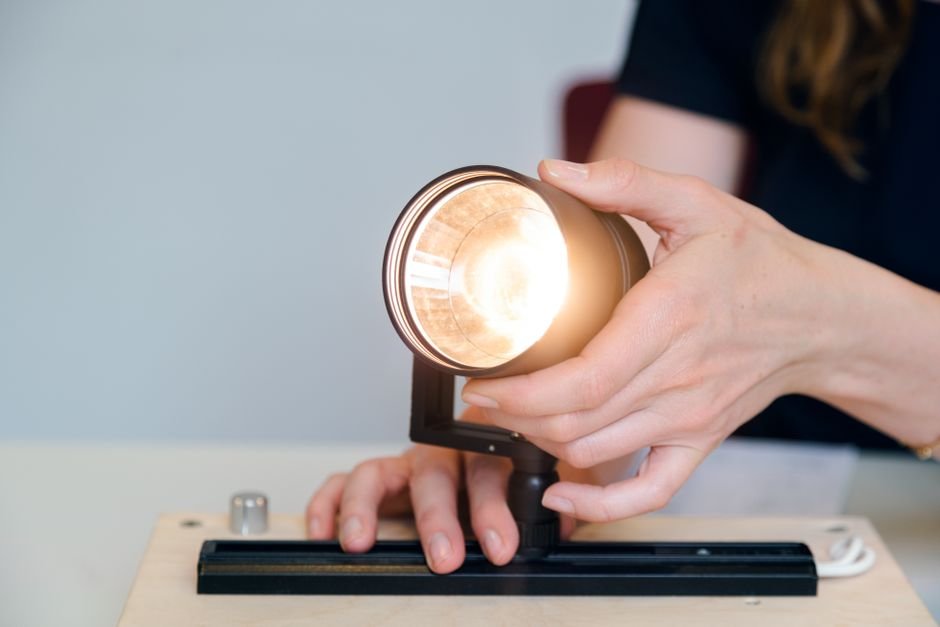
OEM starts from your spec and builds a product only your brand sells — with new tooling, custom optics and your own certification.
OEM vs ODM: Key Differences
The cleanest way to see the difference is side by side. This comparison table is what sourcing teams actually use to decide:
| Dimension | ODM (existing design) | OEM (custom-built) |
|---|---|---|
| Design ownership | Factory’s existing design, adapted | Your specification |
| Time to market | 2–6 weeks (catalog + light customization) | 8–14 weeks full cycle (tooling + cert) |
| Upfront cost | Low — no tooling, small MOQ | Higher — tooling + certification amortized |
| MOQ | Lower (often 100–300 units) | Higher (often 1,000+ to absorb tooling) |
| Flexibility | Pick from supported options | Any buildable spec — custom optics, driver, materials |
| Exclusivity | Shared design — competitors can offer it | Unique to your brand |
| Risk | Low — design is proven | Medium — engineering + tooling commitments |
| Certification | Factory’s existing certs, add your brand | Your SKU, custom test reports |
| Best for | Fast launch, low budget, testing a market | Long-term brand, unique product, control |
The cost–time–flexibility tradeoff
There is no free lunch. Pick any two and you give up the third:
- ODM is fast and cheap — but you inherit the factory’s design, so you trade flexibility and exclusivity.
- OEM is flexible and exclusive — but you pay more in time and money for the tooling and engineering.
A rough cost comparison for a typical LED track light line:
| Cost driver | ODM | OEM |
|---|---|---|
| Tooling / mold investment | $0 (existing tooling) | $3,000–$30,000+ (new tooling) |
| Per-unit product cost | Lower (amortized at scale) | Higher at low volume, competitive at scale |
| Certification cost | Minimal (brand label on existing certs) | Higher (your SKU, custom test reports) |
| Design / engineering fees | Low | Moderate to high |
| Typical all-in first order | Lower | Higher |
Which One for a Startup Brand?
If you are a startup brand — an e-commerce store, a new showroom, a designer launching their first private-label line — ODM is almost always the right starting point. Here is why:
- Cash preservation. No tooling, low MOQ, no multi-thousand-dollar design fee. You test the market before you commit capital.
- Speed. 2–6 weeks to a saleable, branded product. In a startup, time-to-revenue beats perfection.
- Lower risk. The design is proven and certified. You are not debugging an unproven prototype on your first order.
- Learn the market. ODM lets you find out which fixtures sell before you invest in proprietary tooling for the winners.
The honest caveat: an ODM product is not exclusive. Another buyer can offer the same fixture with different branding. For a startup, that is a fair price for speed and low risk — you earn exclusivity later with an OEM SKU once you know what sells.
Which One for a Chain or Multi-Location Project?
If you are a retail chain, a hospitality group, or a spec house managing a multi-location project, the calculus changes. OEM is usually the better fit — and sometimes the only option:
- Consistency across sites. Every location needs the exact same photometric performance, color consistency (SDCM ≤ 3), and visual appearance. Only a spec-controlled OEM product guarantees that.
- Brand identity. A chain lives on a consistent visual identity. A custom housing color, finish, and logo make every storefront unmistakably yours.
- Quantity justifies tooling. With 1,000+ units across locations, the tooling and certification costs amortize into a per-unit cost that beats paying a design premium on a shared ODM product.
- Compliance and liability. Chain projects often require certificates naming your SKU and full test reports. OEM gives you those documents in your name.
For a chain, the extra lead time (8–14 weeks) is planned for anyway — you schedule it into the build-out calendar. The control and consistency are worth far more than the ODM speed advantage.
How ENCORE Supports Both Models
At ENCORE we are set up to run both OEM and ODM from the same Shenzhen factory — and we will tell you honestly which one you actually need rather than upsell you.
- ODM from 9 product families. Track lights, LED downlights, magnetic track systems, and commercial fixtures with ready tooling. We adapt finishes, CCT, CRI, beam angle, branding and packaging, with sample lead times of 7–15 days and low MOQs for market testing.
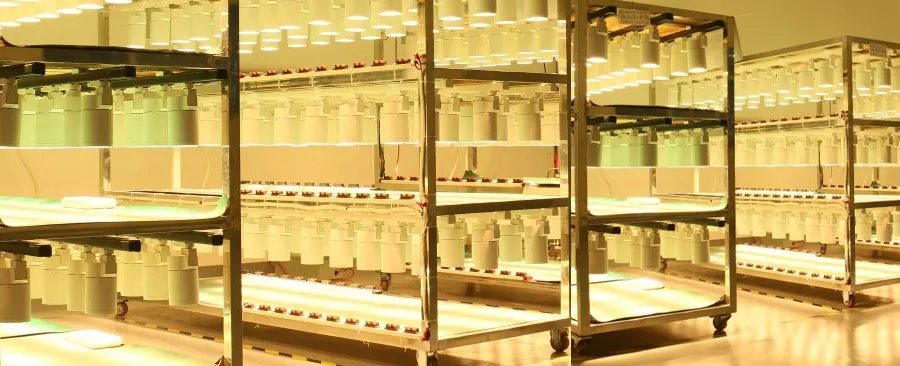
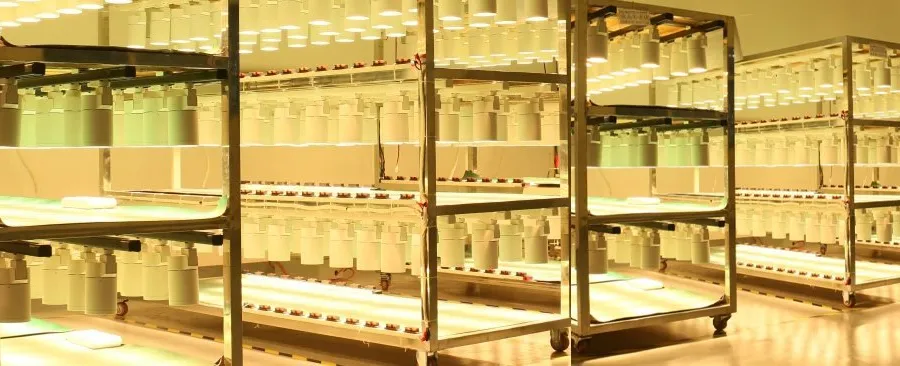
- OEM from your spec. In-house R&D covering optics, thermal, electronics and structure. We build engineered prototypes with IES/LDT photometric files, run tooling, certify your SKU, and follow IQC → IPQC → OQC with 100% aging test before shipment.
- One factory, one quality bar. Whether you start ODM and migrate to OEM later, or run both lines in parallel, the ETL/CE/ISO certified production line and QC standard are identical.
The common path we see: a brand starts ODM to launch fast, then converts the best-selling fixtures to OEM once volumes justify tooling. Both models coexist in our factory, so the transition is seamless — you keep the same QC, the same team, and the same product family as your exclusivity grows.
Why This Keyword Is Worth Targeting
The keyword ODM LED lighting manufacturer is a rare near-empty B2B keyword — effectively KD 0 at low search volume (~90/month). That makes it an attractive first-rank opportunity precisely because almost nobody has built a proper page for it.
Looking at the current SERP, page one is mostly thin directory pages and generic supplier listings: Made-in-China aggregators, YouTube shorts, and catalog categories that never explain the actual OEM-vs-ODM decision. There is very little content that answers a sourcing team’s real question: “Which model fits my project, and what will it cost in time, money and control?”
That gap is the opportunity. A clear, structured comparison page like this one:
- Ranks for the exact intent buyers type when they are about to source — because it actually answers it
- Attracts backlinks — comparison and decision-guide content is the type other lighting sites and blogs naturally link to as a reference
- Feeds the related long-tails — OEM vs ODM LED lighting, ODM lighting factory, private label LED lighting, OEM LED lighting all point to the same sourcing decision
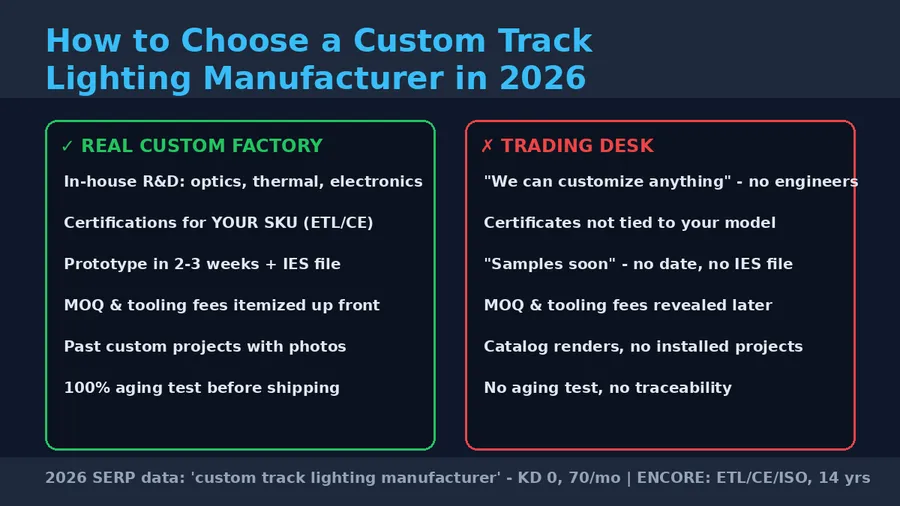
This guide is the companion to our custom track lighting manufacturer buyer guide, which covers how to vet a factory versus a trading desk once you know which model you want.
FAQ
What is the difference between OEM and ODM in LED lighting? ODM means you brand an existing design the factory already makes — fast, cheap, low MOQ, but the design is shared. OEM means the product is built to your specification with new tooling and your own certification — more control and exclusivity, but more time, cost and quantity commitment.
Which is better, ODM or OEM? It depends on your project. ODM is better for a startup or a market test: fast, low-cost, low-risk. OEM is better for a chain, a multi-location project, or a brand that needs a unique, spec-controlled product and volume to justify tooling.
Is ODM cheaper than OEM? Yes, at the start. ODM has no tooling cost, lower MOQ, and lower per-unit cost at low volume. OEM carries tooling, design and certification costs upfront, though per-unit cost can become competitive at scale.
How long does ODM take vs OEM? ODM typically ships in 2–6 weeks because tooling and certification already exist. A full OEM cycle — prototype, tooling, certification, mass production — usually runs 8–14 weeks, compressing to 4–6 weeks for repeat orders.
Can I start ODM and switch to OEM later? Yes — and it is a common strategy. Launch with ODM to test the market, then convert your best sellers to OEM for exclusivity once volumes justify the tooling investment.
Does ENCORE offer both OEM and ODM? Yes. ENCORE runs ODM from 9 ready product families and full OEM from your spec, on the same ETL/CE/ISO certified production line — so you can start ODM, migrate to OEM, or run both in parallel.
Conclusion
OEM and ODM are not one-size-fits-all — they are two points on the same sourcing spectrum, and the right choice depends on your budget, timeline, and how much control your brand needs. ODM gets a startup to market fast and cheap on proven designs. OEM gives a chain or an established brand a unique, spec-controlled product that no one else can copy.
The good news: you do not have to pick permanently. The most efficient path for most brands is launch ODM, scale OEM — and that is exactly how we run our factory. Send us your project brief and we will tell you plainly whether ODM or OEM fits your goals, and what it will cost in time, money and MOQ. Request a custom lighting quote →
Read next: OEM LED Track Lighting: A Complete Guide to Private Label Track Lights — the 6-step OEM process, customization menu, and packaging options for a fully custom line.