· ENCORE · Custom & OEM Lighting · 14 min read
Custom LED Lighting Manufacturer: OEM/ODM Services
How to choose a custom LED lighting manufacturer for OEM/ODM services. Compare OEM vs ODM, what you can customize on track lights, downlights and magnetic systems, the engineering-to-shipment process, MOQ and lead times, and the vetting checklist to avoid trading desks.
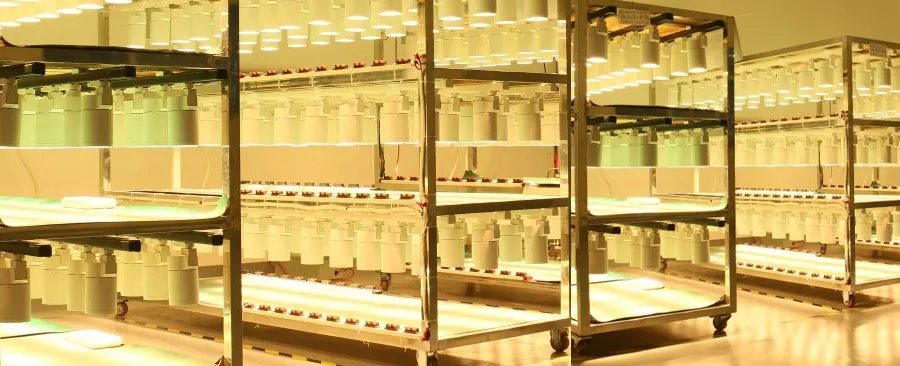
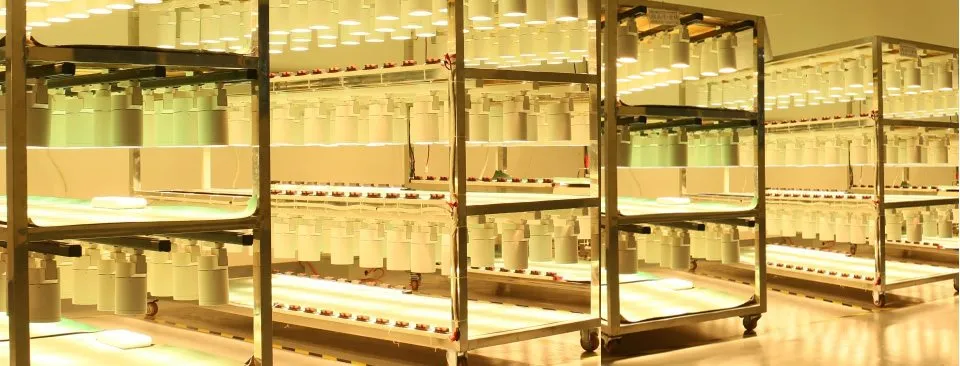
If you are sourcing lighting for a retail chain, a hotel, a showroom, or an e-commerce brand, the phrase custom LED lighting manufacturer gets thrown around by almost every supplier on Alibaba — but very few of them actually mean it. “Custom” can mean anything from cutting a track to length to engineering a brand-new optical system around your drawings. Getting that definition wrong is where projects blow past budget, miss opening dates, and end up with fixtures that look nothing like the mock-up.
This is the complete guide to working with a custom LED lighting manufacturer on OEM and ODM services: what each model actually means, the full menu of what you can customize on track lights, downlights and magnetic systems, the step-by-step engineering-to-shipment process, realistic MOQ and lead times, and a vetting checklist that separates a real factory from a trading desk.
If you are still deciding which sourcing model fits your project, our ODM vs OEM LED lighting guide is the fast read; this guide goes deeper on the manufacturing side of the same decision.
What Does “Custom LED Lighting Manufacturer” Really Mean?
The word “custom” hides four different sourcing models. Knowing which one you are buying changes your MOQ, your lead time, and who owns the design:
| Model | Who designs | Who owns tooling | Best for | Main risk |
|---|---|---|---|---|
| OEM | You | You (or shared) | Brands with their own IP and drawings | Higher upfront tooling cost |
| ODM | Factory | Factory | Brands that need speed and a proven design | Less differentiation from competitors |
| Private label | Factory (standard product) | Factory | Resellers launching a brand at minimum cost | No meaningful customization |
| Bespoke | Joint / project | Shared | Unique architectural or museum projects | Longest lead time, highest engineering cost |
A genuine custom LED lighting manufacturer runs OEM and ODM from the same certified production line — it will build to your drawings if you have them, and adapt a proven platform if you do not. That flexibility is what “custom” should mean at the factory level. Most of the time, though, the buyer’s real intent sits in one of two camps:
- OEM services — you hand over a spec or drawing and the factory manufactures it to your exact specification, under your brand.
- ODM services — you pick an existing design from the catalog and customize the parts that are cheap to change: branding, finish, CCT, CRI, beam angle, packaging.
Both are handled by a custom LED lighting factory; the difference is who owns the design. For the full comparison of these two models, our ODM vs OEM LED lighting guide breaks down the cost, lead-time and exclusivity trade-off line by line.
Why Custom LED Lighting Instead of Off-the-Shelf?
If standard fixtures worked for every project, “custom” would not be worth the extra cost. Custom LED lighting earns its premium in five specific situations:
- Brand identity. A retail chain or a hotel group needs a consistent visual identity — a custom housing color, finish, and logo that no competitor can buy from the same catalog.
- Exact photometrics. You need a specific beam angle, CCT binning with SDCM ≤ 3 color consistency, or a CRI target (90, 95+) that a generic fixture cannot meet.
- Matching fixtures to the architecture. Custom track lengths, magnetic systems, or downlight trim that fit a specific ceiling, millwork, or control system.
- Compliance for your market. Certificates that name your SKU — ETL/UL for North America, CE for Europe, SAA for Australia — not the factory’s general range.
- Control and control systems. Dimming protocols (TRIAC, 0–10V, DALI, Casambi, Matter) integrated into a building-management system.
Off-the-shelf is cheaper per unit and faster. Custom is for when the fixture has to do something specific or look like your brand. If you are unsure how custom the project really needs to be, our custom track lighting manufacturer buyer guide walks through when each level of customization is worth the cost.
What You Can Customize (The Full Menu)
This is where a real custom LED lighting manufacturer earns its price. Customization is engineering, not stickers. Here is the full menu on track lights, downlights, and magnetic systems:
Housing, color & material
- Colors — any RAL or Pantone: black, white, silver, matte, anodized, custom brand colors
- Finishes — powder coat, anodizing, electroplating, sandblasted, textured
- Materials — die-cast aluminum (standard), extruded aluminum, custom profiles for architectural or magnetic track
Photometrics — the light itself
- Beam angle — narrow spot (15°–24°) for accent and display, medium flood (30°–40°) for general retail, wide flood / wall-wash (45°–60° and asymmetric) for grazing and ambient
- CCT — 2700K warm hospitality, 3000K retail/hotel, 3500K mixed, 4000K retail/commercial, 5000K–6500K supermarket/daylight; custom CCT binning and SDCM ≤ 3
- CRI — standard 80–90, premium CRI 90+ / 95+ with strong R9 (reds), and optional UV/IR filtering for artwork and merchandise
- Custom optics — a reflector or lens engineered for your distribution, delivered with an IES/LDT photometric file. This is the signature of a true OEM factory, not a re-labeler.
Not sure what your numbers should be? Use our color temperature guide to pick CCT, our CRI guide to set a color-rendering target, and our beam angle calculator to size optics before you write the RFQ.
Electrical & controls
- Wattage — 5W–50W per track head; custom power for linear and magnetic systems
- Voltage — 120V, 220–240V, 277V, or low-voltage 24V magnetic track
- Dimming — TRIAC (North American residential), 0–10V (commercial), DALI / DALI-2 (building management), PWM / Zigbee / Casambi / Matter (smart and wireless)
- Driver platforms — constant current (CC) or constant voltage (CV) selected to your spec
Branding & packaging
- Custom logo — laser engraving, silk screen, pad printing, or brand-color finishing on the housing
- Retail-ready packaging — your brand, EAN/UPC barcode, spec sticker, inserts, custom carton
- Documentation — multilingual manuals, wiring diagrams, compliance labels for your market
For the complete customization menu specific to one product line, our OEM LED track lighting private label guide goes deep on everything you can change on a track light.
The Custom Manufacturing Process: Brief to Shipment
A reliable custom LED lighting manufacturer follows a defined sequence. A supplier that says “no problem, we can do anything” with no process behind it is the red flag, not the selling point.
1. Spec & RFQ
Everything starts with a clear spec sheet. The more concrete you are here, the fewer costly surprises later. At minimum, send the factory:
- Application — retail, museum, hospitality, residential, office
- Photometrics — beam angle, lumens, CCT, CRI, target lux
- Electrical — voltage, wattage, dimming protocol
- Mechanical — product type (track, downlight, magnetic), housing style, finish, dimensions
- Compliance market — North America (ETL/UL), EU (CE), Australia (SAA)
2. Engineering review
Design-for-manufacturing check, thermal simulation, and optical simulation — before a single sample is cut. This is where an in-house R&D team earns its keep.
3. Prototype
Typically 3–5 pieces with an IES/LDT photometric file and measured beam angle, lumens, CRI, and SDCM. Serious projects add an on-site mock-up so you see the light, not just the spec. Prototyping takes 2–3 weeks with a file you can verify in your own lighting-design software.
4. Approval
You sign off on the prototype — appearance, photometric data, performance, and sample test results. This is the point where the spec is frozen. After approval, changes get expensive because tooling and production parameters are locked in.
5. Tooling & certification
Injection molds or extrusion tooling, plus safety certification for your market and your SKU. The certificate must name the exact model you will import, or customs and inspectors will not accept it.
6. Mass production
A real OEM factory follows IQC → IPQC → OQC:
- IQC — incoming quality control on components (LED bins, drivers, housings)
- IPQC — in-process quality control on the line
- OQC — outgoing quality control, including a 100% aging test (burn-in) before packing
7. QC & shipment
Beyond in-line QC, finished goods should pass an electrical safety test, lumen and CCT verification against the approved sample, and a carton drop-test. The order ships per your terms — FOB, CIF, EXW, or DDP — with the compliance documents alongside.
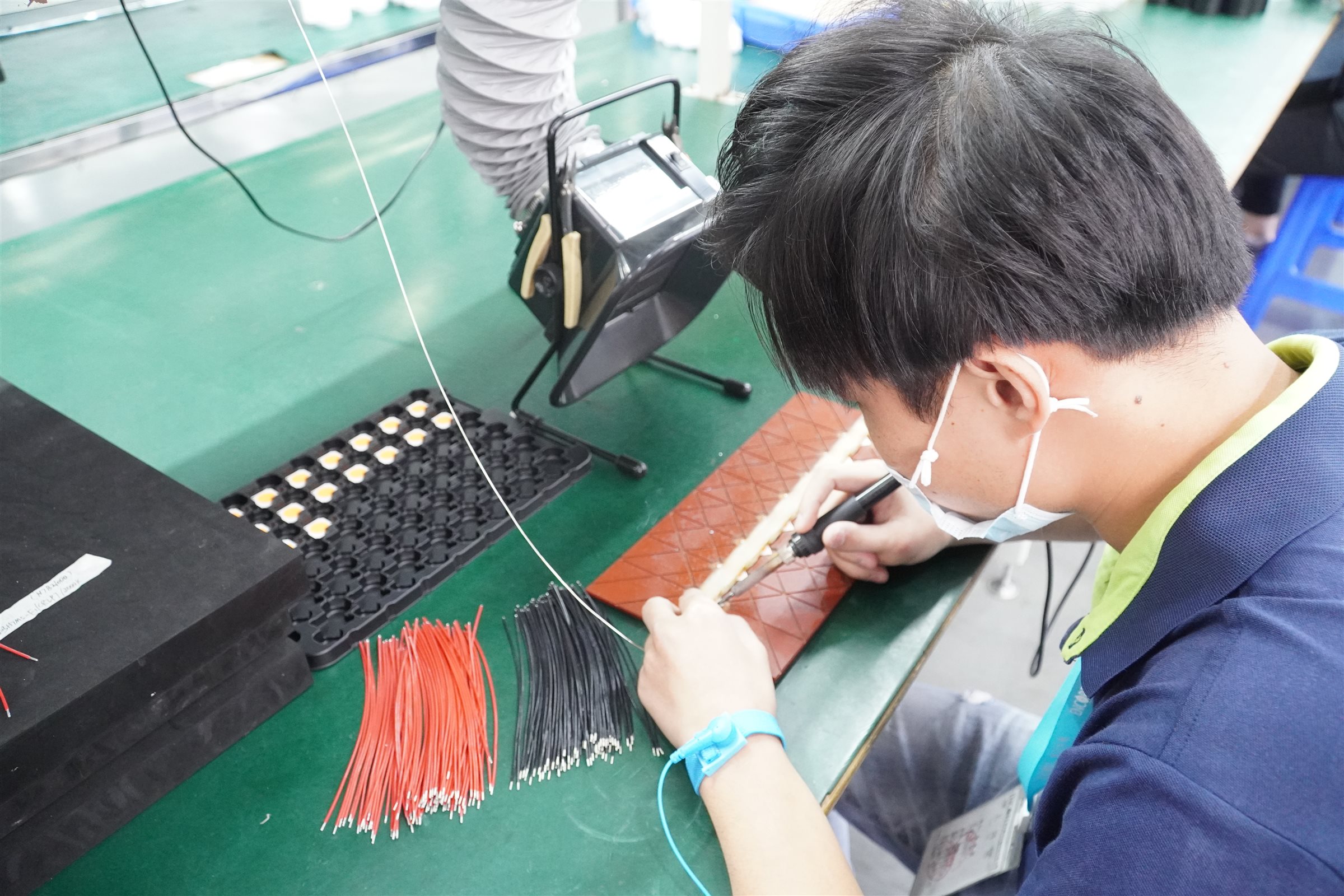
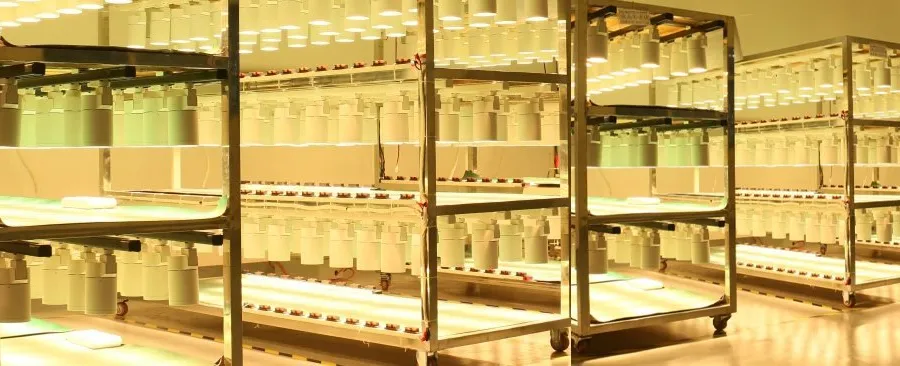
100% aging test and final QC before custom LED fixtures ship — this is what protects your brand on delivery day.
For the six-step process applied specifically to track lights, our OEM LED track lighting guide documents the full sequence with real timelines.
MOQ, Lead Times & Costs
Realistic lead times
| Stage | Time |
|---|---|
| Prototype (with IES file) | 2–3 weeks |
| Tooling + certification | 3–6 weeks |
| Mass production + QC | 3–5 weeks |
| Full OEM cycle | 8–14 weeks |
Repeat orders after the first production run usually compress to 4–6 weeks because tooling is already done.
Minimum order quantities (MOQ)
- ODM — often 300–500 units; low enough to test a market
- OEM with new tooling — usually 1,000+ units to absorb tooling cost
- Private label on a standard product — can be lower still
What drives cost
- Tooling / mold investment — $3,000–$30,000+ for new tooling
- Design & engineering fees — moderate to high for bespoke work
- Certification — higher for a custom SKU, minimal for a branded existing certificate
Always get itemized MOQ and tooling costs in writing before you pay a deposit. Our custom track lighting manufacturer buyer guide has the full checklist of what to line-item before you commit.
How to Vet a Custom LED Lighting Manufacturer (Not a Trading Desk)
Before you send a deposit, vet the factory against six signals:
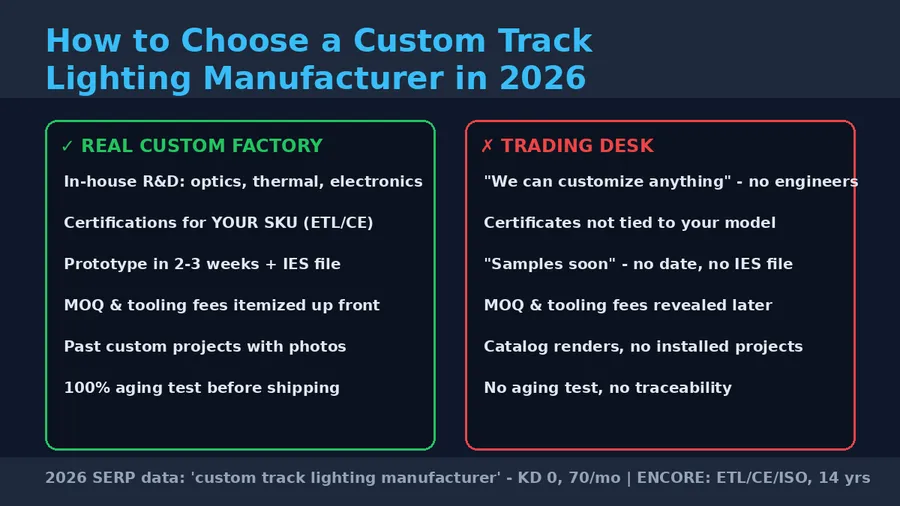
- In-house R&D across five disciplines — industrial design, optics, thermal, electronics, and structure. A sales team without engineers behind it cannot customize; it can only reconfigure.
- An owned factory, not a trading desk. Ask for the workshop photo, not the showroom photo.
- Certifications for YOUR market and YOUR SKU. ETL for North America, CE for Europe, SAA for Australia. A certificate the factory holds for a different SKU does not cover yours.
- Prototype lead time you can verify. Two to three weeks with an IES file signals real capability. “No problem, we’ll send samples” with no date and no file signals a middleman.
- Past custom cases with photos. Catalog renders are easy. A photo of a finished installed project is proof.
- MOQ and tooling transparency. You should see both line items before you commit, not after.
The “custom” traps to avoid
- Trap 1 — “We can customize anything” said by a company with no engineering team. Capability is built, not promised.
- Trap 2 — An MOQ so high it is not custom. At 5,000 units with one fixed design, you are buying private label at volume, not customization.
- Trap 3 — Hidden tooling fees revealed only after the deposit clears. Itemize everything up front.
- Trap 4 — Certifications “available” but not for your SKU. The certificate must name the exact model you import.
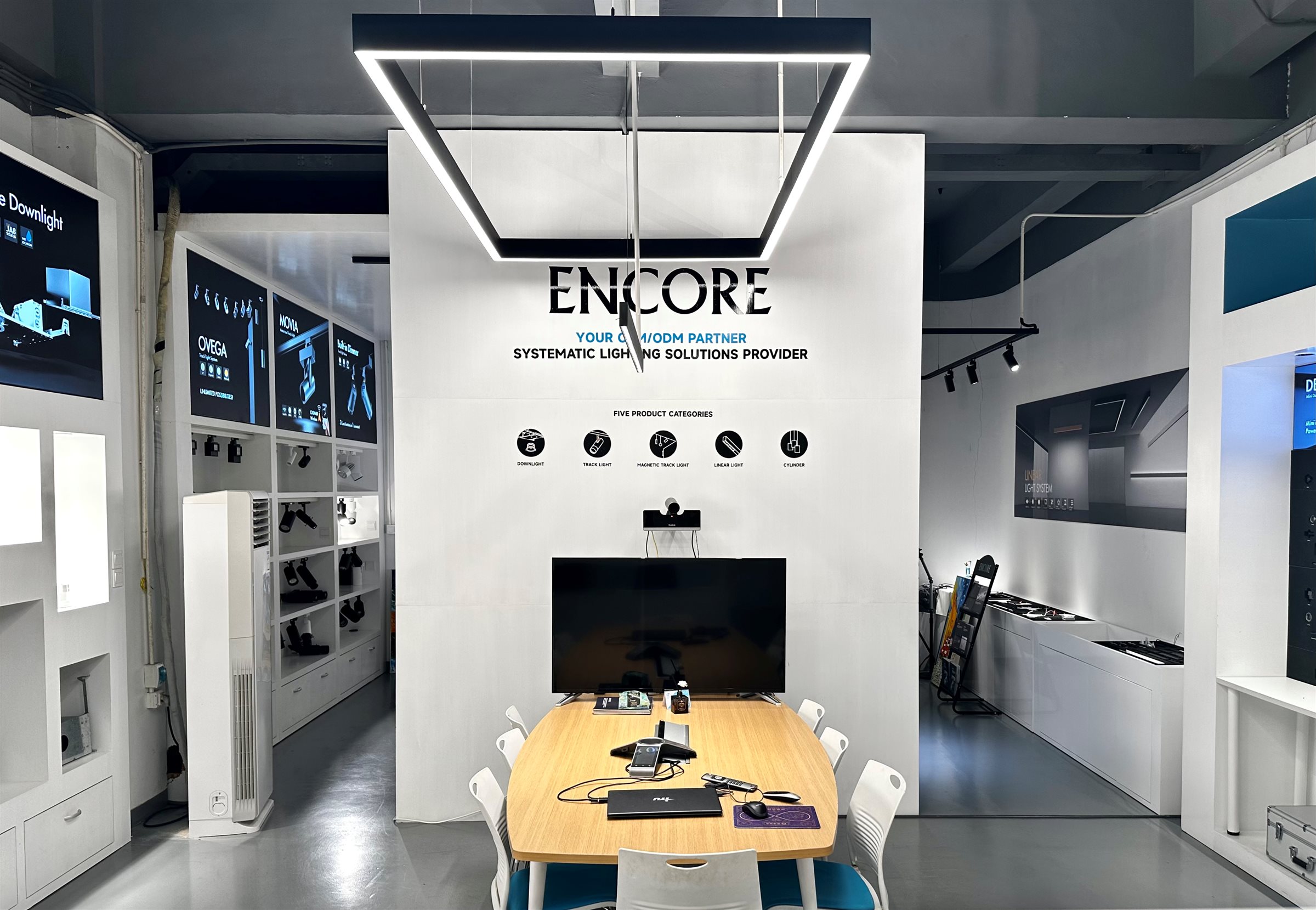
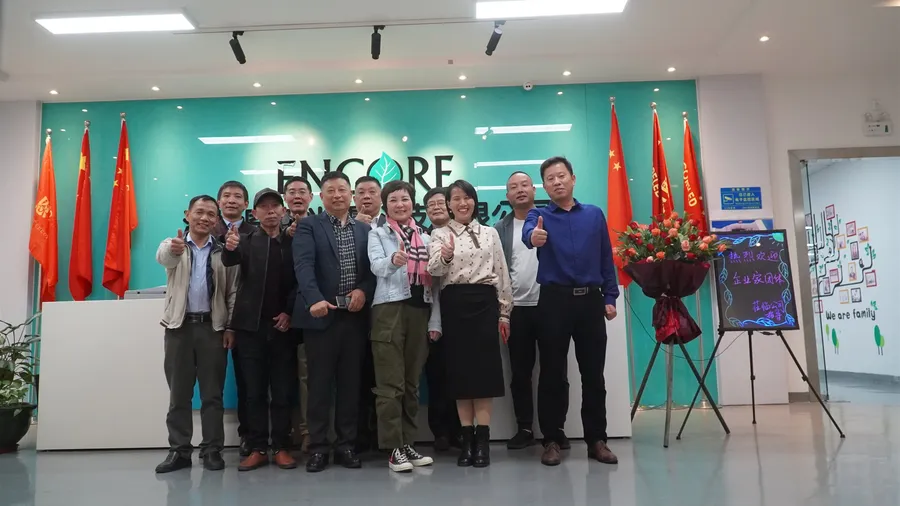
A showroom consultation for a custom LED lighting project — bring your spec sheet, leave with an engineering review.
How ENCORE Runs OEM & ODM as a Custom LED Lighting Manufacturer
At ENCORE we run both OEM and ODM from the same Shenzhen factory, on an ETL/CE/ISO certified production line — and we will tell you honestly which model you actually need rather than upsell you.
- ODM from 9 product families — track lighting, LED downlights, magnetic track lights, and commercial fixtures with ready tooling. We adapt finishes, CCT, CRI, beam angle, branding, and packaging, with sample lead times of 7–15 days and low MOQs for market testing.
- OEM from your spec — in-house R&D covering optics, thermal, electronics, and structure. We build engineered prototypes with IES/LDT photometric files, run tooling, certify your SKU, and follow IQC → IPQC → OQC with 100% aging test before shipment.
- One factory, one quality bar — whether you start ODM and migrate to OEM later, or run both lines in parallel, the QC standard is identical. That transition is seamless, so your exclusivity can grow without changing suppliers.
The common path we see: a brand starts ODM to launch fast, then converts best-selling fixtures to OEM once volumes justify tooling. Both models coexist in our factory, so the switch is frictionless.
FAQ
What is a custom LED lighting manufacturer? A factory that manufactures LED lighting to a buyer’s specification (OEM) or adapts its own designs for a buyer’s brand (ODM), rather than only selling standard catalog products. Real custom manufacturers have in-house R&D for optics, thermal, electronics, and structure, and certify fixtures for the buyer’s market.
What is the difference between OEM and ODM LED lighting? OEM means the product is built to your exact specification and branded for you; you own the design. ODM means you take one of the factory’s existing designs, customize it, and brand it. OEM gives more control but usually needs tooling; ODM is faster and cheaper to start.
What can I customize on custom LED lighting? Housing color and material, beam angle (with custom optics and an IES file), CCT (2700K–6500K) with SDCM ≤ 3 color consistency, CRI (80/90/95+), wattage, voltage, dimming protocol (TRIAC, 0–10V, DALI, wireless), plus your logo, packaging, and manual.
What is the MOQ for custom LED lighting? ODM often starts at 300–500 units, OEM with new tooling usually starts at 1,000+ units to absorb tooling cost, and private label on a standard product can be lower. MOQ should be negotiated per design and itemized separately from tooling.
How long does a custom LED lighting order take? A prototype takes 2–3 weeks with an IES file; tooling and certification add 3–6 weeks; mass production and QC run 3–5 weeks. A realistic full custom cycle is 8–14 weeks, compressing to 4–6 weeks for repeat orders.
How do I verify a custom LED lighting factory is not a trading desk? Ask for workshop photos (not showroom), an IES file with your prototype, certificates naming your exact SKU, itemized MOQ and tooling before deposit, and installed-project references. Then audit in person for a material order.
What certifications do I need for my custom LED lighting? For North America, ETL or UL (cUL for Canada). For Europe, CE. For Australia, SAA. The certificate must name your exact SKU and the model you import, not the factory’s general range.
Conclusion
A custom LED lighting manufacturer is not a supplier that can “do anything” — it is a factory with in-house engineering, a defined process, owned tooling, and certifications that name your SKU. Whether you choose OEM for a unique, spec-controlled product or ODM for a fast, proven launch, the decision comes down to how much control and exclusivity your brand needs against how much time and budget you have.
The most efficient path for most brands is launch ODM, scale OEM — and that is exactly how we run our factory. If you are scoping a custom LED lighting project and want an engineering review before you commit budget, send us your spec sheet and we will tell you honestly what is buildable, what is not, and what it costs. Request a custom lighting quote →
Read next: ODM vs OEM LED Lighting: Which One Is Right for Your Brand? — the sourcing-model decision explained, and Custom Track Lighting Manufacturer 2026: B2B Buyer Guide for the full vetting checklist.